
CHAPTER 2: THE PHYSICAL BOUNDARY
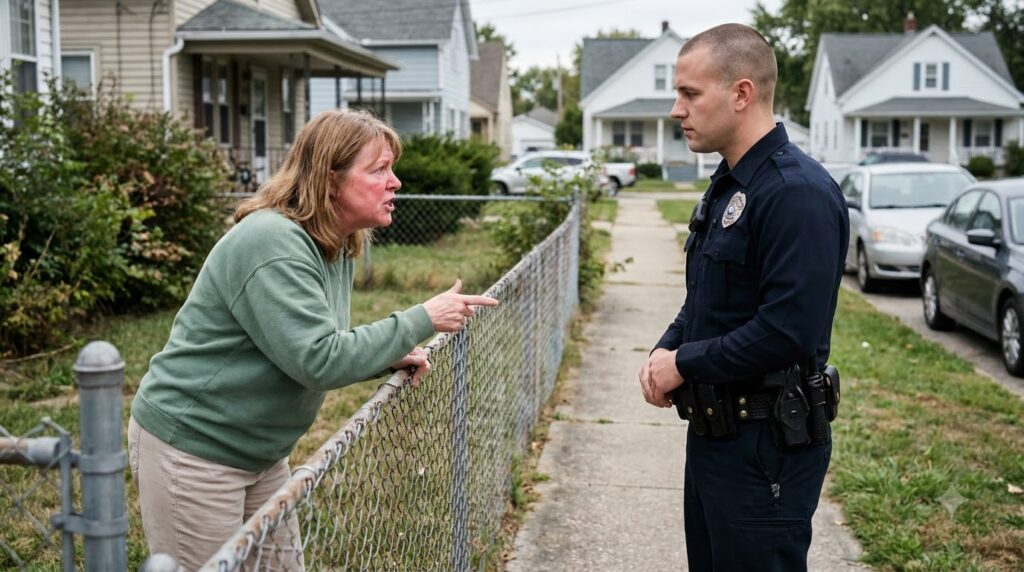
“A contractor’s estimate isn’t a property deed, Mrs. Vance,” Miller said. His voice was gravel-dry, matching the dust kicked up by a passing delivery truck at the corner. He didn’t return the plastic-wrapped paper; he folded it once, smoothly, and held it against his chest rig alongside his mobile terminal. “This receipt shows what you paid a company to pour concrete footings. It doesn’t tell me where your legal lot line begins or ends.”
“It tells you where the fence went twelve years ago!” Brenda’s voice pitched higher, a shrill, scraping sound that set the neighborhood dogs barking down the block. She took another quarter-step forward, her green sweatshirt brushing against the edge of Miller’s leather radio pouch. “The fence has stood right here for over a decade. That makes it the line. You can’t just come onto my street and tell me my fence is wrong!”
“I’m not telling you anything about your fence yet,” Miller replied, his eyes narrowing slightly as he registered her physical proximity. He didn’t retreat. Instead, he turned his torso sideways—a tactical angle that naturally blocked her from advancing further toward Hayes while keeping his primary hand clear of his duty belt. “I am telling you to step back off my boots. We are establishing facts, not holding a vote.”
Brenda stiffened, her jaw working as if chewing on glass. Her eyes darted past Miller’s shoulder, locking onto Marcus Hayes. Hayes hadn’t moved an inch. He stood with the coil of green hose resting against his thigh, his expression unreadable, grounded in the quiet patience of a man who had watched this storm build over three summers.
“You’re taking his side,” she hissed, her voice dropping into an ugly, raspy whisper that barely carried past the wire mesh. “You see a lone woman living on a corner lot and you think you can let him walk all over my grass.”
“Mrs. Vance, I don’t care who lives on the corner,” Miller said, the flat tone of his voice cutting through her accusation like a cold draft. “I care about what’s recorded at the county courthouse. Right now, you’ve called dispatch for a criminal trespass. If I write a report based on a contractor’s receipt, I’m the one doing it wrong. Stand over by your porch step while I inspect the boundary markers.”
“There’s nothing to inspect!” she shouted, her arm whipping out again to point at the base of the chain-link structure. “The fence is the marker!”
Miller ignored her, taking three deliberate steps along the edge of the concrete sidewalk. The soles of his duty boots crunched against a sharp, brilliant white layer of crushed river gravel that lined the base of the galvanized fence. It was fresh stone—stark, clean, and out of place against the weathered grey of the fence posts and the patchy, yellowed turf of Brenda’s front yard. The gravel formed a neat, four-inch-wide band that ran parallel to the sidewalk, spilling slightly over the cracked lip of the public concrete.
Miller stopped. He looked down at the bright white stone, then up at the fence line itself. The galvanized steel posts were bowed slightly outward, leaning toward the sidewalk as if pushed from behind by years of shifting soil and unclipped weeds.
“When did you lay this gravel, Mrs. Vance?” Miller asked, his eyes remaining fixed on the ground.
Brenda’s breath hitched. For a fraction of a second, the aggressive tilt of her chin slackened. “Last month. To keep the weeds down along the line. What does that have to do with anything?”
“It covers the ground,” Miller said softly. He crouched down, his knees popping in the quiet heat. He reached down with one gloved hand, his fingers brushing aside a handful of the coarse white granite chips right where the fence post met the sidewalk seam.
Underneath the fresh stone, the dirt was dark, damp, and recently packed. His fingertips struck something hard and metallic buried two inches beneath the surface—not the round, hollow steel of the fence post, but a heavy, solid cylinder set flush into a forgotten chunk of concrete.
Miller didn’t pull the dirt away completely. He held his position, feeling the cold, oxidized top of the metal object beneath his glove, while Brenda let out a sharp, ragged breath behind him.
“You have no right to dig up my yard,” she whispered, her voice suddenly stripped of its booming authority.
Miller stood up slowly, dusting the grey grit from his leather palm. He turned to face her, his face completely devoid of triumph or anger—only the cold, heavy weight of an officer who had just found the first loose thread.
“I’m not digging, Mrs. Vance,” Miller said, bringing the mobile terminal up between them. “I’m looking for the city’s brass survey pin. And I think you already know exactly where it is.”








