
CHAPTER 4: THE DIGITAL OVERLAY
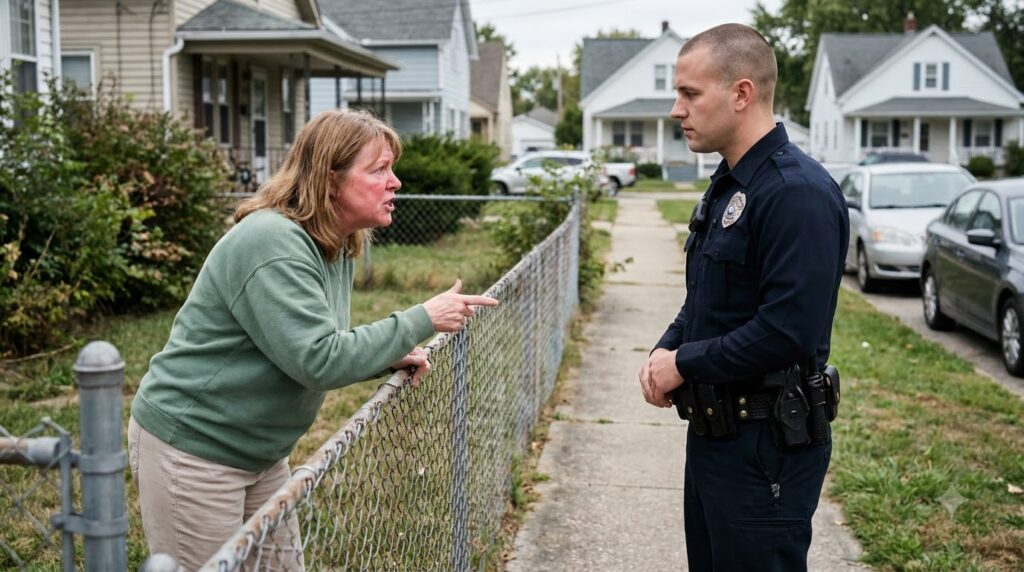
“Maps on a phone don’t mean anything,” Brenda spat, though the flush on her neck had turned a mottled, bruised purple. She backed away from the terminal screen as if the glowing vector lines were radiating heat. “The county sits twenty miles away in an air-conditioned office. They don’t know where my house is built. They didn’t pour the footings.”
Miller didn’t raise his voice. He rotated the screen toward Marcus Hayes, who took two short, measured steps closer along the public concrete.
“Mr. Hayes,” Miller said, his thumb zooming in on the satellite view until individual rooflines and sidewalk joints became visible. “Look at the red vector line crossing parcel forty-two. Where does it place the municipal right-of-way relative to that chain-link corner post?”
Hayes squinted against the harsh July glare, his hand shading his eyes. “The red line runs three feet inside her fence. It aligns straight with my property line down the block, and with the utility pole at the corner.”
“Because it’s a digital glitch!” Brenda yelled, stepping up onto the raised concrete lip of her driveway. She gripped the top wire of the gate until her knuckles turned yellow. “Officer, I am telling you as the homeowner—I paid for this land! I have lived here twenty-four years! You cannot use a satellite phone to take three feet of my yard away!”
“Mrs. Vance, this isn’t taking anything away,” Miller said, his boots crunching on the fresh white gravel as he walked four paces down toward the south corner of the lot. “It’s showing what was never yours to enclose. Look at the utility pole right behind your fence line.”
He pointed toward a weathered wood pole embedded near the corner of the property. The thick cedar post was scarred with old iron climbing gaff marks and stamped with a brass city utility tag dated 1984. The chain-link fence didn’t pass behind the pole on private property—it wrapped around the outside of the pole, boxing the city’s infrastructure inside Brenda’s yard.
“That pole belongs to the municipal power department,” Miller said softly. “City easement rules require a minimum thirty-six-inch clear radius around all public utility structures. Your fence chokes the pole right against the sidewalk.”
Brenda’s chest rose and fell in shallow, jagged gasps. Her gaze darted from the utility pole to the glowing terminal screen in Miller’s hand, then down to the white river gravel under his boots.
“The contractor put the fence there so the pole wouldn’t look ugly in the middle of the grass,” she stammered, her voice losing its razor-sharp edge, sagging under the weight of visible facts. “He said… he said the city didn’t care about a couple of feet around a pole.”
“The city cares when a line worker needs emergency access,” Miller replied. “And the county cares when a private structure crosses onto a public right-of-way.”
Hayes folded his arms, his quiet eyes remaining on the officer. “Officer Miller, if that fence is three feet over the line, then the sidewalk easement isn’t just blocked for me—it means her fence is encroaching on the city’s water main valve right beside my driveway.”
Brenda spun on Hayes, her fingers clawing at the air. “You shut your mouth! You’ve been waiting for years to find something to complain about!”
“I didn’t complain, Brenda,” Hayes said, his tone entirely level, grounded in the quiet satisfaction of a man whose patience was finally paying off. “You called the police on me because my boot touched a piece of concrete you thought you owned.”
Miller shifted his weight, his leather utility belt creaking in the silence that followed. The porch observers across the street had stepped down onto their lawn, their heads turned toward the three figures at the fence line.
“Mrs. Vance,” Miller said, bringing the screen back to eye level. “The GIS data gives us a clear baseline. But a digital map is confirmed by physical markers on the ground. You have a choice right now. We can wait for a city code enforcement officer to drive out here with a survey crew and dig out the official survey pins, or you can let me finish verifying the physical markers along this line.”
Brenda stared at Miller, her lips pressed into a thin, bloodless seam. Her hand trembled against the wire mesh of the gate, but she didn’t step back down onto the sidewalk.
“There’s nothing under that gravel,” she whispered, her voice barely audible over the hum of the transformer on the utility pole above.
Miller looked down at the pristine white granite chips beneath his boots—the neat, clean barrier she had laid just weeks ago to hide the dark, freshly packed dirt beneath.
“We’ll see about that,” Miller said.








