
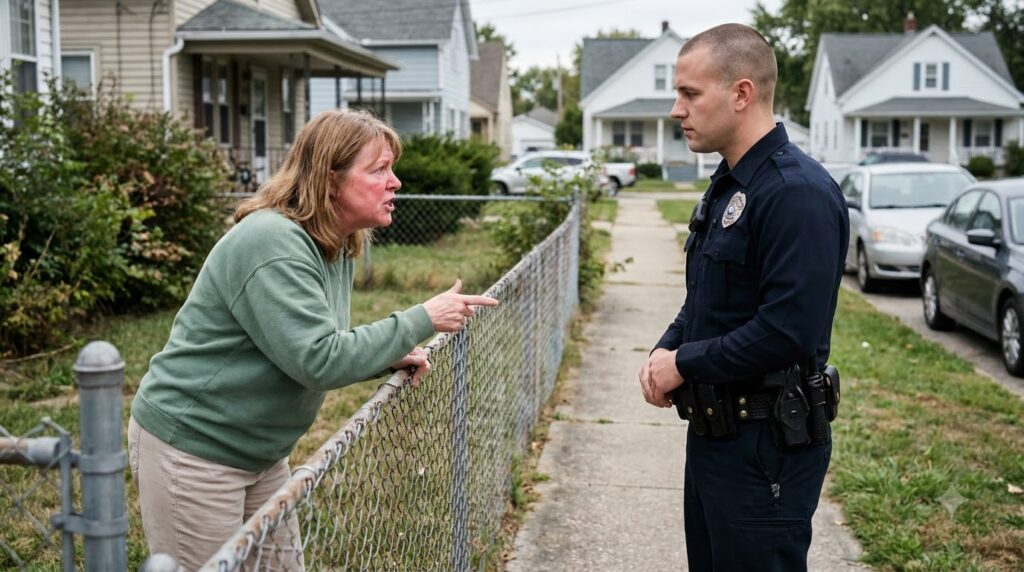
CHAPTER 6: THE BURIED BRASS PIN
“Leave that alone!” Brenda took a sharp step off the driveway, her voice losing its piercing screech and collapsing into a dry, breathless raspy demand. “I told you, that’s just construction trash! The fence crew dumped scrap paper in the dirt!”
Miller didn’t answer. He dropped back onto his left knee, ignoring the sharp bite of white granite gravel through his trousers. His gloved fingers dug past the loose topsoil, catching the edge of the stiff, brittle tar paper. The material was sun-baked and rotted at the edges, flaking off in greasy black scales against the damp earth.
He pulled back the rotted wrapping. Beneath it lay a heavy, solid iron rod set inside a square collar of poured concrete, crowned with a gleaming brass cap that had been shielded from oxidation by the waterproof paper.
“Mr. Hayes,” Miller called out, his voice dropping into an unyielding, deliberate register. “Come take a look at this.”
Hayes stepped over the curb, his boots quiet against the concrete. He leaned down, his eyes narrowing as he read the crisp, unweathered stamping cut deep into the brass face.
“That’s a property boundary pin,” Hayes said, his voice measured, devoid of gloating but heavy with realization. “That’s not a right-of-way benchmark. That’s the actual private lot corner marker for parcel forty-two.”
Miller flicked his flashlight beam over the brass face. The stamping was pristine: COUNTY REGISTERED SURVEY MARKER — LOT 42 — EAST CORNER. The pin sat exactly three feet inside the galvanized chain-link fence line.
“Look at the dirt around the collar, Mr. Hayes,” Miller said, probing the soil with the tip of his tactical pen. “This gravel was poured right over fresh soil. Someone scraped off the top layer, wrapped the pin in tar paper to keep the brass from tarnishing, and covered it with four inches of decorative river rock.”
Hayes looked up from the hole to Brenda. “Your husband laid this gravel three summers ago, right before he passed. You didn’t just put up a fence where a contractor told you to. You knew where the real pin was the whole time.”
Brenda stood motionless on the concrete walkway. Her face had drained of color, leaving her cheeks a hollow, mottled grey. Her chest rose and fell in shallow, rapid twitches, her hands clutching the front of her oversized green sweatshirt as if trying to hold herself upright against the sudden shift in gravity.
“He… he built the fence for me,” she whispered, her voice barely carrying across the narrow strip of grass. “He said… he said the city would never miss three feet of lawn. He said everyone on the street takes a little bit of the public easement.”
“Taking an easement is a civil dispute, Mrs. Vance,” Miller said, standing up smoothly and pulling his mobile terminal back into his grip. “Concealing a legal boundary marker with intent to misrepresent property lines to law enforcement during a police call is a criminal matter.”
“I didn’t… I didn’t hide it!” she gasped, taking a stumbling step backward toward her porch. “I just… I wanted the yard to look nice! I wanted the white gravel to match the flowers!”
“You called dispatch at eleven-forty this morning requesting an emergency officer to remove a neighbor for criminal trespass,” Miller stated, tapping his screen as he opened the formal incident report log. “You used a false contractor estimate with an obsolete inspection code to assert ownership over a public sidewalk, while knowingly covering the official survey pin that proved your fence encroached three feet onto municipal land.”
Across the street, the neighbor holding the phone stopped recording and lowered his hand. The two women on the adjacent driveway stood in silence, watching Brenda Vance—a woman who had spent a decade enforcing imaginary boundaries with sharp tongue and threats—collapse into defenseless, quiet isolation behind her illegal fence.
Miller didn’t raise his voice. He began typing the primary narrative entry into the department terminal, the light tapping of his gloved fingers marking the cold, procedural end of her twelve-year deception.
“Mrs. Vance,” Miller said, looking up from the screen. “Stay right on your porch. I am issuing two formal citations.”








