
The Weight of Recorded Earth and the Unyielding Line Between Public Right and Private Claim
CHAPTER 1: THE ACCUSATION AT THE EDGE
“He’s on my dirt, Officer! Put him in cuffs or I’ll drag him off myself!”
Officer Jim Miller didn’t accelerate his stride. He kept his boots at a measured cadence across the cracked asphalt of Elm Street, the heavy weight of his utility belt shifting with familiar friction against his duty trousers. The July heat radiated off the concrete, bringing with it the dry smell of cut grass and sun-baked dust.
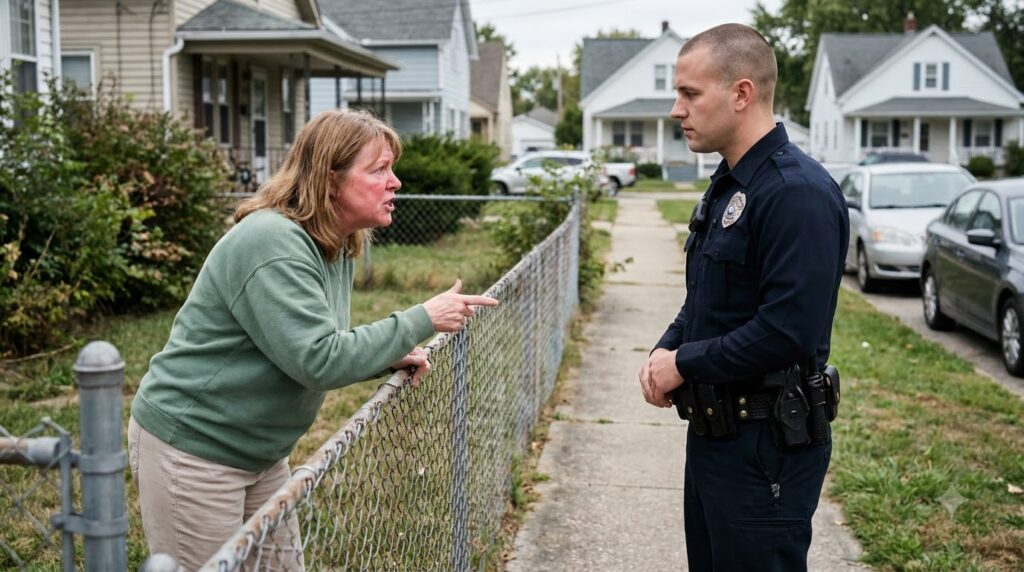
Ten yards ahead, beside a rusted galvanized chain-link fence, Brenda Vance stood with her feet planted wide. Her oversized green sweatshirt was flushed dark at the collar, her knuckles white where she gripped the top rail of the wire mesh. Her arm jabbed toward the quiet man standing on the public sidewalk—Marcus Hayes, a mid-40s neighbor who held a folded garden hose in one hand and maintained a deliberate, silent distance.
“Mrs. Vance, step back from the sidewalk edge,” Miller said, his voice flat, low, and stripped of urgency.
“Don’t tell me where to step on my own land!” Brenda barked, closing the gap until her face was less than two feet from Miller’s chest rig. Her shoulder-length hair flew wild as she pointed directly at the concrete beneath Hayes’s work boots. “I called nine-one-one because this man is trespassing. He’s been warned. My fence is right here. That makes everything on this side of the line mine!”
Miller didn’t flinch. He raised his right hand—palm outward, fingers relaxed—creating a clear half-yard of buffer between his chest badge and her advancing chin.
“I’m going to ask you once, clearly,” Miller said, his gaze locking onto her bloodshot eyes until her tirade stuttered. “Step back. Lower your voice. Let me speak to both of you without a shouting match.”
On the porch across the street, an elderly man paused his lawnmower. Two women on the adjacent driveway stopped loading groceries, their eyes fixed on the dark blue uniform standing between Brenda’s shaking finger and the quiet neighbor.
Brenda took one reluctant step back, her chest heaving against the faded cotton of her sweatshirt, but her posture remained coiled like a rusted spring. “He’s standing on my property line, Officer. I built this fence. I pay the taxes.”
“Mr. Hayes,” Miller turned his head slightly, keeping Brenda in his peripheral vision. “What’s the situation?”
“I was clearing the drainage ditch along the curb,” Hayes said softly, pointing to a small pile of silt and dead leaves near the gutter. “She came out shouting that my boots were touching her turf. I haven’t stepped past the metal fence posts.”
“It’s all my turf!” Brenda shouted again, taking a twitching step forward. “The city gave me this parcel in ninety-eight!”
Miller unclipped the heavy mobile data terminal from its chest mount on his uniform vest. The hardened screen flickered to life in the harsh sunlight, displaying the active dispatch file and the GIS mapping portal connected directly to the county land registry.
“Mrs. Vance,” Miller said, his thumb tapping the screen to bring up the official parcel survey layer for the block. “Do you have a physical deed or a stamped land survey on you right now?”
Brenda’s mouth snapped shut. Her hand darted into her sweatshirt pocket and pulled out a yellowed, plastic-wrapped piece of paper, thrusting it toward Miller’s face. “Right here. Twelve thousand dollars I paid the contractor. Signed and sealed.”
Miller took the paper. It wasn’t a deed. It was a handwritten estimate from a long-defunct fencing company dated 2012, with a hand-drawn arrow pointing to the sidewalk.

CHAPTER 2: THE PHYSICAL BOUNDARY
“A contractor’s estimate isn’t a property deed, Mrs. Vance,” Miller said. His voice was gravel-dry, matching the dust kicked up by a passing delivery truck at the corner. He didn’t return the plastic-wrapped paper; he folded it once, smoothly, and held it against his chest rig alongside his mobile terminal. “This receipt shows what you paid a company to pour concrete footings. It doesn’t tell me where your legal lot line begins or ends.”
“It tells you where the fence went twelve years ago!” Brenda’s voice pitched higher, a shrill, scraping sound that set the neighborhood dogs barking down the block. She took another quarter-step forward, her green sweatshirt brushing against the edge of Miller’s leather radio pouch. “The fence has stood right here for over a decade. That makes it the line. You can’t just come onto my street and tell me my fence is wrong!”
“I’m not telling you anything about your fence yet,” Miller replied, his eyes narrowing slightly as he registered her physical proximity. He didn’t retreat. Instead, he turned his torso sideways—a tactical angle that naturally blocked her from advancing further toward Hayes while keeping his primary hand clear of his duty belt. “I am telling you to step back off my boots. We are establishing facts, not holding a vote.”
Brenda stiffened, her jaw working as if chewing on glass. Her eyes darted past Miller’s shoulder, locking onto Marcus Hayes. Hayes hadn’t moved an inch. He stood with the coil of green hose resting against his thigh, his expression unreadable, grounded in the quiet patience of a man who had watched this storm build over three summers.
“You’re taking his side,” she hissed, her voice dropping into an ugly, raspy whisper that barely carried past the wire mesh. “You see a lone woman living on a corner lot and you think you can let him walk all over my grass.”
“Mrs. Vance, I don’t care who lives on the corner,” Miller said, the flat tone of his voice cutting through her accusation like a cold draft. “I care about what’s recorded at the county courthouse. Right now, you’ve called dispatch for a criminal trespass. If I write a report based on a contractor’s receipt, I’m the one doing it wrong. Stand over by your porch step while I inspect the boundary markers.”
“There’s nothing to inspect!” she shouted, her arm whipping out again to point at the base of the chain-link structure. “The fence is the marker!”
Miller ignored her, taking three deliberate steps along the edge of the concrete sidewalk. The soles of his duty boots crunched against a sharp, brilliant white layer of crushed river gravel that lined the base of the galvanized fence. It was fresh stone—stark, clean, and out of place against the weathered grey of the fence posts and the patchy, yellowed turf of Brenda’s front yard. The gravel formed a neat, four-inch-wide band that ran parallel to the sidewalk, spilling slightly over the cracked lip of the public concrete.
Miller stopped. He looked down at the bright white stone, then up at the fence line itself. The galvanized steel posts were bowed slightly outward, leaning toward the sidewalk as if pushed from behind by years of shifting soil and unclipped weeds.
“When did you lay this gravel, Mrs. Vance?” Miller asked, his eyes remaining fixed on the ground.
Brenda’s breath hitched. For a fraction of a second, the aggressive tilt of her chin slackened. “Last month. To keep the weeds down along the line. What does that have to do with anything?”
“It covers the ground,” Miller said softly. He crouched down, his knees popping in the quiet heat. He reached down with one gloved hand, his fingers brushing aside a handful of the coarse white granite chips right where the fence post met the sidewalk seam.
Underneath the fresh stone, the dirt was dark, damp, and recently packed. His fingertips struck something hard and metallic buried two inches beneath the surface—not the round, hollow steel of the fence post, but a heavy, solid cylinder set flush into a forgotten chunk of concrete.
Miller didn’t pull the dirt away completely. He held his position, feeling the cold, oxidized top of the metal object beneath his glove, while Brenda let out a sharp, ragged breath behind him.
“You have no right to dig up my yard,” she whispered, her voice suddenly stripped of its booming authority.
Miller stood up slowly, dusting the grey grit from his leather palm. He turned to face her, his face completely devoid of triumph or anger—only the cold, heavy weight of an officer who had just found the first loose thread.
“I’m not digging, Mrs. Vance,” Miller said, bringing the mobile terminal up between them. “I’m looking for the city’s brass survey pin. And I think you already know exactly where it is.”
CHAPTER 3: THE PAPER RAILROAD
“The brass pin isn’t my concern,” Brenda said, her voice dropping into a tight, brittle rhythm. She snatched the plastic-wrapped receipt back from Miller’s grip before he could smooth the creased paper against his thigh. “My concern is what I paid for. I didn’t hire a crew to dig holes for fun. A city official stood on this exact curb in 2012, looked at the posts, and gave the contractor a green light.”
Miller straightened up from his crouch, dusting the dry grey soil from the knees of his trousers. The sun was higher now, casting razor-sharp shadows beneath the galvanized mesh of the fence. Across the street, the porch observers hadn’t moved; if anything, two more figures had drifted toward the curb, watching the blue uniform stand over the white gravel.
“A city official,” Miller repeated flatly. He didn’t ask her for a name or a badge number; he knew how those stories mutated over twelve years of summer heat and property tax bills. “Did he give you a signed clearance certificate, Mrs. Vance? Or did he just nod from the window of a city truck?”
Brenda’s jaw tightened. She flipped the yellowed, plastic-sheathed estimate over with shaking fingers, thrusting the back side toward Miller’s chest. “Read it yourself. Right there. ‘Approved by Site Inspector.’ It’s stamped.”
Miller took the document back. His gloved thumb ran along the back of the faded carbon sheet. The paper was dry, brittle as dead oak leaves, smelling faintly of old damp basement storage. In the bottom corner, pressed in blue ink that had bled into the cheap fibers, was a faint oval stamp: BUILDING & SAFETY DIVISION – PRELIMINARY LINE INSPECTION. Inside the oval, a handwritten signature was scrawled in faded ballpoint ink above an inspector code: INSP-44.
Marcus Hayes stepped closer—not past the edge of the public concrete, but near enough that Miller could hear the soft scrape of his boots on the sidewalk. “Officer,” Hayes said quietly, keeping his hands low by his sides. “There hasn’t been an Inspector 44 in this district since the city reorganized the zoning board in ’08. My brother worked for public works back then. That code was retired four years before her fence ever went up.”
Brenda spun on her heel, her green sweatshirt puffing with the sudden movement. “You shut your mouth! You don’t know anything about my paperwork! You weren’t even living on this street in 2012!”
“Mrs. Vance,” Miller’s voice cut through the air like a cold blade. He held the document up between them, his eyes locked on the faint blue oval. “Where did you get this stamp?”
“From the contractor!” she snapped, though her eyes flicked sideways toward the white gravel for a fraction of a second. “He brought the sheet back to me after the post holes were poured. He said the city dropped by, checked the alignment, and cleared the job. I paid him the remaining eight thousand dollars on the spot!”
Miller looked from the brittle paper down to the white granite chips covering the buried metal cylinder. The contractor’s estimate was a classic decoy—a paper shield she had clutched for over a decade to convince herself and her neighbors that her claim was ironclad. Whether the contractor had lied to her to collect his final check or whether she had eagerly accepted a fake stamp to avoid a proper survey didn’t change the physical reality sitting beneath his boots.
“The contractor gave you an estimate form with a rubber stamp on the back,” Miller said, his tone entirely devoid of sympathy. “He didn’t give you a certified property survey. And an estimate doesn’t overwrite the city’s master GIS registry.”
“I have a right to rely on the paperwork I was given!” Brenda shouted, her voice breaking into a rasp as her face turned a deep, mottled red. “If the contractor lied, that’s a civil matter! But the fence is here! The fence has been here for twelve years! That gives me the right to the land by law!”
“Adverse possession against a municipal right-of-way doesn’t exist under state code, Mrs. Vance,” Miller said coldly. He pulled out his mobile data terminal once more, the hardened screen reflecting the glare of the noon sun. “You cannot claim adverse possession against public sidewalk space. It doesn’t matter if the fence has stood for twelve years or fifty.”
He tapped the screen, opening the live county property mapping system. On the display, a high-resolution satellite image of Elm Street appeared, overlaid with bright red vector lines marking the official parcel boundaries.
“Stand right here,” Miller said, step-side stepping to place himself directly between Brenda and the chain-link post. He angled the screen so she could see the glowing red grid. “Look at the line.”
Brenda glared at the screen, her chest heaving, but as her eyes focused on the digital map, her breath hitched once more. The thick red vector line representing her property boundary did not touch the sidewalk edge where the fence stood. It ran three full feet behind the chain-link structure, slicing straight through her manicured flower bed and the front corner of her prized brick planter.
“That’s… that map is wrong,” she whispered, though the certainty in her voice had vanished, replaced by a raw, defensive panic. “That screen is glitching.”
“It’s not glitching,” Miller said, his voice steady as stone. “This is the official county GIS survey layer, updated directly from the city engineer’s office. And according to this record, your fence is sitting three feet out onto municipal land.”
CHAPTER 4: THE DIGITAL OVERLAY
“Maps on a phone don’t mean anything,” Brenda spat, though the flush on her neck had turned a mottled, bruised purple. She backed away from the terminal screen as if the glowing vector lines were radiating heat. “The county sits twenty miles away in an air-conditioned office. They don’t know where my house is built. They didn’t pour the footings.”
Miller didn’t raise his voice. He rotated the screen toward Marcus Hayes, who took two short, measured steps closer along the public concrete.
“Mr. Hayes,” Miller said, his thumb zooming in on the satellite view until individual rooflines and sidewalk joints became visible. “Look at the red vector line crossing parcel forty-two. Where does it place the municipal right-of-way relative to that chain-link corner post?”
Hayes squinted against the harsh July glare, his hand shading his eyes. “The red line runs three feet inside her fence. It aligns straight with my property line down the block, and with the utility pole at the corner.”
“Because it’s a digital glitch!” Brenda yelled, stepping up onto the raised concrete lip of her driveway. She gripped the top wire of the gate until her knuckles turned yellow. “Officer, I am telling you as the homeowner—I paid for this land! I have lived here twenty-four years! You cannot use a satellite phone to take three feet of my yard away!”
“Mrs. Vance, this isn’t taking anything away,” Miller said, his boots crunching on the fresh white gravel as he walked four paces down toward the south corner of the lot. “It’s showing what was never yours to enclose. Look at the utility pole right behind your fence line.”
He pointed toward a weathered wood pole embedded near the corner of the property. The thick cedar post was scarred with old iron climbing gaff marks and stamped with a brass city utility tag dated 1984. The chain-link fence didn’t pass behind the pole on private property—it wrapped around the outside of the pole, boxing the city’s infrastructure inside Brenda’s yard.
“That pole belongs to the municipal power department,” Miller said softly. “City easement rules require a minimum thirty-six-inch clear radius around all public utility structures. Your fence chokes the pole right against the sidewalk.”
Brenda’s chest rose and fell in shallow, jagged gasps. Her gaze darted from the utility pole to the glowing terminal screen in Miller’s hand, then down to the white river gravel under his boots.
“The contractor put the fence there so the pole wouldn’t look ugly in the middle of the grass,” she stammered, her voice losing its razor-sharp edge, sagging under the weight of visible facts. “He said… he said the city didn’t care about a couple of feet around a pole.”
“The city cares when a line worker needs emergency access,” Miller replied. “And the county cares when a private structure crosses onto a public right-of-way.”
Hayes folded his arms, his quiet eyes remaining on the officer. “Officer Miller, if that fence is three feet over the line, then the sidewalk easement isn’t just blocked for me—it means her fence is encroaching on the city’s water main valve right beside my driveway.”
Brenda spun on Hayes, her fingers clawing at the air. “You shut your mouth! You’ve been waiting for years to find something to complain about!”
“I didn’t complain, Brenda,” Hayes said, his tone entirely level, grounded in the quiet satisfaction of a man whose patience was finally paying off. “You called the police on me because my boot touched a piece of concrete you thought you owned.”
Miller shifted his weight, his leather utility belt creaking in the silence that followed. The porch observers across the street had stepped down onto their lawn, their heads turned toward the three figures at the fence line.
“Mrs. Vance,” Miller said, bringing the screen back to eye level. “The GIS data gives us a clear baseline. But a digital map is confirmed by physical markers on the ground. You have a choice right now. We can wait for a city code enforcement officer to drive out here with a survey crew and dig out the official survey pins, or you can let me finish verifying the physical markers along this line.”
Brenda stared at Miller, her lips pressed into a thin, bloodless seam. Her hand trembled against the wire mesh of the gate, but she didn’t step back down onto the sidewalk.
“There’s nothing under that gravel,” she whispered, her voice barely audible over the hum of the transformer on the utility pole above.
Miller looked down at the pristine white granite chips beneath his boots—the neat, clean barrier she had laid just weeks ago to hide the dark, freshly packed dirt beneath.
“We’ll see about that,” Miller said.
CHAPTER 5: THE ENCROACHMENT UNCOVERED
“Don’t touch that stone!” Brenda’s voice cracked across the pavement, but she stayed rooted to her top step, her fingers white where she gripped the doorframe.
Miller didn’t answer. He dropped to one knee, the heavy leather of his duty belt creaking against his thigh. The midday heat hit the back of his neck like a weighted lead sheet, making the air smell of scorched asphalt and dry weed killer. With his right glove, he scraped aside a wide crescent of the bright white river gravel, exposing the dark, damp loam beneath.
Two inches down, his gloved fingertips brushed the flat, heavy rim of a brass cylinder set flush into a square concrete collar.
“Mr. Hayes,” Miller called out, keeping his eye level fixed on the dirt. “Step over here and look at this.”
Hayes moved forward with slow, deliberate strides, stopping right at the edge of the public concrete. He leaned over slightly, his hands resting lightly on his thighs. “That’s the city engineer’s brass cap. It’s got the surveyor’s registration number stamped right on the crown.”
Miller took a small utility flashlight from his belt, flicking the bright LED beam onto the metal surface. The brass was greened with age and oxidation, but the deeply stamped letters were crisp: MUNICIPAL SURVEY BENCHMARK — PARCEL 42 — RIGHT OF WAY BOUNDARY.
“Read the distance mark under the crest, Mr. Hayes,” Miller said softly.
“Three point zero feet east to private lot line,” Hayes read aloud, his voice carrying clearly across the quiet street. “That means this pin isn’t the property corner—it’s the official city right-of-way benchmark. The actual private lot line starts three feet back toward her house.”
Brenda came down off the porch like a storm, her sneakers slapping against the concrete path. “You’re lying! Both of you are making things up to steal my yard! That pin was put there by the gas company thirty years ago!”
Miller stood up smoothly, placing his boots directly over the exposed brass cap. He held his mobile terminal at arm’s length, lining up the camera lens with the physical benchmark and the galvanized fence post. The camera software automatically overlaid the digital parcel coordinates directly against the live video feed.
The red vector line snapped onto the screen, locking precisely onto the center of the buried brass pin.
“Mrs. Vance,” Miller said, turning the glowing display so she had no choice but to see it. “The GIS system doesn’t lie, and neither does six pounds of poured brass in concrete. This pin marks the edge of the public sidewalk right-of-way. Your fence sits three feet past it, completely enclosing city land.”
“It’s my fence!” she screamed, her throat straining as her face turned a deep, blotchy crimson. “I paid twelve thousand dollars for it! You can’t just tell me it’s on public land because of some old piece of metal in the dirt!”
“I’m not telling you, Mrs. Vance,” Miller replied, his voice entirely flat and unyielding. “The city records are telling you. When you called dispatch today to report Mr. Hayes for criminal trespass, you asked law enforcement to enforce an illegal boundary. Mr. Hayes was standing on public city property the entire time.”
Across the street, two neighbors on their porch steps exchanged a long look. One of them raised a cell phone, angling the camera toward the fence line where the exposed brass pin glinted in the harsh sunlight.
Brenda saw the phone rising across the street. Her breath hitched in her chest, a harsh, whistling gasp that sounded like air escaping a punctured tire. She took a half-step backward, her eyes darting from Miller’s unblinking gaze to the exposed dirt at her feet.
“This isn’t over,” she whispered, her voice trembling with a mixture of rage and mounting panic. “I have a lawyer. I have paperwork.”
“You can call your lawyer, Mrs. Vance,” Miller said, pulling a yellow municipal notice pad from his breast pocket. “But right now, we are going to document the physical evidence on scene.”
As Miller clicked his pen, his boot shifted slightly in the loose dirt beside the benchmark. His toe struck something hard buried deeper in the soil—not concrete, and not another brass pin, but something wrapped in thick, decaying black tar paper just two feet inside her fence line.
Miller paused, his pen hovering over the paper. He looked down at the dark outline buried in the earth, a cold realization settling into his mind that the decoy contractor estimate wasn’t the only secret buried along this fence line.
CHAPTER 6: THE BURIED BRASS PIN
“Leave that alone!” Brenda took a sharp step off the driveway, her voice losing its piercing screech and collapsing into a dry, breathless raspy demand. “I told you, that’s just construction trash! The fence crew dumped scrap paper in the dirt!”
Miller didn’t answer. He dropped back onto his left knee, ignoring the sharp bite of white granite gravel through his trousers. His gloved fingers dug past the loose topsoil, catching the edge of the stiff, brittle tar paper. The material was sun-baked and rotted at the edges, flaking off in greasy black scales against the damp earth.
He pulled back the rotted wrapping. Beneath it lay a heavy, solid iron rod set inside a square collar of poured concrete, crowned with a gleaming brass cap that had been shielded from oxidation by the waterproof paper.
“Mr. Hayes,” Miller called out, his voice dropping into an unyielding, deliberate register. “Come take a look at this.”
Hayes stepped over the curb, his boots quiet against the concrete. He leaned down, his eyes narrowing as he read the crisp, unweathered stamping cut deep into the brass face.
“That’s a property boundary pin,” Hayes said, his voice measured, devoid of gloating but heavy with realization. “That’s not a right-of-way benchmark. That’s the actual private lot corner marker for parcel forty-two.”
Miller flicked his flashlight beam over the brass face. The stamping was pristine: COUNTY REGISTERED SURVEY MARKER — LOT 42 — EAST CORNER. The pin sat exactly three feet inside the galvanized chain-link fence line.
“Look at the dirt around the collar, Mr. Hayes,” Miller said, probing the soil with the tip of his tactical pen. “This gravel was poured right over fresh soil. Someone scraped off the top layer, wrapped the pin in tar paper to keep the brass from tarnishing, and covered it with four inches of decorative river rock.”
Hayes looked up from the hole to Brenda. “Your husband laid this gravel three summers ago, right before he passed. You didn’t just put up a fence where a contractor told you to. You knew where the real pin was the whole time.”
Brenda stood motionless on the concrete walkway. Her face had drained of color, leaving her cheeks a hollow, mottled grey. Her chest rose and fell in shallow, rapid twitches, her hands clutching the front of her oversized green sweatshirt as if trying to hold herself upright against the sudden shift in gravity.
“He… he built the fence for me,” she whispered, her voice barely carrying across the narrow strip of grass. “He said… he said the city would never miss three feet of lawn. He said everyone on the street takes a little bit of the public easement.”
“Taking an easement is a civil dispute, Mrs. Vance,” Miller said, standing up smoothly and pulling his mobile terminal back into his grip. “Concealing a legal boundary marker with intent to misrepresent property lines to law enforcement during a police call is a criminal matter.”
“I didn’t… I didn’t hide it!” she gasped, taking a stumbling step backward toward her porch. “I just… I wanted the yard to look nice! I wanted the white gravel to match the flowers!”
“You called dispatch at eleven-forty this morning requesting an emergency officer to remove a neighbor for criminal trespass,” Miller stated, tapping his screen as he opened the formal incident report log. “You used a false contractor estimate with an obsolete inspection code to assert ownership over a public sidewalk, while knowingly covering the official survey pin that proved your fence encroached three feet onto municipal land.”
Across the street, the neighbor holding the phone stopped recording and lowered his hand. The two women on the adjacent driveway stood in silence, watching Brenda Vance—a woman who had spent a decade enforcing imaginary boundaries with sharp tongue and threats—collapse into defenseless, quiet isolation behind her illegal fence.
Miller didn’t raise his voice. He began typing the primary narrative entry into the department terminal, the light tapping of his gloved fingers marking the cold, procedural end of her twelve-year deception.
“Mrs. Vance,” Miller said, looking up from the screen. “Stay right on your porch. I am issuing two formal citations.”
CHAPTER 7: THE REVERSAL ON ELM STREET
The heavy clipboard felt solid in Miller’s hand, its aluminum backing warm from the relentless July sun. He pulled a yellow-and-pink carbon citation slip from his duty binder, clicking his ballpoint pen twice. The sharp, mechanical sound echoed in the sudden silence of Elm Street.
Brenda Vance didn’t move from her porch step. Her hands remained buried in the pockets of her green sweatshirt, her shoulders slumped inward as if the faded cotton had suddenly absorbed thirty pounds of wet sand.
“Mrs. Vance,” Miller called out, stepping over the exposed trench where the pristine white river gravel lay scattered like spilled bone. “I need you to step down to the walkway to receive your copies.”
“You can’t give me a ticket,” she said, though the words lacked any bite, drifting off her lips like dry dust. “I live here. I pay my taxes.”
“Paying taxes doesn’t grant you ownership of a municipal right-of-way,” Miller said, his voice flat, steady, and loud enough for the gathering neighbors to hear every syllable clearly. “You are being issued two formal notices today. First, a municipal code citation for unpermitted structure encroachment on a city easement under Section 14-B. You have thirty calendar days to remove or relocate this chain-link fence three feet back to your true parcel line, or the city public works department will remove it at your expense.”
Across the street, a car door slammed shut. One of the neighborhood women stepped down off her driveway, arms crossed, watching Miller write on the clipboard against the hood of his patrol cruiser. Marcus Hayes stood quietly three feet away, his expression calm, making no attempt to taunt or mock. He simply watched the protocol unfold.
Miller tore the first yellow slip from the book, the sharp zip of perforations cutting through the hum of the idling patrol engine.
“Second,” Miller continued, tearing the pink copy beneath it, “a formal written warning for misuse of emergency dispatch services and filing a false report of criminal trespass. You initiated a priority police call claiming an individual was trespassing on your private property when you knew, or reasonably should have known based on the buried parcel marker, that the individual was standing on public land.”
Brenda’s mouth opened, then snapped shut. She swallowed hard, her eyes darting to the neighbors on the curb, then down at the yellow and pink slips held out in Miller’s gloved hand.
“If you refuse to sign these copies, Mrs. Vance,” Miller added, his eyes meeting hers with unyielding professional weight, “it does not invalidate the citation. It simply means I note your refusal on the official log, and a summons will be served by the county sheriff’s deputy by the end of the week.”
Brenda shuffled down the three wooden steps of her porch, her sneakers dragging through the dead grass. She didn’t look at Marcus Hayes. She didn’t look at the exposed brass pin glinting in the dirt. She reached out a trembling hand, took the pen from Miller’s grip, and scribbled an illegible mark across the bottom line of the form.
“Keep the yellow and pink copies for your records,” Miller said, taking the pen back and clipping it smoothly into his vest pocket. “City Code Enforcement will follow up in person on the thirty-day deadline.”
She snatched the papers without a word, turned her back on the street, and retreated up her walkway. The screen door slammed shut behind her, the rusty spring whining sharply before settling into silence.
Miller turned to Marcus Hayes.
“Mr. Hayes,” Miller said, extending his hand. “Thank you for your patience today. The city easement is clear. You are free to tend to your drainage clearing along the public sidewalk.”
Hayes shook the officer’s hand with a firm, single nod. “Thank you, Officer Miller. For sticking to the facts.”
“The law protects recorded boundaries, Mr. Hayes,” Miller said, stepping back toward his idling cruiser. “Not the loudest voices.”
CHAPTER 8: THE RESTORED LINE
The heavy door of the patrol cruiser closed with a dull, solid thud, sealing Miller inside the air-conditioned cabin. The quiet hum of the V8 engine vibrated through the floorboards, mixing with the low crackle of static from the dashboard dispatch radio. On the passenger seat, the mobile terminal screen still glowed with the red vector lines of Parcel 42, a digital grid anchored firmly to the brass pin buried beneath the white stone outside.
Miller shifted the transmission into drive, but he didn’t touch the accelerator immediately. Through the driver’s side window, he watched the street settle into its new reality.
Marcus Hayes stood at the edge of his property line, unrolling his garden hose along the concrete gutter. His movements were slow, steady, and unhurried. He didn’t look back at the dark windows of Brenda Vance’s house, nor did he glance toward the porch across the street where two neighbors were quietly returning to their yard work. The tension that had choked the air for three hours had evaporated, leaving behind only the dry, sun-baked smell of cut grass and warm asphalt.
Up on the porch of the corner house, a curtain flickered once behind the screen door, then fell still.
The galvanized fence still stood where it had been built twelve years ago—leaning slightly toward the public sidewalk, its rusted mesh catching the glare of the high sun. But the illusion was gone. The bright white granite gravel along its base was scattered now, scarred by the shallow trench where the brass survey benchmark sat open to the sky. Thirty days from now, a municipal work crew or a private fencing team would arrive with post-hole diggers and concrete mixers to pull the galvanized posts from the earth and push them three feet back onto her actual lot line.
Miller turned his steering wheel, guiding the cruiser smoothly away from the curb. The tires crunched once over the loose white gravel that had spilled into the gutter, then caught the smooth, dark pavement of Elm Street.
He unclipped his lapel microphone, holding it close to his mouth as he tapped the steering wheel toggle. “Unit twelve to dispatch.”
“Unit twelve, go ahead,” the dispatcher’s voice crackled through the cabin speaker, clear and rhythmic.
“Dispatch, show code four on the Elm Street disturbance,” Miller said, his voice flat, steady, and entirely devoid of drama. “Citations issued for municipal encroachment and false reporting. Scene is clear, returning to normal patrol.”
“Copy that, unit twelve. Code four at twelve-fourteen hours.”
Miller hung the microphone back on its dash mount. As he reached the intersection at the end of the block, he glanced in his rearview mirror one last time. In the small rectangular glass, Elm Street stretched out straight and narrow under the summer sky—a quiet ribbon of public pavement framed by recorded property lines, where the earth was no longer governed by the loudest voice on the corner, but by the quiet, unyielding weight of the truth buried beneath it.







