
CHAPTER 3: THE PAPER TRAIL
The basement stairs of terminal 4 printing were narrower than Miller’s shoulders. The walls were unpainted brick, sweating a white, powdery fur of saltpeter that rubbed off on his canvas coat as he navigated the turn. At the bottom, the air was different—heavy with the chemical bite of isopropyl wash, old lead alloy, and the rhythmic, industrial thudding of an offset press operating somewhere behind the drywall.
An old man named Arkwright sat beneath a bare sixty-watt bulb, his skin the color of parched vellum, his fingers stained a permanent, indelible black from decades of handling fresh ink. He didn’t look up when the iron-framed door clicked shut. His eyes stayed fixed on a flatbed scanner from the turn of the century, its glass top cracked and held together with yellowed packing tape.
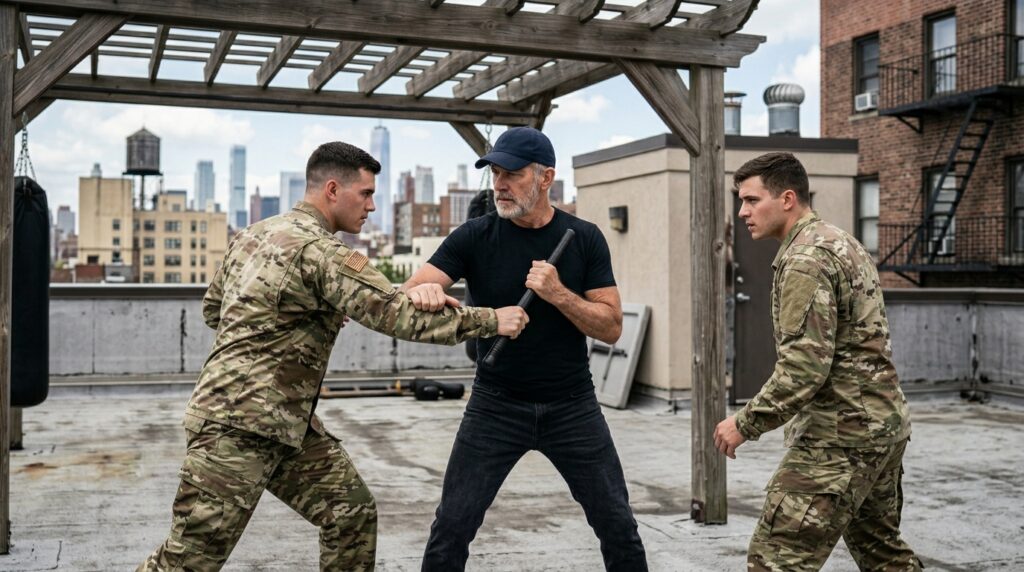
“The roof team didn’t look happy when they came down,” Arkwright said. His voice was like two bricks being dragged across gravel. “The young one was holding his ribs. He looked like he’d been run over by a freight car.”
Miller reached into his canvas duster, took out the black plastic data drive, and set it on the iron surface of Arkwright’s desk. The drive looked unnaturally clean against the ring-stains of stale coffee and the dried grease of the printing tools. “They dropped this. See what’s on the ledger line.”
Arkwright looked at the plastic rectangle for five long seconds. He didn’t touch it. Instead, he reached into his apron, pulled out a pair of thick, wire-rimmed spectacles, and hooked them behind his ears with trembling, scarred fingers. “You shouldn’t have brought that here, Miller. The newer stuff has a signature. If it connects to the junction, the routers flag the node within twelve minutes.”
“It’s cold,” Miller said, sitting on a wooden crate marked Type Metal. He rested his bad shoulder against the brick wall, feeling the damp chill penetrate his shirt. “No battery. No active ping. It’s standard administrative issue. They were using it to log my daily cycle. Someone had to sign the operational clearance to pull the log.”
With a low grunt, Arkwright picked up the drive using a pair of rusted metal tweezers, as if the plastic were infected. He slid it into an isolated bay on a machine that looked older than the warehouse above. The monitor was a heavy cathode-ray tube, its green phosphor screen flickering with a low, micro-tonal hum that made the fillings in Miller’s teeth ache.
Columns of dull green text began to crawl upward through the glass. The interface was crude—no icons, no modern design, just the raw administrative language of a system that had forgotten its own creators. Arkwright’s fingers worked a mechanical keyboard, the keys striking the microswitches with a heavy, rhythmic clacking that sounded like a small caliber weapon being cycled in an empty room.
“It’s an unindexed deployment ledger,” Arkwright murmured, his nose three inches from the glass. He spat a dark fleck of tobacco into a rusted tin can by his foot. “No name for the project. Just a budget line: Legacy Reconciliation Protocol. They’re clearing out the old storage lockers, Miller. You’re listed as unamortized hardware.”
“Look at the regional signature,” Miller said. His fingers wrapped around his manual watch, feeling the heavy, uneven vibration of the mainspring through the steel case. “The kids didn’t come from the local detachment. Their boots were wrong. The leather was too stiff for the coastal humidity. They were shipped in from the western depot.”
Arkwright typed a command, the green light reflecting off his spectacles in twin, pale squares. The machine groaned, its cooling fan rattling against its iron housing. A fresh block of data appeared—a single logistical manifest listing the fuel requisitions, the vehicle serial numbers, and the digital authorization key required to cross state lines with state-sanctioned training equipment.
“The signature is encrypted,” Arkwright said, his thumb tracking down the edge of the screen. “But the stamp… the stamp has an old ink pattern. The office doesn’t use it anymore, but the old logistics clerks still keep the physical plates for internal audits.” He paused, his blackened fingers freezing over the keys. “This isn’t an automated script, Miller. This was cleared by hand.”
Miller leaned forward, his boots scraping against the grit on the concrete floor. “Whose hand?”
Arkwright didn’t answer. He reached out and tapped the glass monitor with his fingernail, right over a line of alphanumeric code that looked identical to every other string on the screen. But to an eye that had spent forty years reading the margins of the state’s ledgers, the discrepancy was visible. It was a secondary validation code—a personal identifier used back when the training programs were still run out of the old concrete camps in the desert.
“It’s an old instructional mark,” Miller said softly. The iron tang in his mouth felt sourer now. “The triple-zero sequence. Only three men from my cycle had the clearance to use that prefix when ordering a field verification.”
“Two of them died in the river crossing back in ’94,” Arkwright said, turning his head to look at Miller through the side of his spectacles. The green phosphor light caught the deep, leathered wrinkles around his mouth. “Which leaves the boy you brought out of the salt flats. The one who used to clean your files before they gave him a desk in the main building.”
The silence in the basement became absolute, saving for the distant, heavy thudding of the offset press on the other side of the brick wall. Miller looked down at his own hands—the thick, scarred skin around the knuckles, the permanent grease under the nails, the wear and tear of a life spent staying outside the lines. He had taught that boy how to measure the distance between a man’s collarbone and his pulse using nothing but a three-inch piece of iron pipe. He had taught him how to look for the tiny irregularities in an official manifest to find out if an ambush was being prepared.
And now, those same irregularities were sitting on a green glass screen in a cellar that smelled of rot, signed with the exact operational prefix he had given the boy thirty years ago as a field name.
“He’s the director of the regional modernization initiative now,” Arkwright said, his voice dropping an octave until it was barely a vibration in the brickwork. “They call it the Unified Core. They’re rewriting the books, Miller. If it isn’t in the system, it doesn’t exist. And if it doesn’t exist, it can’t be permitted to leave an impression on the gravel.”
Miller stood up. The canvas duster felt heavier now, as if the water-resistant wax had absorbed the dampness of the entire basement. He reached down, took the watch from the zinc table, and slipped it back into his pocket. He left the data drive where it was.
“He knows where the workshop is,” Miller said. He walked toward the narrow stairs, his right shoulder twingeing with a sharp, iron heat. “He knows the timing of the locks. He knows I don’t leave by the front.”
“He sent kids with wooden sticks, Miller,” Arkwright called out after him into the dark of the stairwell. “Next time, it won’t be an evaluation. He knows you won’t accept a pension.”
Miller didn’t look back. He began the climb, his boots finding the worn centers of the stone steps, his hand sliding along the cold, rusted iron rail until the daylight from the upper door hit his eyes like a dry slap.








