
CHAPTER 2: WINDING THE OLD GEARS
The iron door latch didn’t give easily. It had been exposed to three decades of river damp and soot from the freight yards below, and when Miller put his weight against it, the metal screamed—a sharp, dry screech of oxide grinding against oxide. He didn’t look back at the two men on the gravel, but his ears tracked the wet, heavy rasp of Vance trying to stand.
Before the door swung closed, Miller’s boot slid three inches to the left. The thick, oil-resistant rubber edge of his sole caught the black plastic data drive, dragging it across the grit until it vanished into the shadow of the interior threshold. He let the heavy fire door slam shut behind him. The deadbolt dropped with a solid, hollow thud that vibrated through the concrete under his feet.
The stairwell was a vertical shaft of desaturated gray. The air was cold, smelling faintly of old lime mortar and the copper tang of leaking radiator pipes. Miller stood still for ten seconds, his back pressed against the corrugated steel of the door, listening to the iron frame hum. No one was pounding on it. Not yet.
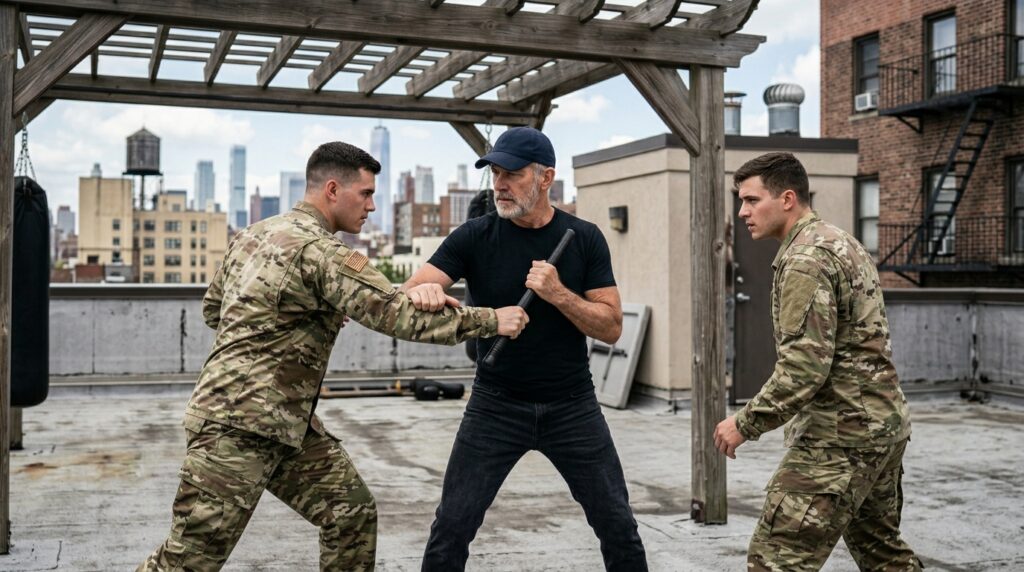
He let out a long, slow breath through his teeth. His right shoulder was locked tight, the deltoid stiffening where the younger operator had tried to wrench the humerus out of its socket using a standard textbook lever. It was a good lever. If Miller had been twenty years younger, he would have countered with a rotational break; today, he had simply let his weight drop like a sack of wet salt, letting gravity dissolve the geometry of the hold. It had worked, but the price was a dull, throb-like heat radiating from the joint.
He reached down into the gloom and picked up the data drive. The plastic was smooth, too clean for a building that had been shedding its skin since the mid-seventies. It was light—less than an ounce of carbon fiber and flash memory—but it felt heavy with implication. He dropped it into his shirt pocket, where it clinked against the steel casing of his manual watch.
He descended the stairs, his boots rhythmically striking the iron treads. Each step was an inventory of friction. His left knee clicked—a reminder of an old deployment in an anonymous port town whose name had been redacted from every official ledger. The handrail was rough under his palm, the green paint flaking away in dry flakes to reveal the pitted orange rust beneath.
On the third-floor landing, he entered his workspace. It wasn’t an office; it was a workshop for things that couldn’t be repaired by a machine. A heavy cast-iron lathe sat in the corner, covered in a thin skin of amber machine grease to keep the salt air from seizing the gears. Above it hung a pegboard lined with files, hacksaws, and specialized punches—all of them manual, all of them worn smooth at the grips by the skin of his hands.
He walked over to a small zinc-topped bench, his movements deliberate and unhurried despite the clock ticking in his head. He laid the wooden baton down on the metal. The plum-colored hickory looked dark against the gray zinc, its surface marred by a few fresh silver gray scratches from the gravel above.
“They won’t go back to the barracks,” he said aloud to the empty room. His voice sounded small against the concrete walls, dry as a dead leaf.
They wouldn’t. Modern protocol required a secondary perimeter validation if the primary collection team experienced an operational deficit. They would call the center from their encrypted units before they even reached the street. The administrative machine didn’t like empty spaces in its spreadsheets; an unresolved asset was an unhedged risk.
Miller sat down on a stool made of welded angle iron. He reached up, unbuttoned his shirt, and checked his shoulder in the reflection of a grease-smeared mirror hanging above the sink. The skin was already turning a deep, yellowish purple where the camo-clad operator’s fingers had dug in, trying to find the nerve bundle behind the collarbone. It looked like an old bruise, the kind that never really leaves a man after he passes fifty.
He reached into his pocket and pulled out the data drive alongside his grandfather’s watch. He laid them side by side on the zinc. The watch’s mechanical heartbeat was loud here—tick-tick-tick-tick—uneven but persistent, a small brass balance wheel fighting against its own friction. The data drive just sat there, black and dead, a piece of silent logic waiting for a current to make it speak.
He didn’t have a computer that could read it. He didn’t want one. Those lines left traces in the glass cables under the streets, crumbs for the auditors to follow. But he knew someone two blocks over who still kept an isolated terminal in the back of a legal printing shop—a man who still understood that some records were better kept on magnetic tape than in the cloud.
Miller stood up, his joints protesting with small, dry pops. He reached into the lower drawer of the tool chest, beneath a pile of oil-hardened leather gaskets, and pulled out an old canvas duster. It was stiff with dried tallow and road dust, the hem frayed where it had dragged along coach floors and train steps. He slid his good arm through the sleeve first, then carefully eased his injured shoulder into the rest of the fabric.
He picked up the drive and the watch. He didn’t take the baton. A stick in the street drew eyes, and the street was about to become very small. He looked around the workshop one last time, his eyes lingering on the iron lathe. The machine had been built to last a century, but if he didn’t move now, they’d scrap it for the iron value before the week was out.
He walked to the rear exit—the one that opened into the alley where the grease traps from the commercial kitchens drained into the brick gutters. He turned the heavy brass handle, feeling the resistance of the old mechanism before the latch withdrew. The air that came in from the alley was hot, thick with the smell of scorched lard and the gray exhaust of delivery trucks.
He stepped out, locking the door behind him with a key that had been cut by hand from a blank piece of iron stock. The city was out there, moving at its own digital pace, entirely unaware that the old gears had begun to turn again.








