Chapter 7: Bringing Robert Home
Autumn arrived in Virginia with cool mornings, golden leaves, and the familiar smell of woodsmoke drifting through the neighborhood.
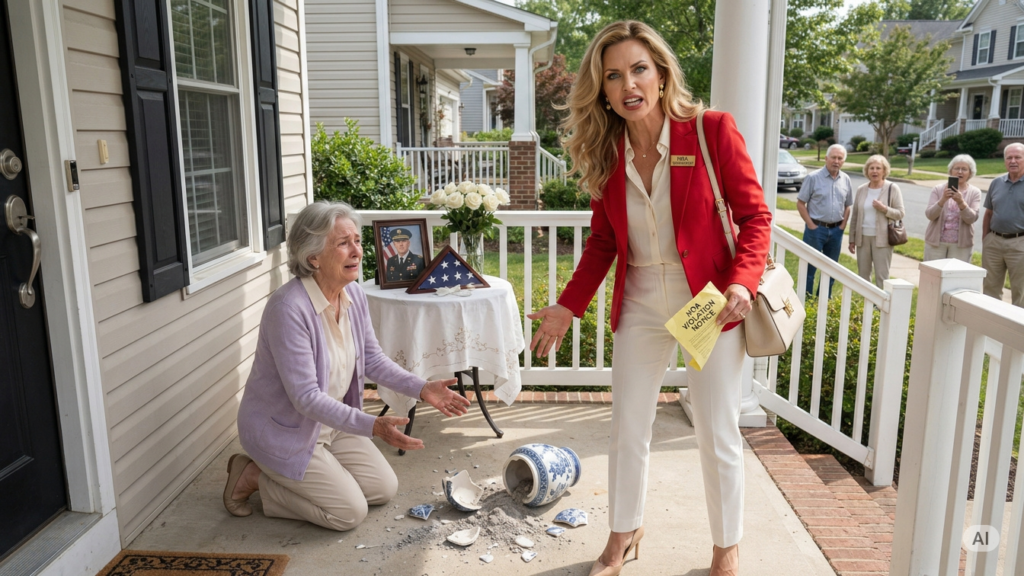
Nearly four months had passed since the urn shattered.
Eleanor’s front porch looked different now.
The memorial table remained, but its embroidered cloth had been replaced. The white roses continued blooming beside the railing.
Robert’s photograph stood in its original frame.
The folded American flag rested beside it.
And between them sat a new urn.
Daniel Price, the funeral director, had helped Eleanor choose it.
Rather than another ceramic vessel, she selected a handcrafted wooden urn made from American walnut.
Its surface was smooth and warm, with a small brass plate bearing Robert’s name, military service, and the dates of his life.
Daniel transferred the recovered ashes into it with quiet dignity.
Eleanor knew some of Robert’s remains had been lost.
For weeks, that knowledge had tormented her.
Then one afternoon, while tending the roses, she noticed a familiar red cardinal sitting on the porch railing.
Robert had loved cardinals.
He used to joke that they were the neighborhood’s only residents who never received violation notices.
Watching the bird, Eleanor began thinking differently about the ashes that had drifted into the flowerbed.
Robert had planted those roses.
He had carried bags of soil from the garage, repaired the wooden railing, and spent countless afternoons sitting on that porch.
If a small part of him now rested among the flowers he loved, perhaps she did not need to think of it only as a loss.
It was still painful.
But the pain no longer felt quite so sharp.
Susan suggested holding a small remembrance gathering.
Eleanor agreed.
She invited neighbors, family members, several of Robert’s former military friends, and Daniel.
On a bright Sunday afternoon, folding chairs filled the front lawn.
Margaret brought homemade lemon cake.
Frank set up a coffee station.
Dorothy Benson arrived carrying a photograph of Robert helping repair her garden fence years earlier.
Thomas Reed wore his old Army service cap.
One by one, people shared memories.
They remembered Robert lending tools without expecting them back immediately. They remembered him clearing snow from driveways belonging to neighbors who could no longer manage it themselves.
They remembered his terrible jokes, his excellent tomatoes, and his insistence that every Independence Day cookout needed more hamburgers than anyone could possibly eat.
Eleanor laughed more that afternoon than she had in months.
Robert was becoming a whole person again in her memories.
Not just a photograph.
Not just an urn.
Not just the subject of a terrible video.
He was the man who had shared her life.
At the end of the gathering, Thomas stood beside the memorial table and offered a quiet tribute to his fellow veteran.
Nobody recorded it for social media.
Nobody needed to.
The people who mattered were already there.
Across Willow Creek, other changes were taking shape.
The newly elected board adopted clearer enforcement procedures and strengthened its conflict-of-interest policies. Residents received more detailed financial reports. Meeting minutes became easier to obtain.
The board created a formal process for accessibility requests and established a reasonable approach to temporary personal memorials.
Homeowners could still be held responsible for legitimate violations.
But enforcement would require documented procedures, appropriate notice, and respect for private property.
The community had not abandoned its standards.
It had rediscovered the importance of applying them fairly.
Dorothy returned her husband’s wooden bench to its original place beside her front door.
Frank was elected to the board, although he insisted that no president should ever exercise unchecked control.
Margaret volunteered to organize a neighborhood support committee for residents experiencing illness, bereavement, or other hardships.
Eleanor joined her.
She understood how easily an older person could become isolated after losing a spouse.
She wanted Willow Creek to become the kind of place where someone noticed an empty driveway, brought over a meal, or offered help with the yard.
Not the kind of place where grief attracted a violation notice.
Vanessa remained in the neighborhood.
She completed her court-ordered obligations and paid the required restitution. She no longer held a leadership position.
Occasionally, Eleanor saw her walking along the sidewalk.
Their exchanges were brief and polite.
There was no dramatic reconciliation.
Eleanor did not pretend that the past had disappeared.
But she also refused to spend the rest of her life consumed by what Vanessa had done.
Robert would have wanted more for her.
On the anniversary of his death, Eleanor placed fresh white roses beside his photograph.
She sat in the wooden rocking chair he had repaired so many times and watched the afternoon sunlight move across the lawn.
Children visiting their grandparents rode bicycles along the sidewalk. Frank waved from across the street. Margaret was watering her flowers.
Willow Creek looked much as it had before.
Yet it felt different.
People stopped to talk again.
They attended meetings without fear.
They understood that protecting a neighborhood meant protecting the people who lived in it, especially those whose voices were easiest to overlook.
Eleanor rested her hand on the walnut urn.
She remembered the question she had asked Vanessa on the worst afternoon of her life.
How do you plan to give him back?
The answer had taken months to understand.
Nobody could give Robert back.
Not a judge.
Not a homeowners association.
Not an apology, a payment, or a new urn.
But neither could Vanessa take away fifty-one years of marriage.
She could not destroy the children they had raised, the kindness Robert had shown his neighbors, or the love that remained long after his final breath.
Those things had never belonged to her.
As the sun lowered behind the Virginia rooftops, Eleanor carried Robert’s urn inside and placed it beside their wedding photograph.
Then she returned to the porch, leaving the white roses where they were.
It was her home.
Her memories.
Her decision.
And no one in Willow Creek would ever again mistake her kindness for permission to take those things away.
The End.