Chapter 2: A Letter Without an Apology
Eleanor did not sleep that night.
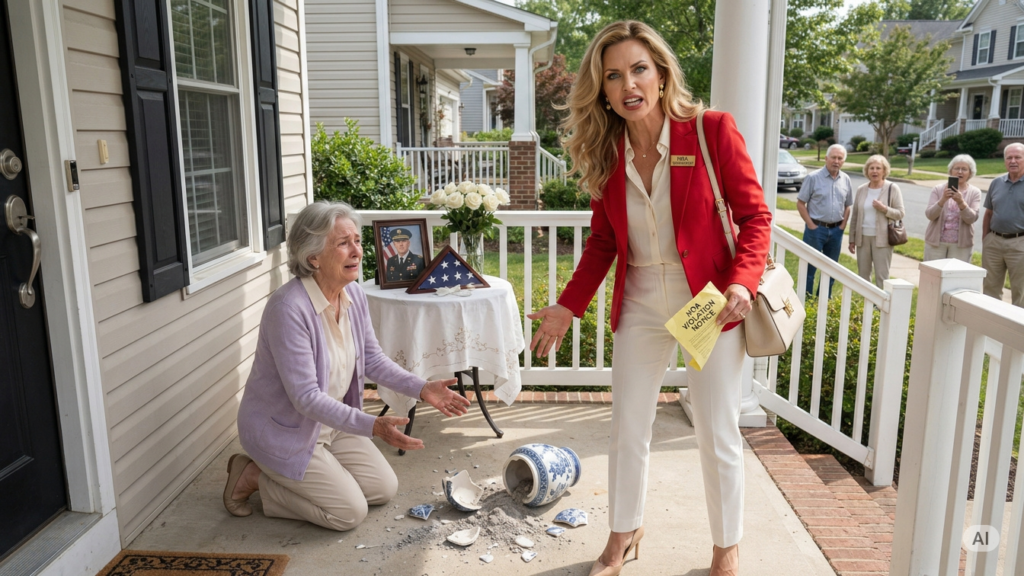
She sat at her kitchen table until nearly three in the morning, staring at the temporary container holding Robert’s recovered ashes.
Margaret had offered to stay, but Eleanor insisted she would be all right.
She was not.
Every familiar sound in the house reminded her of her husband. The refrigerator hummed. The old grandfather clock chimed. A loose floorboard creaked near the hallway.
Robert had promised to fix that floorboard for twenty years.
Eventually, they had both decided they liked it.
Now the silence surrounding those little sounds felt unbearable.
At breakfast, Eleanor received an email from the homeowners association.
She expected an apology.
Instead, the subject line read: NOTICE OF CONTINUING PROPERTY VIOLATION.
The letter stated that unauthorized decorative items had been placed on her front porch. It described the previous afternoon’s confrontation as an unfortunate incident arising from an enforcement action.
There was no mention of Robert.
No acknowledgment of the shattered urn.
No expression of sympathy.
At the bottom was a warning that Eleanor could face a daily fine if the memorial remained visible from the street.
Vanessa had signed the letter electronically.
Eleanor read it twice before calling Margaret.
Within twenty minutes, Margaret was sitting beside her, wearing reading glasses and an expression of disbelief.
Frank arrived shortly afterward with a printed copy of the association’s governing documents.
He had served on the Willow Creek board years earlier, before Vanessa moved into the neighborhood.
The original rules prohibited permanent structures that obstructed walkways, damaged property, or created safety hazards. There was nothing specifically prohibiting temporary memorial displays on private porches.
More importantly, Frank could find nothing authorizing an HOA president to enter a homeowner’s property and physically destroy belongings.
The association had procedures for issuing notices, scheduling hearings, and imposing certain penalties.
Vanessa had ignored those procedures.
Eleanor wondered how someone could become so confident in authority she did not actually possess.
The answer, Frank suggested, might be found in what had happened to the neighborhood during the previous three years.
Vanessa had arrived in Willow Creek after a successful career in luxury real estate. She purchased the largest house near the community entrance and quickly became involved in neighborhood affairs.
She was articulate, attractive, and persuasive.
At her first association meeting, she promised to protect property values and improve the appearance of the community.
Many residents welcomed her enthusiasm.
Willow Creek was aging. Several homeowners were struggling to maintain their properties. The clubhouse needed repairs, and the landscaping contract was overdue for review.
Vanessa appeared capable of solving those problems.
Within a year, she became president.
At first, her changes seemed harmless.
New entrance flowers. Fresh paint at the clubhouse. Updated community newsletters.
Then came stricter inspections.
Residents received notices about faded shutters, porch furniture, garden ornaments, and vehicles parked in their own driveways.
People who questioned the notices often received additional violations.
An eighty-year-old homeowner named Dorothy Benson had been fined for keeping a small wooden bench beside her front door. A retired schoolteacher had received a warning about a bird feeder. Another resident had been ordered to remove a ramp that helped his wife enter their home.
Most people paid rather than fight.
Many were living on fixed incomes. Some were caring for sick spouses. Others simply did not have the energy for prolonged disputes.
Vanessa understood that.
Whether intentionally or not, she had created a neighborhood where silence was easier than resistance.
Eleanor had received her first violation notice two months after Robert died.
It concerned the white roses she planted along her porch railing.
Robert had purchased those roses during their final spring together. Eleanor refused to remove them, and the matter eventually disappeared.
She had assumed Vanessa had reconsidered.
Now she wondered whether the president had merely been waiting for another opportunity.
Later that morning, Eleanor’s daughter, Susan, arrived from Richmond.
She had seen Frank’s recording online.
Susan was fifty-two, worked as an elementary school administrator, and had inherited her father’s habit of becoming unusually calm when she was angry.
She hugged her mother, examined the broken ceramic pieces, and read the HOA’s email.
Then she began organizing everything.
She photographed the porch, saved the recording, printed the violation notices, and created a folder containing the deputy’s incident information.
She also contacted the funeral home that had handled Robert’s arrangements.
The funeral director, a gentle man named Daniel Price, offered to visit Eleanor personally.
When he arrived, he treated the recovered ashes with the same care he had shown eleven months earlier.
He explained that he could help separate the remains from the larger ceramic fragments and transfer them into a suitable container.
He could not promise that everything had been recovered.
Eleanor already knew that.
Still, hearing it aloud hurt.
Before leaving, Daniel noticed the photograph of Robert in uniform.
He asked where Robert had served.
Eleanor told him about Germany, Virginia, and the years their family spent moving between military communities.
Daniel listened without interruption.
For the first time since the incident, Eleanor was speaking about Robert as a person rather than as something Vanessa had destroyed.
That distinction mattered.
After Daniel left, Susan checked the mailbox.
Inside was another yellow violation notice.
This one had been delivered by hand.
Attached to it was a photograph of Eleanor’s porch taken that morning.
Someone had returned to inspect her property while she was inside grieving.
Susan turned the photograph over.
At the bottom, beneath the date and time, was Vanessa Caldwell’s signature.