Chapter 6: The Price of Authority
The weeks before the special meeting were difficult.
Vanessa circulated letters defending her leadership. She listed improvements completed during her presidency, including landscaping projects, clubhouse repairs, and updated community signage.
Some of those accomplishments were genuine.
Eleanor did not deny them.
A person could do useful things and still be responsible for harmful ones.
That was precisely why accountability mattered.
The independent reviewer began examining the association’s records.
Several residents were interviewed. Contracts, invoices, meeting minutes, and enforcement practices were compared.
The preliminary findings identified significant weaknesses in the association’s management.
Required approvals had not always been properly documented. Enforcement procedures had been applied inconsistently. The contract involving Vanessa’s brother presented a conflict-of-interest concern that had not been adequately addressed.
Some invoices lacked sufficient supporting detail.
The reviewer recommended further examination, stronger financial controls, and a comprehensive reassessment of the association’s enforcement practices.
The report did not establish that Vanessa had stolen money.
Rachel reminded the residents of that distinction.
They did not need to exaggerate the findings.
The documented problems were serious enough.
Meanwhile, the criminal investigation concerning Eleanor’s property continued through the appropriate local authorities.
Vanessa retained her own attorney.
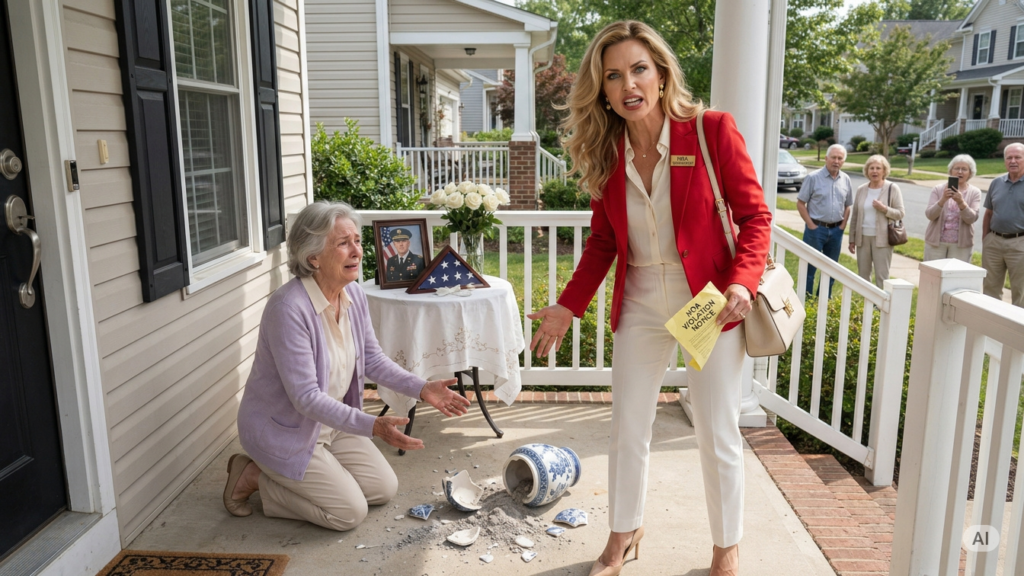
After reviewing the recording and other evidence, the prosecutor pursued a property-damage charge.
Several weeks later, Vanessa entered a negotiated guilty plea to a misdemeanor property offense. The court imposed conditions that included restitution for documented losses and community service.
Eleanor understood that the legal system could assign a monetary value to the urn.
It could not assign one to Robert.
No payment could recover the ashes carried away by the wind.
Still, the court’s acknowledgment mattered.
Vanessa’s actions were no longer being described merely as an unfortunate disagreement between neighbors.
They had consequences.
The special membership meeting took place on a clear Saturday morning.
Residents arrived carrying identification, association documents, and carefully completed voting materials.
Rachel attended to advise the homeowners who had requested her assistance. The association arranged independent oversight of the voting process.
Vanessa addressed the membership before the ballots were collected.
She spoke about her commitment to Willow Creek and acknowledged that mistakes had been made.
She described the previous month as one of the most painful periods of her life.
Eleanor listened quietly.
Vanessa’s voice lacked its usual sharpness.
But she still did not mention Robert by name.
When the ballots were counted, a decisive majority supported removing Vanessa from the board.
The necessary voting threshold had been met.
Her presidency was over.
There was no cheering from Eleanor.
She simply closed her eyes.
Frank squeezed her shoulder.
Margaret began crying.
For many residents, the result represented more than the removal of an unpopular president.
It represented the recovery of a voice they had gradually surrendered.
The remaining board members appointed interim leadership in accordance with the association’s governing procedures while preparations began for a new election.
The enforcement contract with Caldwell Residential Compliance Services was suspended pending review and subsequently terminated through the applicable contractual process.
The board also established a procedure for residents to challenge questionable fines.
Dorothy Benson submitted her records.
Thomas Reed provided documentation concerning his wife’s accessibility request.
Dozens of homeowners came forward.
Some penalties were canceled. Others were refunded after review. Several remained under examination because the circumstances were more complicated.
The changes were not immediate or perfect.
But the association had finally begun operating as an organization accountable to its members rather than as an extension of one person’s preferences.
One evening, several days after the vote, Eleanor found Vanessa standing at the end of her walkway.
She was dressed simply, wearing dark trousers and a cream sweater.
Her hair was tied back.
She carried no violation notices.
For a moment, neither woman moved.
Then Vanessa asked whether she could speak with Eleanor.
Eleanor remained on the porch.
She did not invite Vanessa inside.
Vanessa explained that she had written an apology but felt she should deliver it personally.
She held out an envelope.
Eleanor accepted it.
Inside was a handwritten letter acknowledging that Vanessa had entered the porch without permission and deliberately destroyed the urn.
There was no reference to neighborhood appearance.
No claim that the incident had been misunderstood.
Vanessa admitted that she had become accustomed to having her instructions obeyed. She had treated disagreement as disrespect and had convinced herself that protecting the community justified increasingly aggressive behavior.
She apologized for what she had done to Eleanor.
And, finally, she apologized for what she had done to Robert’s remains.
Eleanor folded the letter.
She appreciated that Vanessa had written it.
But forgiveness was not something Vanessa could demand, any more than she could demand the removal of a memorial.
Eleanor told her that rebuilding trust would require more than words.
Vanessa nodded.
She turned and walked away.
Eleanor watched until she disappeared down the street.
Then she returned to the memorial table and placed the letter beside Robert’s photograph.
She was not ready to forgive.
She was ready to move forward.
And those were two very different things.