Chapter 4: The Records Behind the Rules
Rachel Morgan arrived at Margaret’s house carrying a leather briefcase and a yellow legal pad.
She was in her late fifties, with short brown hair, practical shoes, and the patient manner of someone accustomed to sorting facts from emotion.
She listened to Eleanor first.
She watched Frank’s recording, examined the photographs, and reviewed the violation notices.
Then she turned to the other residents.
Rachel explained that homeowners associations could possess legitimate enforcement powers. Buying property in a planned community often meant accepting certain restrictions.
But those powers were not unlimited.
An association still had to follow applicable law, its governing documents, and required procedures. An elected president did not automatically gain permission to destroy private belongings.
Rachel identified several possible issues worth investigating, including property damage, unauthorized entry, improper enforcement, and potential conflicts of interest.
She made no promises about the outcome.
Instead, she asked for documentation.
Over the next week, the residents assembled a remarkable collection of records.
They discovered that several supposed neighborhood policies had been announced through newsletters without clear evidence of formal adoption.
Meeting minutes were incomplete.
Some financial statements listed administrative expenses without identifying the recipient.
Other documents contained vague references to special enforcement initiatives.
The more Rachel reviewed, the more concerned she became.
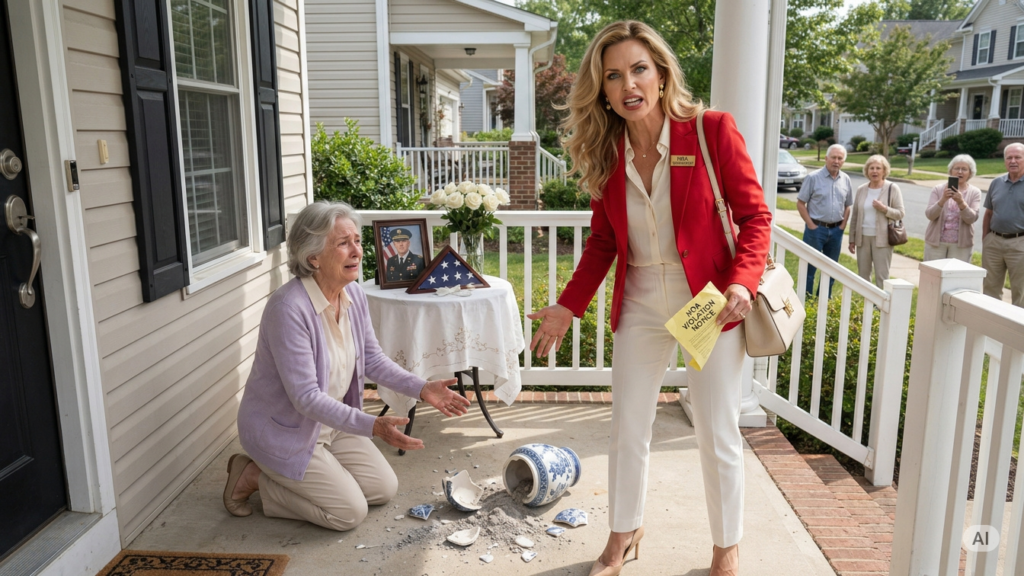
Meanwhile, the sheriff’s office continued investigating the destruction of Robert’s urn.
Vanessa had provided a statement claiming she believed the ceramic container was an empty decorative object.
That explanation did not change the fact that she had intentionally knocked it onto the concrete.
It also raised an uncomfortable question.
Why had she believed she was entitled to destroy an object simply because she considered it decorative?
Eleanor thought about that question often.
Even if the urn had been empty, it would still have belonged to her.
The association’s attorney eventually responded to Rachel’s records request.
Some documents were provided. Others were withheld pending further review.
Among the records was a contract with Caldwell Residential Compliance Services.
The company had been hired to perform inspections, prepare notices, and coordinate enforcement-related administrative work.
Rachel examined the contract carefully.
The company’s registered owner was Vanessa’s younger brother, Eric Caldwell.
Over eighteen months, the association had paid the company tens of thousands of dollars.
The records did not establish that every payment was improper. The company might have performed legitimate services.
However, the family relationship had not been clearly disclosed in the board minutes provided to the residents.
Neither was there evidence of a competitive bidding process.
Leonard confirmed that he had never been told Eric was Vanessa’s brother.
The discovery changed the nature of the dispute.
What began as an act of cruelty against one elderly widow had become a question about the management of the entire community.
Rachel advised the residents to avoid public accusations of theft or fraud until an independent review could establish the facts.
They followed her advice.
Vanessa did not respond with similar restraint.
She sent another community-wide email accusing a small group of residents of attempting to destabilize Willow Creek.
She warned that legal disputes could increase association dues and damage property values.
For several homeowners, the threat was frightening.
Many depended on their homes as their primary financial asset. They had spent decades paying off mortgages and could not afford sudden assessments.
A few began distancing themselves from Frank’s group.
Vanessa understood the power of uncertainty.
But Eleanor understood something else.
Fear was already costing the neighborhood money.
Residents were paying questionable penalties, replacing perfectly usable property, and avoiding improvements because they worried about receiving notices.
Their homes no longer felt entirely like their own.
That Friday, Eleanor received a certified letter from the association.
It announced a hearing concerning her alleged porch violations.
The hearing would take place at the clubhouse the following Wednesday.
The notice suggested that additional penalties could be considered.
Susan was furious.
Rachel, however, saw an opportunity.
She requested permission to attend with Eleanor and asked that the board identify the specific governing provisions supporting the alleged violations.
She also requested that Vanessa recuse herself from decisions involving the incident because of her direct personal involvement.
The board’s response was brief.
Vanessa would chair the hearing.
Eleanor read the letter while sitting in Robert’s old armchair.
She remembered the countless evenings when he had listened to her worries about bills, their children, or repairs around the house.
He had never solved every problem.
Sometimes, he simply reminded her that difficult things became more manageable once they were faced directly.
She decided she would attend the hearing.
Not because she expected kindness.
Because she wanted Vanessa to look her in the eye and explain, in front of the community, exactly which rule had supposedly authorized her actions.
On Wednesday afternoon, Eleanor dressed in her lavender cardigan, placed Robert’s photograph inside her handbag, and walked toward the clubhouse.
When she arrived, the parking lot was nearly full.
Word of the hearing had spread.
Vanessa had expected to confront one elderly homeowner.
Instead, more than sixty residents were waiting outside.