
Chapter 5: The New Button
Three weeks later, the intersection looked different.
The old pedestrian button had been removed.
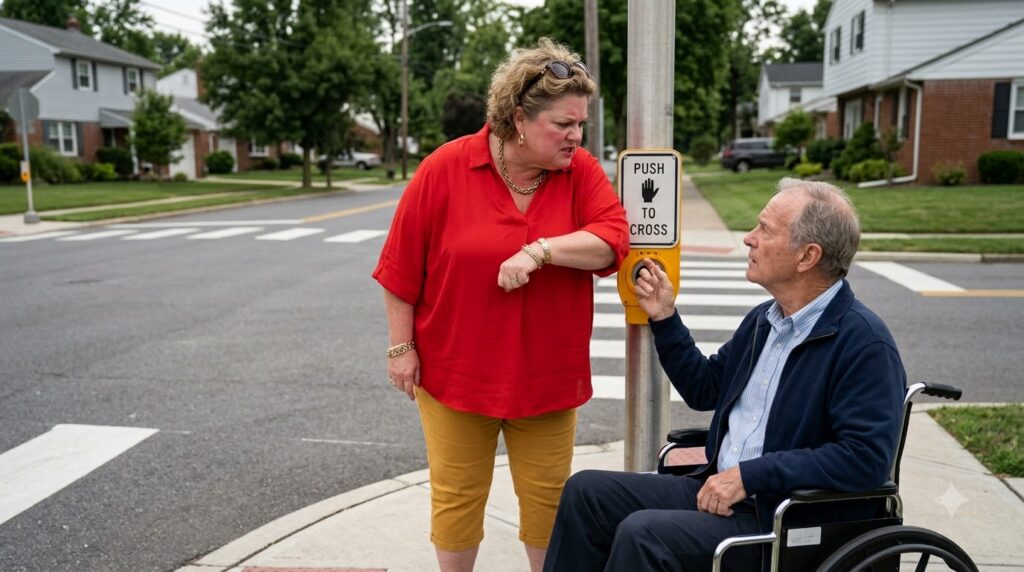
A new accessible button had been installed slightly farther from the curb ramp, leaving enough space for a wheelchair user to approach without having to angle awkwardly around the pole.
The cracked pavement had been repaired.
The signal’s audible tone was clearer.
For most people, the changes were barely noticeable.
For Daniel, they mattered.
He arrived one Saturday morning carrying a small paper bag from the bakery.
The street was quiet.
He rolled toward the crossing.
Then he stopped.
Karen was there.
She stood beside the pedestrian signal.
Daniel almost laughed.
She noticed him.
For a second, the old tension returned.
Then she stepped away from the button.
“You go ahead.”
Daniel looked at her.
“You don’t have to.”
“I know.”
She pointed toward the button.
“It works better now.”
Daniel pressed it.
Click.
The signal answered with its familiar electronic tone.
They waited.
Karen looked across the street.
“I didn’t understand it before,” she said.
Daniel waited.
“The button, I mean.”
He glanced at her.
She continued.
“I thought pressing it first meant something.”
“It doesn’t.”
“I know that now.”
The WALK signal appeared.
Daniel began crossing.
Karen followed, leaving plenty of space.
At the opposite curb, they stopped.
Karen looked embarrassed.
“I owe you an apology.”
Daniel said nothing.
She took a breath.
“I was wrong that morning.”
Those words seemed difficult for her to say.
Daniel nodded.
“Thank you.”
Karen looked relieved, almost surprised that he had accepted the apology so simply.
Then she noticed the paper bag on his lap.
“Bakery?”
“Every Saturday.”
“What do you get?”
“Cinnamon rolls.”
Karen smiled faintly.
“My husband used to like those.”
Daniel looked at her.
“Used to?”
“He passed away last year.”
The revelation changed the tone of the conversation.
Daniel had assumed Karen’s anger came from entitlement alone.
Now he realized there had been another layer he knew nothing about.
She explained that since her husband died, she had become increasingly protective of the routines they once shared. She had been arguing about parking spaces, signs, neighborhood rules, and small inconveniences because they gave her something to fight about when everything else felt empty.
It did not excuse what she had done.
Daniel didn’t pretend it did.
But understanding and forgiveness were not the same thing.
He could understand her without surrendering the boundary she had crossed.
Karen looked back toward the intersection.
“I made that morning much worse than it needed to be.”
“Yes.”
She smiled sadly.
“You’re very direct.”
“I’ve had practice.”
That made her laugh.
For the first time, Daniel saw the woman underneath the confrontation.
Not a cartoon villain.
Not a monster.
Just a flawed person who had behaved badly and finally had to face the consequences.
And sometimes, that was where change actually began.








