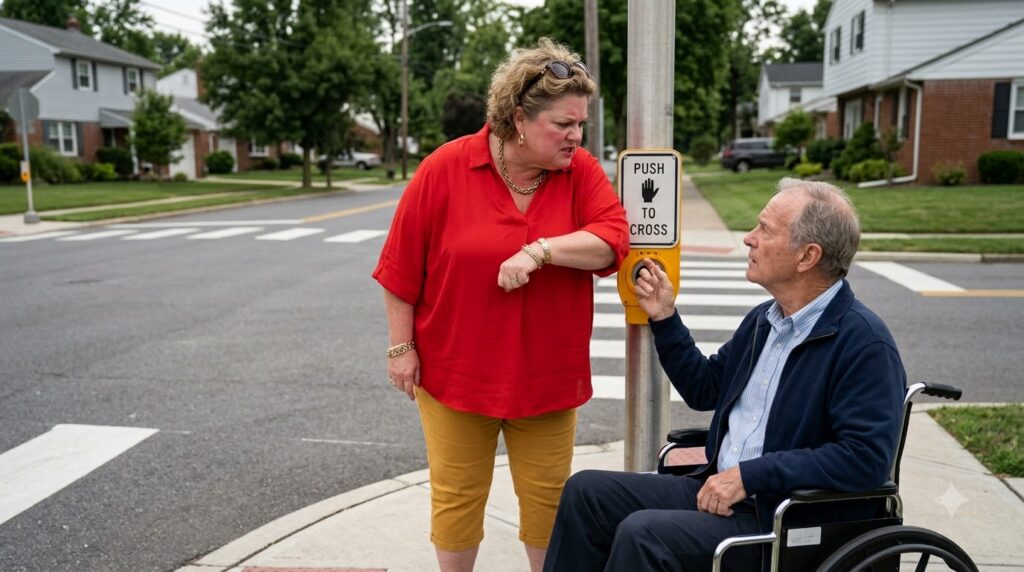
Chapter 2: The Woman in the Red Blouse
The first driver rolled down his window.
“Ma’am,” he called, “the crossing signal is on.”
Karen turned toward him.
“I know that!”
The driver hesitated, apparently unsure whether to become involved.
The wheelchair user waited.
He had learned over the years that patience could sometimes be the only practical weapon available when someone decided to turn an ordinary moment into a confrontation.
But patience did not mean surrender.
The signal continued its audible rhythm.
WALK.
WALK.
WALK.
Karen finally moved half a step.
The wheelchair user began crossing.
She immediately followed beside him.
“You could have waited your turn,” she muttered.
He kept moving.
“I did wait.”
“You know exactly what I mean.”
“No,” he answered. “I don’t.”
That made her angrier.
She stopped near the edge of the crosswalk and folded her arms.
The man continued toward the other curb.
Halfway across, he heard a car horn.
Not an angry one.
A warning.
A silver sedan had stopped behind the first vehicle. The driver, an older woman, was watching the crossing carefully.
When the wheelchair user reached the opposite curb, she gave him a small nod.
He nodded back.
By then, Karen had crossed too.
She walked into the shopping center without looking back.
The wheelchair user assumed that was the end.
It wasn’t.
Inside the small grocery store, he saw her again.
She was standing near the entrance, arguing with an employee about the location of the accessible parking spaces.
He almost kept walking.
Then he noticed the employee’s expression.
The young woman behind the service desk looked exhausted.
Karen was pointing through the glass doors.
“That space is practically empty,” she said. “Why should I have to park all the way over there?”
The employee explained that the marked space was reserved for vehicles displaying the appropriate permit.
Karen scoffed.
“I only need it for five minutes.”
The wheelchair user stopped.
There was something unsettling about seeing the same attitude appear in a completely different situation.
The employee noticed him.
Her eyes briefly met his.
Neither spoke.
Karen suddenly recognized him.
“You again.”
He said nothing.
She laughed under her breath.
“Of course.”
He continued toward the produce section.
For the next twenty minutes, he tried to forget her.
He couldn’t.
Near the checkout, he noticed a folded piece of paper lying beside the community bulletin board.
It was an announcement from the local neighborhood association about accessibility improvements planned for the intersection.
The crossing button was scheduled to be replaced with a larger, easier-to-reach model.
He read the notice twice.
Then he saw something handwritten at the bottom.
Meeting tonight — 6:30 p.m. — Community Room.
He almost ignored it.
But when he looked through the glass doors, he saw Karen outside.
She was standing beside the very accessible parking space she had been complaining about.
And she was taking a photograph of it.
He wondered why.
By the time he left the store, Karen was gone.
So was the paper.
Only a small piece of tape remained on the bulletin board.
The meeting was still scheduled.
And suddenly the morning confrontation seemed less random than it had at first.