
Chapter 3: The Meeting Nobody Expected
The community room was nearly full that evening.
Residents sat in folding chairs beneath fluorescent lights while a neighborhood committee discussed traffic safety, sidewalk repairs, and the proposed replacement of the pedestrian signal.
The wheelchair user arrived early.
He introduced himself simply as Daniel.
He had lived in the area for several years and knew many of the people in the room, although he wasn’t particularly interested in neighborhood politics.
He had come because the crossing mattered.
The current button worked, but its position was awkward. The curb ramp also had a shallow crack that became difficult to navigate after heavy rain.
A city accessibility coordinator named Linda presented the improvement plan.
The replacement button would be larger.
The activation pressure would be lighter.
The curb ramp would be repaired.
And the signal timing would be reviewed.
Everything sounded straightforward.
Then Karen entered.
She took a seat near the back.
Daniel noticed her immediately.
So did Linda.
Karen waited until the presentation ended.
Then she raised her hand.
“I don’t understand why we’re spending money on this.”
Linda explained that the project was intended to make the crossing usable for people with different mobility needs.
Karen shook her head.
“I use that crossing too.”
“You’re welcome to use it,” Linda said.
“Exactly. So why change it?”
Daniel remained silent.
A resident beside him leaned over.
“Isn’t that the woman from this morning?”
Daniel gave a small nod.
The resident frowned.
Linda continued explaining the project.
Karen interrupted again.
“What happens to people who don’t want the new button?”
There was a pause.
Linda looked genuinely confused.
“It doesn’t prevent anyone from crossing.”
“But it changes the intersection.”
“Yes.”
“Then residents should get a say.”
Daniel finally spoke.
“We do get a say. That’s why we’re here.”
Karen turned toward him.
Her expression hardened.
“You seem very interested in this.”
Daniel met her eyes.
“It affects me.”
That answer silenced the room for a moment.
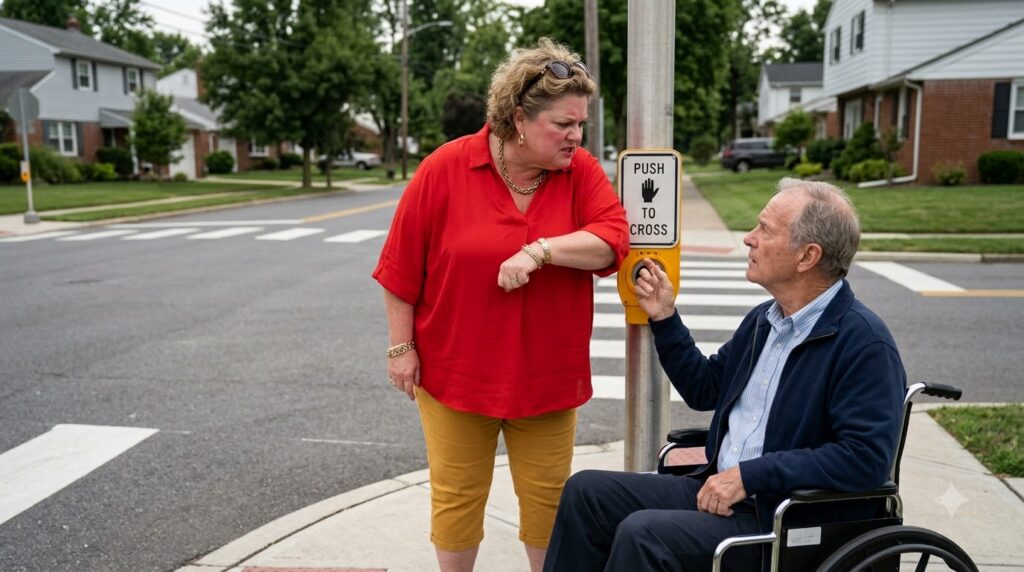
Daniel explained that he used the crossing regularly. He described the difficulty of reaching the existing button when another person stood directly in front of it.
He did not mention Karen by name.
He didn’t need to.
Everyone understood.
Karen’s face reddened.
“I never stopped you from crossing.”
Daniel looked at her.
“You stood in front of the button.”
“I had already pressed it.”
“Yes.”
“So what’s the problem?”
“The problem was that you wouldn’t move.”
A murmur moved through the room.
Karen pushed back her chair.
“This is ridiculous.”
She left before the meeting ended.
Daniel expected that to be the last of it.
Instead, Linda approached him afterward.
“There’s something you should know,” she said.
She showed him the photographs Karen had submitted earlier that day.
They were pictures of the crossing.
But Karen had circled something in red.
Not the button.
Not the curb.
A small sign attached to the pole.
Daniel studied it.
Then he understood why she had been taking pictures.
The sign contained the neighborhood association’s old parking and loading rules.
Karen had been claiming that the space near the crossing was part of a private loading area.
It wasn’t.
Linda sighed.
“She has been trying to get that area restricted for months.”
Daniel looked back at the empty chair where Karen had been sitting.
The morning’s argument suddenly made more sense.
The button had never really been about the button.
It was about control over a small piece of public space.
And Karen had already decided that the space belonged to her.








