
Chapter 1: “I Pressed It First”
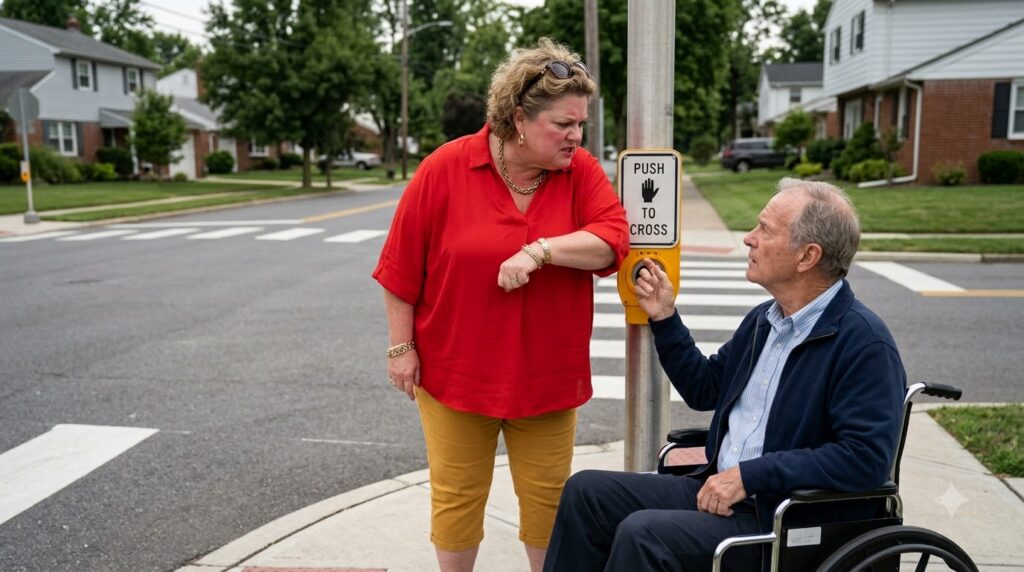
The wheelchair user’s fingers were less than an inch from the pedestrian crossing button when a large hand suddenly slammed over the metal housing.
“Don’t touch that!” the woman snapped.
The man in the wheelchair stopped.
The woman stepped directly between him and the pole, blocking his view of the button with her body. She was in her late fifties, extremely heavyset, dressed in a bright red blouse, mustard-yellow pants, and enough gold jewelry to catch the morning sunlight. Her sunglasses sat on top of her messy dirty-blonde hair.
She looked at the pedestrian signal as though she owned it.
“I pressed it first,” she said sharply. “You’re going to wait.”
The man, a gray-haired wheelchair user in his early sixties, stared at her for a moment.
He had been trying to cross the suburban street to reach the small shopping center on the other side. Nothing about the crossing was complicated. There was a curb ramp beneath his chair, a painted crosswalk, and an accessible push button mounted at a comfortable height.
Except now there was a woman standing in front of it.
He tried to reach around her.
She moved.
He shifted his chair slightly to the left.
She shifted left too.
He moved right.
She moved right.
The strange little dance continued for several seconds.
Finally, he looked up at her.
“You’re actually blocking the crossing button so I can’t cross?”
Karen’s eyebrows rose.
“I said wait.”
The man glanced toward the empty crosswalk.
“There’s plenty of room for both of us.”
“That’s not the point,” she replied.
“What is the point?”
Her lips tightened.
“I was here first.”
She pressed the button again.
Click.
Then again.
Click.
Her palm remained against the metal housing.
The man could hear the faint electronic tone beginning inside the pedestrian signal.
He calmly turned his chair another few degrees and reached around her.
Karen immediately stepped sideways.
“You’re not listening!”
The man stopped.
He looked at her, then at the button.
“So this isn’t about the button,” he said quietly. “You just want to decide who gets to cross.”
For the first time, Karen’s confidence flickered.
Then the pedestrian signal began its audible activation sequence.
A rhythmic electronic sound came from the pole.
Karen froze.
The WALK symbol illuminated.
The man looked toward the crosswalk.
He began rolling forward.
Karen stepped directly into his path.
“Just because the light lets you cross,” she said, “doesn’t mean I have to make room for you.”
For one uncomfortable second, neither moved.
Then a car approaching the intersection slowed.
Another vehicle stopped behind it.
And suddenly the tiny argument at the button was no longer private.
People had started noticing.
The man looked at the line of cars.
Then he looked back at Karen.
He didn’t raise his voice.
He simply said, “Please move.”
She didn’t.
And that was the moment the situation became something neither of them had expected.








