
CHAPTER 4: THE COUNTERENGAGEMENT LINE
“Stand down, Miller,” a sharp, reedy voice cut through the cavernous space. The glass elevator door bounced open with a pneumatic hiss, and the director stepped onto the desaturated gray concrete, his leather soles snapping aggressively against the floor. “Mr. Marcus has simply lost his orientation. We are going to help him find it.”
Marcus didn’t turn to face the director. He kept his heels planted, his weight balanced perfectly over the balls of his feet as the heavy, rhythmic boot-heels he had tracked from the North Gallery accelerated into operational velocity. The sound wasn’t civilian private security. It was the synchronized, aggressive stride of a three-man interception team moving in a staggered wedge formation.
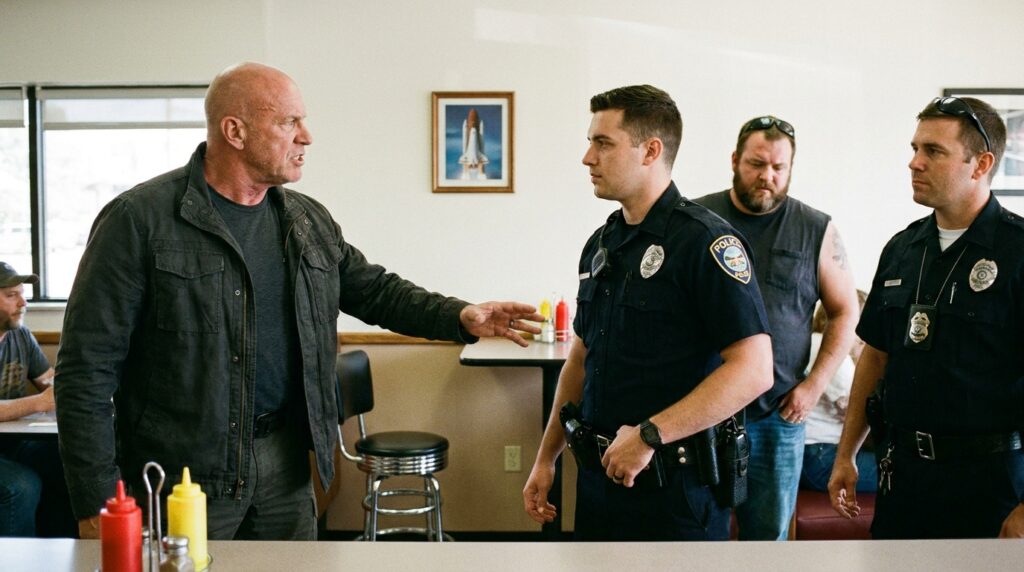
Before the director could take a third step, the massive bouncer from the tavern burst through the side airlock door. His face was a mottled purple, his sleeveless arm taped tightly with a white compression wrap where Marcus had pinned it. Fuelled by public humiliation and the sudden presence of his superiors, the large man didn’t call out a warning. He simply lunged across the concrete lane, his good arm extended like a battering ram, targeting Marcus’s blind flank beneath the immense overhang of the shuttle wing.
Miller shifted his stance to intervene, his hand darting into his jacket, but the three-man team from the North Gallery arrived at the exact same microsecond. The lead interceptor, clad in unbadged tactical black nylon, didn’t draw a weapon; he used his momentum to shove Miller backward, isolating Marcus completely in the center of the lane.
The bouncer’s shadow expanded across the pale concrete underbelly of the craft.
Marcus dropped six inches into his center of gravity, his dark jacket snapping against the cold draft as he pivoted inward, directly into the path of the lunge. He didn’t throw a strike. As the bouncer’s massive weight bore down, Marcus caught the extended wrist with his right hand, his left palm slamming violently into the bouncer’s armpit to redirect the sheer kinetic force. The physics were unyielding—friction, momentum, and mass colliding over a two-inch patch of polished stone.
The bouncer’s boots lost contact with the floor. The forward rush was completely hijacked, the trajectory altered from a tackle into a violent, airborne spin. With a hollow, concussive boom that echoed through the skeletal rafters eighty feet above, the large man slammed horizontally into the reinforced brick support pillar. Glass condiment jars inside the tavern wall rattled a hundred yards away. The bouncer slithered down the brickwork, his breathing reduced to a wet, defensive rattle, entirely contained.
Marcus didn’t check the body. He was already rotating his torso to face the three tactical interceptors, but his heel slipped.
A slick patch of pressurized hydraulic fluid, venting silently from the landing gear well above, compromised his footing by a fraction of an inch. It was the single variable he hadn’t calculated. The lead tactical interceptor capitalized instantly, his boot checking Marcus’s ankle while a second operator threw a heavy, nylon-insulated shoulder into Marcus’s chest, driving him back against the cold, unyielding steel struts of the main landing gear.
The impact knocked the breath from Marcus’s lungs, a sharp, metallic taste filling the back of his throat as his tactical watch scraped harshly against the structural framework. He was pinned, his arms locked by two men while the third stepped forward, holding a high-frequency digital scanner directly over Marcus’s face.
“The biometric signature matches,” the third man said, his voice entirely devoid of emotion. He didn’t look at the director. He looked down at the tablet. “He has the original command keys encrypted in the watch mechanism. But he doesn’t know what’s inside the payload bay.”
The director walked slowly into the light of the landing gear bay, a thin, superior smile fracturing his pale face. He stopped exactly three feet out, his bespoke gray suit looking entirely out of place beneath the scarred, heat-shielded belly of the reconnaissance craft.
“You thought I was trying to sell the hull to a foreign buyer, didn’t you, Marcus?” the director murmured, his voice echoing flatly within the steel confines of the gear well. He reached down, his fingers snapping sharply to command the interceptors to tighten their grip. “That is the story we put on the network. A neat little piece of corporate espionage to keep the regulators looking at the bank accounts instead of the manifest. You bit the hook perfectly.”
Marcus didn’t struggle against the nylon straps now binding his forearms. His gray eyes looked past the director’s tailored shoulder, tracking the massive, matte-black underbelly of the vehicle. The decoy secret had just shattered into worthless dust. The director wasn’t a corrupt administrator skimming assets for a payday; he was a custodian for something far larger, an active node in a continuity-of-government protocol that was currently warming up its systems right beneath the public’s feet.
Deep within the structural core of the shuttle, a low, sub-audible hum began to vibrate through the steel struts, a rhythmic, high-pressure thermal pulse that Marcus recognized from a lifetime spent in the dark. The ship wasn’t an exhibit. It was alive, and the countdown had already passed the primary threshold.








