
CHAPTER 2: THE REGIMENT PIN
The polymer baton didn’t move. It hovered four inches above Marcus’s right shoulder, a matte-black wedge of high-impact plastic vibrating slightly under the junior officer’s white-knuckled grip.
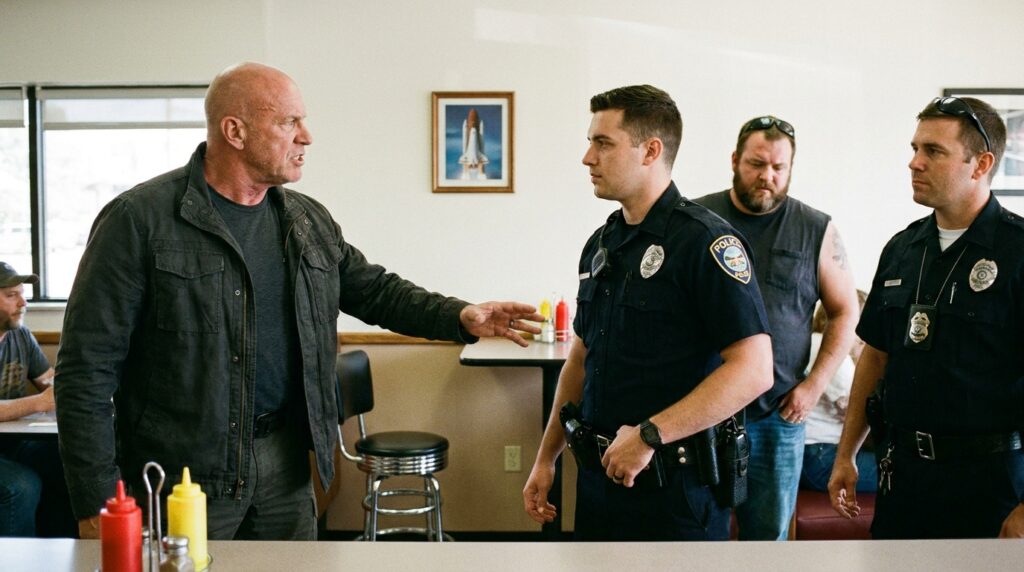
Marcus kept his left palm welded to the bouncer’s elbow. The bouncer was breathing in short, ragged wheezes, his face pressed flat against the sticky oak counter next to a puddle of spilled rye. Every small twitch the large man made sent a ripple through the condiment bottles, a minor friction that Marcus absorbed easily through his hips. He didn’t look up at the baton. He looked directly at the small, stamped eagle clutching a dagger pinned precisely two millimeters beneath the guard’s silver nameplate.
“Night Stalkers don’t work private security for a middle-tier museum tavern, son,” Marcus said. His voice was too quiet for the surrounding diners to hear, but it had the flat, percussive weight of a command bunker at three in the morning. “Not unless they got thrown out of Fort Campbell, or they’re tracking something that doesn’t belong in a display case.”
The junior guard’s eyes went small. The surname on his tag read Vance. His jaw worked, the muscle bunching under pale, razor-burned skin. The tip of the baton lowered by a fraction of an inch, the aggressive tilt of his stance suddenly hollowed out by a cold draft of recognition. He glanced down at Marcus’s jacket—at the dark, unbranded canvas, the tactical seam lines that didn’t catch the light, and the heavy steel bezel watch tracking the dead seconds between them.
“Who the hell are you?” Vance whispered.
“Release the arm,” a new voice commanded from the earpiece inside Vance’s left ear. The bleed-through was sharp enough for Marcus to catch the high-frequency click of a high-end encrypted local net. “Vance, drop the stick. Now. Director’s order.”
Marcus didn’t wait for the guard to process the audio. He loosened his grip on the bouncer’s elbow, using a single fluid push to slide the large man six inches down the polished wood, restoring the spatial perimeter between them. The bouncer pulled his arm back against his chest, his breath coming in ragged gasps as he staggered into the neighboring bar stool, his sleeveless arms instantly slick with defensive sweat. The crowd around them—the high-status patrons holding heavy crystal glasses—backed away by two full steps, their phones rising like a wall of small, black mirrors.
Vance slipped the baton back into its polymer housing with a hollow thwack. He didn’t look at the bouncer. He stayed locked onto Marcus, his hand hovering near his utility belt, not out of aggression now, but out of pure structural uncertainty.
“You’re Marcus Vance,” Marcus said, reading the nameplate again, his voice dropping an octave. “Your father was third battalion. Grenada. He had the same hitch in his left shoulder when the weather turned.”
The guard went completely still. The historical weight of the statement hit him harder than a physical strike. In the United States, military lineage wasn’t just a record; in certain circles, it was a geographic coordinate. Before Vance could answer, the air behind them shifted. The ambient heat of the tavern’s kitchen line dropped as the heavy glass doors to the main museum lobby swung open.
The senior Security Observer moved into the lane. He didn’t look like the guards. He wore an unbuttoned charcoal blazer over a black polo, his chest marked only by a heavy, gold-rimmed visitor supervisor badge that sat perfectly level above his heart. His eyes were entirely hidden behind dark tactical sunglasses, despite the low, amber illumination of the bar. He didn’t draw a weapon. He simply walked between Marcus and the junior officer, his boots silent on the concrete.
“The director wants you in the North Gallery, Mr. Marcus,” the supervisor said. His tone was transactional, dry, and clean of the standard security theater. He didn’t look at the bouncer who was currently nursing a bruised radius against the taps. “He suggests you don’t keep the appointment waiting. The floor closes to the public in seven minutes.”
Marcus checked the dead dial of his watch by habit. The mechanical tick was still there, a tiny iron pulse against his skin. “The director wasn’t on my schedule.”
“He is now,” the supervisor replied, stepping slightly to the right, his body subtly blocking the view of the tavern patrons who were still filming the interaction. “Vance, take the back stairs. Reset the perimeter at the airlock threshold. And take off the lapel pin. You know the regulation regarding non-standard attachments on the floor.”
The junior guard didn’t move for a second. His eyes flicked from the supervisor’s hidden face back to Marcus, a silent, disciplined acknowledgment passing through his jaw before he turned on his heel. His boots made no sound as he vanished into the dark service hallway behind the liquor racks.
Marcus looked at the supervisor’s profile. The man’s skin was weathered, lined with the distinctive salt-and-iron texture of someone who had spent a decade inside high-altitude cockpits. There was a faint, white crescent scar running from the edge of his right ear down into his collar—a thermal burn from a high-pressure line failure.
“The space-shuttle in the center depth,” Marcus said, his eyes tracking the dark, massive silhouette of the wing visible through the glass partition separating the tavern from the main hall. “The tiles on the leading edge aren’t standard silica. They’re reinforced carbon-carbon with an active cooling channel. That design was classified until forty-eight hours ago.”
The supervisor didn’t turn his head. He merely extended his right hand toward the lobby doors, the gold-rimmed badge catching the orange light like a warning light on a runway.
“The director will explain the inventory, sir,” the supervisor said, his voice flat as iron. “Assuming you survive the walk across the floor.”
Marcus stepped away from the brick pillar, his dark jacket settling back into its neutral hang. He could feel the weight of thirty eyes on his back as he crossed the threshold out of the wood-paneled warmth of the tavern and into the vast, desaturated gray of the museum’s main exhibition hall, where the shadows of old wings stretched out like long, black knives across the concrete.








