
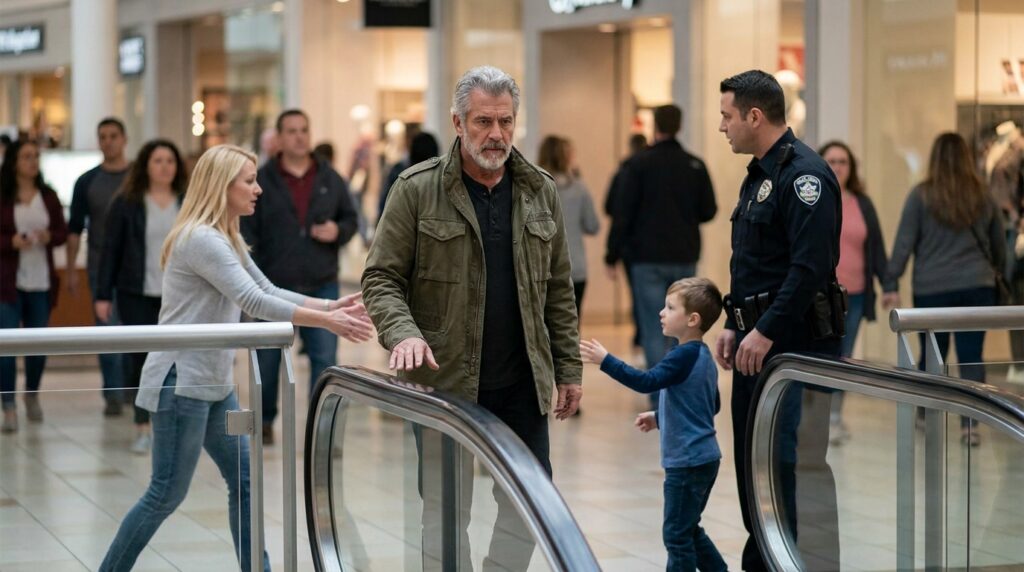
CHAPTER 6: THE STANCHION STANDDOWN
The brass clip of the nylon barrier didn’t give way easily; it was old, its internal spring clogged with years of floor wax and accumulated lint. Tyler’s fingers slipped twice against the cross-hatched metal casing, his thumb leaving a small, pale smudge where his sweat hit the tarnished plating. The entire structure groaned—a low, metallic scrape that echoed across the stone floor of the atrium as Tyler yanked the heavy cast-iron base ten yards to the left, jamming it hard against the concrete structural column exactly as Arthur had instructed.
“Back up! Clear the access lane!” Tyler’s voice finally found its register, breaking out of the brittle administrative squeeze that had choked it for the last ten minutes. He didn’t use the polite, standardized phrasing of the employee handbook. He threw his weight against the second stanchion, his leather boots skidding slightly on the polished floor. “Every shopper in this sector, clear the lane immediately! Turn your cameras toward the glass entryway!”
The crowd didn’t disperse; they did something far more effective for Arthur’s tactical calculus. They shifted their weight as a singular, dense mass, their consumer curiosity hardening into defensive alertness. The smartphones that had been tracking Arthur’s profile swung around in a wide, synchronized sweep, sixty glass lenses catching the flashing amber glare of the utility truck parked outside. The collective witness pressure in the room grew heavy, a wall of small black mirrors reflecting the entry vestibule back at the two men in the gray canvas coats.
The first man had already taken three long, calculated strides past the inner matting before the shift hit him. He froze. His right hand remained submerged inside the unzipped cavity of his gray canvas pocket, his fingers clearly wrapped around something dense and metallic, but his head jerked upward, tracking the sudden glare of dozens of raised phone screens. The low brim of his baseball cap no longer offered concealment; the white fluorescent light of the multi-level atrium caught the greasy line of his jawline and the tight, flat press of his lips.
Arthur didn’t move an inch from the base of the escalator. His solid, sixty-two-year-old frame remained anchored between the intrusion lane and the concrete recess where Elena held Toby against her chest. He unbuttoned the top notch of his faded olive field jacket with a slow, deliberate twist of his calloused thumb, letting the fabric pull away just enough to expose the heavy silver star insignia pinned securely to the pocket flap beneath. The star wasn’t a modern civilian decoration; it was a weathered piece of command brass, its edges dull from decades of deployment crates and high-altitude logistics management.
“You’re out of your sector, son,” Arthur said. The gravelly resonance of his voice didn’t rise to a shout, but it carried across the twenty feet of tile with the heavy, unyielding friction of a closed gate. He kept his hands visible, his fingers loose and steady, but his posture possessed the dense, unbothered physical permanence of a man who had spent his life managing logistics blockades under real fire. “The vehicle outside doesn’t match the service manifest for this wing. And your partner on the third-floor walkway just missed his elevator check.”
The man in gray didn’t answer. He took one slow half-step backward, his boots making a dry, sticky sound against the terrazzo where some spilled soda had dried into a faded stain. His eyes traveled from the silver star on Arthur’s jacket up to the unblinking, slate-gray intensity of the veteran’s face. He wasn’t looking at an old mall patron anymore; he was looking at an active command barrier—an equal intellect that had dismantled the geometry of his trap before he could even reach the target.
Behind the man, the second worker in gray remained at the threshold of the glass doors, his hand resting flat against the aluminum frame to keep the automated slider from cycling shut. He caught his partner’s eye, a brief, silent communication passing between them that carried the sharp, bitter taste of an operation that had just lost its invisibility. The three-beat manual override click on Tyler’s shoulder radio stopped instantly, replaced by a low, hollow rush of standard white noise as the jamming transmitter was cut off from above.
“Tyler,” Arthur murmured, never taking his eyes off the man’s right pocket. “The local sheriff’s department drops their transport units at the north ring road every Saturday at three-fifteen. Hit the emergency toggle on your belt console now. The signal will clear the main junction box even if your handheld frequency is down.”
Tyler didn’t ask for verification. He slammed his palm against the small, yellow plastic box clipped to his belt behind his utility pouch. A dull, distant siren began to throb from the mall’s exterior facade—not the frantic fire alarm, but the low, steady building-evacuation pulse used to signal a vehicle gate breach at the commercial loading bays.
The man in the gray jacket let his hand slide slowly out of his canvas pocket. It was empty, his fingers splayed wide to show compliance under the glare of sixty recording lenses. He gave Arthur a single, cold nod—a recognition of the unyielding wall he had just slammed into—and turned on his heel. He and his partner moved back through the glass entryway with the long, rapid strides of men who knew their escape lane was narrowing by the second. The white utility truck’s diesel engine roared outside, its tires barking against the asphalt as it lunged out of the drop-off lane into the afternoon traffic.
The immediate bottleneck at the escalator was broken, but as Tyler dropped his arms from the stanchion post and the surrounding shoppers began to murmur in relief, Arthur looked down at the pink carbon report still gripped in his left hand. The signature of the regional administrator who had authorized Tyler’s old reprimand wasn’t standard corporate print; it was signed with the exact same specific, seven-digit logistics prefix stamped onto the orange tracking tag dangling from Toby’s backpack.
The immediate rescue was complete, but the deep paradigm shift had just begun—the corporate hand that had set Tyler’s bottleneck in motion belonged to someone inside Toby’s own family circle, and the final truth was still heavily locked behind the administrative offices upstairs.








