
CHAPTER 2: THE FRACTION OF PROTOCOL
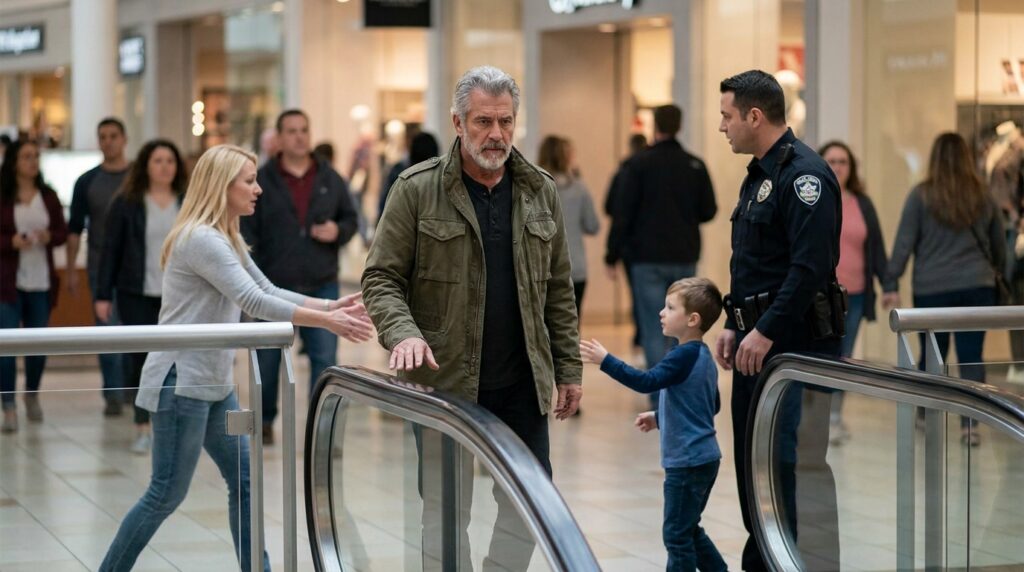
The young guard’s uniform shirt didn’t just smell of crisp starch; it carried the sour, metallic tang of a man whose adrenaline had spiked past his ability to process it. Tyler’s jaw remained unhinged for a fraction of a second, his lips frozen in the middle of a syllable that Arthur had effectively cut out of the air. The mall’s multi-level atrium seemed to contract around their immediate two-foot pocket of space, the ambient noise of descending shoppers and distant cash registers flattening into a low, pressure-cooker hum.
“I have a directive from mall administration,” Tyler managed to say, though his pitch lacked the sharp velocity it had carried only moments before. His hand remained hovering over the black plastic casing of his radio, his fingers twitching against the toggle switch like an itch he couldn’t scratch. “The perimeter is non-negotiable, sir. If you interfere with a securing action during an active code, I am authorized to hold every civilian in this lane for municipal transport.”
Arthur didn’t blink. He allowed the silence between them to stretch, a tactical weight he had used a thousand times in gray briefing rooms across the Atlantic. He watched the subtle giveaway in Tyler’s eyes—the way the pupils dilated not out of authority, but out of a deep, exhausting panic. Underneath the pristine navy blue fabric of the guard’s shoulder straps, the fabric was slightly frayed at the seam, a small cluster of loose threads unraveling under the pressure of his hyper-extended posture. It was a faded texture, a sign of wear that exposed the cheap contract nature of the security firm beneath the glossy presentation.
Behind Arthur, Elena’s breath came in ragged, uneven gasps. Her palms were still pressed against the smooth, cold surface of the chrome stanchion pole, the metal groaning softly under her shifting weight. “He’s just a boy,” she whispered, her voice cracking against the unyielding stone floor. “Please. He doesn’t know what a code means.”
Arthur’s gaze remained locked onto Tyler’s face, but his peripheral vision was already cataloging the surrounding perimeter. He noticed the scuff marks on the white terrazzo tile—the dark, jagged streaks left by rubber-soled boots during the initial rush of the crowd. And then his eyes dropped slightly, catching a detail on the small blue long-sleeve shirt of the child. Toby had stepped back into the shadow of a large concrete structural pillar, his small hands clutching the nylon straps of his backpack.
Looping through the metal teeth of the main zipper on that backpack was an unauthorized orange plastic routing tag. It wasn’t a standard retail price tag or a colorful key chain. It was thick, industrial-grade plastic, stamped with a specific seven-digit tracking sequence and a faded matte finish. It was the exact type of cargo-routing marker used in high-security commercial freight yards—the kind of tag Arthur used to inspect on supply crates in the logistics depots of the mid-nineties. It didn’t belong on a child’s schoolbag in an Ohio shopping center.
“You’re running a secondary protocol, son,” Arthur said, his voice dropping into a register that was sparse, transactional, and entirely devoid of anger. He took an absolute, three-inch step forward, closing the remaining distance until the dull brass buttons of his olive field jacket almost brushed the silver-painted shield on Tyler’s chest. “You’re thinking about the report you had to sign three weeks ago. The one where the jewelry gate didn’t drop in time.”
Tyler went entirely rigid. The color drained from his lips, leaving them a pale, bluish gray that matched the tint of the mall’s tinted skylights overhead. The psychological strike landed cleanly, hitting the hidden pocket of professional shame the young guard had been trying to mask with aggressive enforcement.
“How did you…” Tyler started, his voice dropping out of its command rhythm entirely. He glanced nervously toward the gathering crowd of shoppers whose phones were still tilted toward them like polished obsidian mirrors. The collective weight of those lenses was an immense, silent pressure, a modern witness layer waiting for a single misstep to record an institutional collapse.
“Because you’re looking at the access lane instead of the exit,” Arthur said softly, his thumb resting lightly against the old silver watch on his left wrist. The watch’s internal gears gave off a faint, mechanical click that only the two of them could hear in the tight space between their chests. “A man who wants to secure a perimeter watches the doorways. A man who’s terrified of losing his job watches his supervisor’s line of sight.”
Arthur reached slowly into the fold of his jacket, his fingers wrapping around the smooth, scuffed edge of his old laminated service card. He didn’t pull it out completely. He merely allowed the top half of the faded seal—the unmistakable eagle crest of federal command logistics—to peek above the canvas lip of his pocket.
Tyler’s eyes dropped to the sliver of plastic. He didn’t know the exact division or the specific rank, but he recognized the cold, administrative permanence of the ink. It was the language of real institutional power, an ancient echo of authority that made private mall regulations look like chalk lines on a rainy sidewalk. The young guard’s shoulders dropped exactly two inches, the rigid, militaristic illusion of his posture finally beginning to show its cracks.
“I’m just trying to keep the sector clear, sir,” Tyler muttered, his head tilting slightly downward as the defensive anger left his voice, replaced by the heavy, shared burden of a man who felt completely isolated in a crisis he couldn’t control. “They told us anything within twenty yards of the escalator landing had to be locked down until the inventory count on the third floor was verified.”
“Then verify it from the side of the lane,” Arthur commanded quietly, his tone shifting into a gentle but unyielding instructional guide. “Let the boy cross. The mother isn’t your threat, Tyler. And neither is the child.”
The young guard’s hand slowly left his radio casing, his fingers dropping to his side with a heavy, loose limpness. He looked at Toby, then back to Elena, whose face was still strained with a desperate, human hope that seemed to soften the sharp edges of the white fluorescent room. Tyler turned his body slightly, his leather belt squeaking against his uniform trousers as he prepared to unhook the nylon stanchion line.
But before his fingers could touch the metal clasp, a sharp, erratic burst of static tore through the speaker on Tyler’s shoulder. The sound was brutal, cutting through the silence of the atrium like tearing tin.
“All units, all units,” a voice rasped through the small plastic grille, the tone frantic and completely undisciplined. “We have a secondary alarm trigger at the western loading dock. The vehicle registry doesn’t match the manifest. Repeat, the blue transit van is moving toward the lower service ramp. Block all exit lanes immediately.”
Arthur’s eyes snapped toward the upper walkway directly across from their position. A man in a dark, unlabeled utility uniform was standing by the glass balustrade, looking straight down at the escalator landing. He wasn’t watching the security guard, and he wasn’t watching the crowd. He was looking directly at the orange plastic tag dangling from Toby’s backpack, his fingers tapping a rhythmic, tactical pattern against the scuffed aluminum railing.
Arthur realized with a cold, hollow certainty that the entire retail theft on the third floor hadn’t been an uncoordinated crime at all—it was a calculated diversion designed to drive everyone down to this exact bottleneck, and the man on the walkway was waiting for the boy to step into the clear.








