CHAPTER 8: THE LAST COLD LINE
The barrel of Frank’s sidearm did not waver. It caught the dull, flickering amber glow of the terminal screen, steady as a plumb line.
“Step back from the flatbed, Vance,” Frank said. His voice was completely devoid of the strain that had frayed his words at the curb. The exhaustion in his posture was gone, replaced by the clean, lethal economy of a man stepping onto familiar hunting ground.
I didn’t step back. I kept my hand flat on the glass of the scanner, feeling the hot hum of the internal lamp burning through the scorched leaves of the binder.
Behind me, the woman against the bulkhead let out a ragged breath, her fingers slipping against the empty shotgun receiver. “He was never running from them, Vance,” she muttered, blood seeping through her knuckles. “He built them.”
“Quiet, Martha,” Frank said without glancing in her direction. “You did your job. You kept the line cold for thirty years. Now let the boy understand the contract he inherited.”
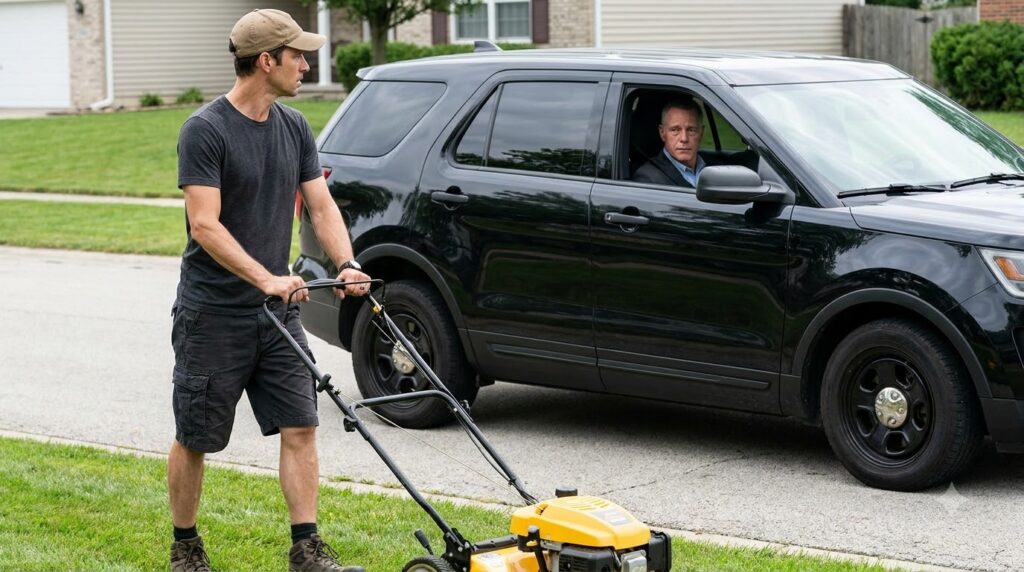
“The foreclosure notices,” I said, my voice dropping low, calculating the four paces of diamond plate between my boots and his forward stance. “The tax liens. You didn’t come to my lawn to save the homestead. You brought me the parcel card because the vault in the municipal basement required an active biometric bloodline to unlock the fire-safe. You needed a Vance to turn the key.”
A ghost of a smile touched the deep creases around Frank’s mouth. “Your mother was thorough. When we set up the easement grid in eighty-eight, she didn’t trust the federal marshals, and she certainly didn’t trust the regional director. She keyed the physical lockboxes to her family registry. When she died, the archive locked down. I couldn’t touch the paper trail without setting off the automatic audit flags in Philadelphia.”
“So you staged the syndicate,” I said. “You leaked the unmapped tracts to the county director, let him think he was running an illegal eminent domain scam, and waited for him to send his cleanup crews so I’d feel the noose.”
“A man who thinks he’s defending his home moves fast, takes risks, and doesn’t ask questions until the iron is in his hands,” Frank said. He stepped forward one pace, his heavy work shoes clicking against the wet steel grating. “Look at the terminal header. Read the routing node.”
I looked over my shoulder at the amber display.
The data stream wasn’t transmitting to a federal intake server. The packets were downloading into a standalone hard drive slaved to the secondary transceiver beneath the desk.
“The eight families on your street were never witnesses in a union trial,” Frank said softly, the hum of the rushing spillway beneath us filling the pause. “They were the principal couriers. The union money, the municipal kickbacks, the federal transit subsidies—it all flowed through those eight parcels. Your mother didn’t protect them from the mob. She protected the ledger from the Justice Department. She built a fortress in plain sight, staffed by people who could never leave without walking straight into a life sentence.”
The truth didn’t crash; it settled like heavy frost over iron.
The quiet suburban street, the neighbors who never spoke above a murmur, the neat, manicured lawns that never had visitors, the silent surveillance that felt like protection—it wasn’t a haven. It was an open-air containment cell, managed by my family and secured by a county cruiser that made sure no one ever broke formation.
“And now?” I asked, my fingers slowly curling into the sharp edge of the terminal frame.
“Now the state is closing the books,” Frank said. “The digital transition means paper archives have to disappear. Once this drive finishes copying the encrypted keys, the auxiliary diesel below is set to vent directly into the fuel manifold. The pumping station floods, the transformer shorts, and forty years of history burn to the waterline. You and Martha get logged as casualties of the county director’s hit squad. The syndicates take the blame. And I walk out the ridge gate with the only operational ledger left on the Eastern seaboard.”
“You made one miscalculation,” I said.
Frank tilted his head slightly, his grip on the weapon firm. “I don’t make miscalculations on county ground, kid.”
“You assumed my mother left the emergency override on the terminal board.”
I pulled my left hand from my cargo pocket.
Resting between my fingers wasn’t the notched padlock key. It was the unindexed transponder he had tossed to me during the chase. While running the catwalk, I hadn’t just thrown the auxiliary breaker; I had jammed the transponder’s ground wire into the high-voltage bus bar of the emergency diesel.
“The radio isn’t sending a locator ping,” I said, staring directly into his sunken gray eyes. “It’s an open-frequency beacon broadcasting the unencrypted audio from this room across the entire state emergency channel.”
A heavy, metallic screech echoed from the upper access road above the dam.
Through the shattered exhaust louvers, the darkness lit up with blinding red and blue strobes—not the single, covert halogen beams of a private security unit, but the massive, coordinated sweep of a dozen state police interceptors locking down the ridge.
Frank’s eyes flickered toward the ceiling for a split second.
That fraction of a second was the only gap I needed.
I lunged off the steel floor, throwing my entire weight across the four paces of catwalk. My shoulder slammed into Frank’s chest before the barrel could drop, driving both of us hard against the rusted safety railing. The sidearm discharged into the concrete roof with an ear-splitting crack, the muzzle flash blinding in the damp gloom.
We hit the iron grating together. Frank was old, but his frame was seasoned iron, his forearms locking around my throat with crushing leverage.
I didn’t fight the choke. I drove my right thumb into the nerve cluster behind his ear while wrenching the scorched canvas binder with my left arm, jamming the heavy, metal-cornered spine directly into his wrist. The bones in his fingers cracked, and the sidearm tumbled over the edge, plunging into the black, deafening torrent of the overflow spillway forty feet below.
Frank fell back against the bulkhead, clutching his fractured hand, breathing in ragged, bloody gasps.
Above us, the heavy steel intake doors were breached from the surface. Tactical boots pounded down the iron steps, flashlights cutting through the sulfur smoke in blinding, crisscrossing spears.
“Federal custody!” the voices roared over the din of rushing water. “Keep your hands visible!”
I stepped back from Frank, standing straight under the glare of the approaching lights.
On the terminal console, the master transfer reached one hundred percent, but the local cold-lock was completely shattered. The open emergency carrier had dumped every single name, every account, every altered surveyor map, and every sealed indictment across the regional federal wire.
Frank looked up at me from the wet concrete, his lined face stripped of authority, looking every bit the tired, hollow shell of an era that had just run out of road.
“It’s over, Frank,” I said, wiping the cold river silt and grease from my face. “The lawn is cut.”