CHAPTER 2: THE PERIMETER EMBARGO
The blue laminated card stayed pressed flat against the glass, two inches above the rubber seal of the driver’s window. Red county ink glared under the midday sun. My mother’s maiden name—Vance—was stamped across the bold header, followed by a seven-digit parcel reference code that hadn’t been active since the reservoir expansion project thirty years ago.
The engine of the utility vehicle held its low, rhythmic vibration, sending subtle tremors through the dry curb.
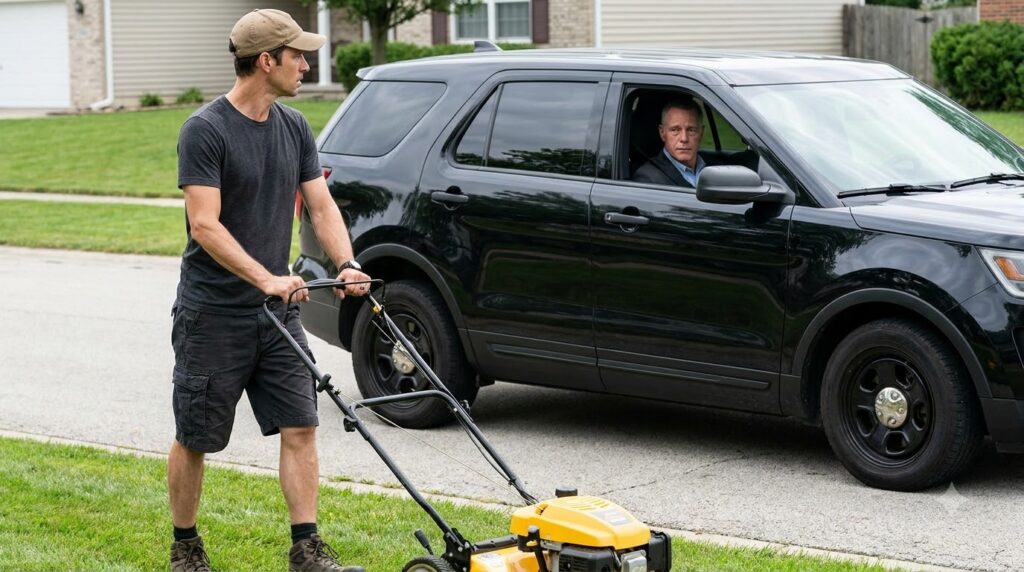
I didn’t lunge. I didn’t yell. In a grid where every driveway has an eye and every mailbox is within sightline of a kitchen window, sudden movement is an admission of guilt. I pulled my hands slowly from the rubber grips of the lawn mower, leaving the dead throttle bar suspended in the air. The soles of my work boots made a dry, crushing sound against the clipped Bermuda grass as I took three calculated strides toward the perimeter fence.
The man in the driver’s seat didn’t turn his head. He kept his eyes locked on the empty asphalt straight ahead, his weathered fingers resting lightly against the bottom curve of the steering wheel. The dark utility jacket he wore was unzipped just enough to show the dull gunmetal clip of an inside-holster harness tucked against his ribcage.
“You’re standing on dead grass, kid,” the man said. His voice was gravelly, quiet, pitched low enough that the chattering sprinkler down the road almost washed it out.
I stopped two feet from the driver’s door, positioning myself just behind the B-pillar where reaching for a weapon from the front seat required an awkward shoulder twist. “The township surveyor stamped that parcel clear in ninety-four.”
“The township surveyor died in a ditch off Route 9 three months after he signed it,” he replied without missing a beat. “New maps came down from the county seat this morning. They don’t have your house on them.”
I looked through the narrow gap in the window. The laminated card wasn’t just an index record. Taped to the bottom edge, concealed on the inside face where only someone standing right beside the glass could spot it, was a small, notched brass key with two filed ridges along the spine—the kind used for old commercial utility padlocks.
“Who sent you down this lane?” I asked, keeping my voice flat, every muscle in my neck braced for a sudden shift in his weight.
“Nobody sends an unmarked cruiser unless they want the tires counted,” he said. His jaw set hard, the deep lines around his mouth tightening like pulled wire. “You’ve got twenty-four hours before the assessment crew rolls in with a sheriff’s escort to drop the boundary stakes. If you’re still cutting this lawn when the front loader idles at the curb, you won’t be walking away from the ditch.”
“You didn’t drive out here on county gas just to give me a zoning lecture.”
For the first time, his gaze cut sideways. Gray, sunken eyes under heavy lids fixed on mine. There was no theatrical anger in them, only the cold, tired calculus of a man who had survived four decades of institutional butchery by learning exactly when to discard dead weight.
“Your old man thought he was clever hiding the paper trail in the drainage easements,” the driver whispered. “He thought because he kept it off the digital ledger, the county clerk would let it rot in the vault. But the new district director is clearing the slate. Every unmapped acre between here and the ridge is being auctioned off under an emergency blight decree.”
He eased his foot off the brake pedal just enough to let the heavy SUV roll forward six inches.
“Take the card,” he muttered. “Or don’t. Either way, the gate at the culvert goes under chain tonight.”
I didn’t hesitate. I reached out, my fingers hooking over the warm glass to pull the laminated card free. The adhesive on the brass key gave a faint tear as it came loose against the interior tint.
Before my hand was back at my side, the driver engaged the accelerator. The black SUV lurched smoothly into the middle of the residential lane, its exhaust leaving a faint, bitter scent of unburned high-octane fuel hanging in the heat. It didn’t speed away. It maintained a strict twenty-five miles per hour, rolling toward the subdivision exit like a standard patrol car that had never paused at all.
I turned the blue card over in my hand.
Beneath the red parcel number, etched into the cardstock with the hard tip of a ballpoint pen, was a handwritten grid coordinate and a single line of script that made the heat in my chest go cold:
The vault at the township annex isn’t locked from the outside.
I looked down at the brass key in my palm. The two filed ridges were fresh; tiny specks of brass dust still clung to the cut grooves. This wasn’t a warning to pack up and run. It was an unauthorized key to the municipal records basement, handed over by an officer who wanted someone else to trip the alarm.
I slid the key into the watch pocket of my cargo shorts, walked back to the yellow mower, and yanked the pull-cord until the engine roared back to life, masking the sound of my steps toward the garage.