
CHAPTER 4: THE TRANSFER AGREEMENT
The rain began as a fine, cold mist when they crossed the perimeter fence, turning the coal dust on the tracks into a slick, black paste. It clung to the soles of Thomas’s boots, adding an unwanted ounce of resistance to every step. Ahead, the old transfer station rose from the weeds like the skeleton of a starved beast, its corrugated iron panels rattling in the river wind with a wet, metallic shuttering.
Miller walked two paces behind, the muzzle of his silenced pistol hidden within the deep folds of his canvas sleeve. He didn’t need to press the iron against Thomas’s ribs; the calculation was already understood. In an environment defined by structural decay, distance was the only true currency.
Inside the transfer shed, the silence was different. It was heavy, shielded from the wind by thick brick retaining walls that had sweated salt for fifty years. A single battery-powered work lamp sat on an overturned oil drum, casting long, desaturated shadows that crawled up the rusted girders.
Beside the drum stood Major Vance.
He hadn’t aged like Thomas. His hair was cropped with the same razor-edge precision as it had been in the Andean camps, and his civilian trench coat looked crisp, untouched by the damp soot of the yard. Between his fingers, he held the missing silver-print photograph from 1994. The edges of the paper were soft, grayed by the oil from Thomas’s fingers over three decades of quiet keeping.
“You look tired, Thomas,” Vance said. His voice was smooth, a trained instrument that had spent thirty years negotiating contracts in rooms where the lighting was always controlled.
“The room above the dry-cleaners had a good mattress,” Thomas said. He stopped five feet from the drum, his center of gravity settled over his heels. His eyes didn’t look at the Major’s face; they tracked the position of Vance’s thumbs, which were tucked into his pockets—a relaxed posture that suggested a secondary shooter was already positioned in the overhead crane loft.
“It was an acceptable retirement,” Vance murmured, flicking the photograph into the center of the oil drum. It landed face-up in a circle of yellow light. “Three years of quiet labor. Minimal administrative oversight. We even handled your local tax filings through a shell utility company. You were safe here, Thomas. Safe from the congressional committees, safe from the border enforcement inquiries. But safety breeds stagnation.”
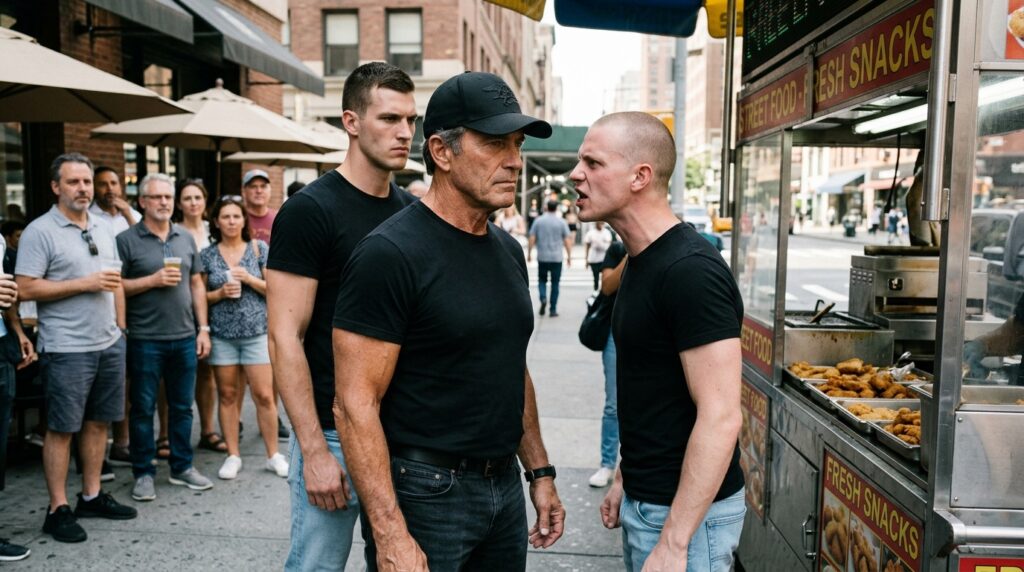
“The food cart wasn’t a probe,” Thomas said, the realization clicking into place with the cold weight of an iron bolt sliding home. “It was an announcement.”
“An announcement to our buyers,” Vance corrected. He didn’t hide his purpose; he laid it out with the clinical pragmatism of an accountant. “The District Development Corporation is expanding its security footprint into three adjacent zip codes. The city council wants guarantees that the local population can be managed without standard legal protocols. They wanted to see the quality of our instructional assets. A retired logistics supervisor dismantling two active street enforcers with four ounces of leveraged kinetic force… that’s a very persuasive marketing demonstration, Thomas.”
The true final reality of Layer 2 was entirely laid bare. His entire civilian sanctuary had never been a hiding place. It was a showroom. He was the product—the living proof that Vance’s localized black-ops clearing project could take an old tool and use it to maintain absolute compliance in a modern corporate district.
“I won’t go back to the camps,” Thomas said. His voice was a flat, dry scrape.
“You aren’t going back anywhere,” Vance said softly. He reached down and tapped a gray manila folder resting on the drum. “Your identity as Thomas Vance is already scheduled for deletion from the municipal registry at 0800 tomorrow. If you sign the transfer agreement in this folder, you become Thomas Miller’s regional supervisor for the transit corridor. You stay in your room. You keep your watch. But you train the new units. You teach them how to find the bone-frictional points you used on the sidewalk today.”
“And if the machine stays disassembled?” Thomas asked.
Miller shifted his weight behind him, the fabric of his sleeve whispering against the canvas jacket. “Then the file goes to the federal prosecutor’s desk by morning. An unflagged foreign national with your specific fingerprint history… you wouldn’t survive three weeks in a maximum-security transit facility, Thomas. Your lungs can’t handle the industrial air conditioning anymore.”
Thomas looked down at the photograph on the oil drum. The rusted generator shed behind his younger self seemed small now, a distant monument to a war that had never really concluded. The friction of the world was constant; it didn’t care about his need for silence. It only recognized leverage.
He stepped forward, his boots crunching on the dry grit near the drum. He reached out his right hand, his thumb tracing the frayed edge of his plastic watch strap. Tick. Tick. Tick. Fifty-eight beats per minute. The internal machine was cold, operating with absolute, transactional clarity.
He didn’t touch the pen resting on the folder. Instead, his fingers brushed the edge of the photograph, sliding it across the cold iron surface until it touched the Major’s hand.
“The transit cops use bad gear,” Thomas said, his voice entirely devoid of emotion. “The silver plating on their watch casings reflects the overhead lights. If you’re going to clear the adjacent corridors, tell them to use matte finishes. Otherwise, someone who actually knows how to look will see them coming from a block away.”
Vance watched him, a slow, grim approval settling into the lines of his mouth. He picked up the pen and held it out. “A functional note. I’ll have the inventory adjusted before the morning shift.”
Thomas took the pen. The metal casing was cold, heavy, and smelled faintly of copper. He signed his name at the bottom of the first leaf—not the name on his birth record, but the designation Vance had written for him thirty years ago in the dust of Melgar. Every victory on this path left a scar; every sanctuary had its rent due in iron.
He turned away from the drum without waiting for a confirmation, his boots sinking into the wet, black paste of the tracks as he walked back toward the perimeter fence. Behind him, the transfer station rattled in the rising wind, a rusted shell holding the contract that had bought his next three years of silence.








