
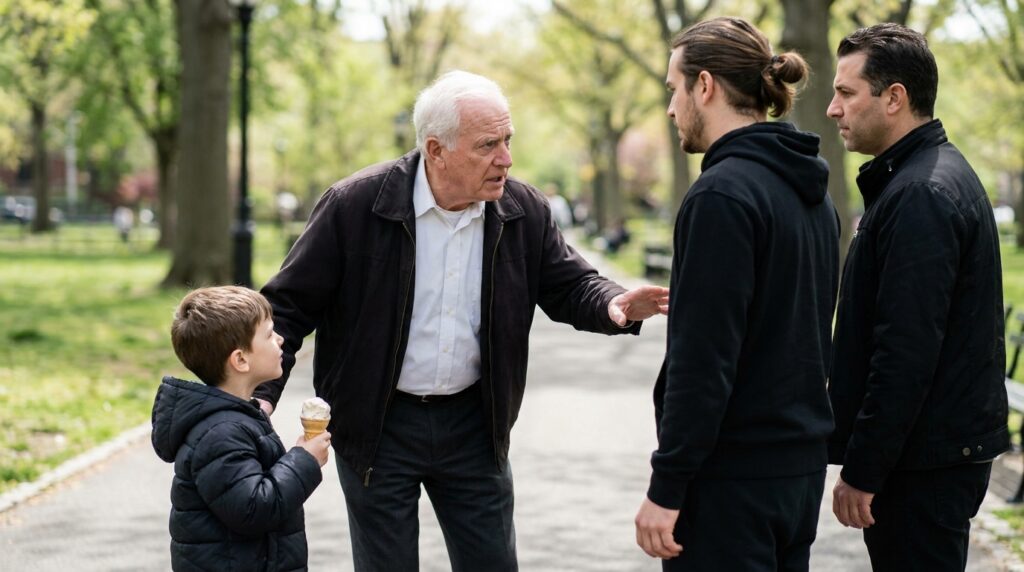
CHAPTER 5: THE COLLAPSE OF THE BARRIER
The tall youth did not swing again. His boots didn’t slide forward into the cedar mulch; they ground backward, leaving two jagged gray streaks across the sun-bleached concrete of the walkway.
The shorter companion had completely stopped moving, his palms flattened against the thighs of his black cargo pants. The broken brass anchor pin lay static in his hand, its broken hinge glinting once like a drop of oil in the dirt. On the grass perimeter, forty yards out, the jogger’s phone remained steady at chest level, its black camera lens catching the harsh, flat noon light. The utility worker in the orange vest had stepped off the gravel path, his heavy work boots sinking into the sod as he watched the triangle of bodies lock into absolute stillness.
“You’re shaking, Jason,” Samuel said. His voice didn’t rise above the level of the cold wind pushing through the oak limbs. It stayed low, an unyielding current that left no room for negotiation. His thumb remained braced against the inner tendon of the youth’s wrist, feeling the frantic, disorganized hammer of the pulse beneath the skin. “Your chest is moving three inches too high. You’re thinking about the camera behind you, and you’re thinking about the forty-six seconds it takes for a park vehicle to reach this gate from the main road.”
Jason swallowed. The movement of his throat was a sharp, clicking click against his high collar. The white skin around his jaw had gone tight, turning the gray blotches beneath his eyes a dark, bruised violet. “You don’t own this block. You don’t get to stand here and look at me like I’m a report on a desk.”
“I own the consequences of the report,” Samuel said. He slowly withdrew his right hand, his fingers releasing the pressure point but remaining exactly four inches from the youth’s sleeve. The tactical distance was still closed. “Your brother didn’t disappear behind the shipyard, Jason. He left the state on a greyhound bus three hours after the master-at-arms cleared his locker. I bought the ticket. I signed the authorization for his travel voucher out of my personal account.”
Jason’s posture dropped another inch. His shoulders curved forward, the heavy fleece of his black hoodie bunching around his neck until the high knot of his hair tilted toward the concrete. “You’re a liar. He sent letters from San Diego for six months. He said he was working the docks.”
“The letters were routed through a freight forwarding firm on Harbor Drive,” Samuel said, his eyes tracking a tiny blue ink smudge that had transferred from the yellowing document onto his own thumb. The ink was old, a specific shade of indigo used only by the branch office in ninety-two. “The firm belongs to my former logistics chief. Your brother wasn’t on the docks, Jason. He was in a rehabilitation facility in Idaho, getting the grease out of his blood before the liver gave out.”
The shorter youth took a short, sharp step backward, his boots kicking up a small cloud of cedar dust. “Jason… the old man’s right about the dates. Remember the postmarks on those envelopes? They didn’t have a city stamp. They just had the numbers.”
“Shut up,” Jason muttered, but the sound lacked its previous edge. It was dry, hollowed out by the realization that the target he had selected wasn’t an isolated elder on a casual walk, but a deliberate anchor that had been sitting in the center of his family’s life for three decades. He looked down at the torn corner of the discharge paper lying in the dirt, the blue ink of the official stamp severed neatly across the line of his brother’s name.
Samuel didn’t offer a hand to retrieve the paper. He kept his spine locked against the hard, vertical pull of the silver stay beneath his chin. The cold metal was a constant wedge against his throat, a warning that any display of empathy right now would dissolve the command structure he had spent thirty minutes enforcing. An old soldier didn’t offer comfort until the lane was entirely clear of threats.
“The trust in Chicago didn’t close when your mother died,” Samuel said. His voice dropped another note, the sound tracking below the level of the wind. “The remainder was transferred to a technical institute in the city under your name three months ago. The enrollment forms are sitting in a blue folder on the kitchen table in your apartment. The one your brother signed before he took the job in the timber country.”
Jason froze. His eyes widened, the pupils shrinking to tiny black dots against the glare of the concrete. He didn’t look at Samuel; he looked at his companion, whose face had gone completely slack.
“The blue folder,” the shorter one whispered, his hands dropping entirely into his pockets. “The one from the logistics company. Jason, you said it was junk mail.”
“He’s tracking us,” Jason whispered, his voice rising into a thin, ragged panic that caught the attention of the onlookers on the grass. The utility worker took two steps closer, his eyes scanning the grandfather’s unmoving posture. “He’s been watching the house. He’s been sitting in that diner every Tuesday waiting for us to cross the fence.”
“I don’t watch houses,” Samuel said, his right hand moving back down to lock around Leo’s cold, sticky fingers. The boy didn’t move; his eyes remained fixed on the white pool of melting ice cream at his feet, his jaw set in the same rigid line as his grandfather’s. “I manage perimeters. And your perimeter is currently leaking, Jason. The jogger behind you has been on a line with the precinct dispatcher for ninety seconds.”
A low, dual-tone siren wail drifted over the treeline from the eastern avenue—not a full emergency response, but the short, authoritative chirp of a municipal unit clearing an intersection.
Jason looked at the path ahead, then at the grass where the utility worker stood with his arms crossed over his orange vest. The numerical advantage had evaporated; the social pressure of the park had solidified into a grey wall of witnesses who had recorded every micro-second of the posture collapse.
“Alright,” Jason said, his voice dropping into a flat, defeated rattle as he stepped backward off the concrete path, his sneakers sinking into the loose wood chips. He didn’t pick up the torn corner of the document. He didn’t look at his companion. “Alright, we’re leaving.”








