
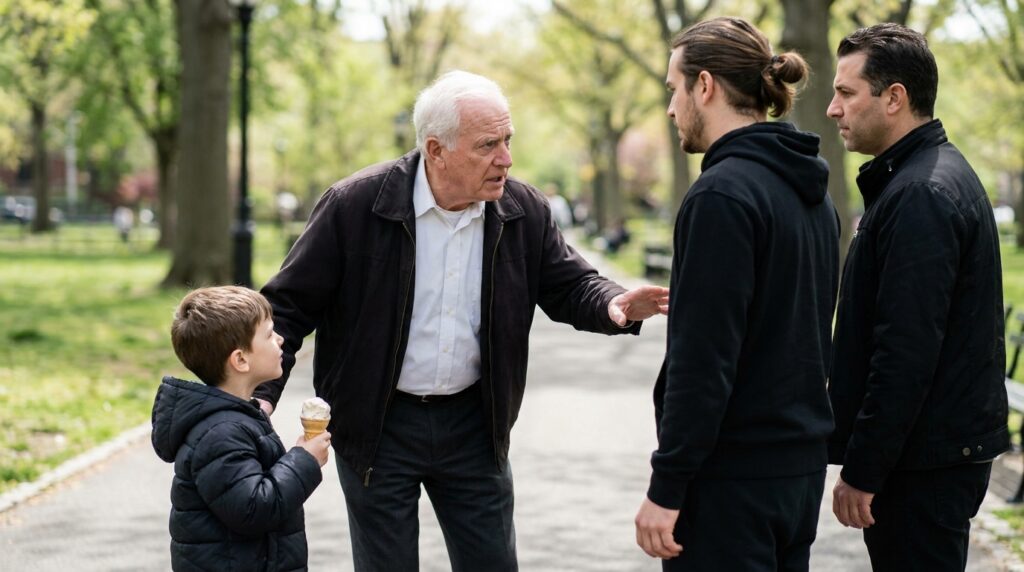
CHAPTER 2: THE ANCHOR IN THE MULCH
“You’re walking too fast, Grandpa.”
Leo’s fingers were small, sticky with the vanilla trail that had escaped his cone, but his grip was solid. Samuel adjusted his stride, cutting three inches from his pace until the heavy rubber of his soles clicked in a perfect four-four rhythm against the concrete of the Jefferson Park entrance. The sun here didn’t warm; it bounced off the chain-link border of the tennis courts, sharp and white, slicing the shadows into clean, hard geometric bars across the gravel.
Behind them, ninety yards back, the diner door’s bell didn’t ring, but the silver reflection on the park’s steel rules told him the perimeter was already compromised. Two pairs of boots had left the linoleum. They were tracking thirty paces behind, their cadence loose but intentional. They were closing the lateral exit lanes.
Samuel didn’t turn his head. He adjusted his dark wool jacket, his thumb brushing the rigid line of the collar stay beneath his chin. The metal stay was cold against his throat, a small knife of discipline forcing his chin up, his eyes level, his peripheral vision locked on the flanking treeline.
“Hold the ice cream flat, Leo,” Samuel said. His voice stayed flat, low enough to stay between them, high enough to command the boy’s attention without triggering panic. “Watch the edge of the path. Don’t look at the trees.”
“Are those men from the restaurant coming to play?”
“No,” Samuel said. “They aren’t here to play.”
The park was typical for this corner of the county—desaturated turf, wood-chip mulch that smelled of damp cedar and old rain, and a line of green municipal benches bolted into the concrete footings. To a civilian, it was a park on a Tuesday afternoon. To Samuel, it was a bottleneck. The path ahead narrowed between two old oaks whose roots had buckled the pavement into a series of jagged, concrete teeth. If they crossed the root-line, the youths would have the high ground and the sun at their backs.
He felt the change in the wind before he heard the steps accelerate. The air grew thinner, carrying the faint, chemical scent of cheap laundry soap and the sour tang of nervous sweat.
The tall youth with the high skull-knot broke right, his black hoodie billowing as he stepped off the concrete onto the mulch, his boots crunching through the cedar chips to cut off the diagonal escape route toward the swings. The shorter one stayed on the pavement, his weight forward, his hands deep in his pockets, his elbows flared out like broken wings.
Samuel stopped. He didn’t drop his hands. He didn’t pull Leo behind him yet; that would signal a defensive posture, an admission of vulnerability. Instead, he simply anchored his heels into the seam of the concrete, his feet exactly shoulder-width apart, his center of gravity dropping two inches.
“Lost your way, old man?” The Lead Aggressor spoke from the mulch. The sun caught the side of his face, highlighting the erratic twitch of a muscle just beneath his left jawline. He was leaning in, his shoulders curved into a predatory arch, trying to use his sixty-four inches of height to shadow the elderly man.
Samuel looked at the youth’s collar. Not the eyes—the eyes were full of useless, emotional noise. He looked at the point where the trapezius met the neck, calculating the muscle tension. The youth was breathing through his mouth, his chest rising too fast.
“The path is public,” Samuel said. His voice was transactional, clear as a bell in the chilly air.
“The path belongs to whoever’s using it,” the shorter one said, moving up on the left. He took his hands out of his pockets. In his right palm, he was toggling something small and metallic. It wasn’t a blade; it didn’t have the weight. It was the brass pin Samuel had seen in the diner—the fouled anchor with the missing crossbeam. The hinge was broken, the pin-back scraping against the boy’s thumb with a rhythmic, mechanical click.
Samuel’s mind processed the sound in micro-seconds. That specific pin hadn’t been issued since the winter of ninety-two. It wasn’t an online surplus buy; the specific wear on the brass indicated it had been worn against wool for a long time before it was discarded.
“That’s an inspector’s mark on that brass,” Samuel said, his tone shifting from civilian caution to an icy, analytical precision that made the shorter youth’s thumb freeze against the metal. “The crossbeam didn’t break. It was clipped by a master-at-arms in San Diego. Thirty years ago.”
The Lead Aggressor’s eyes narrowed, the arrogance faltering for a fraction of a second as he looked from Samuel to his companion’s hand. “The hell are you talking about?”
“He’s talking crazy,” the shorter one muttered, but his weight shifted back onto his heels. His elbow dropped three inches, losing its aggressive flare. “He’s just an old man.”
“Your boots are loose,” Samuel said, his gaze returning to the tall youth’s chest. “Your laces are dragging in the mulch. If you try to swing your right leg, you’ll catch the loop on that root behind you. You’ll go down on your left hip before your hand leaves your pocket.”
The tall youth didn’t move, but his jaw locked. The silence between them grew thick, punctuated only by the distant, rhythmic squeak of a child’s swing two hundred yards away. A jogger in a gray sweatshirt was approaching from the western loop, her pace slowing as she noticed the rigid geometry of the group on the path.
Samuel didn’t look at the jogger. He kept his focus on the space between himself and the Lead Aggressor—exactly thirty-six inches now. The tactical baseline had been established. The youths had the youth and the numbers, but they were standing in an environment Samuel had mapped before they were born.
“You don’t know who we are,” the tall one whispered, his voice losing its wet confidence, replacing it with a hard, defensive rattle.
“I know exactly what you are,” Samuel said, his right hand slowly tightening around Leo’s small, sticky fingers, preparing for the barrier step. “You’re thirty seconds away from a mistake you can’t afford.”








