
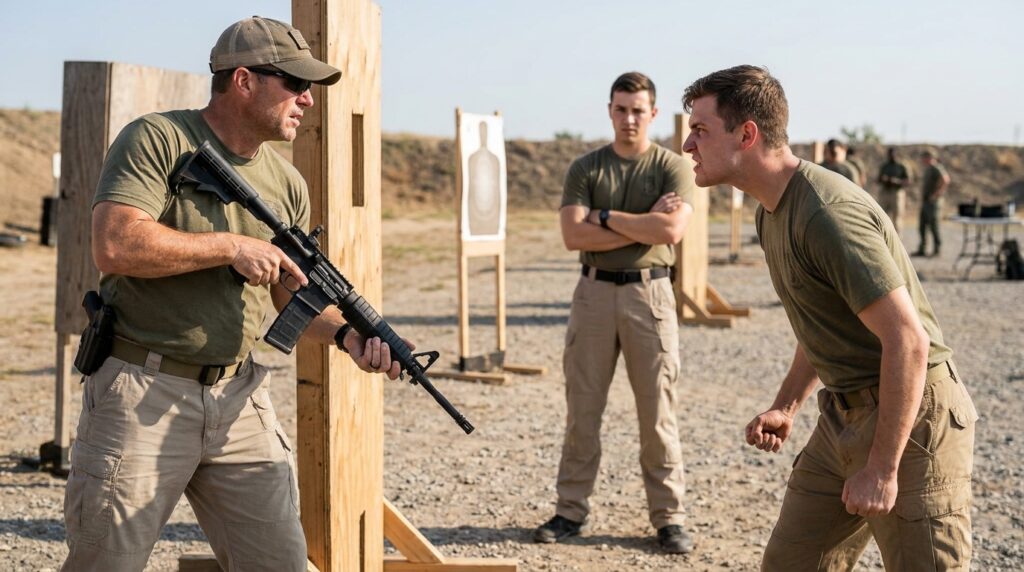
CHAPTER 4: THE LIVETISSUE CRISIS
The wind howling through the canyon carried a heavy curtain of coarse sand that stung like birdshot against Samuel’s weathered cheeks. In the desaturated darkness of the canyon floor, the simulated kill-zone was a maze of rusted shipping containers, their iron surfaces pitted by decades of desert neglect. The air was a thick, suffocating slurry of dry caliche and burning diesel fumes from the transport truck’s idling engine.
“Red baseline is active!” Samuel shouted over the roar of the gale, his thumb striking the side of his old brass stopwatch. The internal gears ground together with a dry, sand-choked rattle, but the needle jumped forward. “Three targets downrange, hostage profile unverified. Move!”
Miller moved first, his silhouette stiff, his boots skittering across the loose gravel. Behind him, Garrett trailed by exactly two paces, his hand hovering near the small of Miller’s back, a tense anchor in the shifting shadows. The beams of their weapon-mounted lights cut through the swirling dust, illuminating the oxidized iron walls of the kill-box.
Then the geometry shattered.
A sudden, metallic bang echoed from the interior of the primary container—not the sharp crack of a blank cartridge, but the dull, heavy thud of shifting structural iron. A structural support cable, corroded by years of salt-air exposure and neglected by the front office’s risk-management teams, snapped with a sound like a pistol shot. The rear wall of the rusted container sheared off its mountings, collapsing inward with massive weight.
“Hold the line!” Samuel roared, his boots digging into the shifting sand as he lunged forward.
It wasn’t a simulation anymore. The falling iron plate caught Miller across his ballistic vest, slamming him hard against the gravel floor and pinning his legs beneath two hundred pounds of industrial scrap. The carbine tore from his grip, its light spinning through the dust before dying completely.
“Garrett, anchor left!” Samuel commanded, dropping to his knees beside the pinned trainee. The iron frame of the container was cold, rough with decades of scaling rust that tore through the leather of his instructor’s gloves, biting into his palms. He jammed his shoulder beneath the edge of the plate, utilizing raw mechanical advantage to keep the weight from crushing the boy’s femoral artery. “Lift on three! One, two—”
“Chief, the radio’s dead!” Garrett yelled, his fingers frantically working the dials of his chest-mounted tactical transponder. The indicator light remained a stubborn, cold gray. He reached down, pulling at the manual emergency beacon attached to the wall of the training lane. The wire had been cleanly severed, its copper core exposed and oxidized. “The whole grid is down. There’s no medical air transport coming.”
Samuel didn’t look down. His teeth ground against the grit in his mouth as his muscles locked under the strain of the iron plate. The disabled transponder wasn’t an equipment failure; it was the final signature of the corporate takeover. The administration hadn’t just set up an insurance breach—they had cut the safety lines entirely, ensuring that whatever happened in the dark stayed in the dark until the property transfer could be executed at dawn.
Beneath the plate, Miller gasped, his face gray under the film of desert dust. His fingers caught Samuel’s canvas vest, pulling him down until their faces were inches apart. “My father… he told me I wouldn’t make the weekend,” the boy whispered, his voice cracked and hollow. “He said the yard… would be cleared out anyway.”
“Shut your mouth, Miller,” Samuel growled, his spine popping under the weight of the steel. He looked across the iron plate at Garrett, whose hands were still locked onto the frame, his knuckles white and bleeding where the metal had sheared. “Garrett, look at me. No one is coming. If we don’t clear this box ourselves, the morning transport finds three corpses and a liquidated lease. Take his shoulders.”
Garrett met Samuel’s gaze through the swirling sand. The fear in the boy’s eyes hardened into something flat, transactional, and permanent. He dropped his broken transponder into the dirt, reached down, and locked his arms beneath Miller’s armpits.
“On three,” Garrett said. His voice had lost its tremor.
Samuel threw his entire weight against the rusted iron frame, his legs driving into the caliche until his boots slipped. With a brutal, metallic scream, the plate lifted four inches. Garrett hauled Miller backward, the boy’s boots scraping over the sharp gravel until his legs cleared the shadow of the steel. Samuel dropped the weight, the plate slamming into the ground with a definitive thud that shook the canyon floor.
Samuel stood up slowly, his breath coming in ragged, shallow wheezes. He reached down and picked up the broken emergency beacon, his thumb running over the clean, diagonal cut in the copper wire. He looked toward the ridge line, where the dark silhouette of the administrative tower stood against the desaturated gray sky.
They had survived the lane, but the contract was gone, replaced by a cold, industrial reality that didn’t care about discipline or the legacy of the line. Samuel reached into his vest, his fingers wrapping around the warm casing of his brass stopwatch. He didn’t look at the time. He squeezed his fist until the glass face cracked, the tiny shards biting into his palm as he turned toward the perimeter fence.








