
CHAPTER 2: THE WEIGHT OF THE COLD IRON
“That magazine doesn’t belong to the yard, Garrett.”
Samuel didn’t look up from the workbench. His thumb worked a greasy rag into the receiver tracks of the fouled carbine, the metal raspy and cold beneath his calluses. The armory smelled of mineral spirits, stale coffee, and the orange rust that crept off the corrugated tin roof whenever the desert temperature dropped ten degrees at dusk.
Garrett stood under the flickering fluorescent bulb, his shadow stretched long and thin across the concrete floor. He didn’t drop his gaze, but his throat moved as he swallowed a dry knot of sand. “He brought it with him from the coast, sir. Private stock.”
“Private stock doesn’t carry a laser-etched inventory code from Vanguard Logistics,” Samuel said. He dropped the bolt carrier group onto the steel table with a sharp, heavy clink. The sound vibrated through the small room, cutting through the low hum of the generator outside. “Vanguard is currently sitting in the county commissioner’s office with a checkbook, waiting for my lease to expire. Now tell me why my legacy candidate is carrying their hardware.”
The silence stretched, thick with the smell of carbon and unsaid truths. Samuel watched the boy’s eyes. Garrett’s jaw was locked so tight a muscle twitched beneath the dust on his cheek. He was a good kid—too quiet for the line, maybe, but he saw everything. He had seen Miller breaking down piece by piece during the forty-mile navigation drill, and he had kept his mouth shut.
“He’s my friend, Chief,” Garrett whispered. The words were thin, almost swallowed by the rattle of the tin wall as a gust of high-desert wind hit the building. “His old man… you don’t know what his old man does to him if he fails a cycle. If he gets sent back without the certification, he’s done. The whole family is done.”
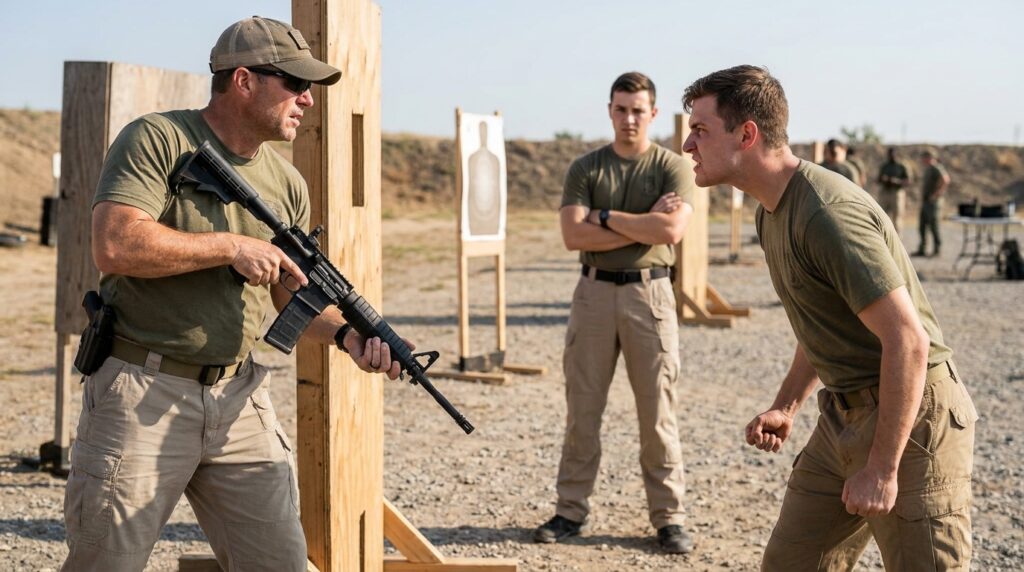
“The line doesn’t care about his father,” Samuel said, his voice dropping an octave into that steady, dangerous calm. He stood up, his knees popping with a sound like dry kindling. He reached into his pocket and pulled out the brass stopwatch, placing it on the table between them. The casing was scratched, the chrome wearing away at the edges to reveal the dull, yellowish zinc beneath. “The line cares about muzzle discipline. If he sweeps my range again, I won’t use a throat-jab. I’ll let the lead do the talking. Do you understand me?”
Garrett looked at the stopwatch, then at the half-disassembled rifle. “You didn’t report it to the front office.”
“The front office is looking for an insurance violation so they can break my contract before the weekend,” Samuel said, his fingers tightening around the greasy rag. “If I log a red-line safety breach, the corporate lawyers will have the gates locked by sunrise. We finish the cycle. Miller stays on the line, but you anchor him. You hold his belt during the night-fire. If he twitches, you pin him. If you don’t, I’m tossing both of you over the wire.”
He didn’t wait for Garrett to answer. He turned his back, picking up the solvent bottle to signal the end of the transaction. Dialogue in the armory was always transactional; you paid in information, or you paid in blood.
Garrett hesitated, his boots shifting on the grit-strewn concrete, before he turned and pushed through the heavy plywood door. The sudden draft from the desert floor blew a swirl of fine caliche dust across the workbench, settling into the clean grease of the rifle parts.
Samuel waited until the footsteps faded into the gravel outside before he walked over to the corner locker. The padlock was old, its iron shackle scarred by years of salt-air before he brought it out to the hills. He twisted the dial—three turns right, two left—and pulled the door open.
Inside, behind the spare cleaning rods and the cases of green-tip five-point-five-six ammunition, sat Miller’s personal gear bag. It was a high-end nylon pack, far too expensive for a contractor trainee, the zippers clean and uncorrupted by sand.
Samuel unzipped the side pocket. He wasn’t looking for contraband weapons; he was looking for the source of the tremor in the kid’s hands. His fingers brushed past a spare tourniquet, a pair of ballistic lenses, and settled on a small, hard plastic case disguised as an individual first-aid kit.
He popped the latch.
Inside lay three amber vials of Propropanol—heavy-duty beta-blockers used to suppress physical tremors and high-stress panic—along with a folded sheet of official letterhead. Samuel unfolded the paper with his grease-stained thumbs, his eyes scanning the dense bureaucratic text.
It wasn’t a medical release. It was a formal psychiatric waiver, stamped three days ago by the facility’s own administrative medical officer.
The text at the bottom was explicit: Candidate exhibits acute stress-induced psychological volatility. Monitor closely for contractual non-compliance.
Samuel’s chest tightened as the internal calculation shifted. The administration hadn’t been kept in the dark by Garrett’s silence. They already knew. They had known before Miller even stepped onto the bus at the airfield. They had approved an unstable legacy candidate, cleared him for live-fire drills, and dropped him directly into Samuel’s lane like a timed charge, waiting for the inevitable blast to destroy the facility’s safety record.
A floorboard creaked in the dark corridor outside the armory door.
Samuel didn’t drop the paper. He reached out with his right hand, his fingers instantly wrapping around the cold, checkered steel grip of the unholstered Colt forty-five resting on the shelf beneath the ledger. He didn’t cock the hammer; the sound would give away his position. He simply stood in the shadow of the locker, his eyes locked on the narrow strip of yellow light beneath the door, listening to the slow, heavy breathing of someone standing just on the other side of the wood.








