The Concrete Line We Do Not Cross Lest the Whole Neighborhood Burn

CHAPTER 1: THE DISRUPTION OF THE CONES

The metallic scrape of two orange plastic cones sliding across coarse asphalt shattered the artificial quiet of Elmwood Avenue, a declaration of war delivered in broad daylight.

Elena didn’t look up at the second-story bay window of number forty-two, though she felt the sudden, twitching vibration of the blinds behind her shoulder blades. She kept her fingers clamped tight around the rough, sun-faded plastic of the second cone, lifting it just high enough to clear the oil-stained curb before setting it down on the narrow strip of grass between the sidewalk and the street. Her breath came out short, tasting of lukewarm coffee and the stale, air-conditioned air of her ten-hour shift at the logistics terminal.

With her left hand, she reached down, her thumb catching the cold, heavy brass teeth of her olive field jacket’s zipper. She yanked it upward, pulling the thick cotton collar tight against her throat like a shield. The weight of her leather shoulder bag cut into her collarbone, a dull, familiar ache that matched the thrumming tension building at the base of her skull.

She climbed back into the driver’s seat of the silver sedan. The engine died with a wet, heavy cough. When she opened the door again, the silence of the suburban street felt thicker, pressurized by the immaculate rows of green lawns and the identical brick facades that lined the block. She stepped out, squaring her shoulders against the driver-side panel, her boots finding a steady anchor point on the concrete seam of the gutter.

“You’ve got exactly two minutes to put those back where you found them.”

The voice was thin, sharp, and instantly recognizable, cutting through the heavy summer air from thirty feet away.

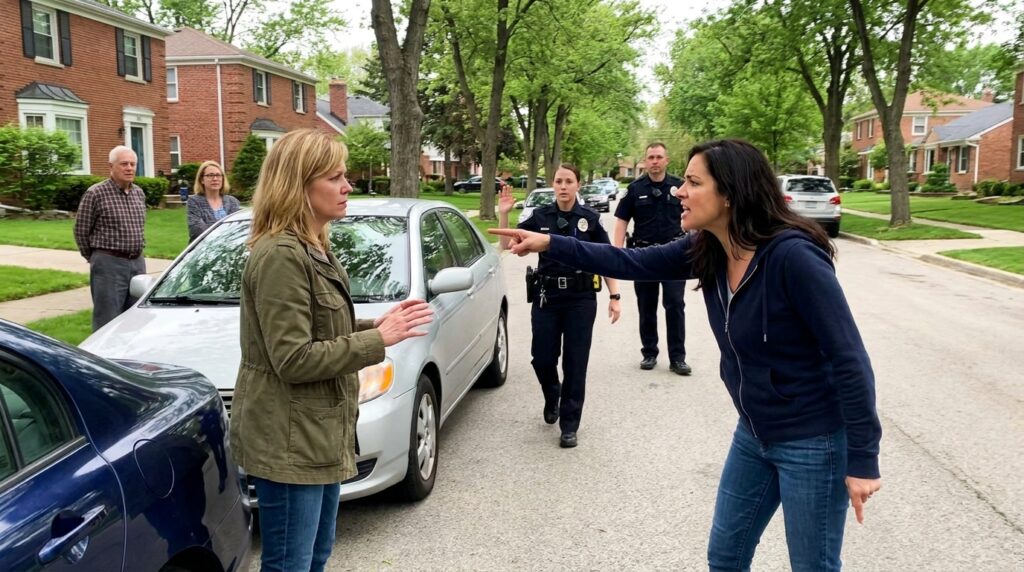
Victoria was already halfway down her driveway, her dark sneakers slapping the asphalt with a rhythmic, military precision. She wore a navy zip hoodie, the hood pulled down to expose a nest of tight, dark curls that vibrated with every stride. In her left hand, she clutched a thick, black plastic clipboard, a stack of white violation notices pressed flat beneath a heavy metal hinge. Her face was a mask of rigid, twitching outrage, her sunglasses pushed high onto her forehead like an additional set of eyes.

Elena didn’t move. She kept her back pressed against the silver door of her car, her hands dropping to the pockets of her jacket, her fingers curling around the cold, flat edge of her smartphone. She watched Victoria close the distance, the overreaching neighbor’s chest expanding as she took a deep, theatrical breath to fill the narrow space between them.

“You don’t live on this end of the block, Elena,” Victoria whispered, her voice dropping into a tight, controlled hiss as she stepped over the curb line, her body leaning forward until her face was mere inches away. She raised her right hand, a single pointed index finger jabbing the air, cutting so close to Elena’s cheek that the blonde resident could smell the chemical tang of her hand sanitizer. “You don’t get to park your junk in front of my landscaping. You can’t stand in my place and judge me like that.”

From three houses down, a screen door clicked. An older man in a dark plaid shirt stepped onto his porch, his hands freezing on the railing.

Elena felt the brass zipper of her jacket pressing hard against her sternum as she braced her spine against the window glass. She didn’t blink. She watched the twitch in Victoria’s left eyelid, the white-knuckle grip on the black clipboard, and the deliberate way the woman’s shadow completely blotted out the silver hood of her car.

“It’s a public street,” Elena said, her voice flat, transactional, completely devoid of the anger Victoria was begging for. “I have every right to park here.”

Victoria’s jaw tightened, her mouth opening to unleash the next tier of her rehearsed authority, but the words were drowned out by the low, heavy rumble of a standard V8 engine turning the corner. A black-and-white cruiser slowed to a crawl, its tires kissing the curb as it pulled directly into the center lane, its roof lights dark but its presence instantly freezing the air.

Through the tinted glass of the cruiser’s windshield, Elena caught the pale outline of a familiar face—not the patrol sergeant Victoria usually called, but someone entirely different, holding a manila folder against the steering wheel.


CHAPTER 2: THE BLACK BOUNDARY

The crown victoria’s driver-side door didn’t slam; it swung shut with a heavy, pressurized thud that vibrated through the silver panel beneath Elena’s palms. The engine remained idling, a low, rhythmic heartbeat that sent small ripples through a puddle of standing water near the rear tires.

Elena didn’t shift her weight. Her fingers remained buried deep within the pockets of her olive field jacket, her left thumb hooking the cold brass tooth of the zipper at her collarbone. She kept her eyes locked on the sharp angle of Victoria’s jawline, watching the skin there turn a mottled, aggressive purple under the harsh glare of the mid-afternoon sun. The distance between them was still too narrow—less than a foot of hot, stagnant air that tasted faintly of exhaust and cut grass.

“Officer,” Victoria barked, her voice snapping back into its familiar, practiced pitch of civic entitlement before the boots even hit the asphalt. She didn’t drop her pointed finger from Elena’s face; instead, she used it as a pivot, turning her upper torso toward the center lane without ceding an inch of the curb. “Thank God. I’ve been on the phone with dispatch for twenty minutes. This vehicle is a persistent code violation, and the owner is actively creating a hostile environment on a residential right-of-way.”

The lead officer didn’t answer. The slow, deliberate scrape of her tactical boots against the gravel was the only sound that broke the street’s sudden paralysis. She was smaller than Victoria, her dark hair pulled back into a severe, wind-resistant bun that left the sharp lines of her profile completely exposed. Her black uniform was stiff, unyielding, the heavy leather utility belt clinking softly with every third step—handcuffs, radio casing, the dull matte finish of her sidearm. Her hands were low, resting near her belt line, her palms turned slightly inward in a deceptive gesture of calm.

“Hands where I can see them, both of you,” the officer said. The command wasn’t shouted. It was a flat, administrative requirement that instantly stripped the air out of Victoria’s next breath.

Elena pulled her hands slowly from her pockets, letting them hang loose at her sides, her palms flat against the silver paint of her car. She felt the cold edge of the metal transfer through her jeans, a solid, grounding reminder of the physical layout.

Victoria, however, stiffened. Her clipboard clicked as her thumb twitched against the metal spring, the white pages underneath fluttering like trapped wings. “I am the one who called, Officer. I am the homeowner at forty-two. This woman is—”

“I don’t care who dialed the three digits,” the lead officer interrupted, her stride bringing her directly into the slot between them. She didn’t look at either face yet. She used her shoulder to gently but fundamentally displace Victoria, her frame cutting off the trajectory of the pointed finger. “Step back. Both of you. Six feet. Now.”

The backup officer, a broad-shouldered man with a pale, close-cropped haircut, moved into a wide anchor position near the cruiser’s rear bumper. He didn’t speak, but his arms crossed over his chest, his eyes scanning the porches down the block where the dark plaid shirt of their neighbor had been joined by two more figures standing near a garage door. The witness layer was thickening.

Victoria scrambled backward onto the grass strip, her dark sneakers catching the lip of the concrete curb with a clumsy, heavy scuff. “She moved my markers, Officer. Those cones were placed to preserve the clearance for emergency vehicle access. She’s deliberately obstructing—”

“The vehicle is registered to this address block,” Elena said, her voice remaining low, cutting beneath Victoria’s rising octave. She kept her eyes on the lead officer’s nametag—Officer Miller—noticing the small, silver pin above the pocket was slightly tarnished at the corner. “It’s legally inspected, legally parked, and within the twenty-four-hour public street limit.”

Officer Miller turned her head, her focused gaze tracking from Elena’s guarded stance to the heavy, worn leather of the shoulder bag pinned against the sedan’s door. There was no sympathy in the look, only a calculated assessment of weights and balances. “Registration,” Miller said, extending a hand toward Elena without breaking eye contact with Victoria. “And identification.”

Elena reached into her bag, her fingers finding the smooth plastic of her wallet by touch alone. She didn’t pull the bag off her shoulder; she kept it braced against her ribs like a cushion. When she handed the documents over, the corner of her driver’s license brushed Miller’s leather glove.

“This is ridiculous,” Victoria muttered, her clipboard now held against her chest like a breastplate. She was tracking the backup officer now, trying to find a softer target, but the man remained a statue against the black-and-white panel of the cruiser. “I have the municipal easement filings right here. The township explicitly granted my property line an exemption for the curb maintenance lane. It’s right here in the folder.”

Elena caught the specific phrase—easement filings. It wasn’t standard neighborhood association jargon. It was precise, legal, and entirely out of place for a woman who spent her mornings measuring the height of her neighbors’ clover patches. Through the translucent plastic of Victoria’s clipboard casing, Elena saw the edge of a bright blue municipal seal—too crisp, too fresh for a document that should have been locked in a county records vault since the fifties.

Miller didn’t take the clipboard. She kept her back to Victoria, her thumb flicking through Elena’s identification cards against the hood of the silver sedan. “You say you have a filing?” Miller asked, her voice dropping into a dangerous, conversational quiet.

“Yes. Signatures from the zoning board chairperson,” Victoria said, her chin lifting as she stepped forward again, her hand reaching for the metal clip. “It gives forty-two Elmwood the exclusive right to regulate non-resident parking within the thirty-foot frontage.”

Elena watched the shadow of the clipboard stretch across the grass. The shadow had sharp, rigid corners, but the paper inside didn’t lie flat; it buckled against the plastic, a tiny discrepancy that caught the low western light. A cold line of calculation went through Elena’s mind. The city hadn’t updated the Elmwood frontage maps since the late-nineties expansion. If Victoria had a signature, it wasn’t from the clerk’s office.

“Let me see it,” Miller said, turning slowly.

But she didn’t look at the paper. Her eyes went straight to the way Victoria’s thumb was covering the lower left quadrant of the seal—a defensive, protective grip that had nothing to do with holding the pages down.

CHAPTER 3: THE CUT IN THE LANE

Officer Miller did not reach for the black clipboard immediately. She let her gloved hand remain extended in the space between them, her fingers perfectly still against the backdrop of the manicured lawn. The blue ink of the municipal seal caught the sharp glare of the three-o’clock sun, throwing a small, saturated refraction onto the plexiglass edge of the casing.

“Let’s see the filing, then,” Miller said. Her voice lacked the defensive weight of someone arguing. It was simply the cold, level request of a machine resetting to zero.

Victoria’s thumb twitched. Her grip shifted downward, the stiff paper beneath the heavy metal hinge buckling with a sharp, fibrous pop. She did not hand the entire board across the line. Instead, she tilted the frame forward, keeping her knuckles tightly locked against the lower left corner where the blue seal bled slightly into the off-white grain of the paper. “It’s all on record with the county surveyor’s deputy. Frontage restrictions for number forty-two. Permanent easement control.”

Elena watched Miller’s eyes track the movement of that thumb. Elena didn’t lean forward. She kept her spine anchored against the cold, vertical ridge of her car’s B-pillar, her ears tuning out the low, idling hum of the cruiser to catch the precise cadence of the dialogue. The rhythm was changing. The aggressive forward lean that Victoria had used to dominate the pavement had frozen into a rigid, defensive block.

“Step back, ma’am,” the backup officer called out from the rear lane, his boots taking two short, crunching steps on the loose gravel near the gutter. His shadow stretched long and heavy across the curb, cutting through the space between Victoria’s shoes. “Keep the distance we gave you.”

Victoria pulled her shoulder back, but her hands stayed elevated, the clipboard tilted at a sharp angle toward Miller’s face. “I am perfectly within my rights to show the officer the documentation. This street is being degraded by unvetted vehicles, and the local ordinances are very clear about public nuisance thresholds.”

Miller took one step into the curb lane. The movement was fast, fluid, completely ignoring the paper Victoria was thrusting forward. Her left hand came up, two fingers lightly tapping the top edge of the black clipboard, tipping it down until it was level with her own heavy leather duty belt. Her right hand remained loose, hovering three inches above the black grip of her sidearm.

“I’ll take the document out of the clip, ma’am,” Miller said. The tone was transactional. She didn’t wait for Victoria’s fingers to uncoil; she used the rigid edge of her thumb to depress the metal spring herself. The hinge snapped open with a loud, metallic ring that made the older watcher on the porch three houses down cross his arms tighter against his chest.

The white page slid out into Miller’s gloved palms.

Elena caught the texture of the paper as it turned in the light. It wasn’t standard twenty-pound bond from an office supply store, nor was it the heavy, vellum-coated stock used by the municipal archives. It was thick, slightly textured, the type of linen-blend paper used for high-end certificate printing, the blue ink of the seal sitting on top of the fibers rather than soaking through into the reverse side. Elena’s hand went into her jacket pocket, her fingers brushing the smooth, cold glass of her phone. She knew the county hadn’t used blue ink signatures since the digital conversion project four years ago. Everything was black toner and a generic bar code now.

“This lists a variance for the frontage,” Miller muttered, her thumb tracing the embossed border of the blue circle. Her eyes didn’t drop to the signature line yet; she was looking at the alignment of the text blocks, the faint gray shadow that ran beneath the header font like a poorly aligned scanner bed. “Dated November of last year.”

“Signed by the zoning director himself,” Victoria said, her chin rising, her voice recovering its sharp, lecturing bite as she mistook Miller’s silence for compliance. “I spent three months getting that processed through the municipal center. It gives me the exclusive authority to maintain the clearance zone for the entire frontage lane. That silver car has to be towed.”

Elena watched Miller turn the page over. The reverse side was entirely blank, lacking the gray watermarked tracking matrix that every legitimate township document carried to prevent duplication. Miller’s face remained a blank, unreadable wall of polished leather and dark shadows under the rim of her uniform cap.

“Officer,” Elena said, her voice small but steady against the backdrop of the argument. “The zoning board doesn’t issue parking variances for individual residential curb cuts. That’s a traffic engineering mandate under section four-B.”

Victoria’s head snapped toward Elena, her curly hair bouncing against the collar of her navy hoodie. “You don’t know the first thing about the local codes here. You don’t have the standing to debate county filings.”

Miller didn’t look at either of them. She reached up with her left hand, her finger pressing the toggle on the small, square radio unit clipped to her shoulder epaulet. The unit burst into life with a short, jagged burst of static that cut the argument in half.

“Unit twelve to dispatch,” Miller said, her gaze fixed entirely on the blue ink of the seal. “Run a verification on a physical filing. Variance code seven-dash-alpha-two-four, registered to forty-two Elmwood.”

The radio stayed silent for three long seconds, the open channel carrying only the faint, distant whistle of the county repeater system. Victoria didn’t move. Her hands had dropped to her sides, but her fingers were curled into tight, pale fists against the fabric of her jeans, her eyes tracking the steady, slow movement of the backup officer as he moved into a tight, blocking position at the base of her own driveway. The exit was closed.

CHAPTER 4: THE INTERCEPTED CLIPBOARD

“Say that code again, twelve,” the radio speaker barked, the voice thin, squawking through a heavy layer of digital encryption.

Officer Miller didn’t look up from the crisp linen sheet held between her gloved fingers. She kept her thumb hooked against the fake blue seal, her boots locked on the asphalt seam as she tilted her shoulder to block Victoria’s sudden forward reach. “Variance seven-dash-alpha-two-four,” Miller repeated, her delivery clipped, entirely empty of conversational warmth. “Address forty-two Elmwood Avenue.”

“Negative, twelve,” the dispatcher’s voice returned after a jagged second of dead air. “Our index lists seven-alpha as a commercial zoning bracket for the industrial park zone. No residential extensions on record for Elmwood block four. That code doesn’t exist on our servers.”

The silence that followed was a physical weight, dropping hard onto the manicured grass of number forty-two.

Elena did not shift her weight away from the silver door of her sedan. Her gaze remained drilled into the precise point where Victoria’s fingers were twitching against the side of her navy hoodie. Elena calculated the geometry of the space: the backup officer was four feet to the left, his hand resting flat over his tactical belt; Miller was centered, holding the forged linen sheet like a piece of evidence; and Victoria had gone entirely rigid, her forward-leaning confidence evaporating into the cold shadow of the police cruiser.

“There’s been a processing error at the records desk,” Victoria said, her words rushing out too fast, her voice losing its sharp, lecturing edge, sliding into a frantic, reedy defensive cadence. She reached out, her fingers snapping toward the edge of the paper in Miller’s hand. “Give that back to me. I need to take it to the clerk’s office myself tomorrow. They gave me the wrong printout.”

“Stay where you are, ma’am,” Miller said, her left arm swinging up in a quick, horizontal arc that checked Victoria’s chest before she could cross the curb line. The movement was a classic lane block—clean, non-graphic, and completely final. Miller folded the document once, the heavy linen paper resisting with a sharp, fibrous crack, before sliding it flat into the pocket of her tactical vest. “This document stays with me. This is an official verification call, and right now, you’ve handed me a fraudulent municipal instrument.”

“Fraudulent?” Victoria’s face went white, her sunglasses slipping down the bridge of her nose to expose wide, frantic eyes that flickered toward the neighbors watching from the driveway across the street. “It’s a neighborhood matter! I am protecting the infrastructure of this block! You have no right to confiscate my personal files!”

“You called us here to enforce a citation based on a document that doesn’t exist in the county system,” Miller said, turning her back on Victoria with a deliberate, dismissive twist of her heel. She faced Elena, her pad out, her pen poised above the small grid of lines. “Ma’am, I need your formal statement regarding the duration of this parking dispute.”

Elena took her hands from her pockets, her thumb catching the heavy brass zipper at her throat, pulling it down a fraction of an inch to clear her jaw. “It’s been eighty-four days,” Elena said, her voice a flat, level contrast to Victoria’s rising panic. “Cones placed every morning at five-thirty. Multiple notes left on my windshield claiming the township would impound the car. Three separate phone calls to my employer claiming I was abandoning a vehicle on a restricted easement.”

“She’s documenting things that never happened!” Victoria screamed, stepping laterally to bypass Miller, her dark sneakers digging deep into the soft sod at the edge of her yard. Her clipboard casing cracked against her hip as she pointed a shaking finger at Elena’s face. “She’s trying to ruin the property valuations! Look at the curb clearance! If a fire engine turns this corner, that silver car blocks the entire turning radius!”

“The turning radius is sixty feet, Victoria,” Elena said, her strategic pursuit logic finally dropping the trap she had spent three months building. She reached into her shoulder bag, her fingers pulling out a small, blue-tinted paper duplicate from the municipal archive folder she had fetched a week ago. “I checked the engineering grid before I moved the cones. The public easement extends twelve feet past your grass line. But your driveway doesn’t.”

Victoria froze, her arm remaining extended in mid-air, her jaw locking before she could deliver the next syllable of her argument.

Elena unfolded her map against the silver hood of her car, the paper flat, crisp, casting a cold white reflection onto her own face. “Officer Miller, if you check the surveyor’s ledger from ninety-six, the frontage variance isn’t what Victoria was hiding. She’s been using these cones to keep vehicles off this specific curb because the asphalt here is failing from underneath.”

Miller stepped closer, her leather gloves creaking as she leaned over the silver hood, her sharp eyes scanning the technical coordinates Elena pointed out.

“What are you talking about?” Victoria hissed, her voice dropping into a desperate, hushed whisper that didn’t reach the neighbors but cleared the narrow space between the cars. “That’s my property. You don’t touch that map.”

“It’s not your property,” Elena said, her fingers tracing a heavy gray line that cut directly beneath the foundation of forty-two Elmwood. “The city main runs straight through your front lawn. And according to this ledger, your house was built over an unrecorded trunk line. Every time a heavy vehicle parks on this curb, the ground settles three millimeters. That’s why you’re terrified of my car.”

Victoria’s clipboard slipped from her hand, hitting the grass with a dull, hollow thud that split the plastic frame down the center.

CHAPTER 5: THE SUBTERRANEAN FAULT

The split plastic clipboard lay entirely forgotten in the dandelion-choked grass at the base of Victoria’s driveway, its internal metal spring completely uncoiled.

Elena did not shift her weight from the hood of her car, though the thin, blue-tinted paper duplicate beneath her fingertips rattled slightly as a fresh gust of wind blew down Elmwood Avenue. She kept her knuckles pinned to the exact grid coordinate labeled Trunk Line 4-East, her fingers catching the dull, unyielding texture of the archival ink. The street had dropped into a deep, clinical quiet, broken only by the rhythmic click of the police cruiser’s engine block cooling down in the center lane.

“The ninety-six ledger was cleared during the municipal infrastructure updates,” Elena said, her voice small, transactional, and entirely lacking the performative anger that Victoria had relied on to dominate the pavement. She looked up, her gaze tracing the cold, geometric lines of Victoria’s front porch—the subtle, structural droop in the eastern load-bearing pillar, the microscopic spiderweb fractures spreading across the concrete driveway pad. “But the surveyor’s office doesn’t delete baseline structural easements. They just quarantine them under private liability clauses. Your entire foundation is settling into the clay, Victoria.”

Victoria’s hands remained clamped at her sides, but the fabric of her navy zip hoodie was trembling now, the metal teeth of her pocket zippers clicking against each other in a frantic, micro-rhythmic pattern. Her eyes darted from the map to Officer Miller, then down to the split plastic on the grass. “That map is an unverified drafting sketch,” she muttered, her words losing their sharp, lecturing edge, dissolving into a hollow, frantic monotone. “It has no standing. My property was inspected during the closing process. It was completely clear.”

Officer Miller didn’t join the debate. She leaned her upper body forward, her stiff leather utility gloves creaking loudly as she adjusted her uniform cap to shield her eyes from the sharp glare of the afternoon sun. She looked past Elena, past the silver sedan, her focused gaze tracing the physical line of the street curb where a long, serpentine fissure ran parallel to Victoria’s lawn edge—a crack that was filled with fresh, gray asphalt patch material that still smelled faintly of tar.

“Twelve to base,” Miller said, her thumb depressing the radio toggle on her shoulder epaulet without breaking eye contact with Victoria’s porch line. The unit came alive with a sharp, electronic hiss that sliced through the open air. “Get a supervisor from code enforcement down to this sector. Tell them I have a severe residential structural encroachment on an active municipal right-of-way. Block four-hundred, Elmwood.”

“Copy that, twelve,” the dispatch speaker rattled back, the tone short and entirely bureaucratic. “Enforcement unit four is currently cleared. Dispatching with an ETA of ten minutes.”

Victoria took one clumsy step backward onto the grass strip, her dark sneakers sinking into the soft, over-watered sod. Her face had gone completely gray, her skin turning an unnatural, sickly color that matched the pale concrete of her retaining wall. “You’re escalating a civilian parking dispute into a property violation,” she whispered, her hands rising defensively to her chest as she looked toward the porches down the block. The dark plaid shirt of their neighbor was now surrounded by three more residents from across the lane, all of them standing perfectly still, their silent, heavy attention focused entirely on her driveway. “This is harassment. You’re targeting my household.”

“You called us, ma’am,” the backup officer called out from his wide perimeter stance by the rear bumper, his voice a flat, level reminder that cut through her rising panic. He didn’t cross his arms; his hands remained resting on his duty belt, his broad shoulders completely blocking the visual path to Victoria’s front steps. “We’re just verifying the parameters of the complaint you filed.”

Elena felt the cold metal edge of her car panel pressing hard into her shoulder blades as she watched the final remnants of Victoria’s constructed neighborhood status evaporate. The strategic sting was complete, but the victory felt heavy, industrial, and raw. The street didn’t look like a pristine suburban sanctuary anymore; it looked like a thin sheet of asphalt stretched over an unstable, rotting infrastructure that was about to be torn open by heavy equipment.

“You knew the weight limit when I started parking here,” Elena said, her eyes tracing the precise curve of the silver sedan’s front tire where it rested against the concrete seam. “A compact sedan weighs twenty-eight hundred pounds. But a concrete delivery truck or a contractor’s rig would have dropped your retaining wall straight into the main sewer line. That’s why you spent three months trying to run me off the block. You weren’t protecting the neighborhood. You were hiding the fact that your house is legally unmarketable.”

Victoria didn’t answer. Her mouth opened, her dark curls shaking as she looked down at the split plastic casing in the weeds, her fingers curling and uncurlying into useless, pale shapes against her jeans. She was the protagonist of her own protective logic, an authority faker whose entire world had been built on a foundation of hidden fraud, and she was now standing completely exposed in the center of the lane she had tried to lock.

Officer Miller pulled her pad from her vest pocket, her pen hovering over the fresh lines of Elena’s statement, her head turning as the distant, high-pitched whine of an approaching city enforcement vehicle began to echo from the main avenue. The complication was no longer a personal feud; the city was coming to claim its easement, and the concrete line was about to be broken permanently.

CHAPTER 6: THE ABSTRACT FRONTIER

The diesel whine of the approaching city enforcement truck didn’t roar onto Elmwood Avenue; it slowed to a low, heavy mechanical throb as its broad orange bumper crossed the intersection. High-intensity amber strobes on its cab cut the afternoon shadows into precise, repeating blocks of light, bouncing off the brick walls of number forty-two and turning the green manicured lawns into an unstable canvas of pulsing orange.

Elena did not remove her palms from the blue-tinted map duplicate. She stood perfectly loose, her spine still locked against the silver B-pillar of her sedan, her chest drawing slow, deliberate breaths that registered the sharp, cold smell of fresh tar and diesel exhaust. The geometric trap had closed. The private war over three hundred square feet of public asphalt had dissolved under the heavy, administrative weight of yellow steel and city badges.

Victoria remained on the grass strip, her posture frozen in a strange, half-bent tilt, her dark sneakers buried up to the rubber seams in the soft, over-watered turf. She didn’t reach for her fallen clipboard. Her eyes were fixed on the side panel of the city truck, where the white-and-blue municipal emblem—Department of Building Inspection and Safety—shone under the flashing amber light. Her lips moved, dry and pale, but no sound came out to fill the gap between the vehicles. The sharp, lecturing authority that had driven her down her driveway for eighty-four days had been completely ground down by the unyielding machinery of the city ledger.

A man in a heavy fluorescent vest climbed down from the truck’s cab, a steel-tipped measuring tape dangling from his leather belt with a heavy, metallic clink. He didn’t look at Victoria, and he didn’t look at Elena. He walked straight to the long, serpentine fissure filled with fresh patch material, his boots making a hard, rhythmic slapping noise against the concrete gutter.

“Twelve,” the city worker said, nodding once toward Officer Miller as he drew a heavy digital level from his side pocket and laid it flat across the asphalt seam. “We’ve got the internal telemetry reports up on the terminal now. The trunk line is bowing under the structural load of the retaining wall at forty-two. The entire right-of-way is dropping five millimeters a week.”

Miller didn’t check her pad. She stood with her arms loose, her gloved hands resting near her leather duty belt, her focused gaze tracking the tiny red laser line projecting from the worker’s level onto the lower stone tier of Victoria’s porch. “Is the perimeter secure for civilian transit?”

“Negative,” the worker replied, his thumb clicking the tape measure locked against the curb. “The soil displacement under the driveway pad has cleared out the sub-base entirely. We’re posting an immediate structural red-tag for the frontage. No vehicles over fifteen hundred pounds within twenty feet of this curb line. That means the driveway itself is quarantined until the main line is excavated.”

A low, collective murmur passed through the crowd of neighbors gathered down the block. The older man in the dark plaid shirt stepped off his porch railing, taking three short steps toward the curb before the backup officer raised a flat, black-gloved palm to check his advance. The neighborhood watchers didn’t speak, but their silent, heavy eyes shifted from the city truck to Victoria, tracking the sudden, complete collapse of the block’s most pristine property.

Victoria’s hands came up, her fingers clawing at the thick cotton fabric of her navy zip hoodie, her face turning an unnatural, dead-white color under the flashing amber strobe lights. “You can’t quarantine my driveway,” she whispered, her voice cracking, losing all its performative edge, sliding into a thin, desperate plea that was instantly swallowed by the idle of the diesel engine. “I have code compliance certificates from the construction phase. The builder certified the foundation line.”

“The builder lied to clear the zoning grid, ma’am,” Elena said, her voice dropping into the quiet space with a flat, transactional finality that ended the argument before Victoria could build a new defense. Elena picked up her blue map, folding the thick, blue-tinted sheets once, twice, until the technical coordinates of Trunk Line 4-East were hidden back inside the pocket of her olive jacket. “You knew the certificates were unverified when you found the structural ledger last year. That’s why you forged the parking variance paper. You thought if you could keep my car off the asphalt, the ground wouldn’t drop fast enough to trigger a city inspection before you listed the house for sale.”

Victoria didn’t deny it. She didn’t scream, and she didn’t lift her hand to jab her finger into the air again. She simply stood on the edge of her grass, her shadow stretching long and fractured across the broken concrete of her driveway pad, her dark curls shaking as she watched the city worker begin to plant three heavy, interlocking steel barriers across the mouth of her garage access lane. The orange plastic cones she had used to weaponize the public street were tossed aside into the weeds, replaced by the heavy, official barricades of a municipal hazard zone.

Officer Miller stepped back onto the sidewalk, her boots making a clean, sharp sound on the concrete as she handed Elena’s identification cards back across the line. “You’re cleared to move your vehicle down the block past forty-six, ma’am,” Miller said, her delivery clinical, empty of personal bias, but completely final. “The curb clearance lane is officially under city restriction.”

Elena took the cards, sliding them flat into her leather wallet without looking down. She felt the heavy brass zipper of her field jacket cold against her throat, a solid, unyielding boundary that she pulled all the way to the top seam. She didn’t look at Victoria’s face as she climbed back into the driver’s seat of the silver sedan. She turned the key, the V6 engine turning over with a steady, rhythmic thrum that broke the lingering quiet of the cul-de-sac.

As she pulled away from the curb, her rearview mirror caught the final layout of number forty-two: Victoria standing entirely alone on her over-watered lawn, the flashing amber lights of the city rig casting repeating, rhythmic blocks of orange across her empty driveway, while the neighbors she had spent years trying to intimidate watched her house sink into the quiet, forgotten clay of the public easement.

Similar Posts

Leave a Reply

Your email address will not be published. Required fields are marked *