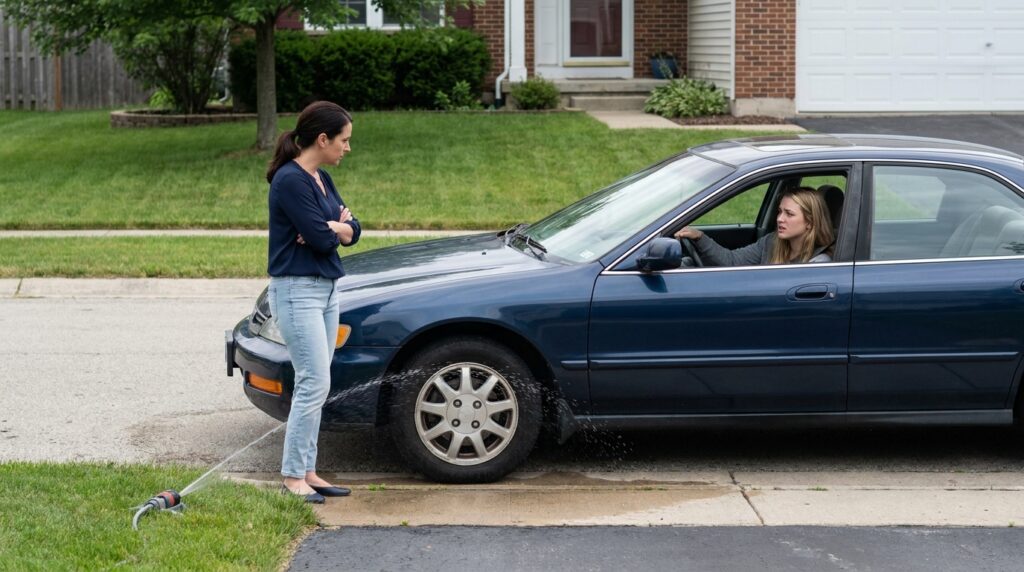
The Weight of the Apron and the Chilling Certainty of Cold Water along the Concrete
CHAPTER 1: THE FIRST INCURSION
The engine didn’t cut out; it just sat there, a low, oily vibration that rattled the cheap glass pane of Sarah’s front door. It was 7:14 AM. Through the thin mesh of the screen, the morning light looked gray and gritty, catching the floating dust motes before hitting the parched turf of the parking strip.
Sarah didn’t move from the kitchen threshold. Her fingers stayed wrapped around the handle of her ceramic mug—not for the warmth, but for the weight. On the street, the blue sedan’s exhaust left a faint, pale smudge against the dry summer air. The car’s front bumper didn’t just clear the curb; it hung three inches over the sloped concrete apron, its plastic underside casting a dark, aggressive shadow across the hairline fracture in the stone that Sarah had tracked since the spring thaw.
She knew the car before she saw the driver. A faded dealer decal from two counties over was peeling off the trunk lid, and the rear left quarter panel carried the dull, unpolished look of cheap primer. It was a machine built for short distances and small oversteps.
When the driver-side door finally clicked open, the sound was dry—metal scraping against dry rubber seals. Chloe didn’t get out immediately. She swung her legs out first, her sneakers scuffing the sun-bleached weeds that grew from the seam where the public asphalt met Sarah’s private stone. She was young, her movements carrying the loose, uncalculated weight of someone who believed every empty curb was an unowned invitation. She didn’t look at the house. She looked at her phone, her thumb flicking with a rapid, mechanical precision that mirrored the idling engine.
Sarah watched the long blonde hair fall forward, obscuring the girl’s profile. There was no malice in the posture, which made it worse. It was the absolute absence of regard. The car was positioned so that anyone trying to back a domestic crossover out of the double garage would have to cut the wheel at a sharp, punishing angle, risking the transmission on the high lip of the gutter just to clear Chloe’s front license plate.
Sarah set the mug down on the counter. The wood beneath her palms felt rough, its grain worn down by years of cheap oil soap and heavy use. She didn’t adjust her navy blouse. She didn’t tuck the loose strands of dark hair back into her tie. She simply walked out onto the porch, her boots striking the gray boards with a flat, hollow thud that didn’t carry past the first row of boxwoods.
The morning air smelled of dry iron and old cut grass. Across the asphalt, the curtains in old man Miller’s front window twitched once, then went still. The street was awake, but it was a silent kind of awake—the sort that kept its hands in its pockets and watched from the shadows of the porch eaves.
Sarah stopped at the third step. From here, she could see the exact point where the blue bumper crossed the line. It wasn’t a large violation—not enough to call a city tow truck, not enough to bring a deputy out from the township station. It was six inches of metal occupying twenty-six years of clear title.
Chloe finally looked up from the screen, her eyes narrowing against the flat glare of the eastern sky. She didn’t drop her hand. She just leaned her shoulder against the door frame, her casual top catching the grit of the road dust. “It’s a public street,” she said, her voice thin, dry, and entirely devoid of apology.
Sarah didn’t close the gap. She stayed on the wood, her arms crossed tight against her ribs, her boots anchored to the grain. “The apron isn’t,” Sarah said.

CHAPTER 2: THE SOFT WARNING
“The street belongs to the town, but the concrete you’re sitting on belongs to the mortgage,” Sarah said. Her voice didn’t rise. It stayed flat, matching the dead heat radiating from the driveway apron. “And I pay the interest on the mortgage.”
Chloe didn’t drop her phone. She let her arm rest against the door’s plastic trim, her fingers tapping a rhythmic, mindless cadence against the glass. The engine gave another wet, uneven cough, sending a fresh whiff of unburnt fuel through the lowered window to mix with the synthetic pine air freshener hanging from the rearview mirror. “My wheels are on the blacktop,” Chloe countered, her gaze flicking toward the cracked curb before returning to the screen. “Look at it. Maybe a couple of inches of the plastic guard is over the slope. It’s not like you’re using the whole width anyway. You’ve got room.”
“Room isn’t the rule,” Sarah replied. She stepped down from the third riser, her boots making a low, dry crunch as she hit the gravel border along the walkway. Every step closer felt like moving through heavy oil. Her vision narrowed to the sharp edges of the sedan—the dented fender, the dull primer, the way the front tire was wedged into the gutter leaf-litter. “The rule is twenty feet of clear clearance from the center line of the apron. You’re short by six.”
Chloe finally let her chin drop, looking up through her long blonde bangs with a look that was more tired than angry. It was the calculated exhaustion of someone used to wearing down opposition by simply being inconvenient. “You’re the only one on this entire block who cares about this, you know that? Nobody else is out here with a tape measure at seven in the morning.”
Sarah stopped at the edge of the grass strip. The distance between them was less than four feet now, close enough to see the gray road dust coating the hood of the blue car, close enough to notice the heavy brown envelope sticking out of old man Miller’s mailbox across the street—unclaimed, its metal clasp rusted orange. A micro-discrepancy. Miller usually cleared his box before the paper delivery at six.
“The others aren’t backing a twelve-ton utility trailer out of a blind stall twice a week,” Sarah said. She kept her hands planted flat in her pockets, hiding the slight, involuntary twitch in her left knuckle where an old fracture from the ledger days still ache during pressure changes. “You clip that plate again like you did on Thursday, and we’re not talking about code enforcement. We’re talking about property damage.”
Chloe’s mouth tightened into a small, hard line. She didn’t deny Thursday. Instead, her grip on the steering wheel shifted, her knuckles turning a brief, bloodless white against the worn leatherette wrap. “I didn’t clip anything. If your concrete is cracking, it’s because it’s old, not because of my car.”
“The stone doesn’t lie about weight,” Sarah said. She watched Chloe’s hand move down toward the gear selector—a subtle, defensive counter-move. The girl was smart enough to know when the spatial leverage was slipping, but she wasn’t ready to yield the curb. Not completely. There was a stubborn, desperate logic under the girl’s entitlement, a hidden weight that Sarah couldn’t quite see through the glare on the windshield. Chloe wasn’t just parking; she was anchoring herself to this specific segment of asphalt for a reason she wasn’t sharing.
Across the street, the brown envelope in Miller’s box caught the morning breeze, its edge fluttering with a dry, paper hiss. Sarah’s eyes traced the trajectory back to Chloe’s rear bumper. The sedan’s exhaust pipe was rusted through near the hanger, dripping a small, dark puddle of condensation onto the dry weeds at Sarah’s feet.
“You’ve got three minutes before the morning truck comes down the lane,” Sarah added, her voice dropping into a transactional register. “If he can’t make the swing because your rear end is hooked into the turn, he’ll lay on the air horn until the whole block is on their porches. We can wait for that, if you want the company.”
Chloe looked past Sarah’s shoulder toward the house, her gaze lingering on the empty front windows where the blinds remained drawn and static. A flicker of real uncertainty crossed her face, gone as quickly as it came, replaced by the practiced indifference of the young. She shifted the car into reverse with a sharp, metallic clunk that shivered through the floorboards.
“I’m just waiting for a call,” Chloe muttered, her eyes dropping back to the phone in her lap. “The street’s public. Remember that.”
“I remember what I own,” Sarah said, her boots holding the grass line as the blue sedan began to back up two inches, its tires scraping against the broken lip of the asphalt with a sound like tearing fabric.
CHAPTER 3: THE MECHANICAL LINE
The metal casing of the oscillating sprinkler felt cold, slick with a thin layer of condensation that quickly collected the dry grit blowing off the asphalt. It was exactly 7:22 AM when Sarah kneeled on the sun-bleached grass strip. Behind her, the blue sedan sat idling fifty feet down the curb, its exhaust still emitting that pale, lazy smudge against the neighborhood’s heavy backdrop. Chloe hadn’t left; she had simply moved just far enough to clear the direct line of sight from Sarah’s front door, parking exactly on the border of Miller’s property line.
Sarah didn’t look back at the car. She uncoiled the heavy, dark-green rubber hose, its surface stiffened by years of heat exposure and cracked at the brass fittings. It resisted her hands, twisting with an stubborn, coiled memory that she forced straight using the weight of her boot. The task required a mechanical exactness. If the water arc didn’t land precisely along the concrete lip where the public gutter met her lawn, the entire gesture would dissolve into a petty neighbor dispute. This wasn’t a dispute; it was an enforcement action.
She positioned the heavy zinc base exactly two inches inside her grass boundary, aligning the rusted nose of the sprinkler head with the hairline fracture in the driveway apron. The metal dials on the side were stiff, clogged with lime deposits from the local hard water. Sarah pressed her thumb against the brass-weighted trip lever, clicking it back into the narrow-angle position. She set the sweep to a rigid, vertical fan—no wide angles, no wasteful overspray that could give city code enforcement a reason to cite her for sidewalk obstruction. The boundary had to be clean, sharp, and legally unassailable.
When she twisted the outdoor faucet valve against the foundation of the house, the ancient copper pipes inside the basement wall gave a hollow, metallic shudder. Water surged through the rubber line, expanding the green skin of the hose until the cracks near the fittings hissed with tiny, pressurized needles of spray.
At the curb, the sprinkler head caught the pressure. It didn’t oscillate immediately; it cleared its throat first, spitting a jagged, rust-brown stream of stagnant water across the hot asphalt before the pressure normalized into a tight, transparent fan. The mechanical clack-clack-clack of the weighted arm began its rhythm, slicing the quiet morning air into precise, three-second intervals. Each pass of the water wall left a dark, glistening sheen on the stone, right at the foot of her driveway mouth.
From across the street, the heavy brown envelope still fluttered against the wire cage of Miller’s mailbox. Sarah stood up, wiping her wet palms down the thighs of her light jeans. The water had a sharp, iron smell that reminded her of well casings and deep silt. Through the shifting curtain of the spray, she watched the blue sedan’s brake lights flare twice. Chloe was watching the water line drop.
The fan of water swept up, paused at its northernmost apex, and dropped back down, slapping the concrete apron with a flat, rhythmic sound. It was an unmistakable barrier. Anyone attempting to pull a vehicle up to the edge of Sarah’s driveway would now have to park their windshield directly inside a pressurized sheet of hard well-water. It was a passive line, entirely dependent on physics and the transgressor’s own willingness to get wet.
Sarah turned her back on the street and walked slowly toward her porch steps. Her boots left damp, dark ovals on the dry gravel walkway, each imprint vanishing within seconds as the summer heat reclaimed the moisture. She knew Miller wasn’t behind his curtains today. The silence from his house was too thick, too unvaried. Usually, the old man’s television hummed loud enough to vibrate through his screen door by this hour, but today there was only the dry hiss of the wind through his untrimmed boxwoods.
She reached the threshold of her front door and paused, her hand resting on the screen frame. The wood was hot to the touch. Down the street, the engine of the blue sedan gave another low, uneven rumble, the sound slightly muffled now by the steady, industrial clicking of the brass sprinkler arm. Chloe’s car shifted into drive, its tires rolling forward six inches until the front bumper sat exactly one inch away from the outer edge of the wet concrete zone. The girl was measuring the water’s reach, testing the exact perimeter of Sarah’s mechanical line.
Sarah didn’t close the door. She pulled a worn metal folding chair from the corner of the porch, set it down behind the screen, and sat. She kept her arms crossed tightly against her navy blouse, her eyes fixed on the point where the first stray droplets of the sprinkler’s fan began to mist against Chloe’s clean, unpainted primer. The trap was set, but the weight of the street felt heavier now, as if the soil beneath the concrete was shifting under the pressure of a completely different machine.
CHAPTER 4: THE LIVE STANDOFF
The front tire of the blue sedan didn’t hit the curb; it ground into the soft, over-saturated soil right at the margin of the grass strip. The weight of the machine pushed a small ridge of black mud over the zinc base of the sprinkler. The metal mechanism hitched once, its oscillating rhythm jarred by the impact, before it began to spray directly into the sedan’s lower grill with a sharp, hollow hiss.
Sarah was down the porch steps before the sedan’s transmission settled into park. Her boots skated once on the wet clover near the walkway, but her weight was forward, low and centered. The air between the houses had turned cold and mist-choked, smelling of iron and deep-well sediment. She didn’t look at old man Miller’s windows this time. Her world had narrowed to the blue hood, the rhythmic thunk-thunk-thunk of the water jet hitting the radiator, and the long blonde hair shifting behind the wet glass of the driver-side window.
“You’re over the line,” Sarah said. She didn’t shout, though she had to plant her hip against the sedan’s front fender to stay upright against the wet grass. The metal beneath her palm was hot, vibrating with the rough idle of a four-cylinder engine that needed a new tensioner pulley. “Move it back.”
Chloe didn’t roll the window down all the way. She left a two-inch gap at the top, just enough for the synthetic pine scent to leak out into the clean smell of the well-water. The spray was hitting the glass now, sheeting down the door panel in thick, translucent folds that blurred the girl’s face into an unrecognizable smudge of pale color. “The water’s on public property, lady,” Chloe called through the glass, her thumb still twitching against the screen of her phone. “You’re blocking the easement. I can call the township right now.”
“Call them,” Sarah said. She reached down, her fingers gripping the cold, vibrating rubber of the garden hose just above the brass fitting. She dragged it six inches forward, anchoring her boot behind the brass coupling to force the water jet into a tighter, more vertical arc. The fan of water now sliced directly across the driver-side mirror, blasting a steady stream into the two-inch gap at the top of the window. “Tell them you’re parked inside a private irrigation line.”
The water struck the interior upholstery with a dull, wet slap. Chloe flinched, her phone slipping from her fingers and dropping into the footwell out of sight. For the first time, the indifference vanished from her face, replaced by a sharp, panicked flash of anger. She didn’t use the gear selector. She threw the door open instead, the metal edge catching Sarah in the ribs and forcing her back a half-step onto the slick grass strip.
“You’re crazy,” Chloe spat, standing up into the cold mist of the sprinkler. Her casual top was soaked within seconds, the fabric sticking to her shoulders in dark, heavy patches. She didn’t look at Sarah; she looked down at her feet, where the water had pooled into a miniature canal along the concrete curb. “Look what you’re doing to my car. This is harassment.”
“This is maintenance,” Sarah said, her voice dropping into that flat, transactional register that left no room for negotiation. She stayed where she was, her navy blouse spotted with grease and well-water, her arms locked across her chest like a pair of iron straps. Her eyes were fixed on the mud beneath Chloe’s sneakers.
The heavy, continuous pressure of the water had begun to wash away the loose topsoil near the edge of the driveway apron. Under the steady erosion, the gray clay was splitting open, revealing something dark and metallic hidden two inches beneath the sod—a heavy, notched iron surveyor’s pin, its top flaked with orange rust. It was positioned exactly six inches inside the line Sarah had guarded for twenty years.
Sarah’s gaze locked onto the iron rod. The cold well-water was clearing the dirt around it with a steady, clinical precision, exposing a deep, chiseled notch that didn’t match the township maps she kept in her desk. It was an older mark, a municipal boundary indicator that effectively pulled the public right-of-way six inches deeper into her property, turning her double-wide driveway apron into city land. The legal certainty of her absolute boundary was dissolving into the mud at her feet.
Chloe followed her look, her eyes narrowing as she saw the rusted metal head emerging from the sod. She didn’t know what it meant—she didn’t have the context of thirty years of property taxes—but she recognized the sudden stillness in Sarah’s posture. It was the first time the older woman had hesitated.
“See?” Chloe said, a thin, defensive edge returning to her voice as she took a step back toward her open door, her sneakers squelching in the newly formed mire. “You don’t own the whole world, Sarah. Some of us have a right to be here.”
Before Sarah could answer, the distinct chime of a cell phone echoed from the floorboards of the blue car—not Chloe’s phone, which was still dark in the footwell, but a second, cheaper burner device hidden deep inside the unzipped glove compartment. It was a rhythmic, persistent ring that matched the clicking of the brass sprinkler head, and it didn’t stop.