The Weight of Quiet Ground: A Story of Rusted Truth, Iron Discipline, and the Collapse of Corporate Pretense

CHAPTER 1: THE FRICTION OF THE BOUNDARY

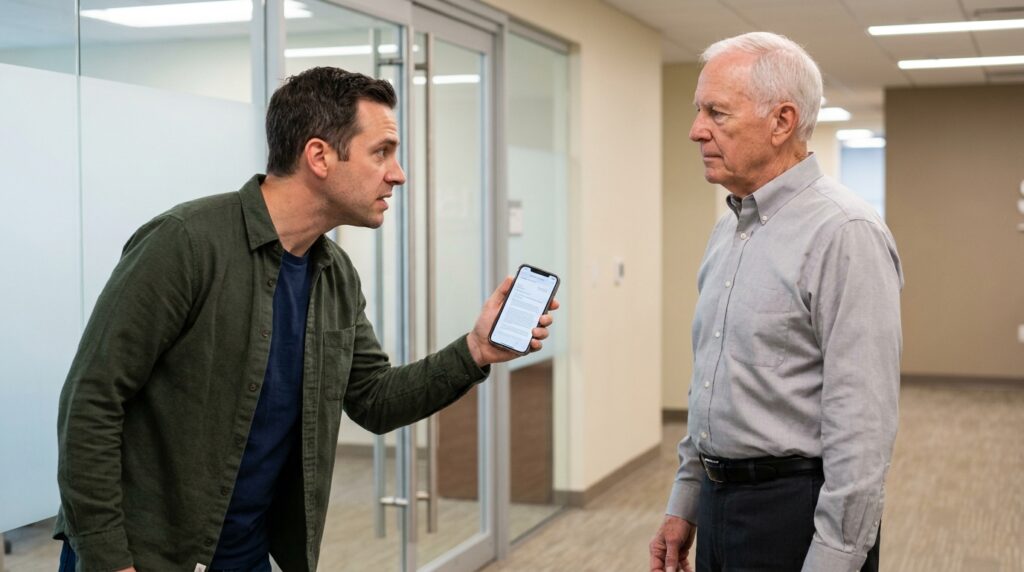
“You don’t get to ignore this, answer me right now,” Marcus Cole barked, his shoulder-width frame cutting off the clean geometric line of the exit.

Arthur Vance did not step back. The polished concrete beneath his thin-soled loafers was cold, vibrating faintly with the distant hum of industrial HVAC units buried deep in the facility’s bedrock. The glare of the overhead fluorescent panels bounced off the modern drywall corridor, catching the fine, dry grain of his gray button shirt. He held a faded leather file folder tucked securely against his ribs, his left thumb resting over a heavy, weathered West Point signet ring—its gold dulled by fifty years of friction, its sharp crest smoothed down to a silver-gray shadow.

“Stop pretending nothing happened, I’m waiting for your response,” Cole said, shifting his weight forward. The corporate security director’s laminated badge swung on its green lanyard, tapping rhythmic clicks against a dark overshirt. Behind him, three floors of glass balconies looked down into the modern indoor corridor. Offices along the perimeter had gone silent. The gentle rustle of keyboard clatter died out, replaced by the heavy, dry stillness of an audience waiting for a fall. A junior clerk stopped mid-stride, two cardboard coffee cups trembling slightly in her grip.

Arthur looked at the young man’s eyes. They were wide, darting to the corner cameras, calculating the visibility of the arrest. Cole wasn’t looking at a man; he was looking at an administrative metric that needed squaring. Arthur knew the type; he had seen them in logistics depots from Frankfurt to Fort Bliss—men who mistook the ink on a regulation sheet for the weight of actual ground.

Arthur let the silence stretch. It was a long, unblinking pause, the kind learned in command tents while the artillery reports filtered through slow radio links. He didn’t tighten his jaw. He didn’t adjust his grip on the folder. He simply listened out the noise until the security director’s breathing grew shallow, caught in the vacuum of the old man’s absolute stillness.

“I’m not arguing with you,” Arthur said. His voice was low, dry like mountain gravel, carrying the flattened rhythm of the old regulatory boards. “We’re done here.”

He turned his shoulder slightly, a minor geometric shift meant to clear the path toward the main entry doors. The double panes of reinforced glass stood twenty feet away, looking out into the pale grey dusk of the Virginia transit lot.

“Then don’t walk away,” Cole snapped, his hand snapping out to grip the cold chrome of a stanchion rail, his body leaning over the line. He was trembling now, a microscopic vibration born from the realization that his institutional leverage wasn’t registering against the target.

Arthur paused. In his left hand, the leather folder felt heavier now, its brass corners tarnished by old salt. Inside lay a single piece of paper with a flagged operational seal—the exact serial registration number of the facility’s master digital gate bypass. The stamp on the upper right corner didn’t belong to corporate oversight. It was signed with a simple, three-letter federal procurement code that Cole had evidently never been cleared to see.

The pneumatic seal on the double glass entry doors behind them gave a sudden, high-pressure hiss.


CHAPTER 2: THE PRESSURE GRADIENT

The hiss of the glass doors was a sharp, clinical decompression that cut right through the dry, stagnant air of the corridor. It smelled of rainwater, ozone, and wet asphalt from the Virginia transit lot outside—a sudden invasion of the raw elements into a space that had been sealed too tight for too long.

Marcus Cole didn’t look back at the doors immediately. His knuckles were still white where he gripped the chrome stanchion rail, his body weighted forward, attempting to maintain the physical blockade he had thrown up between Arthur Vance and the exit. But the sudden shift in the room’s atmospheric pressure wasn’t something that could be ignored. The two junior contractors who had been lingering near the elevators didn’t just look up; they went rigid, their spines straightening in a mechanical reflex that had nothing to do with corporate hierarchy.

Arthur didn’t alter his stance by a single degree. He kept his feet planted at forty-five-degree angles on the polished concrete, his shoulder lowered just enough to shield the faded leather portfolio under his arm from Cole’s proximity. Through the glass panels, the grey dusk outside was rapidly thickening, casting long, desaturated shadows across the modern drywall. The fluorescent lights overhead hummed a flat, metallic B-flat, casting a sickly yellow sheen over the director’s dark green overshirt.

“Sir, you need to return to the desk,” Cole said, though his voice had dropped an octave, the aggressive timber cracking slightly under the weight of the silence behind him. “The log isn’t clear. You’re carrying unvetted material.”

“The material is signed,” Arthur said. His voice remained a level, gravelly rasp. He didn’t point to the folder. He didn’t have to. The heavy gold-and-silver West Point ring on his left hand caught the harsh glare as his thumb remained hooked over the leather seam, a silent anchor of old iron amidst the cheap corporate chrome.

The boots came next. Heavy, synchronized, double-soled leather striking the floor with the unmistakable cadence of a security detail that didn’t stop for badges or digital check-in kiosks. There were four of them—three junior officers in starched utility uniforms, their faces frozen into blank tactical masks, and at the center, a man whose dark green service coat bore the heavy silver weight of four stars on each shoulder.

General Thomas Hayes didn’t look at the corporate signage. He didn’t look at the modern indoor balconies where the administrative assistants were now leaning over the railings, their phones forgotten in their hands. His eyes scanned the concrete corridor like a man checking a familiar grid map for familiar coordinates. When his gaze hit the gray button shirt and the unyielding, white-haired posture of Arthur Vance, the general’s stride didn’t just alter—it locked.

Cole turned then, his corporate ID badge swinging wildly on its lanyard, his mouth already open to offer a well-rehearsed bureaucratic greeting, the defensive reflex of a manager caught out of position. “General Hayes, sir, we were just completing a standard security audit on an unregistered—”

Hayes didn’t let him finish the sentence. The four-star general stopped exactly three paces from the stanchion rail. The air between them tasted of cold salt and discipline. Hayes’s heels came together with a sharp, dry snap that echoed off the synthetic drywall. His right hand came up, fingers straight, thumb tucked, the palm angled precisely over the brow of his cap in a rigid, flawless command salute.

“General Vance, sir,” Hayes said. The words weren’t loud, but they carried the flattened, institutional authority of a man who commanded forty thousand men under federal appropriation. “The transport from the Pentagon is holding in the lower bay. We didn’t expect you on the floor until the morning session.”

The silence that followed was absolute. It was the specific, heavy quiet that happens when an engine drops its transmission at high speed—a sudden cessation of functional noise that leaves only the raw vibration of things breaking.

Cole’s hand didn’t just leave the chrome rail; it dropped as if the metal had turned white-hot. His athletic frame seemed to shrink inside the green overshirt, his shoulders rounding as his gaze traveled from Hayes’s silver stars down to the weathered West Point ring on Arthur’s hand. The skin along Cole’s jawline turned a mottled, chalky white, the modern lighting making his sweat-sheened forehead look like unbaked clay.

Arthur slowly lowered his head by a fraction of an inch—a minimalist acknowledgement that had served as his baseline for forty years. He didn’t return the salute; he was in civilian clothes, and the rules were the rules, even when the floor was melting beneath them.

“The clerk gave me a day pass, Tom,” Arthur said, his voice dropping into the familiar, sparse rhythm of old colleagues who had shared bad coffee in unventilated command tracks. “The digital kiosk was down. This young man felt the discrepancy required an exhibition.”

Hayes’s eyes moved to Cole. They didn’t widen; they simply narrowed, the gray pupils turning into cold, iron sights. “Director Cole, is it?” Hayes asked, his voice descending into a flat, dangerous register that made the junior security guards behind him step back an inch. “You’re the security director for this sector?”

“Yes, General, I—” Cole stammered, his fingers twitching toward his pocketed phone, then freezing as he realized the sheer irrelevance of his digital network. “The protocol… we had an internal leak last Tuesday… I was simply ensuring that no unvetted documents—”

“The documents under General Vance’s arm are federal property,” Hayes interrupted, his hand moving to his side, where a staff officer immediately proffered an official, leather-bound folder with an identical operational seal to the one Arthur held. “More specifically, they are the independent review sheets for your facility’s top-tier defense clearance. The sheets you signed off on when you bypassed the physical perimeter checks to hit your quarterly cost metrics.”

Arthur didn’t smile. He watched the realization hit Cole’s face—the physical collapse of a man who had built his power on the belief that the world was entirely populated by people who were afraid of his green lanyard. Arthur quietly shifted the portfolio under his arm, the brass corners clicking against his ring. The first clue had just been dropped into the corridor, but the heavy iron box of the real investigation remained locked, deep within his gray shirt pocket.

CHAPTER 3: THE ARCHIVE TRAIL

The corporate corridor did not clear quickly; it dissolved. Marcus Cole’s breathing remained shallow, a ragged scraping sound against the smooth click of General Hayes’s detail adjusting their formation. Under the sharp overhead light, Cole’s hand drifted toward the green lanyard around his neck, fingers tangling in the woven synthetic fiber as if looking for a physical anchor in a shifting floor.

“We have an office cleared in Sector Two,” Hayes said, his voice flat, his eyes never leaving the sweat-slicked bridge of Cole’s nose. “Move.”

Arthur didn’t wait for the security director to lead. He walked with a steady, unhurried gait, his worn loafers finding the seams where the carpet met the polished concrete. The leather portfolio remained locked beneath his elbow, its brass hinges cold against his ribs. He could feel the weight of the pages inside—not just the single flagged compliance sheet, but the deeper, unprinted ledger numbers that had brought him out of his quiet retirement in the foothills.

They moved past rows of glass-walled cubicles where the defense contractors sat like ghosts behind anti-glare filters. The modern architecture of Apex Defense Systems was built to suggest transparency—every wall was paneled in structural glass, every cable tray exposed and painted a uniform industrial gray. Yet, beneath the clean scent of high-grade air filtration, Arthur caught the faint, persistent odor of older infrastructure: the damp smell of sub-floor grease and the scorched iron tang of transformers running hot behind the drywall.

The auxiliary office in Sector Two was small, windowless, and isolated by a heavy soundproof door that closed with the dull thud of a vault. A single brushed-aluminum table sat in the center under an unshielded LED grid.

General Hayes stepped to the corner of the room, his security detail remaining outside the glass boundary. He nodded once to Arthur, a silent transfer of tactical priority that required no formal explanation.

Arthur placed the leather portfolio flat on the aluminum surface. The sound of the weathered hide striking the metal was loud, a dead, unyielding thud. He unbuckled the iron clasp with a single twist of his left thumb, his West Point ring scraping the metal casing with a dry, metallic scratch.

“The regional logs from last Tuesday show an eight-hour gap in the primary entry sequence at the assembly bay,” Arthur said. He did not sit. He stood with his fingers lightly touching the edge of the leather folder, his posture remaining perfectly vertical, a human plumb line in the windowless room. “The automated gate threw three separate parity errors. Each one was overridden from a terminal registered to your sector office, Director Cole.”

Cole remained near the door, his athletic frame looking out of balance against the stark white line of the baseboards. He had unbuttoned the top notch of his dark green overshirt, revealing the pale, salt-stained rim of his undershirt. “The system was undergoing a scheduled logic update,” Cole said, his voice returning in thin, structured pieces. “We had five hundred crates of low-latency arrays sitting on the tarmac during a heavy rain filter. If I didn’t bypass the kiosk verification, the moisture sensor would have tripped a secondary quarantine. We would have missed the quarterly delivery milestone by forty-eight hours.”

“You cleared the crates without a counter-signature,” Arthur said.

“I cleared them under the operational efficiency clause,” Cole countered, his eyes hardening as he found the familiar terrain of corporate policy. He stepped closer to the table, his hand flat against the opposite edge, trying to lean into the space. “Apex is a commercial vendor, General. We aren’t running an active-duty motor pool here. If we miss a procurement window, the funding line drops by three percent on the next cycle. I saved the company twelve million dollars in asset penalties.”

Arthur looked down at the open folder. The page on top wasn’t a standard corporate memo; it was a triple-ply carbon copy from an older, military-issue inspection book, its pink edges frayed and yellowed around the margin holes. On the lower right-hand corner, Cole’s digital authorization code was printed in sharp, pixelated black ink. Next to it, the line for the independent federal inspector’s signature was completely blank.

But Arthur’s eyes weren’t fixed on Cole’s printed validation. He was looking at a minor discrepancy on the duplicate page underneath—a faint, indented red ink smudge that didn’t match the digital sequence. It was a physical mark, a manual stamp from a logistics office that should have been decommissioned during the Base Realignment closures ten years prior.

“The twelve million dollars isn’t the metric that matters, son,” Arthur said softly. He reached into his gray shirt pocket and drew out a pair of wire-rimmed reading glasses, unfolding the tarnished steel stems with a deliberate, rhythmic click. “The low-latency arrays you brought through that gate didn’t come from the depot in Chambersburg. The manifest has an old supply depot code from the third-tier sub-contractors in Roanoke.”

Cole’s hand slid an inch across the aluminum table, his palms leaving a damp, grey smudge on the brushed finish. “The sourcing was approved by the procurement board. It’s in the digital annex.”

“The digital annex is a shadow,” Arthur rasping out the words without raising his tone. He adjusted the wire frames on his nose, looking through the glass at the pale reflection of his own white hair. “The paper in this folder shows that the Roanoke facility hasn’t drawn federal steel since the mid-nineties. The parts you brought through the rain aren’t components, Director Cole. They’re old inventory that someone re-labeled to clear an outstanding liability off the books before the independent review team arrived.”

He turned the carbon sheet over. The movement was crisp, the dry paper crackling under his fingers like dead leaves.

“You didn’t bypass the protocol to save a deadline,” Arthur said, his eyes locking back onto Cole’s face with the absolute weight of a commander who had spent thirty years identifying structural failures in the field. “You bypassed it because you knew the inspector’s signature line would stay blank forever if you kept the transaction off the live grid. But you forgot the manual ledger link. Someone in Roanoke still uses a stamp.”

Cole opened his mouth to reply, his jaw working silently for three seconds before he could find the words. The corporate confidence had completely drained from his posture, leaving only the hard, defensive instinct of a mid-level manager who had realized the trap wasn’t behind him—it was already closing around his wrists.

The red ink mark on the duplicate page remained visible under the harsh LED grid, a small, rusted anchor of truth that corporate policy couldn’t erase.

CHAPTER 4: THE CROSSING POINT

The red ink smudge on the frayed carbon paper looked like a dried rust spot under the harsh LED grid. Marcus Cole’s fingers remained flattened against the aluminum table, his palms leaving twin grey halos of condensation on the brushed metal. He did not look up at the ceiling cameras. He was looking at the blank line where an inspector’s signature should have been, his jaw working with a tight, microscopic twitch.

“The Roanoke facility was cleared under the emergency material reallocation act,” Cole said, his voice dropping into a flat, defensive monotone. He didn’t look at General Hayes, nor did he look at Arthur. His focus remained pinned to the manual ledger page. “The compliance parameters allow for the substitution of structural alloys if the primary supplier hits a maritime bottleneck. It’s all logged in the regional server.”

“The regional server only records what you type into the interface, son,” Arthur said. He adjusted his wire-rimmed glasses, his thumb rubbing the worn, silver-gray crest of his West Point ring. “It doesn’t record the weight of the flatbeds when they cross the secondary scales at the perimeter gate. It doesn’t see the rust on the structural tubing before the painters hit it with corporate primer.”

General Hayes shifted his weight, his heavy leather boots creaking against the floorboards. The sound was an unyielding reminder of the institutional authority flanking the small, windowless office. “Director Cole,” Hayes said, his voice carrying the cold rhythm of a formal deposition. “The low-latency arrays aren’t the issue. The defense procurement board flagged forty-eight structural beams shipped to the main satellite integration hangar last month. The digital manifests say they’re aerospace-grade titanium. The manual weigh-bills from the old Roanoke yard say otherwise.”

Arthur reached down and turned the carbon sheet over, his skin rough against the brittle paper. The friction made a dry, scraping sound that seemed to fill the small room. Beneath the first layer lay a duplicate invoice, its edges yellowed from years in an unventilated file drawer. It wasn’t an automated printout; it was typed on an old manual ribbon machine, the letters unevenly spaced, the serial blocks stamped by hand.

“You thought the record was dead because the Roanoke office went dark during the ninety-five closure cycle,” Arthur said softly. He pulled the leather folder closer to his chest, the brass corners catching a thin glint of the cold overhead light. “But some things don’t dissolve in a database. The old logistics battalions didn’t use cloud storage. They left paper trails in the concrete vaults under the old supply tracks.”

Cole finally raised his eyes, his gaze sharp and defensive, the desperate intellect of a cornered bureaucrat looking for an analytical flaw in a veteran’s line. “If the steel wasn’t certified, the automated ultrasonic scanners at the receiving dock would have tripped a code forty validation. The integration team wouldn’t have accepted the shipment. I don’t control the scanners, General. That’s an automated quality control protocol.”

“The automated scanners only check the pieces that pass through the main warehouse portal,” Arthur said. He stepped closer to the aluminum table, his vertical posture cast like a long shadow across Cole’s side of the room. “The gate override you executed during the rain filter didn’t just clear the low-latency arrays. It let three heavy transport flatbeds bypass the diagnostic bay entirely. You told the gate guards the materials were pre-vetted by an external audit team.”

“The delivery milestone was tied to our prime contract renewal,” Cole snapped, his voice cracking slightly as the corporate pretense fell away completely, leaving only the raw anxiety of an executive who had overreached his authority. “If those integration frames weren’t set by midnight, the entire procurement timeline for the next fiscal year would have defaulted. I didn’t write the contract deadlines, General. Your people at the Pentagon did.”

“My people didn’t tell you to use decommissioned structural iron to build a satellite housing,” General Hayes said, his voice dropping into a dangerous, low register that made the security clerks outside the glass door look around. “You didn’t execute an override to save a deadline, Director. You did it because the certified titanium alloy was sold to a commercial aviation broker two months ago, and you needed forty-eight structural columns to fill the physical gap before our inspection team walked through the door.”

Cole’s hand dropped from the table, his arms hanging limp at his sides. The green lanyard looked heavy around his neck, the corporate ID card dangling like an old iron tag. The modern, clean lines of Apex Defense Systems—the structural glass walls, the exposed and painted gray conduit, the anti-glare filters—seemed to lose their high-tech luster, replaced by the ancient, unmistakable atmosphere of an unventilated military stockade.

Arthur quietly picked up the carbon sheets, sliding them back into the faded leather portfolio. The iron clasp closed with a sharp, heavy click that signaled the end of the argument. He looked at Cole one last time, his eyes steady behind his wire frames, offering neither anger nor pity, only the cold, unyielding precision of a man who had spent his life evaluating the structural boundaries of an organization under fire.

“The decoy was well-constructed, son,” Arthur said, his gravelly voice echoing off the synthetic drywall. “The digital ledger looks perfect on the monitor. But the concrete beneath this facility doesn’t lie, and neither do the old weigh-station receipts from the Virginia road depots.”

He turned toward the soundproof door, the folder secure under his elbow. The first layer of the corporate lie had been cracked wide open on the metal table, but the ultimate final truth—the real reason why the Department of Defense had sent an eighty-year-old corps commander to a regional contractor’s office instead of a standard audit team—remained strictly locked inside his gray shirt pocket, waiting for the terminal bay doors to clear.

CHAPTER 5: THE PRESSURE TRANSIT

The iron clasp of the leather folder didn’t just click; it severed the room’s remaining stability. As Arthur Vance tucked the worn case back beneath his elbow, the windowless office felt smaller, the stark white drywall seemingly absorbing the heat from the three men standing inside its narrow perimeter.

“Let’s move to the lower transit bay, Arthur,” General Hayes said, his voice dropping into the lower, gravelly register he used when an advance post was no longer tenable. He reached out to palm the heavy exit lever, but before his fingers could engage the chrome surface, the overhead LED grid flickered once—a cold, blue stutters that left the room in near-darkness before the auxiliary power strips clicked over with a dry, mechanical snap.

The rhythmic thrum of the facility’s main HVAC system died out instantly. In its place came a thin, high-pitched whistle from the ceiling vents as the static pressure dropped across the sector line.

Marcus Cole didn’t look at the door. His eyes stayed fixed on the emergency floor-level indicators where a small amber LED began to flash an unmapped logic sequence: E-00. Clear Boundary Zone. His fingers, still stained with the grey halo of metal dust from the table, twitched against the seam of his trousers. “The offline backups shouldn’t be drawing from this grid,” he muttered, his voice brittle, stripped of its corporate cadence. “The terminal bay has its own isolated isolation bank.”

“It isn’t a power failure, son,” Arthur said, his tone flat as he adjusted his wire frames. His loafers found the seam where the concrete floor joined the structural steel sill. “The main frame just executed a localized quarantine block. Someone on your server floor realized the Roanoke weigh-bills were sitting on the metal table.”

Hayes pulled the door lever down. It clicked, but the heavy steel frame stayed pinned inside its hydraulic casing, the magnetic lock buzzing with a low, sixty-cycle frequency that signaled a forced security hold. “Director Cole,” the general snapped, his head turning with a slow, dangerous precision. “Clear this exit line.”

“I… my credentials won’t override a sector-wide level four isolation,” Cole stammered, stepping back toward the aluminum table as if the metal surface could protect him from the four-star detail waiting outside the glass partition. Through the soundproof paneling, the three junior security officers were already lifting their handheld terminals, their thumbs working the membrane keys as the corridor’s auxiliary red light tubes hummed to life. “The automated system triggers this sequence if the digital integrity metric drops below seventy percent. It’s an anti-espionage baseline.”

“It’s an institutional blanket,” Arthur said, his gravelly rasp cutting through the electrical hum. He turned his vertical frame toward the secondary maintenance corridor at the back of the room, where an old iron hatch led toward the service elevator hoistway. The surface of the hatch was painted a thick, peeling gray, the rivets showing white crusts of oxide around the rims. “The corporate offices want the data confined to this sector until they can run an overwrite routine from the main server house in Bethesda. They don’t want your file folder crossing the threshold of General Hayes’s transport.”

Hayes didn’t argue the point. He knew the architecture of defense contractors better than most; he knew that when a multi-billion-dollar federal appropriation was at stake, the boundary between an administrative audit and a physical containment operation could become thin enough to bleed through. “The service hoist uses a manual hydraulic bypass,” Hayes said, his eyes scanning the rusted iron hatch. “We used to map them into the emergency evacuation annex during the early construction phase.”

“The manual link was disconnected during the 2022 digital modernization cycle,” Cole interjected, his voice rising as he stepped into the gap between Arthur and the hatch. His dark green overshirt was soaked through at the shoulder seams, the fabric clinging to his athletic build like wet moss. “You can’t operate the lift without an encrypted handshake from the central gate desk. If you force that lever, the counterweights will lock into the guide rails. We’ll be stuck in the sub-level shaft until the morning shift resets the logic.”

Arthur walked past him, his shoulder dropping just enough to brush Cole’s green sleeve aside with the indifference of an engine moving along a fixed track. He reached out with his left hand, the weathered West Point ring scraping the oxidized iron handle of the maintenance hatch as he gripped the lever. The cold metal felt familiar—it was the same rough-cast zinc they had used in the old underground command silos during the mid-winter alerts of sixty-eight.

“The modernization cycle only replaces the things the accountants can see on a spreadsheet, Director,” Arthur said softly. He braced his feet against the concrete sill, his spine locking into a rigid, unyielding line of leverage. “They don’t spend money to remove forty feet of solid iron rod buried behind three inches of industrial masonry. They just paint over the handle and tell the staff it doesn’t work anymore.”

He threw his weight into the lever. The sound that followed was a wet, grinding crack as twenty years of calcified hydraulic grease gave way. Deep within the drywall shaft behind the room, a pair of steel cable sheaves turned with a heavy, ungreased groan, their friction vibrating through the polished floor beneath their feet.

The hatch swung open into a dark vertical trench that smelled of wet dust, copper slag, and cold concrete sweat. The service platform sat three inches below the lip, its rusted iron mesh floor groaning under the sudden imbalance of air. On the small control console, a mechanical counter-wheel click-clicked twice, its physical numbers rolling over to reveal an offline routing code that hadn’t been mapped to the corporate server since the facility changed its name from the old naval ordnance yard.

Arthur stood at the threshold, the leather portfolio secured beneath his elbow, looking down into the gray vacuum of the old infrastructure. The first layer of their tactical victory had just dissolved into a forced retreat; they weren’t walking out through the main glass entry doors as victors. They were dropping into the rusted marrow of the old line, and the ultimate reality of what Arthur Vance was actually investigating remained buried, five levels below the clean corporate carpet.

CHAPTER 6: THE GRINDING GEAR

The service platform dropped with a sudden, ungreased lurch that sent a metallic shockwave directly up through Arthur Vance’s ankles. The rusted iron mesh floor under his loafers flexed, groaning against the cold guide channels embedded in the concrete shaft walls. Above them, the iron hatch didn’t just close; it slammed shut under the weight of an automated pneumatic piston, cutting off the flickering red auxiliary light of Sector Two and plunging the descent into a thick, grease-heavy dark.

“Hold the guide rail,” General Hayes said, his breath coming in a rhythmic rasp through the blackness. A heavy leather glove scraped against the cold steel stanchion beside him, the friction throwing off a faint scent of oxidized zinc and wet canvas.

Arthur didn’t reach for the rail. He kept his feet wide, his center of gravity low and immovable, holding the faded leather portfolio pinned tightly against his ribs. His left hand remained resting across the West Point signet ring, the cold metal casting a tiny, dull gleam whenever the platform jarred past a gap in the masonry joints. He could feel the heavy, moist air of the deep sub-levels rising against his face—it smelled of damp shale, mineral salt, and the scorched petroleum odor of transformers that had been drawing juice since the Cold War logistics battalions laid the foundation.

A sudden, sharp mechanical chatter erupted below them as a secondary set of hydraulic governor blocks clamped onto the vertical cables. The platform slowed to a shuddering crawl, the vibration rattling through the wire-rimmed glasses on Arthur’s nose.

Marcus Cole was breathing hard in the corner, his back pressed flat against the oil-slicked steel casing of the hoist mechanism. The dark green overshirt he wore was ruined, the sleeves smeared with black carbon grease from the manual lever pivot. “This line isn’t on the facility schematic,” Cole said, his voice echoing thin and ragged off the sweating structural brickwork. “The automated terminal shouldn’t even recognize these relays. If the logic fails down here, the main yard breaker will trip. We’ll be buried fifty feet beneath the loading docks.”

“The yard breaker doesn’t govern this line, son,” Arthur said. His voice was a level, gravelly scrape that didn’t rise above the mechanical groan of the hoist. “The Navy didn’t tie the ordnance hoist to the regional grid when they poured this basin in fifty-two. This platform runs on an isolated direct-current pool fed from the reservoir spillway.”

“The spillway was concrete-sealed during the modernization audit,” Cole countered, his hand twitching toward the dead interface screen on his wrist terminal.

“The modernization audit only checked the meters that the state inspectors could reach with a clipboard,” Arthur said, his eyes tracking the dark, wet walls of the shaft as they crept past. “They didn’t look at the manual sluice gates behind the lower fuel bunkers. They were too busy writing compliance updates for your digital check-in kiosks.”

The lift settled with a deep, hydraulic thud that rattled the iron mesh against the bedrock sill. A single low-wattage incandescence bulb—protected by a heavy iron cage encrusted with lime deposits—flickered to life on a rusted junction box directly ahead. The yellow light washed over a narrow, low-ceilinged terminal tunnel that looked nothing like the glass-and-steel corridors above. The walls here were raw concrete, stained with dark vertical trails of calcified water and stenciled with faded, white-painted military logistics codes that had been obsolete for forty years.

General Hayes stepped forward, his boots sinking an inch into a thin layer of fine gray silt that coated the concrete floor. “The lower transit line should lead straight to the old rail spur beneath the bay lot,” he said, checking the mechanical watch on his wrist. “My detail has an armoured transport holding at the old drainage portal. But the security house above is going to flag this sector as an active breach within five minutes.”

“They’ve already flagged it,” Arthur said. He stepped off the mesh platform, his loafers crunching softly through the sand. He looked at the massive concrete columns supporting the sub-level roof. Each pillar was stenciled with an old three-digit registration block—but beneath the faded paint, the raw aggregate steel reinforcement bars were visible, showing deep pockets of orange rust where the moisture had eaten through the corporate sealant.

He reached into his leather folder and pulled out the duplicate sheet with the Roanoke stamp. He held it up under the unshielded bulb, comparing the red smudge to an old, stamped brass plate riveted into the base of the nearest column. The numbers matched exactly.

Cole came up behind them, his shoulders hunched as he looked around the damp vault. His corporate pretense had vanished, replaced by the sharp, calculating terror of an auditor who realized the liabilities weren’t just financial—they were structural. “This sector… it was listed as completely filled with aggregate back in ninety-eight,” Cole whispered. “The board certified that the old ordnance foundations were packed with solid slurry to stabilize the upper office complex.”

“They certified the invoice for the slurry,” Arthur corrected him, his voice flat, completely empty of pity. He turned his gaze up toward the ceiling, where the modern drywall and structural glass floors of Apex Defense Systems sat directly above the hollow, rotting concrete vault. “The money went into the regional ledger, but the iron stayed empty. Your employer didn’t just use bad steel for the satellite integration hangar last month, Director Cole. They built the entire three-story office complex on top of a hollow, rusted hull that’s been taking on water since the Roanoke yard went dark.”

Cole’s mouth worked silently, his athletic frame leaning against the rotting pillar as the true paradigm shift began to crack through his understanding. The decoy secret—the minor procurement fraud involving the low-latency arrays—was completely shattered, revealing a massive, systemic institutional failure that threatened the entire multi-billion-dollar defense infrastructure of the sector.

A deep, hollow groan echoed from the far end of the transit tunnel as the heavy automated gate above began to execute a secondary, high-pressure hydraulic override, sealing the lower drainage portal from the outside.

CHAPTER 7: THE ARCHITECTURE OF TRUE ENDURANCE

The mechanical scream of the high-pressure hydraulic override did not arrive as a single sound; it came as a physical wave that traveled straight through the raw concrete underfoot. Fifty feet overhead, the three-story office complex of Apex Defense Systems remained locked in its pristine corporate silence, but down in the rusted guts of the foundation, the iron lines were shearing.

Arthur Vance did not look back at the service elevator shaft. He stood beneath the unshielded bulb, watching the slow, rhythmic descent of the massive perimeter gate blocking the drainage portal. The iron slab was thick, coated in decades of calcified scale and oxidized red lead, dropping an inch every second into its stone-cut trench. The gray silt on the floor danced in tiny, geometric ring patterns as the floorboards vibrated under the grinding weight of the hoist gear.

Marcus Cole had collapsed back against the nearest column, his fingers hooking into the pitted concrete aggregate where the structural primer had flaked away. The dark green overshirt was soaked with cold, mineral sweat. “The system is locking the sub-levels to isolate the data breach,” he whispered, his eyes dilated as he stared at the descending slab. “They’re shutting down the ventilation lines. We won’t clear the lower yard before the baseline oxygen sensors drop to zero.”

“They aren’t trying to save the data, son,” Arthur said. His voice was a flat, unhurried gravel rasp, entirely empty of panic. He didn’t adjust his folder. He unbuckled the iron clasp for the final time, the sound of the metallic tooth clearing the hide loop sounding like a rifle shot in the narrow vault. “They’re trying to save the contract. If General Hayes doesn’t walk out of this facility with the manual ledger pages, the regional board can claim the structural documentation was lost during a localized logic failure.”

General Hayes stepped between Cole and the gate, his hand moving to his side to pull an analog signaling torch from his coat. The harsh white beam sliced through the rising dust, catching the white stencil numbers on the pillars. “Arthur, the platform at the drainage canal is forty yards out. If that gate sets its pins, the detail can’t blow the hinge from the outside without dropping the primary support line for the server floor.”

“The detail won’t have to blow it, Tom,” Arthur said. He drew a final document from the deepest pocket of the leather folder. It wasn’t a pink carbon sheet or an old manual invoice. It was a heavy, vellum-bound federal master dossier bearing a deep, dark blue Department of Defense seal. He didn’t hand it to Hayes. He laid it flat against the stamped brass plate riveted to the column base, his left thumb pinning the page down so the glare from the caged bulb illuminated the bottom margin.

There was a large, indelible red stamp across the clearance block: REVOCATION DECREE – TERMINAL SEC. 4. Below it lay the personal handwritten signature of Arthur Vance, dated three weeks prior to his arrival at the security desk.

Arthur looked at Cole, whose eyes were traveling down from the red stamp to the heavy gold-and-silver West Point ring on the veteran’s hand. “You thought I came here to find your digital overrides, Director Cole,” Arthur said, the prose slowing to match the deliberate, rhythmic crunch of his loafers as he stepped into the center of the shaking corridor. “You thought you were gatekeeping an old man with a day pass. But I signed the clearance suspension for this entire facility before your quarterly milestone was even logged on the server. I didn’t come to look at your databases. I came to take the physical proof of the foundational decay out through the front door.”

The iron slab was six inches from the floor now, the wind screaming through the narrowing gap like a turbine. The smell of scorched iron, wet oil, and ancient dust was thick enough to taste on the tongue—a heavy, mineral grease that corporate public relations couldn’t rinse away.

“Leadership isn’t about the noise you make to scare the room, son,” Arthur said softly, his voice cutting under the roar of the machinery with absolute, unyielding precision. “It’s about the ground you’re capable of holding when the noise stops.”

He reached out with his left hand, the weathered gold ring catching the final yellow glint of the sub-level bulb, and slammed the heavy iron portfolio directly into the automatic safety guide-rail at the base of the gate trench. The hand-crafted leather case—thick, oil-cured, and reinforced with old military brass corners—wedged into the geometric slot with a sickening, grinding crunch of hide and metal.

The hydraulic line hissed. The gate shuddered, its multi-ton descent hitting the unyielding physical obstruction of the old commander’s ledger. For three seconds, the entire foundation of Apex Defense Systems groaned as the electric motors strained against the safety limit switch, until a massive circuit breaker clicked deep in the sub-station floor, and the iron slab froze three inches above the concrete sill.

“Move,” General Hayes barked, his detail already throwing their shoulders against the stalled iron plate to clear the gap.

Arthur didn’t run. He walked with his back straight, his unyielding vertical frame clearing the low lip of the gate with an inch to spare. He didn’t look back to see if Cole was following through the dust. He crossed the concrete threshold into the wet, cold air of the Virginia drainage canal, where the Pentagon transport detail was already waiting with open doors under the grey evening sky. Behind him, inside the windowless vault, the clean corporate pretense of the facility had collapsed into permanent, irreversible stillness, leaving only the rusted iron truth of the old line to hold the weight of the building above.

Similar Posts

Leave a Reply

Your email address will not be published. Required fields are marked *