
CHAPTER 1: THE COLD GEOMETRY OF PERIMETERS
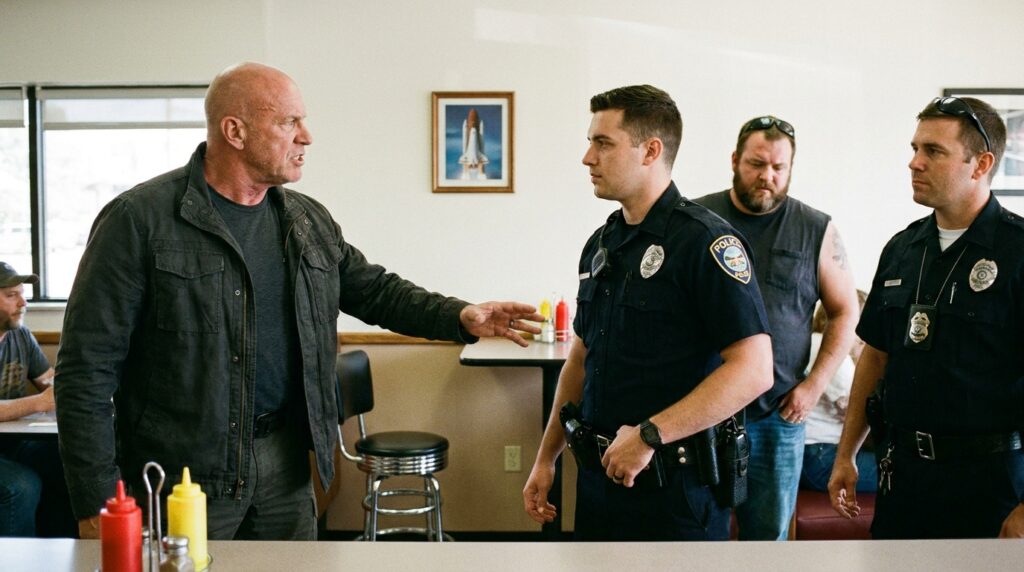
The air inside the museum tavern tasted faintly of pressurized grease, stale draft beer, and the cold, metallic ozone bleeding down from the rafters where the massive replica of the shuttle wing hung suspended. Marcus kept his back to the brick pillar, his fingers lightly resting against the scratched bezel of his watch. The dial was dead, the tritium paint long since decayed into a useless gray paste, but the mechanical ticking remained a steady vibration against his wrist. He didn’t need to look at it to know the contact was four minutes late.
To his left, the bar counter stretched out like an iron-faced shoreline, slicked with spilled liquor and cluttered with glass condiment bottles that caught the low, orange glow of the hanging industrial lights. The tavern was loud—a dense, American chorus of clinking glass, high-status laughter, and the sharp, territorial posture of people who believed their money bought them safety.
Then the shadow cut off the light.
The bouncer was wide, pushing thirty-eight with a beard trimmed to make his jawline look sharper than the soft flesh beneath allowed. His dark, sleeveless shirt exposed arms covered in faded tribal ink, the muscles corded but loose—the build of a man who relied on weight rather than speed. He closed the distance until he was within sixteen inches of Marcus’s chest, his boots clicking heavily against the concrete floor.
“You’re standing in the wrong sector, old man,” the bouncer said, his voice dropping into a performative growl meant for the nearby diners at the counter. He slammed his palm onto the wood right next to Marcus’s hip, his bulk crowding the narrow lane between the bar stools. “This section is reserved for the private reception. You don’t have a wristband. Move.”
Marcus observed the man’s stance. The bouncer’s weight was shifted entirely to his front foot, his chin exposed, his balance completely compromised by his own arrogance. It was an amateur’s leverage, designed to intimidate civilians who feared the mere proximity of mass. Marcus kept his hands low, his fingers curled loosely near the pockets of his dark tactical jacket. He didn’t speak. In the field, speech was noise, and noise was a signature.
“I stood there,” Marcus said softly, his voice dry, level, and entirely devoid of the defensive tremor the bouncer was waiting for. “Because the exit lane is clear from here. I don’t need a wristband to read a fire path.”
The bouncer’s eyes narrowed, a flash of genuine irritation replacing the professional mask. He didn’t like the lack of blinking. He didn’t like the way Marcus’s shoulders remained perfectly squared, unyielding against the brick. The younger man took a half-step closer, his chest rising as he prepared to use actual physical displacement.
“You think you’re funny?” the bouncer muttered, his hand leaving the counter to reach for the collar of Marcus’s jacket.
Marcus didn’t strike. He simply pivoted on his heel, his left hand rising in a brief, circular sweep that caught the bouncer’s wrist from the inside, shifting the man’s incoming momentum down into the hard edge of the bar counter. The movement was a clean, non-graphic redirection of weight—a kinetic equation solved in a single second. The bouncer’s hip slammed into the wood, and the glass condiment bottles rattled violently against the surface, their red contents sloshing behind the glass.
Before the larger man could register the transition, Marcus’s palm was set firmly against the base of the bouncer’s elbow, pinning the arm flat against the slick wood with a cold, unyielding pressure.
“You really thought that move was going to stop me?” Marcus asked quietly, his face inches from the bouncer’s ear.
From behind them, the sharp click of a polymer holster sounded against the concrete, and a junior security guard in a crisp, dark blue service uniform stepped into the lane, his face pale but determined as he drew a short black baton. But Marcus didn’t look at the baton; his eyes were fixed on a small, distinct metallic pin fastened to the young officer’s lapel—a specific insignia from the 160th Special Operations Aviation Regiment, the exact unit Marcus had commanded twenty years before the museum was ever built.








