
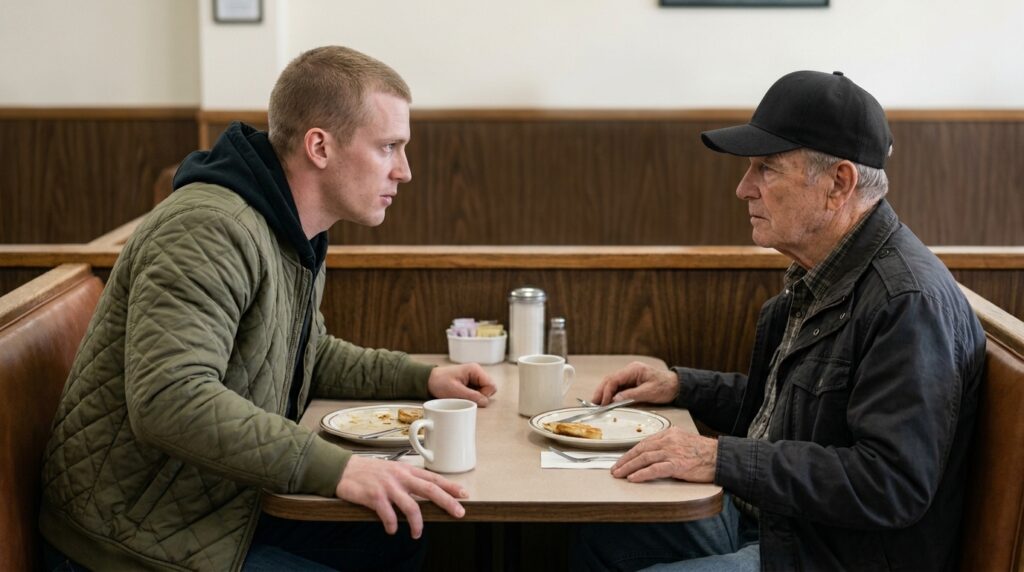
The Steady Weight of Defending Borders Built on Rusted Formica and Broken Promises
CHAPTER 1: THE FRICTION OF OLD HABITS
“You’re not the one I want, stay out of this,” the boy spat, his boots sliding against the grease-slicked linoleum until his hip hit the edge of the booth.
The laminate table hummed under the sudden weight of his knuckles. A heavy, synthetic quilted jacket puffed out as he leaned forward, casting a narrow shadow across the half-empty plate of eggs and the white ceramic mug. The boy’s skin was raw from the dry June wind, his breath smelling faintly of cheap tobacco and stale energy drinks. He didn’t look like a killer; he looked like a transmission that had dropped its gears on a steep grade, grinding itself to shavings because it didn’t know how else to stop.
Calm Seated Veteran did not move his coffee. His thumb remained hooked around the handle, his skin weathered to the texture of a dried riverbed under the structured brim of his cap. The gold lettering on the black wool above his forehead was slightly tarnished, the threads catching the low, yellow glare of the diner’s overhead fluorescent tube. The air between them tasted of burnt grease and old iron, the dull vibration of the upright compressor behind the counter filling the gaps where a conversation should have been.
Behind the register, the waitress froze with the glass pot held three inches above a clean cup, the dark fluid perfectly still. Two booths down, an old mechanic lowered his fork, his eyes tracking the grease stain on the back of the boy’s dark hoodie. Nobody breathed. In towns like this, trouble didn’t arrive with a siren; it walked in through the front door because someone had forgotten to grease the hinges.
The boy’s hand was less than an inch from the rim of the veteran’s mug. His fingers trembled slightly, a white scar slicing across his middle knuckle—a fresh, jagged mark that hadn’t come from a workshop. He was waiting for the flinch. He was waiting for the old man to slide back into the vinyl corner of the booth, to tuck his chin, to look down at the grease-beaded surface of his hash browns.
Instead, the veteran looked up. His neck didn’t crane; he simply tilted his head back until his eyes locked onto the boy’s pupils. There was no fire in them, no sudden flare of ancient authority. There was only the heavy, neutral indifference of a concrete barrier at a highway checkpoint. He had seen men who were actually dangerous—men who didn’t announce their arrival with slammed doors and wet breathing—and this boy didn’t have the weight to tip the scale.
“I’m not your target,” the old man said. His voice was flat, dried out by fifty years of unfiltered cigarettes and North Carolina dust. “Choose someone else.”
The boy didn’t move, but his shoulders dropped a fraction of an inch. The bravado didn’t drain out of him all at once; it hitched in his throat like an engine catching on a bad plug. He looked down at the old man’s hands, expecting them to be balled into fists or reaching beneath the dark winter coat. They weren’t. They lay loose and flat against the Formica, completely motionless beside a small, metallic glint that sat half-hidden under the edge of his saucer.
It wasn’t a weapon. It was an old brass key tag, stamped with three faded digits that didn’t match any lock in this county.

CHAPTER 2: THE BREAKING WEIGHT OF MOMENTUM
“You don’t know a damn thing about what’s mine,” the boy said, but his voice lacked the sharp edge it had carried thirty seconds ago. It dragged now, full of the grit that blew off the dry-farmed topsoil outside.
Calm Seated Veteran didn’t shift his weight on the cracked vinyl seat. The foam beneath the blue-and-white patch repair didn’t even creak. He watched the boy’s fingers twitch away from the Formica, leaving a faint, oily smudge near the base of the white ceramic mug. The boy’s skin was too pale for June, the color of someone who spent his daylight hours under the tin roof of an uninsulated shop, chasing gremlins in old diesel pumps.
“I know the sound of a dry gear,” the veteran said. His tone remained perfectly flat, an unpainted fence post in a wilderness of noise. “And I know when a man’s looking for an exit he hasn’t earned.”
Behind the counter, the short-order cook let the spatula slide down the grease trap with a dull, metallic clink. The sound was too loud in the dead air of the diner. The waitress, her name-tag Clara pinned slightly crooked on her faded blue apron, took a slow step backward until her spine met the stainless steel of the pie case. She didn’t look at the boy; she looked at the tarnished gold lettering on the old man’s cap, as if measuring the distance between what the town used to be and what it was turning into.
The boy took a long, shallow breath through his nose. His teeth ground together, a tiny knot of muscle jumping at the corner of his jawline. He wanted to hit something—the veteran could see the calculation moving behind the boy’s clouded eyes, the kinetic urge to disrupt the absolute stillness of the booth. But there was nothing to anchor the violence. The veteran wasn’t matching his posture; he wasn’t offering friction. He was simply existing there, an immovable mass of salt-and-pepper hair and heavy flannel that had survived colder winters than this boy had seen years.
“My old man said guys like you think you own the county just because you got a piece of tin in a drawer somewhere,” the boy muttered, his hand dropping down to the pocket of his quilted jacket. The nylon rasped against his coarse denim jeans, a dry, grating hiss that scraped against the quiet room.
“Your old man spent his disability checks at the track in Henderson,” the veteran said, his thumb finally moving. He didn’t raise his hand; he just shifted his thumb across the chipped rim of his mug, tracking the small, grey line where the glaze had flaked away down to the porous clay beneath. “And he never learned how to seat a ring properly on a four-stroke. Don’t carry his bad habits into a crowded room.”
The boy’s face flushed a dark, bruised red beneath the grease smudges. He took half a step back, his boot heel catching the metal strip that held the linoleum tiles to the floor. The friction was audible—a sharp squeak of rubber against wax. He looked around the room then, his eyes wild and seeking some kind of leverage, some witness to validate the heat burning in his chest. But the mechanic in the corner booth had turned his back completely, focusing on a grease-spotted napkin, and the couple near the door were already reaching for their coats, their movements silent and hurried.
The lack of an audience was a physical blow. The boy’s shoulder hit the corner of the wooden divider separating the booths, the impact muffled by his padded jacket. He looked back at the old man, his lips parting as if to let out another string of inherited grievances, but the veteran merely raised his cup. The movement was slow, deliberate, the dark surface of the coffee remaining perfectly level as it rose toward his mouth.
“The wind’s coming up from the south,” the veteran murmured before taking a sip. “If you’ve got iron sitting out in the yard, you’d better cover it before the dust takes the oil off.”
The boy stood there for three more seconds, his fingers buried deep in his pockets, his lean frame shaking with the residual vibration of an adrenaline rush that had nowhere to go. He wasn’t a dangerous man anymore; he was just an inconvenience that had run its course. With a jerky, uncoordinated turn, he swung toward the double doors, his boots thudding heavily against the floorboards until the glass shook within its rusted aluminum frame.
The screen door slammed once, twice, the pneumatic cylinder whistling as it gave up its air.
The veteran didn’t watch him through the window. He set his cup back down in the center of the saucer, exactly where it had been before the boy entered the space. The small brass key tag sat beside it, its three faded numbers catching the grey light that filtered through the grease-filmed glass of the front window.
He reached for the napkin holder to clear his side of the table, his rough fingers catching on something stiff and white that had been shoved beneath the weighted metal base. It wasn’t a stray receipt. It was a thick piece of legal stock, folded into thirds, the edges soft and grey from moisture.
The veteran pulled it free with a slow, calloused drag of his hand.
CHAPTER 3: THE GRAIN OF THE PAPER
The paper didn’t want to come out. It had sat beneath the heavy, chrome-plated base of the napkin dispenser long enough for the salt-laden humidity of the valley to soften its grain, molding it against the rusted steel rivets below.
Calm Seated Veteran applied a slow, linear pressure with his right hand. The skin of his knuckles, cross-hatched with old scars and small blue veins that traveled beneath the surface like buried copper wires, didn’t twitch. He felt the resistance first—the dry, microscopic tear of wood pulp catching on oxidized metal—before the folded sheet slid free into the grey light of the table.
It was legal stock, three times the thickness of a diner receipt, stained a deep amber around the bottom margin where old coffee spills had crept into the grain. The printed text at the top was bold and blocky, typed out on a ribbon that had been failing even then, leaving the letters faint, broken at the edges like ancient fencing.
NOTICE OF INTENT TO RECLAIM ACQUISITION AREA 4.
The veteran did not unfold the paper fully. His thumb rested over the small seal at the corner—a circular embossed mark that had flattened out into a ghost of silver foil over the decades. He didn’t need to look at the description of the parcels. He knew the numbers by heart. He knew the surveyor’s lines that cut through the creek beds, the stone markers that had been buried three feet deep in the hard clay under what was now the boy’s unpainted machine shop.
Across the room, Clara let the glass pot settle into its heating element with a small rattle. Her shoes made a wet, sucking sound against the linoleum as she approached the booth, her hand carrying a yellow plastic check pad.
“He shouldn’t have been in here saying those things to you, Arthur,” she said. Her voice was thin, the texture of cheesecloth that had been scrubbed too many times in the back sink. “His mother’s stayed up at the property three days without her well-pump running. He’s out of his mind with it.”
Arthur—the name felt small and detached in his own ears, a label used by people who only knew him by his mail—did not look up from the document. He turned it over, his thumb dragging across the crease until the paper gave a sharp, dry snap.
“The pump isn’t broken,” Arthur said. His voice was lower than the idle of the logging trucks that parked on the shoulder outside. “The line’s capped at the main junction by the county road. They put the lock on it Tuesday.”
Clara stopped two feet away, her apron strings hanging loose down the side of her hip. Her eyes shifted from the tarnished gold on his cap down to the water-damaged document. She didn’t reach for it. No one in this basin reached for paper unless it had a check attached to it or a sheriff’s signature at the bottom.
“The boy thinks it’s the diner owner’s son doing it,” she whispered, her gaze tracking a fly as it buzzed against the dirty glass of the front transom. “He says the family’s clearing out everything north of the old rail spur to build the new dry storage lockers. He was out there at dawn with an iron bar, trying to clear the valve himself.”
Arthur looked out through the window. The sky had lost its blue completely, turning the color of wet zinc as the south wind began to lift the fine silt from the dry lake bed six miles down the valley. A plastic oil drum was rolling across the gravel lot, its hollow thud-thud-thud counting out the seconds against the fence line.
“An iron bar won’t turn a brass cylinder that’s been frozen in lime since seventy-six,” Arthur said. He folded the notice once more, the thick paper resisting his hand until it settled into a stiff square that fit exactly into his inside coat pocket. “He’ll just shear the nut off the stem. Then nobody gets water until the state brings a crew down.”
He reached down to the table, his index finger hooking the small brass key tag with the faded numbers 104. The metal was cool, pitted with small grey spots where the nickel plating had worn away to expose the dull, orange alloy underneath. It didn’t belong to a room; it belonged to a locker that had been cut out of a concrete wall in the basement of the old county clerk’s annex before they tore the brickwork down to make room for the bypass.
“He’s going to the county office next,” Clara said, her pencil tapping twice against the plastic pad. “He was talking about it at the counter before you came in. Saying he’d find out who filed the original easement definition. The old maps from before the state took the corridor.”
Arthur stood up. His knees made a dull, dry sound inside his denim trousers, his weight settling into his boots with a slow, heavy deliberation. He didn’t use the table to brace himself. His back remained straight, his shoulders square beneath the dark wool of his jacket, though his left hip dragged slightly as he cleared the edge of the booth.
He laid a five-dollar bill on the damp Formica, the paper crisp and clean against the grease ring left by his mug.
“If the boy comes back,” Arthur said, his hand settling on the door handle before the bell could ring, “tell him the records aren’t in the town office. They haven’t been there since the fire in ninety-two.”
He didn’t wait for her to answer. He pushed the door open, the heavy glass resisting the rising pressure of the outside air as the first grit of the sandstorm rattled against the aluminum frame like buckshot.
The air in the lot was thick with the smell of dry clay and ozone. Across the gravel, the boy’s old red pickup was gone, leaving only two dark spots of oil where the oil pan had been weeping onto the stones. Arthur walked toward his own truck—an old inline-six with rusted wheel wells and an iron pipe bumper that had seen three separate deer and one stone wall without shifting its alignment.
He pulled the heavy door open, the hinge groaning as the wind caught the metal. On the passenger seat sat a flat, green canvas map case, its leather straps stiff and cracked from forty years of grease and floorboard dust.
He didn’t open it yet. He sat behind the wheel, his eyes on the road that led toward the ridge where the old rail beds used to run, his hand tightly closed around the brass tag in his pocket until the numbers pressed deep into the meat of his palm.
CHAPTER 4: THE GRIT IN THE MACHINE
The starter motor groaned twice, a low, zinc-on-iron scrape that vibrated upward through the floorboards and into the heels of Arthur’s boots. On the third revolution, the straight-six caught, its idle uneven, spitting blue oil smoke into the red dust that was already beginning to pile against the fence posts of the gravel lot.
Arthur shifted the lever into reverse, the mechanical linkage under the floor clicking with the heavy, dry precision of a locking bolt. The truck rolled back, its tires grinding over the packed river stone, before he swung the front bumper toward the county line road. The wind was coming hard now, a steady forty-mile gale from the lake beds that hit the driver’s side door with a sound like dry corn thrown against a barn wall.
The green canvas map case slid six inches across the vinyl bench seat, its brass buckle clinking against the exposed metal seat frame. He didn’t touch it. His hands stayed at ten and two on the cracked plastic wheel, his thumbs hooked loosely inside the rim. His knuckles were gray from the dust that seeped through the rotted rubber seals of the firewall, but they didn’t shake.
Two miles north, where the old rail grade rose to meet the limestone bluff, a dark shape sat skewed across the shoulder. It was the red pickup. The hood was propped open, held against the gale by an old piece of two-by-four, and the boy was leaning deep into the engine bay, his quilted jacket ballooning around his shoulder blades as he worked a wrench against something frozen.
Arthur didn’t slow down until his front bumper was six feet from the boy’s tailgate. He pulled the handbrake, the ratcheting teeth clicking nine times before holding the vehicle against the incline.
When Arthur stepped out, the wind took his cap, forcing him to bring his left arm up to pin the wool against his temple. The air was a thick, orange wall that tasted of sulfur and dry silt. He walked to the edge of the open hood, his boots sinking two inches into the soft sand piling on the asphalt.
“The nut’s sheared,” the boy yelled over the rattle of his loose valve train. He didn’t look up, his fingers slick with black grease as he tried to force a pair of slip-joint pliers onto the rounded shoulder of the fuel line fitting. “The whole line’s dry. They did something to the pump up at the tank. Don’t tell me to leave it, old man. I know what they’re doing.”
“You’re using the wrong jaw for a brass sleeve,” Arthur said. He reached down, his thick fingers bypassing the boy’s hand to touch the copper line. It was cold, vibrating with the pulse of an empty fuel pump that was sucking air from a tank that had been tapped from the bottom. “You didn’t check the filter element. The silt from the storm got past your separator three miles back. The car’s done.”
The boy swung the pliers, the metal missing Arthur’s sleeve by three inches as the wind caught his arm. His eyes were bloodshot, the rims packed with red clay, his face streaked with sweat that had dried into a crust along his jaw.
“The diner owner’s son said you were the one who drew the line,” the boy shouted, his chest heaving under the quilted nylon. He stepped back until his spine hit the rusted radiator support. “He said the county didn’t even have a map for Area 4 until you brought that green case into the office back in eighty-four. He said my mother’s house is sitting on forty feet of state easement because of you.”
Arthur stood perfectly still between the two trucks. The wind was lifting the corners of the green case on his passenger seat through the open cab window, the canvas flapping like a crow’s wing. The boy was breathing through his mouth now, his teeth grey from the grit, his hand holding the pliers like a weapon he didn’t know how to drop.
“The son doesn’t know how to read a legal description,” Arthur said. His voice didn’t rise; it stayed beneath the roar of the wind in the scrub oak, flat and heavy. “He thinks every line on an old blue-print is a fence. He’s pushing you because he wants the concrete slab under your shop for his storage units. If you go to the county clerk with that notice, you’re giving them the right to lock the gate.”
“Then who has the deed?” the boy stepped forward, his boot heel slamming into the oil pan he’d laid on the ground, spilling a dark, viscous circle onto the sand. “Who signed the transfer that took the water line out? My mother’s been there forty years, Arthur. Forty years without a late tax receipt.”
Arthur reached into his inside pocket and pulled out the folded, water-stained document he’d taken from beneath the napkin holder. He didn’t hand it over. He held it down against his thigh, the paper snapping in the wind like a small pistol shot.
“This isn’t an eviction,” Arthur said, his eyes locking onto the boy’s face with the same unyielding mass that had stopped him at the booth. “It’s an appraisal. The son bought the debt from the bank in Henderson three months ago, but he doesn’t have the clear title to the easement. He’s waiting for you to abandon the pump so he can claim failure of use.”
The boy looked from the paper to the green canvas case visible through the window of Arthur’s truck. The physical connection between the old man and the maps that defined the valley was too clear, too heavy to ignore. The boy’s hand lowered, the pliers slipping from his greasy fingers to fall into the red dirt between his boots.
“Then why are you out here?” the boy asked, his voice cracking as the first large drops of a mud-rain began to spot his jacket. “If you didn’t draw the line, why do you have the tag?”
Arthur turned back toward his cab, his left hip dragging slightly as he broke his stance. He didn’t answer. He climbed behind the wheel, his hand going down to his pocket where the brass tag with the numbers 104 sat against his leg. Through the glass, he saw the boy slide down against his own fender, his head buried in his grease-stained hands as the orange dust turned to streaks of red clay across his shoulders.
Arthur engaged the clutch, the truck pulling away from the stranded vehicle with a low, heavy whine from the differential. He looked down at the canvas case beside him. The leather strap was held by a single brass rivet that had gone green with oxidation, but the lock was still bright—a small, square tumbler that required a three-digit key he hadn’t turned since the county office burned down in ninety-two.
The road ahead was disappearing into the grey wall of the ridge, the silt turning the world the color of old iron as the truck climbed higher into the white clay cuts.







