
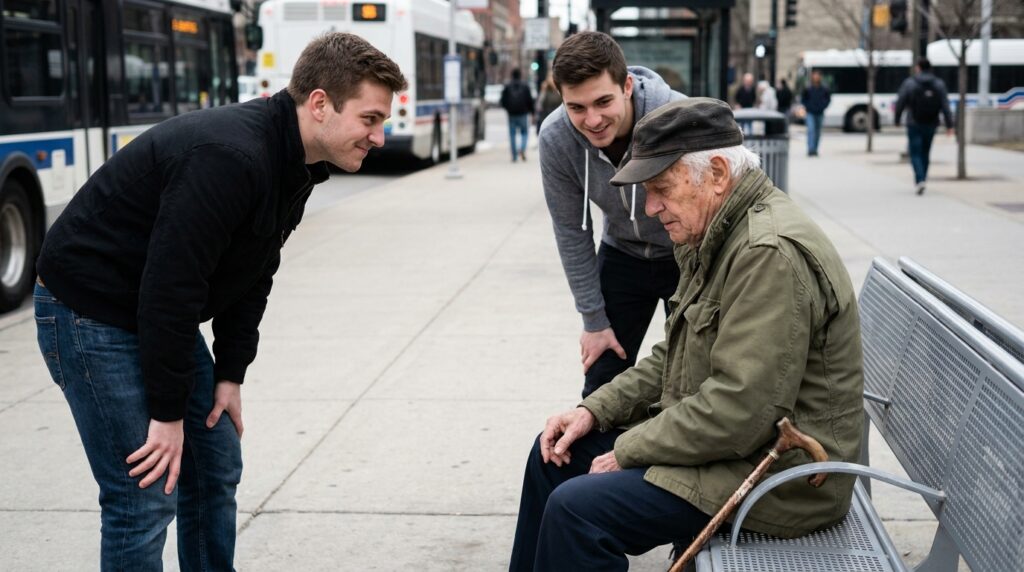
The Iron Alignment: A Story of Cold Calculation, Shattered Bravado, and the Weight of Forgotten Lineage

CHAPTER 1: THE GATHERING FROST

The reflection in the oily puddle near the curb moved too fast to be a commuter. Commuters shuffled; they kept their chins tucked into their collars to shield against the damp Ohio drizzle, their eyes anchored strictly to the schedule or the toes of their boots. These two didn’t shuffle. Their silhouettes lengthened across the wet asphalt, wide-shouldered and loose, cutting through the yellow glare of the streetlamps with the distinct, predatory rhythm of kids who owned the block because nobody else wanted it.

The veteran didn’t turn his head. Under the stiff brim of his unadorned cap, his eyes remained fixed on the gray concrete between his sneakers. He counted the beats of their footsteps against the distant, low-frequency hum of the interstate. Three hundred yards out. Two hundred. They were laughing—sharp, barking sounds that lacked any real humor, designed only to occupy space and test the silence of the corridor.

His hands rested on the curved handle of the ash-wood walking cane. The wood was cold, polished smooth by years of friction against his palm, the rubber tip anchored firmly against the stained edge of the transit pad. To a casual glance from across the avenue, he was just a monument to decay—a slightly hunched frame wrapped in a faded olive-drab field jacket, the frayed stitching on the right shoulder turning silver under the fog.

He felt the shift in the air before he heard the scrape of their sneakers on the concrete. The primary mocker, the one in the heavy black streetwear jacket, stepped directly into his peripheral vision, his shadow blotting out the yellow light from the convenience store window. The kid smelled of cheap vape juice and damp nylon. He didn’t just walk up; he crowded the bench, his hips twisting into a casual, arrogant stance that calculatedly blocked the older man’s path to the sidewalk.

“Hey,” the kid said. It wasn’t a greeting. It was a probe.

The veteran kept his chin low, his breath coming in slow, rhythmic measures through his nose. His ribcage barely moved. Decades ago, in rooms where the walls were thick enough to muffle gunfire, he had learned that men who were about to strike became loud before they became fast. This one was loud. The kid’s companion, a younger boy in a gray hoodie, hovered a half-step behind, his mouth split into an amused, expectant grin, his eyes darting toward the street to ensure no police cruisers were idling at the intersection.

The black jacket leaned forward, his hands deep in his pockets, his face dipping under the shelter’s rusted awning. “I asked you a question, old man. You deaf or just stupid?”

The veteran looked down at the kid’s sneakers. White leather, scuffed at the toe, the laces untied. A detail. A weakness in footwork if the ground became slick. He didn’t answer. He let the silence stretch until it became an active weight in the shelter, forcing the kid to lean in even further to bridge the gap, his posture overextending, his balance shifting entirely to his heels.

Then the kid sneered, his teeth catching the raw light of the vending machine. “Come on old man, what are you going to do about it?”

The veteran’s fingers didn’t tighten on the ash-wood cane. They loosened. He let the wood tip an inch to the side, releasing the illusion of reliance, his weight shifting cleanly into the balls of his feet as his eyes locked onto the dark fabric of the kid’s collar.


CHAPTER 2: THE CONSTRICTION ZONE

The white sneakers didn’t just slide; they hitched on a seam in the wet concrete.

The kid in the black jacket didn’t understand the physics of it yet, but his body did. His eyes, wide and suddenly white-rimmed under the yellow glare of the bus shelter, tracked the movement of the old man’s hands. The wood hadn’t swung. It hadn’t clattered. The ash-wood cane had simply cleared the ground by an inch, its shadow stretching long and sharp toward the curb as the veteran’s center of mass shifted forward.

To the kid, it must have looked like a structural collapse—an old wall suddenly tipping into the street—but it was too quiet for a fall. There was no lunging. There was no amateur gathering of muscle. The veteran’s shoulders remained perfectly horizontal, a rigid axis cutting through the driving mist.

The younger one in the gray hoodie ceased his grinning. The sound didn’t fade; it clipped off cleanly, a small, wet intake of breath that signaled the exact moment his hindbrain recognized a predator. He didn’t step forward to assist his friend. His heels hit the rusted structural pillar of the transit awning, the cold metal catching him between the shoulder blades with a hollow thunk.

“Back up,” the kid in the black jacket muttered. His voice had lost its edge, the cocky Ohio drawl replaced by a high, defensive rasp. He didn’t take his hands out of his pockets. That was his second mistake. By keeping his fingers jammed deep into the nylon lining, he had pinned his own elbows against his ribs, destroying his lateral balance. “I said back up, old man.”

The veteran didn’t grant him the distance. He occupied the space the kid vacated, his boots stepping precisely into the dry square of concrete beneath the awning. Up close, the lines on the older man’s face weren’t signs of fragility; they were deep, calculated fissures that didn’t twitch under the pressure. The yellow light from the vending machine caught the silver edge of his jaw, sharp as a shaved coin.

In the kid’s open pocket, a small object glinted against the dark fabric—a brass key-ring, its edge notched with three deep, uniform filing marks. It was a non-standard modification, the kind of alteration made by someone who spent too much time trying to bypass cheap padlocks on commercial storage units. The veteran’s eyes logged it, stored it, and dismissed it within the space of a single heartbeat. A thief’s tool. A marker of small-time desperation.

“You’re crowding the lane, son,” the veteran said. The voice didn’t come from his throat; it came from deep within his chest, a low, gravelly vibration that carried the structural resonance of an iron grate sliding over granite. It wasn’t loud, but it had the distinct quality of a command that had once traveled across open tarmac through the roar of twin-turbine engines. “The city gives you eight feet of sidewalk. You’re using nine.”

The primary mocker tried to twist his torso, a frantic attempt to re-establish his stance, but his scuffed white sneakers found the slick, oily film of the roadside puddle. His right heel slipped an inch. His weight dropped heavily onto his left hip, his shoulder clipping the wooden slats of the transit bench with a sharp, splintering crack.

The gray hoodie watched the descent, his face pale within the shadow of his cotton fleece. He looked down at his companion, then up at the old man’s olive field jacket. His gaze lingered on the frayed stitching on the right shoulder—the pale, faded rectangle where a velcro unit identifier had been stripped away with enough force to scar the fabric permanently. The boy’s fingers twitched against his thighs, but he remained anchored to the metal pillar, a historical witness to a total systemic failure.

The black jacket didn’t get back up. He sat heavily on the damp wood of the bench, his breath coming in short, ragged puffs that turned to white vapor in the cold air. His hands finally slipped free of his pockets, but they didn’t form fists. They spread flat against the wet slats, his fingers gripping the grain as if the earth itself had begun to tilt beneath his boots.

A square white corner of paper showed at the lip of his jacket’s internal pocket—heavy stock, official, bearing a faint blue watermarked seal that looked remarkably like a selective service heading. It was crisp, uncreased by travel, the kind of document that arrived via certified mail and remained unread on a kitchen table for weeks until the pressure forced it into the street.

The veteran stood over him, his shadow completely enveloping the bench. He didn’t lean down. He didn’t offer the kid the satisfaction of a threat. He simply adjusted his cap, his long, scarred fingers pulling the brim down until his eyes were completely swallowed by the darkness of the shelter’s awning.

“You’ve got five minutes before the forty-two line pulls up,” the old man said, his eyes shifting back to the road where the yellow headlights were just beginning to cut through the fog at the edge of the industrial park. “I suggest you find another place to wait.”

The kid didn’t answer. His mouth stayed slightly open, a small drop of rain catching the light on his chin as he looked up at the straight, unyielding line of the veteran’s spine. The silence returned to the shelter, but it was different now—it wasn’t the silence of an empty street, but the heavy, vibrating stillness that follows a sudden explosion.

CHAPTER 3: THE LEVER OF PRECISION

“The forty-two line doesn’t detour for mistakes,” the veteran said.

His hand went down. It wasn’t a reaching motion; it was a deliberate drop, his long, dry fingers closing not around the handle of the ash-wood cane, but across the top edge of the official white stock paper protruding from the kid’s jacket pocket. The movement was so exact, so clean of telegraphing tension, that the primary mocker didn’t react until the crisp grain of the paper was already sliding against his inner lining.

The kid’s hand twitched downward, his fingers spreading like a fan across his knee, but his knuckles struck the hard edge of the veteran’s wrist block. There was no impact sound, just the dull friction of sleeve fabric against sleeve fabric. The veteran didn’t shove. He simply anchored his forearm at a forty-five-degree angle, locking the kid’s shoulder against the back slats of the bench through basic skeletal leverage.

“Give that back,” the kid whispered. The aggressive drawl from three minutes ago was entirely gone, replaced by a flat, unvarnished urgency. His eyes shifted down to the paper, then back up to the shadow beneath the veteran’s cap. “That ain’t yours. You don’t know what that is.”

The veteran pulled the document completely free. The white stock was stiff, damp along the upper corner where the Ohio mist had begun to pool. In the harsh, yellow illumination of the vending machine, the blue watermark wasn’t a standard selective service seal. It was an enlistment rejection matrix from the Department of Defense, stamped with a heavy, crimson overlay: UNFIT FOR SERVICE – PSYCHOLOGICAL DISCONFORMANCE.

Beneath that primary stamp, running along the very margin of the page where the paper met the veteran’s thumb, was a secondary alphanumeric sequence. It was small, rendered in a faded, non-standard violet ink that had bled slightly into the wood pulp: MD-OBL-79.

The old man’s thumb didn’t move over the sequence. His skin remained perfectly still against the ink, but his internal calculation shifted instantly. He knew that sequence. It wasn’t an administrative error; it was an obsolete procurement code used exclusively by the third-tier logistics wing during the late Cold War border reorganizations—the same division that had cleared his own records from the national archives forty years ago.

“MD-OBL,” the veteran murmured. He didn’t say it loud enough for the kid in the gray hoodie to hear, but the primary mocker’s posture froze entirely at the sound of the syllables. The kid’s chest stopped its rapid rising and falling. His fingers dipped back toward the wooden bench, his nails digging into the damp grain.

“You can read it,” the kid said. It wasn’t a question anymore. His voice was thin, sharp as a wire drawn taut between two points. “They told me nobody on the civilian side could read that string. They said if anyone asked, it was a clerical error from the regional intake branch.”

“They lied to you,” the veteran said. His arm didn’t lose its rigidity. He held the paper flat against the yellow light, his eyes moving across the text with a mechanical sweep that left no room for emotional variance. “They always use that specific ink when they want a file to dissolve under standard sorting lights. It keeps the intake clerk from flagging the source station.”

A half-step behind the bench, the boy in the gray hoodie finally moved. He didn’t advance toward the older man; instead, his boots scraped backward over the gravel at the edge of the concrete transit pad. He was looking at his companion’s face, tracing the sudden, bloodless pallor that had spread from the kid’s jawline down into his collar.

“Marcus,” the gray hoodie said, his voice cracking slightly against the distant roar of the interstate. “Marcus, let’s just go. The bus is coming around the curve by the warehouse. We can take the walk down to the avenue.”

The kid on the bench—Marcus—didn’t move a muscle. He remained pinned under the heavy, vertical shadow of the old man, his eyes fixed on the pale rectangle of paper that carried his life’s sharpest failure. His mouth opened slightly, his teeth catching the raw glare of the neon signage.

“He knows,” Marcus said, his voice dropping into a flat, monotone register. “He knows what the station code means, Caleb. He’s not a local.”

The veteran folded the white stock once, the crease snapping like a dry twig in the quiet of the shelter. He didn’t put it in his own pocket. He held it out, his fingers resting on the very edge of the paper, offering it back to the kid with the same calculated indifference he had used to take it.

“A rejection from a ghost station isn’t a draft notice, son,” the veteran said, his gravelly voice dropping an octave until it cut cleanly beneath the sound of the approaching bus engines. “It means they looked at your lineage and decided you were too loud to keep a secret. You want to prove you’re worth the ink they used on you? Learn to sit still when the room gets dark.”

Marcus reached out, his hand shaking with a fine, high-frequency tremor as his fingers took the folded document. He didn’t slide it back into his pocket; he held it tightly against his ribs, his shoulders hunching forward until his chin nearly touched the black nylon of his jacket.

The headlights of the forty-two line swept across the wet asphalt of the intersection, turning the yellow puddles into blinding, silver mirrors. The reflection struck the shelter’s rusted awning, casting a lattice of sharp, dark bars across the veteran’s face. Beneath the cap, his jaw remained set, his eyes already shifting away from the two young men to analyze the hydraulic entry system of the approaching vehicle.

CHAPTER 4: THE SHATTERED MASK

The blinding reflection of the headlights didn’t hit the bus shelter like a public transit vehicle should.

A municipal forty-two bus carried a broad, high-mounted halogen array that washed over the entire concrete pad uniformly. This light was different. It came from dual, tightly focused projector lenses mounted low to the bumper, slicing through the gray Ohio mist in two parallel, razor-sharp needles. They didn’t slow at the designated transit line forty feet out. They surged forward, the massive chrome grille of an unbadged black transport van swelling into the frame with the heavy, hydraulic momentum of a machine built for kinetic interception.

The veteran’s eyes didn’t widen. They narrowed, his pupils instantly tracking the deceleration rate through the rhythmic slap of the heavy wipers against the windshield. It wasn’t the municipal line.

“Get behind the bench,” the veteran said. The command didn’t carry the previous instructional gravel; it was a flat, low-frequency clip that left no room for hesitation. His hand went down to the ash-wood cane, his fingers sliding into the notched grip with absolute mechanical precision.

Marcus didn’t move fast enough. He was still staring at the folded document in his fist, his brain locked in the shock of the station code reveal. The black van’s tires struck the curb with a sharp, heavy thud, the wet rubber spitting a fan of dark, oily puddle water directly across the concrete pad. The pneumatic hiss of the front doors releasing wasn’t the standard two-stage hiss of a city transit carrier—it was a rapid, high-pressure decompression that signaled an up-armored air brake layout.

Before the door had fully clearing the latch, a man stepped onto the asphalt. He didn’t wear a uniform, but his posture was identical to the line work the old man had left behind forty years ago—shoulders pinned back, weight centered low over heavy leather tactical boots, a dark nylon windbreaker concealing his right hip. His face was completely smooth, devoid of distinguishing features except for a thin, pale communications wire coiling into his right ear canal.

The visitor’s gaze didn’t linger on Marcus or Caleb. It locked directly onto the frayed stitching on the veteran’s right shoulder, his eyes identifying the specific dimension of the missing patch frame within a fraction of a second.

“Station code seven-nine is inactive, old man,” the visitor said. His voice was entirely neutral, carrying the flat, monotone drone of someone reading coordinates off a terminal display. He didn’t draw a weapon, but his right hand remained anchored near his lower pocket lane, his fingers curved into an open ready position. “The regional branch noted a signal trip on the administrative subnet three minutes ago. You’re holding paper that belongs to a locked ledger.”

Marcus finally collapsed backward, his spine hitting the wooden slats of the bench with a dull impact as his boots slipped on the wet concrete. His fingers let go of the folded sheet; the white stock fluttered once in the draft before the visitor’s heavy boot came down flat across the paper, pinning it to the stained concrete pad with a heavy crunch of gravel.

The veteran stood his ground, his spine forming a vertical line that cut the yellow light of the vending machine cleanly in two. He didn’t raise the cane. He didn’t drop into a defensive crouch. He shifted his grip down the ash-wood shaft by exactly three inches, utilizing the lower third of the wood as a counterweight against his forearm.

“The boy was rejected at an intake portal,” the veteran said, his low voice cutting beneath the idle of the van’s heavy diesel engine. “That makes him a civilian asset under the seventy-two agreement. You have no operational logic to cross the transit lane.”

The visitor took a half-step forward, his weight pressing down on Marcus’s pinned file until the crisp white paper began to tear along the margin ink. “The seventy-two agreement was dissolved before these kids were born, counselor. The ledger is entirely open. You’re standing in an unmapped grid with a dead man’s cap.”

With his left hand, the visitor reached out—not toward the veteran, but toward Marcus’s collar, his fingers ready to grab the black nylon fabric to pull the boy toward the open door of the van.

The veteran’s response was a single, measured micro-movement. He didn’t swing the wood; he stepped into the visitor’s approach lane, his left shoulder blocking the man’s reach while his hand pulled the cap from his own head.

As the cap came free, the yellow neon light from the convenience store caught the side of the older man’s skull. Running from the crown down to the very base of his left ear was a thick, silver ridge of fibrous tissue—a precise, surgical track that could only have been left by a high-velocity bone saw during a military medical intervention. It wasn’t an ordinary scar from a field injury; it was the distinct hallmark of an unauthorized cranial clearing, the kind administered to personnel before their names were scrubbed from the national service registry to prevent any recovery of operational memory.

The visitor’s fingers froze an inch from Marcus’s jacket. His eyes dropped to the silver ridge of tissue, his jaw tightening as his head tilted slightly to process the structural geometry of the scar. His communication wire gave a small, distinct electronic beep that echoed in the quiet of the shelter.

“The tribunal,” the visitor said, his flat tone breaking for the first time, a sharp note of institutional recognition surfacing in his throat. “The sixty-eight line. You’re the asset from the valley.”

“There are no assets left in this valley,” the veteran said. He didn’t look down at the man’s hand. He kept his eyes locked on the visitor’s pupils, his gaze completely steady under the driving rain. “Just two kids who need to get on the forty-two line, and an old man who knows exactly how much noise a diesel engine makes when it’s idling in a restricted zone.”

The visitor didn’t retreat, but his hand slowly lowered away from Marcus’s collar. His fingers returned to his side, his posture stiffening as the communication wire in his ear clicked twice in rapid succession. The heavy door of the black transport van remained open, its low-frequency engine vibration rattling the rusted metal frame of the shelter.

CHAPTER 5: THE SUBDUED HORIZON

The visitor’s fingers didn’t stay near his pocket. They moved back to his side, sliding an inch down his thigh to clear the lower edge of his nylon windbreaker, his hand flattening against his denim trousers. The pale wire in his ear gave another sharp, metallic click—a dry, double-pulse transmission that sounded like a remote relay station confirming an unlisted data point.

He looked down at the mud-stained leather of his boots, then back at the silver ridge of tissue trailing into the veteran’s collar. The identification was complete. In the logic of the registry he served, a man with that specific surgical marker didn’t possess an address, a financial routing number, or a active file in the national census. He was a historic variable—a ghost left behind in the rust belt because the state had run out of black ink to finish the ledger.

“The sixty-eight line was logged as non-recoverable,” the visitor said. His voice had returned to its flat, monotone baseline, but the horizontal orientation of his shoulders had shifted. He was no longer crowding the center depth of the awning. He was leaning back into his heels, his weight redistributing to allow for an immediate lateral exit if the space became hostile. “The archive division in Arlington cleared the terminal logs two cycles ago. You shouldn’t be standing on a municipal transit route.”

“I have a monthly voucher,” the veteran said. His hand went back to his head, his fingers smoothing the dark cotton of his cap back over the scar until the silver tissue was entirely blotted out by the shadow of the brim. He didn’t lock the cane back into his palm; he let the rubber tip rest light against his sneaker, using it to monitor the low-frequency vibrations humming through the wet concrete. “The county transit board doesn’t check the Arlington registry before they clear the forty-two line.”

On the bench, Marcus let out a slow, trembling breath that formed a gray cloud against the glass of the vending machine. He was still looking at the visitor’s boot, which remained parked squarely on the edge of his folded rejection letter. The blue watermark was crushed, the fibers of the paper pulp absorbing the dark, grease-heavy moisture of the curb until the crimson PSYCHOLOGICAL DISCONFORMANCE stamp began to smear into a dull violet stain.

“Get up, Marcus,” the boy in the gray hoodie—Caleb—said from the edge of the shelter. His voice was raw, thin as a shaved wire. He hadn’t stopped looking at the black transport van idling at the curb. The exhaust pipe was spitting a thick, blue plume of diesel smoke into the drizzle, the smell of burnt petroleum completely drowning out the scent of the convenience store trash. “Marcus, move your legs. Now.”

The primary mocker didn’t look at his friend. He gripped the edge of the bench, his knuckles turning a dry, bloodless white against the damp wood grain. He didn’t use the cocky, expansive posture that had defined his entrance. His shoulders were drawn inward, his chest hollowed as if he were trying to reduce his physical volume under the steady, vertical gaze of the old man.

“I didn’t know,” Marcus whispered. He wasn’t looking at the visitor; he was looking directly at the frayed stitching on the veteran’s right shoulder where the unit patch had been cut away. His voice lacked its previous resonance, dropping into the submissive cadence of an enlistee addressing an inspector at a high-intensity intake point. “They just gave me the packet at the regional courthouse. They told me to wait here for the commercial shuttle to the depot.”

The visitor looked down at the paper beneath his heel, then slowly dragged his boot backward, releasing the sheet. The white stock was torn along the upper corner, the alphanumeric sequence MD-OBL-79 nearly obliterated by the tread mark.

“The shuttle isn’t coming, kid,” the visitor said, his eyes returning to the veteran’s face, tracing the unblinking, mechanical stillness of the older man’s pupils. “The intake sequence for station seven-nine was closed out forty-eight minutes ago. The ledger is clean. If you’re still on this pad when the city bus pulls in, you belong to the county.”

He turned on his heel. The movement was a perfect ninety-degree pivot, clean of the amateur hip-sway that Marcus had used to crowd the shelter. He didn’t look back at the old man or the two boys. He stepped into the open doorway of the black transport van, his tactical boots clicking twice against the up-armored threshold before the pneumatic system slammed the panel shut with a heavy, metallic clack.

The air brakes released with a loud, high-pressure screech that rattled the rusted tin roof of the shelter. The low projector lenses swept away from the concrete pad, their needles of white light pivoting into the rain as the vehicle swung back onto the industrial park access road, its heavy tires throw up a high fan of yellow water as it accelerated into the dark.

Marcus reached down, his fingers shaking as he picked up the damp, torn sheet of paper from the wet gravel. He didn’t look at the text. He folded it twice more, reducing it to a small, tight square that he shoved deep into the interior lining of his jacket, pulling the zipper all the way to his throat.

The true forty-two line was visible now at the far end of the avenue—a large, lumbering white box with a high-mounted halogen array that washed over the entire street with a flat, predictable glare. It wasn’t fast; it rolled forward with the slow, hydraulic indifference of a public service machine, its windshield wipers rhythmic and loud against the glass.

The veteran turned back toward the road, his spine locking into the same rigid alignment he had held since his feet left the bench. He adjusted his cane, the rubber tip finding its regular anchor point on the concrete seam.

“Keep the change on the lesson, son,” the old man said, his low voice completely flat as the municipal bus pulled to the curb, its brakes groaning in the wet dark.

CHAPTER 6: COLD DEPARTURE

“The ticket box doesn’t give receipts for vouchers,” the driver muttered.

He didn’t look back as the old man stepped up the ribbed rubber tread of the platform. The interior of the forty-two line was bathed in the dead, blue-white flicker of overhead fluorescent tubes that smelled weakly of ozone and old vinyl. It was empty save for an old woman asleep against the rear emergency exit door, her head bouncing rhythmically against the scratched plexiglass window with every revolution of the heavy rear tires.

The veteran didn’t answer. His hand, steady and unhurried, slid two gray tokens into the mechanical brass slot of the farebox. They dropped with a dull, heavy clink—the sound of iron hitting iron at the bottom of a locked drawer. He didn’t drop his chin; he kept his eyes on the narrow aisle lane, his ash-wood cane tracking the centerline of the rubber floor strip with centimeter-level precision.

Behind him on the platform, Marcus and Caleb stepped into the warmth of the cabin. They moved with the jerky, uncoordinated haste of civilians who had just watched a mountain shift position in the dark. Marcus’s hand remained pressed flat against his interior lining, his fingers maintaining direct physical pressure on the torn, damp square of paper where the station ink had already begun to bleed into the fabric of his pocket. He didn’t look at the driver. He didn’t look at the empty rows of brown vinyl seats. His eyes remained fixed entirely on the faded rectangle of stitching on the veteran’s right shoulder, tracing the missing outline like a surveyor tracking an abandoned border wall.

“Sit in the midground,” the veteran said. His voice was low, carrying no more volume than the hum of the defroster vents beneath the dashboard, but it hit the boys with the clean, vertical weight of a structural beam dropping into its slot. “The rear axle vibrates enough to distort your balance if you’re not used to the load.”

They dropped into the two seats directly behind the partition lane. Marcus didn’t let his knees expand; he kept them drawn tightly together, his posture mimic-ing the compact, defensive configuration he had seen under the shelter’s rusted tin roof. Caleb sat beside him, his gray hoodie pulled low over his forehead, his fingers interlocking across his lap to suppress the residual, fine-frequency tremor that had taken over his wrists when the black transport van cleared the curb.

The heavy hydraulic doors closed with a long, whistling sigh that ended in a sharp thud as the rubber seals locked against the frame. The driver pushed the primary lever forward; the transmission groaned deep within the undercarriage, a massive transfer of friction that set the metallic structural plates of the floorboards into a low, continuous ring.

Through the large, scratched side window, the bus shelter began to slide backward into the rain. The yellow glare of the vending machine struck the wet asphalt one last time, casting long, dark shadows from the empty transit bench across the empty concrete pad where Marcus’s life had been disassembled and put back together within the span of fifteen minutes. The puddle near the curb was already clearing, its oily film reforming into a smooth, reflective mirror that captured nothing but the cold Ohio sky and the distant, rhythmic blink of an industrial hazard light.

The veteran took a seat across the aisle from them. He didn’t lean his back against the vinyl support; he sat perfectly upright, his hands resting on the curved top of the ash-wood cane, his center of gravity aligned precisely with the motion of the chassis. In the harsh, vertical light of the interior tubes, the silver ridge of flesh on the left side of his skull looked like a cold seam of solder holding a broken machine together. It didn’t pulse. It didn’t catch the red glare of the tail lights. It simply existed—a permanent, physical record of an index that had been deleted from every archive in the country before the kids across from him had learned to walk.

Marcus looked up, his voice cracking slightly beneath the roar of the exhaust pipe. “Sir… the man in the van. What happens if the ledger doesn’t stay closed?”

The old man didn’t turn his head to meet the boy’s focus. Under the dark brim of his cap, his eyes remained anchored strictly to the rain-streaked windshield at the front of the cabin, watching the long, empty corridor of the industrial park dissolve into the yellow fog of the avenue ahead.

“The state doesn’t reopen a ledger for three hundred dollars’ worth of storage locks, son,” the veteran said, his gravelly voice dropping into the flat, final cadence of a closing terminal report. “They only come back when they hear an echo. Keep your mouth shut and your spine straight. The forty-two line goes all the way to the end of the county.”

The vehicle hit the main intersection, its heavy tires throwing up two massive wings of gray water as it swung away from the warehouse district. The light from the shelter was completely gone now, swallowed by the desaturated shadow of the factories and the grey, relentless drizzle that had wiped the transit pad clean of any proof that a ghost had ever stood there.

Similar Posts

Leave a Reply

Your email address will not be published. Required fields are marked *






