
The Cold Friction of Living: A Story of Old Iron, Broken Ground, and the Heavy Cost of Standing Still
CHAPTER 1: THE WEIGHT OF A BASKET
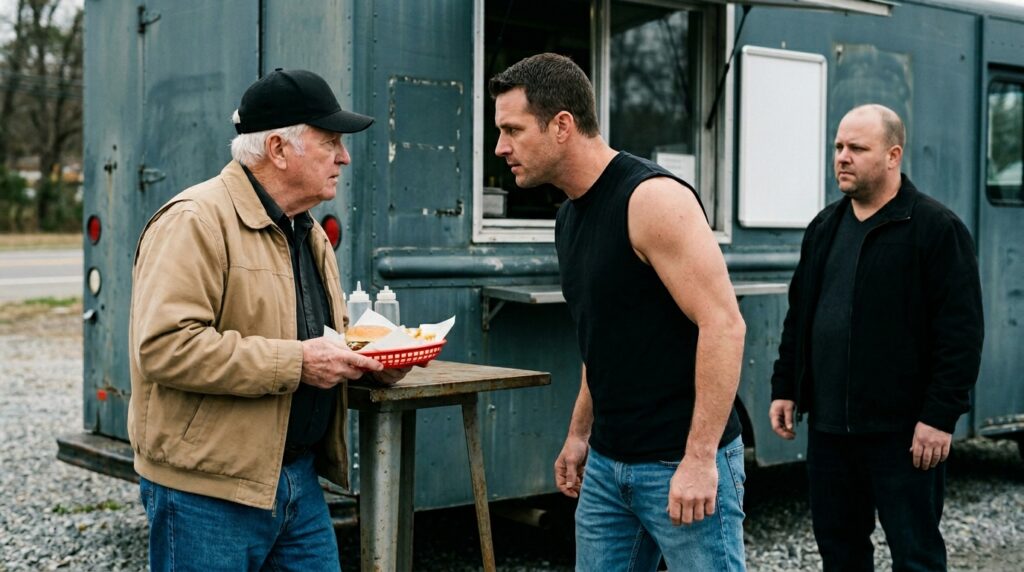
“You’re breathing my air, old man.”
The words smelled of stale tobacco and cheap energy drinks. They came from a mouth that hadn’t smiled with anything resembling sincerity in a decade.
I didn’t turn my head right away. My thumb was pressed against the rough wicker handle of the food basket, feeling the grease-soaked wax paper beneath the fried chicken. The metal counter of the truck’s service window was cold, pitted with rust along the welded seams where the salt air and diesel exhaust had eaten through the zinc coating over twenty years.
“I asked you a question,” the voice grated closer. A heavy work boot came down on the loose gravel behind me, the sharp crunch of limestone echoing against the side of the aluminum trailer.
“I heard you,” I said. My voice sounded like dry gravel shifting in a bucket. I didn’t look at the big man in his late thirties—the one with the tight neck muscles and the faded tattoo of a dying hawk stretching out from under his grease-stained collar. Instead, my eyes locked on his shadow, which had completely erased my own against the sun-bleached wood of the menu board.
Behind him stood the other one. A heavy-set, bald man in a stiff black nylon jacket that crinkled every time he shifted his weight. He didn’t speak. He just leaned against the rusted fender of a parked dually, his arms crossed over his chest, his eyes dead as ditch-water. He was the witness. The kind of man who didn’t throw the punch but held the jacket so the blood wouldn’t splatter.
“Then move,” the younger man spit, stepping directly into my peripheral vision. He didn’t want the spot at the counter. The truck wasn’t even busy. He wanted the dirt I was standing on. He wanted to see if seventy-something years of living had left anything solid inside the tan jacket, or if it was just hollow straw ready to be scattered by the county wind.
I tucked the food basket tighter against my ribs, using it as a shield between my sternum and his chest. My black cap cast a shadow down to my nose, but I could feel the heat radiating off him—the erratic, sour heat of a man who believed the world owed him a debt the local banks wouldn’t pay.
“I’m just here to eat,” I said, keeping my heels dug into the limestone. “Take the trouble down the road. There’s plenty of it out there.”
“The road’s full,” he said. His hand came down on the metal counter with a dull, ringing thud that shook the napkin dispenser. “And your time’s up. You and that patch of scrub pine you’re sitting on.”
The mention of the land wasn’t an accident. It settled in the pit of my stomach like a cold stone. This wasn’t about the line. It was about the long, slow squeeze.
Before I could pull air into my lungs, his shoulder swiveled. A thick, calloused palm shoved hard against my left arm, aiming to spin me off the platform and into the dirt. My boots slipped an inch on the loose stones, the sudden strain firing a hot, iron spike of pain straight up my lower lumbar—the old injury from the foundry days, reminding me exactly how few miles were left on the clock.
But forty years of lifting pig iron teaches you how to drop your center. I didn’t fall. I let the basket take the brunt against the counter, the cardboard box inside groaning under the pressure. My right hand, stiff and thick-jointed from arthritis, locked onto the lip of the metal window frame.
“I told you,” I breathed, my teeth clicking together as I lunged back into his space, using the rigid bone of my forearm to wedge between his collarbones. “I don’t get pushed.”
For three seconds, it was just the wet, heavy sound of two men breathing in the humidity. We were locked there, the rusted metal of the truck creaking under our collective weight. I could see the broken veins in his nose, the yellow tint in the whites of his eyes. My strength was leaking out through my knees—I could feel the tremor starting deep in my thighs—but I didn’t give him the inch.
The cook inside the truck, an older woman named Martha who had known my dead wife, pulled the slide wire shut with a sharp, metallic screech. She didn’t call out. In this town, you didn’t call the sheriff unless someone was already dead on the floor.
The bald man off the truck finally took his hands out of his pockets. “Hey. Caleb. Let it go. People are looking from the crossroads.”
The younger man—Caleb—swung his eyes toward the road, then back to me. The heat in him didn’t cool; it just went underground, turning into something dark and calculated. He stepped back slowly, his boots grinding the gravel into powder. He reached up, wiped a smear of grease from his tan forearm onto his jeans, and fixed me with a flat, level stare.
“You’re a long way from the house, old man,” he muttered, his voice dropping into a register that didn’t carry past the counter. “And those old locks on your gate don’t mean a damn thing when the wood’s already rotten.”
He didn’t turn his back to me as he walked toward the dually. He kept his eyes on mine until the truck door slammed shut with the heavy, hollow sound of cheap American steel.
I stood by the window for a long minute after the diesel engine roared to life, my hand still white-knuckled on the grease-slicked ledge. The food basket felt three times heavier than it had ten minutes ago. When I finally looked down to check the strap, my fingers brushed against a long, jagged splinter of fresh pine that had been jammed into the tight weave of the wicker—something that hadn’t been there when I left my porch.

CHAPTER 2: THE SPLINTER IN THE WEAVE
The high-pitched hum of Caleb’s diesel truck died out a mile down the county line, leaving nothing but the dry, rhythmic clicking of cicadas in the roadside ditches. My fingers stayed hooked into the wicker of the food basket until the plastic handles bit deep into my skin. I didn’t look back at Martha’s food truck. I didn’t want to see her looking through the grease-stained plexiglass, deciding whether to pity the old man or fear the trouble he was bringing into the lot.
When I reached the truck, the door handle of my old F-150 felt rough, the chrome plating long since pitted by winter salt until it resembled the coarse gray hide of an old elephant. It didn’t open smooth; it required a hard, upward jerk that jarred my shoulder, a stiff pop of ungreased iron meeting iron. I placed the food basket on the passenger vinyl, my eyes fixed on the three-inch sliver of pine jammed into the reed.
It wasn’t a windfall twig. The edge was clean, sheared off by a sharp blade—a surveyor’s stake, the kind they drive into the clay with a five-pound mallet to mark a line that wasn’t there yesterday. It was fresh enough that a drop of sticky, fragrant resin was still welling out of the grain, catching the yellow light of the dashboard.
I didn’t pull it out. I left it there, a small white tooth biting into the dark wicker, and shoved the transmission into reverse. The gearbox wailed its familiar, low-register complaint as I backed out into the dust.
The drive back to the homestead was three miles of washboard gravel that vibrated through the floorboards, rattling the loose bolts in the steering column and sending a dull, repetitive ache from my tailbone up to the base of my neck. Every fence line I passed looked tired. The cedar posts were silvered and leaning at forty-five-degree angles, held up more by the rusty weave of old barbed wire than the dry earth beneath them. This corner of the county was drying out, the topsoil turning to powder while the young men spent their afternoons sitting on the tailgates of expensive trucks they couldn’t afford, watching the horizons for a sign of change that wasn’t coming from the sky.
When I turned down my own lane, the iron gate didn’t look right.
I stopped the truck twenty feet back, leaving the engine to idle with a heavy, rhythmic thud that shook the rusted quarter-panels. The sun was dropping behind the ridge, casting long, desaturated shadows that turned the yellow weeds into a dull, iron gray.
The heavy log chain I kept looped around the main post was hanging loose. The padlock—a solid brass Master Lock covered in years of brown road grit—was still snapped shut, but the heavy steel eyebolt it latched into had been worked over. Someone had taken a pipe wrench to the threaded shank, twisting the metal until the dry grain of the oak post had split open, leaving a white, raw scar in the wood. They hadn’t cut the chain; they had just checked the tolerance of the timber to see how much force it would take to tear the whole assembly out of the ground.
I got out of the cab, my boots sinking into the fine gray dust of the driveway. The air smelled of iron and dried cedar. I walked to the post and ran my thumb over the split oak. The wood fibers were dry, but there were tiny flakes of bright orange paint embedded in the bark—the exact shade of the commercial machinery Caleb’s crew parked behind the old county maintenance shed.
“Still standing,” I muttered to the empty lane, my voice flat, swallowed by the wide, dry silence of the acres behind me.
I unlooped the chain, letting the heavy links clink against each other with a leaden, metallic clatter that felt entirely too loud for the evening. My palms were dry, the skin rough as sandpaper from forty years of manual labor, and the cold iron of the chain left a gray, greasy smudge across my lifeline.
Instead of driving up to the house, I walked the inside perimeter of the ditch line, following the three-strand wire toward the eastern boundary where the old creek bed had gone to gravel five years ago. My knees made a dry, cracking sound with every third step, a reminder that the frame was wearing out even if the mind wasn’t ready to yield.
Every twenty yards, I checked the tension of the wire. It was slack. Not from age—someone had taken a pair of fencing pliers to the staples on the backside of the posts, backing them out just enough so the wire would sag into the weeds. It was a professional bit of work. It didn’t look like vandalism; it looked like a preparation. A way to clear a path without making enough noise to wake an old man who slept with a twelve-gauge across the foot of his bed.
I reached the corner post where my land abutted the old rail easement. A surveyor’s ribbon—a strips of neon pink plastic—was tied to a low branch of a dead scrub oak. It fluttered in the evening draft with a thin, plastic hiss.
Below it, the dirt had been turned. A single, deep boot heel impression was pressed into the dry clay near the base of the wood. It was large, the tread pattern consisting of heavy, blocky chevrons—the same heavy-duty work boots Caleb had been wearing at the counter of the food truck.
I reached down, took a handful of the dry earth, and let it sift through my fingers. It felt cold a few inches down, but it was dead. Nothing was growing in that corner but horse nettle and cocklebur. Yet they were circling it like vultures over a down heifer.
I stood there until the last of the red light died behind the silos on the northern ridge, leaving the valley in a dark, bruised violet. The physical fatigue was a heavy vest around my shoulders, but beneath it, the old blue-collar stubbornness was setting hard. They wanted me to see the broken wood. They wanted me to spend the night staring out the window, counting the miles between my porch and the nearest neighbor.
I turned back toward the house, my shadow completely gone now, leaving me an anonymous shape moving through the dark gray weeds. I had twelve fence posts to restaple before the sun came up tomorrow, and my hands didn’t work as fast as they used to. But the hammer was still in the shed, and the iron was still heavy.
CHAPTER 3: THE PRICE OF COLD IRON
The overhead tin roof of Miller’s Supply groaned under the heat, expanding with a series of sharp, rhythmic pops that sounded like small-caliber fire. Inside, the air was thick with the smell of floor sweep, kerosene, and ninety years of oxidized iron. It was a dark, narrow cave of a store where the shelves reached the ceiling, packed with cardboard boxes whose labels had faded from black to a ghostly, water-logged gray.
I set a plastic bucket of heavy fencing staples onto the wooden counter. The wood beneath my palms was deeply grooved, scarred by generations of farmers sliding logging chains and disk blades across the pine planks.
Old man Miller didn’t look up right away. He was scraping a thick crust of hardened grease off an ancient threading die with a dull pocketknife. His knuckles were swollen into pale knots, his breath coming in a dry, whistling rattle through his teeth.
“Twenty pounds of the inch-and-a-half,” I said.
Miller stopped his scraping. He wiped the blade of his knife against the thigh of his grease-blackened overalls, leaving a dark, oily smear. He looked at the bucket, then at my hands, his eyes squinting through grease-smudged spectacles held together at the bridge by yellowed masking tape.
“Hear you had a bit of friction out by Martha’s truck yesterday,” Miller said, his voice flat, rhythmic, carrying the non-committal caution of a man who had seen three generations of families go broke in this valley.
“A misunderstanding about space,” I said, keeping my hands flat on the pine counter. “Nothing that didn’t clear itself up.”
“Caleb don’t clear things up,” Miller muttered, reaching behind him to pull a heavy ledger from a shelf covered in dry-rot dust. He flipped the pages with a thick thumb, the yellowed paper crackling like dry corn husks. “He unloads. He’s been buying up structural posts, heavy-gauge t-posts, and three-ply wire for a month now. All of it billed to the county road commission account, but none of it going toward the state routes.”
I didn’t answer. I reached into my tan jacket pocket, my fingers brushing against the cold, notched edge of the key to my pump-house before pulling out a handful of crumpled bills. As I pulled the hand back, a faint, chemical tang hit my nose—a sharp, copper-and-sulfur scent that had stayed on my skin ever since I inspected the eastern boundary fence line this morning. It wasn’t the smell of cedar or ditch weed. It smelled like the runoff from an old battery vault.
“Who’s signing the vouchers on that county account?” I asked, dropping the bills onto the ledger.
Miller stopped his pencil midway down a column of figures. He looked toward the open screen door, where the heat waves were dancing off the rusted hood of my truck parked in the gravel lot. A lone bluebottle fly buzzed frantically against the wire mesh, trapped between the iron screen and the heavy wood frame.
“A name you know,” Miller said softly, his voice dropping into the lower register reserved for bad news. “Your boy Jesse’s name is on three of the haul receipts. The ones for the survey stakes and the lime bags.”
The iron spike in my back didn’t fire this time, but a cold, heavy weight settled directly behind my ribs. Jesse. My late brother’s boy. A lad who had spent his thirty-something years drifting from one municipal road crew to another, always looking for a shortcut through the clay, always six months behind on his truck notes.
“Jesse doesn’t own anything on that ridge,” I said, the words coming out stiff, like ungreased gears turning in winter.
“He don’t own the dirt,” Miller agreed, closing the ledger with a heavy thud that puffed a tiny cloud of lime dust from the seam. “But he’s got the registration on your late brother’s estate car. And he’s been sitting in the back booth of the Diner with the supervisors from the regional syndicate three nights a week. The ones running the new industrial corridor through the lower marsh.”
He pushed the bucket of staples toward me. The heavy wire fasteners rattled against the plastic sides with a sound like loose teeth.
“They’re looking for a leverage point, Silas,” Miller added, leaning over the counter until I could smell the peppermint lozenge he was sucking on to hide his tobacco breath. “Caleb’s just the hammer they use to find the soft spot in the timber. If the wood don’t split, they bring the saw.”
I took the handle of the bucket, the wire cutting into the callouses of my palm. “The wood’s oak,” I said. “It don’t saw easy.”
“Everything saws when the blade’s got teeth enough,” Miller said, turning back to his threading die without another word.
I walked out into the glare of the gravel lot, the heat hitting me like a physical blow against the tan jacket. The air smelled of hot tar and parched weeds. I threw the bucket into the bed of the F-150 next to the fence tool, the metal clanging against the wheel well with a hollow, lonely ring.
As I climbed into the cab, my eyes caught the small commercial folder tucked into the side pocket of the passenger door—an old map of the county water districts I’d kept since my time on the drainage board twenty years ago. I pulled it out, the paper stiff and yellowed along the folds. My thumb left a faint gray smudge of hardware grease near the blue line that marked the aquifer under my eastern section.
The water line ran straight under the dead creek bed, right where Caleb had left his boot heel in the clay.
I put the truck in gear, the transmission whining as I pulled onto the empty main street. The storefronts were mostly dark now, their display windows covered in gray grime or boarded over with rough plywood that had started to warp and cup under the June sun. The town wasn’t dying; it was being hollowed out from the inside, the old framework left to stand while something new and greasy took root in the basement.
I didn’t go home. I drove toward the county records office behind the courthouse, my foot steady on the gas pedal despite the tremor in my knee. I needed to see exactly what kind of paper Jesse had been putting his name to, and whose ink was drying on the back of my fence posts.
CHAPTER 4: THE PERIMETER CHECK
The tires hit the limestone wash at the foot of my driveway with a dry, crunching roar that rattled the loose steel tools in the truck bed. I didn’t even kill the headlights. The two yellow beams cut straight through the rising dust, painting the thick, gray oak trunks along the lane in a pale, sickly light.
They were already there.
The dually sat idling at the edge of my fence line, its massive black silhouette blocking the gravel turn-around like an iron wedge driven into the clay. The twin chrome exhaust stacks behind the cab belched a thick, oily plume of diesel smoke into the dark violet sky, the heavy odor of unburnt fuel settling over the sweet clover weeds like a wet blanket.
I let my F-150 coast to a halt ten feet from their bumper, the worn brake pads squealing a thin, metallic note that died instantly against the deep, rhythmic thrum of their larger engine. My hands stayed wrapped around the steering wheel, the cracked vinyl cold against my palms. Through the dust-streaked windshield, I could see two figures behind the dark glass of the dually.
The driver’s side door opened with a slow, heavy groan of ungreased hinges. Caleb swung his boots down into my gravel, his large frame silhouetted by the orange amber glow of his running lights. He didn’t have his work shirt on now; he wore a sleeveless undershirt stained with grease at the collar, his thick forearms pale under the twilight. He didn’t approach the truck. He walked to the edge of my ditch line, standing right where the fence wire hung slack from the loosened staples.
The passenger door remained shut, but the window rolled down three inches. The smooth, hairless crown of the bald man’s head caught the yellow reflection of my high beams. He didn’t move. He just watched through the narrow opening, a silent, heavy weight keeping the truck anchored to my dirt.
I checked the iron latch on my door, slipped my thumb through the loop of the fence tool on the seat beside me—a solid, fourteen-inch piece of forged iron with a cold chisel head—and stepped out into the night air. The dust coat on my boots was thick, rising in small gray puffs around my ankles as I walked toward the front fender.
“You’re back early,” I said, my voice staying low, even, carrying no more weight than a dry wind through an empty barn.
Caleb didn’t look at me. He kicked a loose chunk of limestone into the ditch with the steel toe of his boot. “The county’s changing the zoning on the lower marsh route, old man. They’re running the survey line straight through the oak grove. Your nephew Jesse signed the access waiver at noon today.”
The cold iron weight behind my ribs tightened until it felt like a band of steel. Jesse had done it. He’d signed the paper that gave these bastards the right to bring the heavy yellow iron across the boundary line. But Caleb wasn’t looking at the trees. His eyes were fixed on the small concrete blockhouse sixty yards behind my kitchen—the pump-house that drew the deep well water from the limestone shelf below.
“Jesse doesn’t have the deed to this section,” I said, my fingers tightening around the forged iron tool in my jacket pocket until the metal corners bit into my callouses. “His name isn’t on the land registry.”
“It’s on his daddy’s probate file,” Caleb said, finally turning his head to fix me with that flat, predatory stare. “And that’s enough for the state road office to grant a temporary easement for the utility core. We bring the clearing dozers through at seven tomorrow morning. If the fence is still up, the blades will do the work for us.”
Behind him, from the dark interior of the dually, a sharp, metallic click echoed through the gap in the passenger window—the distinct, heavy sound of a lighter wheel striking flint, followed by the orange ember of a cigarette glowing in the shadows. The bald man didn’t lean out, but the smoke drifted through the opening, sour and thick.
“The easement requires a certified notice,” I said, stepping closer until the heat from the dually’s radiator hit my face like a furnace blast. “A registered copy delivered by the clerk. You don’t carry the county paper in a tool box, Caleb.”
A slow, ugly grin split Caleb’s face, but his eyes stayed dead, calculating the distance between my boots and his bumper. He leaned back against his truck’s fender, the sheet metal popping under his weight. “You want the paper? Go ask Jesse. He’s sitting in his trailer down by the old gravel pit, looking at the check they cut him for the timber rights. Or you can look in the folder on my dash. It’s all the same ink.”
He reached back, his hand tapping the dark tinted glass of the dually’s windshield right above the instrument cluster, where a thick, manila envelope sat flat against the plastic trim.
My heart hammered against my ribs, a fast, shallow rhythm that felt too fragile for the size of the dark valley around us. It was a decoy—a piece of corporate misdirection designed to make me turn my back on the ridge and hunt down my own blood while they set the stakes for the industrial corridor. But beneath the diesel exhaust and the sour tobacco smoke, a stranger detail caught my attention.
A low, rhythmic vibration was hummed through the soles of my boots. It wasn’t the engine of the dually. It was a deep, underground throb coming from the direction of the pump-house—the distinct, hollow knocking of an overloaded suction valve trying to draw water through a choked line. My well was running dry, or something down in the dark aquifer was fighting the pump.
“Seven AM, Silas,” Caleb said, his voice dropping into a tight, transactional rasp as he stepped back toward the open cab door. “Have the gate unchained, or we’ll leave the iron in the weeds.”
He swung up into the seat, the door slamming shut with a heavy, double-striking thud that echoed off the dry silos across the road. The dually lunged forward in reverse, its massive tires tearing two deep, white trenches through the limestone gravel of my turn-around before spinning out onto the dark asphalt of the county line.
I stood in the settlement of the dust plume, the red taillights of their truck shrinking into two bloody pinpricks against the black horizon. The iron tool in my pocket felt frozen against my thigh, but the low, hollow thumping from the pump-house was getting louder, a rhythmic shuddering in the limestone shelf that felt like a dying pulse deep inside the earth.
CHAPTER 5: THE COLD BOTTOM
The headlights of the F-150 caught the edge of the gravel pit, cutting through a thick wall of river fog that smelled of wet iron and rot. Jesse’s trailer was an old thirty-foot Spartan, its corrugated aluminum skin dented and discolored to a dark, zinc gray by decades of woodsmoke and dampness under the willow trees.
I didn’t knock. My boot hit the wooden block he used for a doorstep, and I threw my weight against the door frame. The cheap latch didn’t split; it just tore clean through the rotten pine jamb with a sharp, splintering crack.
Jesse was sitting at a formica table covered in grease rings, a half-empty bottle of generic whiskey between his elbows. He didn’t jump. He looked up with the watery, loose-jawed stare of a man who had been expecting the hammer to fall but hoped it would wait until morning.
In the center of the table, sitting on top of a greasy commercial folder, was the manila envelope Caleb had mentioned. The corporate seal of the regional contracting syndicate was stamped in dark purple ink across the flap.
“Uncle Silas,” he stammered, his hand twitching toward the glass. “They said… they said it was just a surface easement. For the line clearing. They gave me twenty-four hundred on a county voucher.”
I didn’t waste the breath to curse him. I reached out, my fingers rough as dry leather as they wrapped around the back of his collar, and dragged him up from the chair. His weight was nothing—he was soft, hollowed out by years of small-time thievery and county beer—but the effort brought the sharp, white heat back into my lower lumbar, making my jaw click with the strain.
“The paper, Jesse,” I rasped, pressing him back against the thin paneling of the trailer wall until the aluminum exterior groaned. “Read the second rider on the plat map.”
He couldn’t see it through his tears, so I tore the envelope open myself. The sheets inside weren’t standard road waivers. They were corporate release forms from the regional water authority, dated three months back. Attached to the back was a certified laboratory analysis report with a bright orange header: MUNICIPAL WELL DISTRICT 4 – CONTAMINATION ZONE.
I held the paper six inches from his nose. “They didn’t buy the timber rights, you fool. They bought the liability waiver for the deep shelf. Look at the numbers on the chemical index.”
Jesse’s eyes drifted over the columns of data, his mouth opening like a landed carp. “I don’t… I don’t know what that means, Silas. They just said if I signed for the estate, they’d clear the back taxes on the family lot.”
The realization didn’t come with a flash of light; it came with the greasy smell of the sulfur that had been staying on my palms all day. The syndicate hadn’t sent Caleb to clear a path for a road. They had sent him to fence off the last clean injection point into the valley’s limestone aquifer. The municipal wells in town were already dead—fouled by the illegal battery-vault runoff from the industrial corridor up-ridge—and my independent well was the only clean sample left within twenty miles. If they controlled my pump-house, they could bury the test results, sign the corporate buyout for the new manufacturing zone, and leave the entire township drinking poison out of the tap.
“They’re bypassing the county board,” I said, my voice dropping until it was as cold as the iron tools in my truck. “They needed the fence line down so they could seal the well head before the state inspector arrives on Tuesday.”
“Silas… Caleb’s got four men with him,” Jesse whispered, his hands shaking against my sleeves. “They’re already setting the posts by the creek bed. They told me to stay clear of the ridge tonight.”
I let go of his collar. He dropped back into the formica chair like a sack of damp corn, his face the color of wood ash. I picked up the folder, stuffing the laboratory report into the deep pocket of my tan jacket next to the forged iron fencing tool.
“Stay here,” I told him without looking back. “Drink your whiskey. You’ve earned every drop of it.”
I walked back out into the river fog, the mist settling on the rusted hood of my truck like fine grey grease. When I reached the homestead, the dually wasn’t in the turn-around, but the low, hollow thumping from the concrete pump-house had changed. It wasn’t an overloaded valve anymore. It was the dry, scraping screech of an unlubricated impeller spinning against dry stone.
I walked down the lane with the heavy flashlight in my left hand, the beam cutting a dim, yellow tunnel through the weeds. When I reached the small square structure, the padlock on the iron door was gone, sheared off by a bolt cutter. Inside, the small glass sediment bowl attached to the main intake pipe was completely filled with a thick, slate-grey sludge that smelled of rotten eggs and boiled copper.
They hadn’t just sabotaged the perimeter wire. They had already dropped the tracing dye down the casing to check the flow rate to the lower development boundary.
I knelt on the cold concrete floor, my knees grinding against the loose sand and iron scale that had collected near the base of the pump. My hands were shaking now—not from fear, but from the bone-deep exhaustion of a man who had spent forty years maintaining things that other people were always trying to tear down. I reached out and took hold of the heavy brass bypass valve, the metal cold and slimy with the grey deposit.
The metal was seized, locked tight by years of hard mineral scale. I leaned into it, my shoulder pressing against the cold concrete wall, my boots slipping in the sulfur mud on the floorboards. Friction against friction. My knuckles scraped the raw iron casing, peeling back the skin until the dark blood started to mingle with the grey sludge on the threads.
With a loud, metallic crack that vibrated through my teeth, the valve gave an inch.
Outside, down by the dead creek bed, a pair of headlights flickered through the willow trees—the orange running lights of Caleb’s truck returning to the section line. The morning was still five hours away, but the yellow iron was already moving in the dark, and the ground beneath my feet was humming with a truth that the town wasn’t ready to swallow.
I stood up, wiping my bloody palm on the thigh of my tan jacket, and picked up the iron fence tool from the floor. The line was marked. It wasn’t about the dirt anymore; it was about the water down in the dark, and I had enough staples left in the bucket to hold the post until the sun came up.
CHAPTER 6: THE MIDNIGHT FILTER
The orange running lights of the dually chopped through the willow branches like dull meat cleavers. I didn’t drop the iron fence tool. I stayed on my knees in the dark of the pump-house, my ears tuned to the wet, heavy slap of mud against the truck’s undercarriage as it cleared the creek bed.
They were coming fast, not caring about the noise anymore. The state inspector’s Tuesday deadline was seventy-two hours away, but seventy-two hours is an eternity to men who carry the county pocketbook in their hip pocket.
I reached out with my bleeding hand and jammed the chisel head of the fence tool into the housing of the main filter cap. The cast iron was slick with the slate-grey sulfur sludge that had welled up from the limestone shelf, and my palm slipped once, the rough metal teeth of the tool tearing another layer of skin off my thumb. I didn’t feel it. The cold, leaden numbness of the midnight air had taken the sting out of the bone, leaving nothing but the hard, rhythmic clicking of the engine getting closer.
With a heavy, grinding grunt, I threw my seventy-eight years of weight against the handle.
The pressure cap split. A sour, pressurized spray of grey water hit me square in the face, burning my eyes with the sharp stink of rotten copper and old battery acid. It tasted like pennies left in a rain bucket. I wiped my chin with the sleeve of my tan jacket, my fingers digging blindly into the wet housing until they caught on something solid.
It wasn’t scale. It was a notched steel shear-pin, three inches long, jammed deliberately into the intake impeller to keep the fresh water from clearing the line before the cement trucks arrived. It had the initials J.M. stamped into the hexagonal head—Jesse’s tool set, the one his father had left him before the drink took his liver.
The diesel engine outside died with a wet, gurgling cough forty yards down the lane.
“Caleb,” a voice called out through the fog—the bald man, his voice flat and deadened by the heavy humidity. “The old man’s truck is still by the well. The hood’s warm.”
“He’s inside,” Caleb’s rasp came back, followed by the heavy, metallic click of a truck tailgate dropping down. “Get the mix bags off the bed. We aren’t waiting for the morning shift. If he’s in the blockhouse, lock the door from the outside and let the lime set.”
I stood up slowly, my back joints popping like dry pine kindling as I straightened my spine against the concrete wall. The flashlight beam was dying, the blue lens flickering twice before fading into a dull, orange wire glow that barely reached the floorboards. I slipped the notched shear-pin into my vest pocket, right next to the laboratory analysis report I’d taken from Jesse’s table.
The gravel outside didn’t crunch. The fog had turned the limestone dust into a thick, paste-like clay that swallowed the sound of their work boots, leaving nothing but the wet, heavy breathing of three men hauling eighty-pound bags of quick-set mortar across the ditch line.
I moved to the iron door frame. The brass padlock I’d kept there for twenty years was gone, but the heavy steel hasp was still intact, hanging loose like a broken finger. Through the narrow vertical gap between the door and the jamb, I could see the reflection of their flashlights moving through the white willow mist.
They had two wheelbarrows and four bags of commercial grade plugging grout—the kind they use to seal abandoned oil wells before the EPA maps the section. Caleb was in the lead, a flat-headed spade held across his chest like an iron bar, his sleeveless undershirt gray with the river dampness.
“Silas,” he called out, stopping ten feet from the door. The beam of his five-cell light hit the rusted iron of the panel, the glare bouncing off the metal and filling my narrow space with a harsh, white fog. “Jesse’s down at the pit. He said you took the papers. Those papers belong to the regional road commission. They don’t belong on your shelf.”
I didn’t open the door. I leaned my shoulder against the inside steel plate, feeling the cold vibration of his voice through the iron.
“The papers are in my coat, Caleb,” I said, my voice staying flat, carrying the cold, unyielding weight of the well bottom. “And the state inspector’s already got the digital routing log from the drainage board. You can pour your lime down the casing, but you can’t cement the record office.”
A long silence followed, the only sound the low, bubbling hiss of the wet quick-set mortar as the bald man dropped the first bag into the wheelbarrow behind him. Caleb didn’t move. I could see the shadow of his spade drop three inches, his thick neck muscles tightening as he calculated the thickness of the iron door between us.
“The state inspector don’t live in this valley,” Caleb said softly, his voice dropping into that transactional tone he used when he was looking for the weak spot in the wood. “He lives in a brick house three hours north. He don’t drink out of this dirt, Silas. And he don’t care who owns the water as long as the manufacturing voucher is signed by the county clerk on Wednesday morning.”
“The clerk won’t sign a contaminated zone,” I said.
“The clerk’s already got his nephew on the clearing crew,” Caleb said, his boot taking one slow, wet step into the clay near the step. “The valley’s already sold, old man. You’re just the last fence post holding up a line that’s already been plowed under.”
Behind him, the bald man stopped his shovel mid-mix. He looked down the lane toward the crossroads, his hand rising to touch his hairless temple. A thin, distant whine was coming from the state highway—the high, rhythmic drone of a multi-axle diesel running without a load.
The state inspector wasn’t waiting until Tuesday.
Caleb heard it too. He didn’t look back at the truck, but his shoulders squared, the iron spade rising until the edge was level with the brass hinges of my door. “Get the chain,” he told the bald man behind him, his voice losing its patience, turning into the hard, sharp edge of a tool being driven into stone. “We’re sealing it now.”
I didn’t wait for the hasp to drop. I jammed the forged chisel head of my fence tool into the gap between the lock plate and the frame, using every ounce of my remaining strength to throw the heavy iron door outward into his chest.
CHAPTER 7: THE STATE ROUTE RUN
The iron door hit Caleb with a hollow, leaden thud that sounded like a cold ham dropping onto a butcher’s block. The force of the steel plate catching his collarbone sent him stumbling backward into the grey paste of the driveway, his flat-headed spade slipping from his palms and clattering against the concrete step.
He didn’t yell. A hard, sour grunt left his throat as his heels caught the lip of the mortar wheelbarrow, throwing his balance completely into the ditch weeds.
“Move!” I barked at the bald man, but I didn’t wait for him to clear the lane. My boots were already grinding into the wet clay, the weight of the plastic sample jar tucked into my left jacket pocket slamming against my ribs with every stride.
The high, rhythmic whine of the multi-axle diesel on the state highway was louder now—the state inspector’s transport was clearing the northern ridge mile post, less than four minutes from the turn-off. If Caleb’s crew blocked the driveway with the dually, the inspector would pass right by the lane, leaving the section line quarantined under the county’s fraudulent road voucher until Tuesday morning.
The bald man lunged forward from the shadow of the truck bed, his stiff nylon jacket crinkling as his thick fingers reached for the front of my tan collar. He didn’t want the paper; he wanted to anchor me to the limestone until Caleb could get his boots back under him.
I didn’t turn to face him. I brought the fourteen-inch fencing tool up in a short, vertical arc, the cold chisel head catching the meat of his forearm through the heavy sleeve. The impact didn’t break bone—it wasn’t meant to—but the dull iron weight was enough to slip his grip on the wet fabric, his boots sliding six inches into the gray mortar sludge that had spilled from the broken bags.
“Silas!” Caleb’s voice came out of the ditch, thick with the wet grit of the clay he’d swallowed. “You don’t make the highway! The state police have the crossroads blocked for the heavy haul!”
I didn’t answer. I reached the F-150, my hand catching the pitted chrome handle and pulling it upward with a savage jerk that tore a fresh pocket of pain across my lower spine. The starter didn’t catch smooth; it whined twice, a dry, zinc screech of old gears fighting the cold oil before the eight cylinders caught with a ragged roar that shook the rusted quarter-panels.
Through the rearview mirror, I saw Caleb rising from the weeds, his face coated in white lime dust, his hands dripping with the grey sludge of the quick-set mixture. He didn’t chase the truck on foot. He swiveled toward the dually’s open door, his boots tearing deep ruts in my turn-around as he swung himself into the cab.
I slammed the transmission into first, the gearbox wailing its long-standing complaint as I dumped the clutch. The rear tires spun for three seconds in the wet limestone powder, throwing a thick curtain of gray grit against the pump-house wall before the tread bit into the hard clay beneath.
The lane was a narrow tunnel of willow mist and yellow high beams. I didn’t light the dashboard; I needed every volt of the alternator to keep the forward lights cutting through the river fog. In the passenger seat, the plastic sample jar sat flat against the vinyl, the slate-grey sludge inside sloshing against the unlisted laboratory seal I’d noticed on the neck—a tiny, water-stained paper tag that read TEST SITE B – NOT FOR PUBLIC DISCLOSURE.
The syndicate hadn’t just bought off Jesse. They had quarantined the entire upper aquifer data log from the county health board, leaving the valley’s water grid under a false green light while the chemical runoff from the industrial corridor seeped down through the limestone fissures.
A hundred yards ahead, the red reflector tape on my main gate post caught the yellow glare of my beams. The gate was unchained, but the heavy log post was leaning three inches further into the lane where Caleb’s truck had grazed it during his retreat.
Behind me, the twin chrome stacks of the dually erupted with a blast of black diesel smoke that lit up the fog in an orange, subterranean glow. Caleb was fifty yards back and accelerating, his massive bumper bouncing over the washboard ridges with a mechanical scream of over-torqued iron. He wasn’t trying to turn me back now. He was going to use the four tons of his front end to push my F-150 into the ditch line before my bumper could clear the state asphalt.
I didn’t touch the brakes for the turn. I let the passenger fender scrape the wet willow branches, the twigs slapping the glass with a sound like small-caliber fire. My right hand stayed locked onto the steering wheel, the arthritis in my knuckles setting so hard the bone felt like it was part of the iron column.
The truck cleared the gate post with two inches to spare, the rear bumper catching the loose log chain and dragging it twenty feet through the gravel with a leaden, clattering shriek that died as my tires hit the hard, black asphalt of Route 4.
A quarter-mile north, the white strobe lights of the state inspector’s transport were cutting through the low cloud deck, the heavy flatbed slowing down as it approached the county maintenance marker.
I didn’t pull onto the shoulder. I swung the F-150 across both lanes, blocking the white line with my rusted tailgate, and left the engine to idle with its heavy, rhythmic thud. As I climbed out into the cold drizzle, the dually cleared my lane behind me, its brakes screaming as Caleb realized the state strobe lights were already painting the road in a bright, official blue.
The truck door stayed open behind me, the cold wind carrying the sour smell of the valley’s bottom straight toward the clean white cab of the approaching state rig. My hand went into my pocket, my fingers locking around the cold glass of the sample vial. The state route was open, but the ink on the county board’s buyout was already dry, and the real friction was just beginning to climb the hill.
CHAPTER 8: THE TWOTON AUDIT
The white strobe lights of the inspector’s transport did not save the ridge; they only bought forty-eight minutes of silence while the state truck idle-purred on the shoulder of Route 4. The inspector had taken my glass vial, checked the unlisted water-stained laboratory seal with a pocket magnifier, and told me that an official investigation required a verified request form from the county seat.
He didn’t hand back the sludge. He kept it in a locked steel box beneath his driver’s seat—a legal impound that left my hands empty and the clock running out.
By nine that morning, the rain had turned the limestone dust on my truck’s hood into a dry, chalky skin that flaked off in the wind as I pulled into the center of town. The regional contracting office wasn’t a trailer; it sat on the second floor of the old Farmers Bank building, a structure built from heavy limestone blocks that had turned the color of wet coal from a century of coal smoke and diesel soot.
My boots made a heavy, dragging sound on the wooden stairs, each riser groaning under the stiffness of my knees. The landing smelled of floor wax and old radiator fluid. I pushed through the frosted-glass door marked VANGUARD INFRASTRUCTURE – DEVELOPMENT DIVISION.
Behind the mahogany counter sat a woman in her late forties with sharp, gold-rimmed glasses and a pile of legal files stacked three inches deep near her left elbow. She didn’t look up when my shadow fell across her desk. Her fingers stayed locked onto the keys of a gray mechanical adding machine, the rhythmic clack-clack-ding filling the narrow lobby like a high-tensile wire snapping under load.
“Registry is closed for the morning session,” she said, her voice coming out dry, flat, carrying the practiced indifference of a county payroll clerk.
“I’m not here for the book,” I said. I reached into my pocket, my calloused fingers pulling out the notched steel shear-pin I’d dug from the pump filter and dropping it onto the center of her green desk blotter. The heavy iron pin rolled three inches, leaving a narrow track of sulfur-grey sludge across her clean white ledger page.
The mechanical adding machine stopped.
She looked at the iron pin, then at the wet collar of my tan jacket. “That looks like field equipment, mister. If you’ve got a voucher discrepancy, the main shed handles the maintenance inventory on Fridays.”
“That pin belongs to Jesse Miller,” I said, leaning my palms against the mahogany ledge until the old wood creaked under my weight. “The lad who signed the clearing waiver for the lower marsh route at noon yesterday. I want to see the plat map index he used to clear the title.”
“Those files are restricted under the industrial corridor exception,” she said, her hand moving subtly toward the brass telephone cradle near the corner of her desk. “Unless you have a registered deed number that overrides the county development core—”
“I have the name on the timber registry,” I interrupted, my voice dropping into that lower register that old men use when they aren’t looking for a compromise. “And I have the certified lab analysis sheet your field crew dropped in the gravel out by my well head last night. The one with the orange header.”
Her eyes went wide behind the gold rims—not with anger, but with the sudden, sharp calculation of an employee who realizes the weight in the lobby is too heavy for the floorboards to hold. She didn’t touch the telephone. She stood up, her skirt rustling against the oak veneer of her desk, and walked back toward the wall of green steel filing cabinets behind the counter.
Through the rain-streaked window behind her, I could see the square tower of the county courthouse across the square. The yellow lights in the basement offices were already burning—the zoning board was meeting two hours early, their vehicles parked in a neat, expensive row along the limestone curb. They weren’t waiting for Tuesday either. They were preparing to sign the corporate buyout before the state inspector could file his impound report with the regional district court.
“This is the unindexed folder for Section 12,” she said, dropping a thick manila file onto the counter with a dull, heavy thud that smelled of stale paper and dry-rot paste.
I flipped the cover back with my thumb. The top map wasn’t an official county survey. It was an altered tax index, the blue lines indicating the aquifer shelf covered over by a heavy, purple corporate seal that read VANGUARD LAND TRUST – RECLAIMED DEPOSIT. Below the seal, someone had used a steel-point pen to scratch out the word POTABLE and replace it with INDUSTRIAL UTILITY AREA.
It was a complete paper quarantine. The decoy secret Caleb had used—the story about a simple road easement and my nephew’s timber debt—was just the outer husk. The real machine was right here in the ledger. They had systematically reclassified the entire sub-surface water table of the valley as dead industrial waste to shield the syndicate from the massive federal clean-up costs of the battery plant up-ridge. If my well stayed on the public index, the falsified environmental clearance would fall apart the moment the state laboratory ran the sulfur analysis.
“Who initialized the index change?” I asked, my finger tracing the jagged scratch where the pen had cut through the old paper fibers.
“The clerk’s office doesn’t log the individual drafts,” she whispered, her eyes darting toward the closed door of the inner office where a typewriter was clicking in short, frantic bursts. “The vouchers come from the regional development pool. The signatures are all municipal blocks.”
I didn’t answer her. I took the altered tax map, folded it twice until the heavy paper split along the seam, and stuffed it into my jacket pocket next to the fencing tool.
“Hey—you can’t take the record copy,” she called out, her voice rising an octave, but she didn’t step out from behind the mahogany counter to stop me. She knew what was written on that paper, and she knew the weight of the iron tool in my pocket wasn’t something she could audit with an adding machine.
I walked down the wooden stairs, my boots hitting the steps with a hard, rhythmic slap that echoed through the empty hallway. The air outside was cold, the rain coming down in a steady, gray drizzle that turned the limestone blocks of the square into slick mirrors.
As I reached the truck, Caleb’s dually pulled up to the curb three doors down, its massive chrome bumper covered in the same grey mortar paste from my driveway. He didn’t get out of the cab. He just lowered the glass three inches, his white-rimmed eyes locking onto mine through the rain-streaked mist as I threw the F-150 into gear.
The clock had run out on the paper. The zoning board was sitting in the dry vault across the square, their pens ready to sign the town away, and the only copy of the truth was riding in the passenger seat of a truck that was out of oil and out of time.
CHAPTER 9: THE RUSTED HORIZON
The door of the F-150 didn’t slam; it met the frame with a wet, heavy click that was instantly swallowed by the downpour. The rain was coming off the courthouse roof in solid gray sheets, cascading over the cold stone steps and churning the limestone dust along the curb into a gritty, milky paste.
I didn’t use the stairs this time. I walked up the side ramp meant for the coal deliveries, my hand sliding along the cold, rusted iron railing to keep the tremor in my right knee from buckling my frame. Inside my jacket, the folded tax map was wet against my ribs, the ink from the purple corporate seal starting to bleed through the lining of the canvas.
The basement hallway of the courthouse was narrow, low-ceilinged, and smelled of eighty years of damp boiler pipes and sour floor wax. At the far end, behind a set of double oak doors with wired-glass panels, the yellow lights of the hearing room were burning.
There were no onlookers in the corridor. The town had already gone home to turn their taps on, completely blind to the gray sludge currently working its way down through the limestone fissures toward their kitchens.
I pushed the oak doors open.
The seven members of the county zoning board were seated behind a curved pine table that had been stained to look like mahogany, though the cheap veneer was peeling away in long, pale curls near the leg joints. At the center of the table sat the final ledger—the master plat book for District 4, its leather spine reinforced with strips of heavy gray duct tape.
Old man Miller had been right about the saw. The board chairman, a man named Henderson whose family had owned the local lumber yard before the syndicate bought his notes, had his gold pen poised two inches above the signature block.
“The public comment period concluded at the Friday morning session, Silas,” Henderson said, his voice echoing flatly off the bare plaster walls. He didn’t look at my face; his eyes locked on the dark grease smudges and wet clay on the sleeves of my tan jacket. “The vote on the industrial corridor infrastructure package is an administrative matter now. We’re on a schedule.”
“The schedule’s dirty, Miller,” I said, my boots leaving a track of wet grit as I walked straight to the railing that separated the benches from the table. I reached into my pocket and pulled out the split, folded tax map, throwing it flat across his clean legal blotter. “The survey lines you’re certifying don’t exist. You’re registering a dead aquifer to clear the liability for the battery plant.”
The other six board members didn’t move. They sat stiff, their faces pale under the flickering fluorescent tubes, looking anywhere but at the paper. They were onlookers—the generation that had watched the factories close, the generation that had signed the municipal waivers because they were too tired to fight the banks and too scared to look at what was coming out of the ground.
“Jesse Miller signed the estate release,” Henderson said, his knuckles turning white as he gripped the gold pen. “The county road office verified the title chain at noon. The development core has a legal right to seal the auxiliary wells for the construction lane.”
“Jesse signed a fraud,” I said. I leaned over the wooden rail, my fingers hooking into the molded pine cap until I felt the ancient varnish crack beneath my nails. “And he signed it with ink that belonged to Vanguard Trust. The deep wells aren’t auxiliary cores, Henderson. They’re the town’s main reservoir feeder on the lower shelf. If you sign that ledger, you’re locking the cement over the only clean well within twenty miles.”
The heavy double doors behind me creaked open.
Caleb stood in the threshold, his sleeveless shirt soaked through by the rain, his thick neck muscles twitching as he looked from my back to the ledger on the table. Behind him, the bald man remained in the shadow of the corridor, his arms crossed over his nylon jacket, his dead-eyed gaze fixed on the floorboards.
“The vote’s already been called, Silas,” Caleb said, his rasp carrying through the small room like a file scraping across a rusted pipe. “The board don’t take evidence from the field. Henderson, sign the book. The trucks are waiting at the crossroads.”
Henderson looked down at the gold pen in his hand, then at the altered map where the scratched-out word POTABLE was still visible beneath the purple ink of the corporate seal. His jaw worked for three seconds, a slow, rhythmic hidden twitch that showed exactly how much his vote had cost the town’s future.
“The vote is certified,” Henderson whispered, his hand dropping to the paper. He didn’t look at me as the gold point traced his name across the signature block, the ink drying dark and official under the yellow light.
The system was locked. The paper had won, just like it always did when the iron was old and the young men were hungry enough to sell the dirt from under their own boots.
I didn’t yell. I didn’t reach for the fencing tool in my pocket. I turned around slowly, my knees making that dry, clicking sound in the silence of the hearing room, and walked past Caleb toward the double doors. He didn’t try to stop me now. He had his signature. He had his road.
As I stepped out onto the courthouse ramp, the rain had stopped, leaving the square in a cold, desaturated gray light that turned the puddles along the limestone curb into mirrors of dull lead. The state inspector’s transport was gone from the highway turn-off, its white strobe lights completely swallowed by the northern fog.
I climbed into the cab of the F-150, my hands shaking so hard I could barely guide the brass key into the ignition switch. The engine caught with that same ragged, eight-cylinder roar, the vibration humming through the floorboards and settling deep into the ache of my lower back.
I drove back toward the ridge, the transmission whining its low, familiar complaint against the silence of the valley. When I pulled down my lane, the concrete pump-house was still there, its iron door swinging loose in the morning draft, the slate-grey sludge still dripping slowly from the split filter cap onto the concrete floor.
They had the ledger signed, and the yellow dozers would be at the gate by seven tomorrow morning. But the well was still mine, and the iron tool was still in my pocket. An aging man cannot stop the county wind from blowing, but he can stay on his feet until the timber splits, and he can make them pay for every inch of the line they try to plow under.
I turned the headlights off, leaving the truck to idle in the dark gray weeds behind the house, and picked up the fencing hammer from the seat.







