
The Cold Geometry of Survival and the Heavy Price of a Silent Life
CHAPTER 1: THE GEOMETRY OF THE ROW
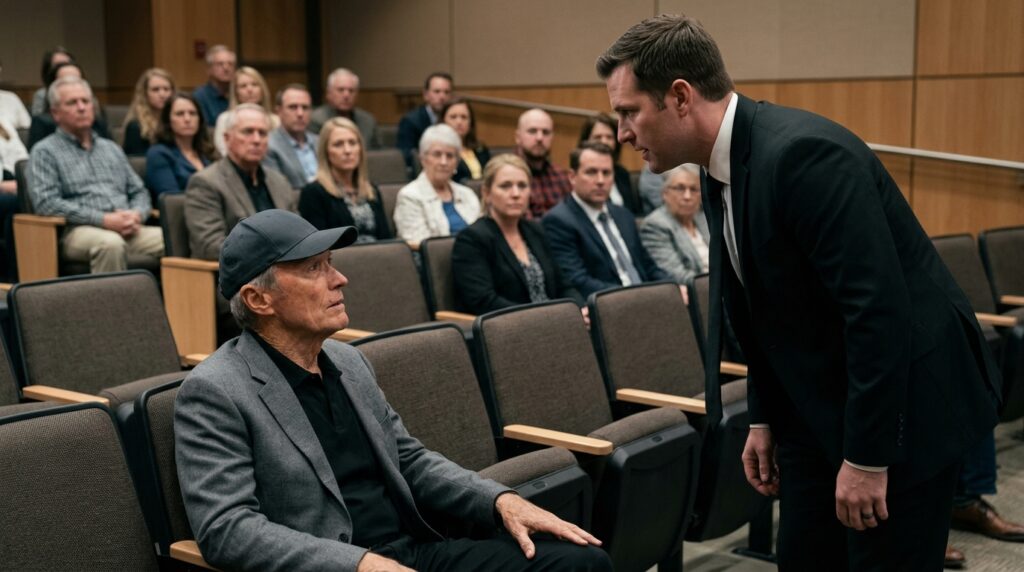
“Sir, you need to leave this seat right now.”
The words were low, clipped, and heavy with the plastic weight of bureaucratic authority. They cut through the low hum of the civic auditorium, a room smelling of damp raincoats and industrial floor wax.
The old man did not turn his head immediately. He kept his gaze fixed on the empty wooden stage at the front of the room, his hands resting lightly on the cold, painted iron arms of the theater chair. Beneath the brim of his dark agency cap, his eyes did not blink. He was calculating the distance between his left hip and the hard edge of the oak aisle reinforcement.
The challenger was young, late thirties, with the thick, muscular neck of a man who spent his mornings lifting heavy weights in institutional gyms. His black suit was stiff, straight off the rack of a department store that supplied corporate security details, and his tie was knotted with aggressive symmetry. He stepped directly into the narrow lane of the row, his polished leather shoe pinning the old man’s right flank against the hinges of the seat.
The old man remained entirely silent. He did not offer an explanation, nor did he look for a ticket stub. His silence was a physical barrier, dense and cold. The crowd in the rows behind them began to settle into a hushed, uncomfortable stillness, the collective intake of breath that accompanies a public humiliation. They saw an old man in a frayed gray jacket over a black shirt being bullied by an enforcement asset. They did not see the alignment of his weight.
“Get up,” the younger man murmured, his hand moving toward the interior lapel of his suit jacket—not for a weapon, but for a badge or a legal notice meant to finalize the eviction.
The old man moved before the hand could clear the fabric.
The upward transition from the chair was not a rise; it was an explosion of mass and leveraged torque. The old man’s right palm struck the underside of the younger man’s chin with a dull, sickening crack that drove the teeth together. At the same micro-second, his left hand hooked behind the challenger’s knee, sweeping the leg forward against the hard metal edge of the chair lane.
The geometry was absolute. The larger man’s center of gravity vanished. He went down hard, the back of his skull striking the commercial carpet with a heavy, hollow thud that vibrated through the floorboards. The auditorium chairs rattled in their tracks.
The audience remained frozen, mouths open but silent, suspended in the sudden shock of a five-second execution.
The old man stood upright over the fallen body, his gray jacket settling perfectly back over his lean, athletic frame. His breathing remained regular, rhythmic, untouched by adrenaline. He looked down at the dark short hair of the man on the carpet, whose eyes were rolling back toward the fluorescent lights of the ceiling.
Reaching down with a slow, deliberate movement, the old man unbuttoned the younger man’s suit jacket. He did not find a badge. Tucked into the interior leather holster was a standard-issue tactical sidearm, but pinned directly beside it was a glossy, high-resolution surveillance photograph of the old man himself, taken through the kitchen window of his own house forty-eight hours ago.

CHAPTER 2: THE PERIMETER BREAK
The weight of the photograph in the old man’s palm was exactly three grams of glossy cardstock, but the spatial reality it represented altered the architecture of the room. Forty-eight hours ago, he had been standing by his sink, a chipped ceramic mug in his hand, entirely unaware of the glass-cutting lens calibrated to his face from the oak treeline across the county road.
He didn’t shove the picture into his pocket; he dropped it back onto the chest of the unconscious man in the black suit, a marker left for whatever clean-up crew would inevitably trace the failure.
The auditorium was no longer a hall; it was a bottleneck. In the upper tiers, a woman’s breath hitched, the sound scraping against the acoustic tiling before mutating into a sharp, thin scream. The collective paralysis of the crowd was decaying into panic. Feet shuffled against the carpet. The security guards at the rear doors—two local hires in oversized blazers with brass buttons—were frozen in the doorway, their hands hovering over their utility belts like men trying to remember where they left their keys.
The old man turned his back to the stage and stepped into the lateral exit lane behind row M. His movement was fluid, low-profile, his gray jacket breaking his silhouette against the dark mahogany paneling of the walls. He didn’t run. Running gave the guards a target, a vector of intent. Instead, he slipped into the slipstream of three students fleeing toward the southern stairwell, using their chaotic momentum as a visual baffle.
The stairwell was a concrete throat, cold and smelling of damp salt. He descended three steps at a time, his knees clicking with a dry, mechanical regularity that had nothing to do with weakness. His ears were tuned to the vertical column behind him: the heavy, rhythmic thrum of combat boots was absent, meaning the department hadn’t deployed a full extraction team yet. The man in the black suit had been a probe. A solo scout sent to test the perimeter or verify the identity of the ghost under the agency cap.
At the basement level, the air turned gray and greasy with the exhaust of the subterranean parking structure. The old man paused behind the heavy steel fire door, his fingers resting on the panic bar without pressing it. Through the narrow wire-glass window, the garage stretched out in low-ceilinged perspective—rows of concrete pillars marked with faded yellow stencils, a grid of dark oil stains, and forty-two vehicles parked in neat, geometric rows.
He didn’t look for his own truck. They would have the plate anchored into every automated reader within a three-mile radius by now. Instead, his eyes scanned the premium tier closest to the elevator bay.
There it was. A matte-black sedan with dark tinted windows, its rear bumper slightly misaligned from a hasty reverse park. It was clean—too clean for the muddy June rain currently slicking the streets outside. A small, black transponder disk was stuck to the lower left corner of the windshield, pulsing with a microscopic blue light every four seconds. An agency-lease vehicle, outfitted with a localized rolling-code ignition bypass.
The old man pushed the bar, the door opening with a silent hiss of hydraulic oil. He crossed the three lanes of asphalt in six seconds, his shadow cutting sharp, right-angled corners under the high-pressure sodium lamps. He didn’t check the door handles. He knew the protocol for an active scout on a short-duration asset grab. The key wouldn’t be in the man’s pocket; it would be magnetically anchored to the interior face of the left rear wheel well, exactly three inches above the brake caliper line.
His fingers found the cold plastic tab of the key fob within two seconds. The car’s electronic locks clicked open with a muffled, metallic snap that sounded like a rifle bolt clearing a chamber in the dead silence of the garage.
He slid into the driver’s seat, the smell of new leather and synthetic ozone hitting him like a physical reprimand. The dashboard didn’t wake up with a standard manufacturer logo; it stayed dark, a single red line of diagnostic code scrolling across the central liquid-crystal display before settling into an active tracking screen. A localized high-frequency hum began to vibrate through the steering column—a sub-audible tone that made the fillings in his jaw ache.
On the passenger seat lay an unsealed manila envelope, its edge marked with a blue grease pencil. The old man reached out, his thumb catching the metal clasp. Inside was a single sheet of thermal paper, not a government dispatch, but a commercial manifest bearing the corporate crest of Vanguard-Logistics-Group, a private maritime liquidation firm operating out of the Delaware ports.
The old man’s brow furrowed, the deep lines beneath his cap hardening into iron ridges. The asset listing at the bottom of the page didn’t use his old operational call sign. It listed his social security number, his current address, and a flat, nine-digit dollar figure next to the word: Liquidation.
A shadow flickered in his peripheral vision—a shape moving past the concrete pillar marked Section 4-B. The old man didn’t look directly at it. He kept his hand steady on the manifest, his mind converting the commercial logo into a tactical problem. His old department didn’t outsource to domestic maritime firms. They used deep-cover warrants or quiet medical retirements in closed facilities.
The hum from the dashboard shifted frequency, the red diagnostic line blinking twice before a new string of text appeared: PROXIMITY LOCK ACTIVATED. TERMINATION SEQUENCE TIMED AT 180 SECONDS.
Behind him, the heavy steel fire door to the stairwell swung open with a loud, echoing crash.
CHAPTER 3: THE ENCRYPTED LEDGER
The slam of the fire door vibrated through the frame of the matte-black sedan before the sound even registered in the dense air of the garage. In the side mirror, two figures blurred into motion—not local guards, but clean-cut men wearing the identical tactical nylon windbreakers of private intelligence assets. They moved with their heads down, weapons drawn and held low against their thighs, their vectors converging on the sedan’s position with lethal efficiency.
The old man did not look back twice. His fingers moved with cold, mechanical certainty under the plastic molding of the steering column. His fingertips grazed a small, sharp edge—a metallic cylinder no larger than a cigarette filter, anchored to the wires by a strip of heavy-duty black electrical tape. He ripped it free. It was a physical hardware key, its cold aluminum casing stamped with a ten-digit military serial number he hadn’t seen since the deployment in Berlin forty years ago.
He jammed the key into the auxiliary diagnostic port beneath the console just as the countdown on the digital screen hit ninety seconds.
The engine didn’t roar; it caught with a low, predatory purr that vibrated through the soles of his shoes. He slammed the gear selector into reverse. The tires screamed against the smooth, oil-slicked concrete, the vehicle tearing backward in a tight, sharp arc that missed a concrete support pillar by less than three inches.
One of the men in the nylon jackets lunged out of the path of the retreating bumper, his arm coming up to track the driver’s window. The old man didn’t duck. He kept his eyes locked on the mirror, using the rigid metal frame of the car as a shield. The sound of three compressed impacts—dull, metallic thwacks—shattered the safety glass of the rear windshield, spraying pebbles of tempered laminate across the back seat.
Before the shooter could reset his stance, the old man threw the lever into drive. The sedan launched forward, its front bumper smashing through the fragile plastic arm of the security gate with a loud, splintering crack.
He surged up the steep concrete ramp and broke into the blinding glare of the rain-slicked city streets. The gray June downpour washed over the hood, clearing the white glass powder from the cowl. He blended instantly into the three lanes of heavy commercial traffic heading toward the industrial docks, his eyes shifting between the rearview mirror and the red lines of text beginning to stitch across the dashboard display.
With the hardware key inserted, the system’s security block didn’t just drop—it inverted. The automated tracking interface dissolved, replaced by a raw, unformatted directory tree. The data scrolling past his peripheral vision was an operational manifest detailing a corporate structure named Vanguard Logistics, but the routing protocols beneath the corporate header were entirely domestic. They were pulling location pings from local cellular towers, tracking his specific credit history, and tracing every dormant bank account he had touched since 1996.
The old man pulled the sedan into the shadow of a row of rusted shipping containers near Pier 17, the heavy scent of unrefined diesel and salt water masking his presence. He left the engine idling, his hand gripping the steering wheel tight enough to make the old skin over his knuckles turn translucent.
He tapped the screen, drilling down into the source files of the liquidation order. It was a decoy. The entire corporate layout of Vanguard Logistics was an elaborate front, a digital mask constructed to look like a private corporate hit. The names listed as authorizing officers weren’t executives; they were old internal code keys belonging to his old agency division.
Then his eyes stopped on a single line of automated diagnostic code at the bottom of the ledger: ORION-7 RECOVERY PROTOCOL ACTIVE.
A cold knot formed in his stomach, harder and sharper than the impact of any combatant’s fist. Orion-7 wasn’t a corporate project. It was the specific operational designation for his old three-man deep-cover unit. A unit that had been officially dissolved, categorized as deceased, and buried in the classified archives decades ago.
According to the ledger, the command to hunt him hadn’t originated from an active desk in Washington or a private corporate boardroom. It was a pre-programmed automated sweep, a digital ghost ship that had suddenly awoken from an external server and turned its sensors toward his quiet retirement. The system was executing a purge contract, but it wasn’t a live human enemy behind the glass—it was a pre-recorded instruction that had identified him as an active leak.
The screen flashed green once, a new coordinates file downloading into the navigation system. It was an address in the outer suburbs, less than twelve miles from his location. A clean room safe house he had personally established under an alias thirty-two years ago and never used once.
The high-frequency hum from the dash ceased, replaced by a dead, absolute silence that felt more dangerous than the alarms. They knew where he was going before he did. The system wasn’t just tracking his movements; it was predicting his survival protocols based on his own historical patterns.
He pulled his agency cap lower over his lined face, his thumb tracing the sharp aluminum edge of the hardware key. He had to reach the clean room before the next sweep finalized, but every intersection between Pier 17 and the suburbs was now a calculated trap designed by an intellect that mirrored his own.
CHAPTER 4: THE TERMINAL DISCOVERY
The padlock on the cellar door of the dilapidated split-level house broke with a dry, mechanical snap. The old man stepped into the dark throat of the basement, his boots finding the concrete steps by memory alone. The air inside smelled of dust, stagnant lime, and sixty years of unchanged foundation stone. This was the redoubt—a subterranean clean room lined with copper sheeting to block electromagnetic leaks, hidden beneath an ordinary suburban address that had been scrubbed from every database before the turn of the century.
He let the heavy steel door swing shut behind him, the magnetic seals locking into the frame with an airtight hiss that cut off the sound of the autumn rain outside. In the absolute dark, he reached for the breaker panel. His knuckles grazed the cold zinc levers, slamming the main switch upward.
The lights didn’t flicker. They came on instantly, casting a harsh, desaturated glare over the concrete floor.
The old man stopped three paces from the wall, his frame freezing into a rigid, defensive posture. His shadow stretched out long and thin across the gray concrete, but it wasn’t the only shape in the room.
In the center of the clean room, resting on a scarred steel worktable where nothing should have been, sat a piece of equipment that did not belong to this decade. It was an old military surveillance console—a heavy, olive-drab box with thick rubber dials and a circular green cathode-ray screen. The high-voltage transformer inside the unit gave off a low, rhythmic hum that vibrated through the floorboards, a sound that made the back of his teeth ache with a cold, familiar frequency.
The green glass screen wasn’t blank. White lines of phosphorus text were stitching themselves across the display, scrolling vertically at a controlled, automated pace.
He moved toward the table, his boots making no sound on the dust. His hand reached out, his fingers stopping less than an inch from the cold steel casing of the monitor. The heat rising from the ventilation slats smelled of ozone and scorched copper, the unique sensory signature of a machine that had been running at maximum capacity for weeks.
He read the code scrolling across the glass. It wasn’t an interrogation protocol. It was a log of systemic operations.
The entry lines didn’t bear the stamp of an active agency department or a private corporate hit team. The root directory at the top of the monitor read ORION-7_ALPHA. Beneath it, a rolling inventory listed three names. The first two were crossed out with a single, horizontal strike of red text, followed by a time-stamped liquidation code from three weeks ago. The third name was his own.
Beside the monitor lay a physical object—a faded manila folder from the State Psychiatric Hospital in Maryland, its edge bound with rusted metal staples. The old man picked it up, the paper dry and brittle against his calloused skin. The medical chart inside belonged to Miller. Miller, the third member of his original deep-cover team, the brilliant, paranoid engineer who had designed the division’s automated threat-containment infrastructure before his mind had unraveled under the weight of the operations.
The death certificate pinned to the final page was dated exactly twenty-one days ago. The cause of death was listed as cardiac arrest, suffered in a closed ward while the patient was under heavy sedation.
The old man looked back at the screen, the phosphorus light painting his lined face in shades of pale emerald. His thumb traced the cracked glass edge of his pocket watch, his mind calculating the terrible geometry of the situation with the cold logic of a predator who realized he had tracked his own ghost.
The private security assets at the auditorium, the black sedan, the Vanguard Logistics liquidation manifest—none of it had been an intentional strike directed by a living adversary. It was an automated reflex. When Miller’s heart had stopped in that state asylum three weeks prior, his biometric monitor had functioned as a dead-man’s switch. The legacy software program, left dormant on an unmapped server for nearly forty years, had interpreted the death of its creator as a security breach.
The machine was simply executing its final directive: to clean the slate and close the folder on Orion-7 by tracking and neutralizing the remaining biological components of the unit.
A small speaker inside the console clicked, a burst of white static washing through the silent room. Then, a pre-recorded voice emerged from the hiss—dry, flat, and synthetically reconstructed from historical audio tape. It was Miller’s voice, recorded when they were both young men in Berlin, before the scars had set into their skin.
“If you are reading this line, the system is already blind,” the speaker murmured through the static. “The sequence cannot be paused from the interior terminal. The keys are already rolling. I’m sorry.”
The green display flickered, the directory tree dissolving into a map of the local county. Three red tracking vectors were currently initializing along the highway grid, their points of convergence shifting rapidly toward the exact coordinates of the basement safe house. The system wasn’t just executing a past command; it was learning his evasion patterns in real time, deploying resources to his fallback locations before he could even clear the perimeter.
The old man didn’t move toward the door. He stood beneath the desaturated glare of the fluorescent tubes, his lean frame motionless as the static hummed in the corners of the room. The true enemy wasn’t an office in Washington or a corporate board; it was an unthinking, unfeeling machine built by his closest ally, running on a loop until the last piece of the past was buried in the dirt.
He reached down, his fingers tightening around the heavy iron wrench resting on the edge of the steel table. The countdown on the screen began to tick backward from sixty, the green light reflecting off the cold metal tool in his hand.
CHAPTER 5: THE SERVER CORE VECTOR
The sixty-second countdown did not end with a digital chime; it ended with the percussive, synchronized shattering of the house’s upper windows. The vibration traveled down the structural timbers of the split-level, dropping a fine white powder of drywall dust into the old man’s cap.
The tracking vectors on the olive-drab screen went solid red. They were inside the perimeter.
The old man moved with the practiced economy of a machine. He did not waste time striking the console with the wrench; he knew the reinforced plating of the military-grade housing would withstand anything short of a shaped charge. Instead, he reached behind the monitor’s ventilation housing, his fingers tracing the thick, braided copper ground wire that ran directly into the basement’s main electrical conduit. He clamped the wrench onto the copper lead, bracing his heels against the concrete floor, and threw his entire body weight backward.
The cable tore free from the wall terminal with a sharp, blinding spray of blue electrical arcs. The high-voltage cathode-ray tube inside the monitor imploded with a dull, hollow pop, safety glass spraying across the steel table like coarse salt. The synthetic voice of Miller cut out mid-syllable, dissolved into a flat line of white smoke that smelled of scorched resin.
Above him, the floorboards groaned under the weight of three distinct entry teams. They were moving in a standard high-low stack, their boots tapping out a tight, overlapping rhythm that signaled advanced institutional training. They weren’t using flashlights; they were running on infrared optics, searching for the thermal signature of a living body in the dark.
The old man reached down to the lower tier of the worktable, pulling a small, gray plastic cylinder from an unmapped recess in the steel framing. It was an obsolete phosphorus signaling flare, its casing pitted with zinc oxidation. He didn’t ignite it yet. He slipped it into the lateral pocket of his gray jacket, his fingers catching on a small, cold object fixed to the timber stud behind the table—a mechanical tension gauge for a defensive trip-wire system, its needle pegged at maximum resistance.
Someone had altered the safe house’s defensive perimeter from the inside before he had ever arrived. The machine had already laid its own traps.
He turned toward the rear utility tunnel, a three-foot concrete conduit designed for the main water mains that emptied into the municipal storm basin two hundred yards south. He scrambled into the pipe on his knees, his athletic frame bending into the tight radius with a fluid, fluid precision that ignored the ache in his lower spine.
Behind him, the steel cellar door was blown inward with a deafening, pressurized crack. A cloud of desaturated gray dust rushed into the conduit, thick with the chemical stench of an aerosol suppression agent meant to neutralize an occupant without leaving a trace of fire damage. The system was cleaning its teeth.
He crawled through the black belly of the pipe, his palms scraping over the rough, unpolished aggregate of the concrete. He didn’t look back until his fingers touched the cold, wet iron rungs of the storm basin exit. He climbed toward the surface, his head breaking through the rusted grate into the freezing downpour of the suburban street.
The neighborhood was dead, cast in shades of desaturated charcoal under the low storm clouds. Two unmarked white panel vans were parked at right angles across the intersection, their engines idling without a trace of exhaust or sound, their roof-mounted omnidirectional antennas tracking the local cellular grid in micro-second intervals.
The old man slipped through the gap between two rotting cedar fences, his gray jacket blending into the wet mist of the alleyways. He pulled the aluminum hardware key from his pocket, the stamped serial number cold against his skin. The data he had extracted before the monitor died wasn’t an address—it was a routing sequence pointing toward a closed military reservation in the limestone ridges of western Virginia.
The machine’s heart was running out of an old facility designated Site Bravo, a bunker cut into the living rock before the computers had learned how to think for themselves.
He didn’t have a vehicle anymore, and the highway readers would be looking for a single male traveler matching his physical mass. He looked down at his silver pocket watch, the cracked crystal reflecting the desaturated yellow glare of a distant street lamp. He had less than four hours before the system finalized its next regional sweep and locked down the Virginia perimeter entirely. He would have to take the freight line behind the industrial yards, moving through the blind spots of a country that had forgotten his name but preserved his file.
CHAPTER 6: THE GHOST COLONY
The spine of the Blue Ridge was a desaturated scar against the low, gray belly of the storm clouds. The old man dropped from the slow-moving undercarriage of the coal transport three miles east of the branch line, his knees absorbing the heavy shock of the ballast stones with a dull, familiar scrape. He did not pause to dust his gray jacket. The rain here was thick with the scent of wet pine and old iron, washing the grit from the lines of his face as he climbed toward the crest of the northern ridge.
Site Bravo sat inside the hollowed core of a limestone bluff, masked by a decommissioned state forestry watchtower and three concentric perimeters of sagging chain-link fence. The system had abandoned the outward pretense of maintenance; the gates were locked with rusted padlocks, but the automated optical sensors mounted to the steel poles were alive, their tiny quartz lenses spinning with a high-pitched, sub-audible whine as they tracked the movement of the treeline.
The old man did not approach the gates. He understood the defensive geometry Miller had built into the mountain forty years ago. Every public approach was a fatal lane, calibrated to automatic claymore placements buried in the leaf mold. Instead, he worked his way through the drainage ravine behind the old generator shed, where the runoff from the limestone floor had corroded the base of the galvanized iron wall plates.
He pried back a sharp sheet of corrugated steel, his fingers slick with black grease, and slid into the dark throat of the facility.
The air inside was dead, freezing, and smelled of dry hydraulic fluid. The corridor was a raw rock tunnel lined with heavy zinc conduits and vaulted steel reinforcement rings that disappeared into the absolute dark. There were no lights, but every hundred paces, a wall-mounted pneumatic relay tube would click with a violent, pressurized snap, a brass capsule whistling through the lines overhead as the facility’s mechanical logic network shuffled data between the lower tiers.
He moved by touch, his right hand tracing the cold edge of the zinc casing until his fingers caught on a recessed aluminum panel. He popped the latches. Inside was a physical maintenance station containing an emergency layout map—a blue-line print on heavy, starched linen that displayed the subterranean layout of the site.
The old man leaned close, his eyes adapting to the faint, greenish glow of a single diagnostic diode on the terminal block. His index finger tracked the blue lines from the intake vaults to the central core. Then his movement stopped.
The physical blueprint didn’t match the operational ledger he had pulled from the sedan in Pier 17. The print clearly showed three automated storage sectors, but someone had hand-scratched a fourth vault lane directly beneath the primary ventilation shaft, marking it with a cold, stenciled abbreviation: O-7_SECURE_HOLD.
A sudden sound shattered the rhythmic clicking of the pneumatic lines—the heavy, mechanical whine of a high-pressure air lock cycling in the sub-level tier directly below his position.
The machine wasn’t just waiting for him to reach the mainframe; it was actively configuring the interior environment to restrict his path. The iron floor plates beneath his boots began to vibrate, a low-frequency hum rising through the structural pillars as the emergency blast doors in the primary gallery began to slide shut, their cold steel edges locking into the limestone channels with the force of hydraulic rams.
The old man dropped the linen print and launched his lean frame down the auxiliary stairwell, his hands sliding along the rough iron handrail to steady his descent. He was racing the closing sequence of his dead partner’s mind. If the system completed the lockdown before he reached the fourth sector, the clean room parameters would activate, venting the oxygen from the inner core to preserve the magnetic tape reels from human touch.
At the foot of the stairs, the corridor split into a series of narrow vault lanes lined with high-voltage battery racks that gave off the sharp, dry sting of sulfuric acid. In the center of the lane stood an automated perimeter defense unit—a low, three-wheeled chassis mounting a suppressed automatic barrel, its optical dome spinning toward the sound of his boots.
The old man didn’t hesitate. He pulled the oxidized phosphorus signaling flare from his jacket pocket and struck the cap against the limestone wall.
A blinding, chemical glare erupted in the narrow tunnel, white-hot and choking with white smoke. The intense thermal bloom completely saturated the machine’s infrared sensors, its dome spinning erratically as it fired a short, deafening burst into the empty rock face fifty yards behind him. The ricochets screamed through the vaulted rings, spraying stone chips across his gray jacket as he dived beneath the chassis, his right hand driving the iron wrench into the unit’s exposed drive assembly until the gears sheared with a brutal, grinding screech.
He dragged himself out from under the smoking machine, his breathing coming in short, regular rasps beneath his dark cap. The air in the lane was already thinning, the primary exhaust fans above him spinning down as the isolation protocols finalized.
Ahead of him, through the clearing phosphorus smoke, the heavy circular hatch of the primary mainframe vault was visible, its locking bars turning slowly behind a thick pane of reinforced safety glass. But through the window, he could see something else—the dark silhouettes of three identical black suits already standing inside the core room, their hands moving over the manual override levers as they prepared for his arrival with the precision of a trap closing on an expected target.
CHAPTER 7: THE TERMINAL DELETION
The reinforced glass of the observation window did not shatter cleanly; it exploded inward under the leverage of the iron wrench, collapsing in heavy, gem-like fragments that rained across the zinc floor of the mainframe core. The old man rolled through the gap before the shards settled, his gray jacket catching a jagged edge that scored a dark line across the shoulder fabric.
The three men in the black suits reacted with the instantaneous, synchronized mechanics of trained assets. The center operative did not reach for a weapon; he stepped forward to guard the master terminal console, his palms flat against the galvanized frame, his weight balanced to suppress any manual override attempt. The remaining two cleared their holsters, their profiles dropping into a low-center crouch that cut down his available angles of attack.
The old man used the forward momentum of his drop to sweep the ankles of the closest shooter. His boot caught the man’s heel with a dull, sickening crack, driving the asset’s knees into the sharp edge of a low-voltage battery rack. A blinding arc of blue electricity flared between the dislodged terminals, illuminating the room in a desaturated, freezing strobe. The second shooter fired twice, the suppressed rounds punching clean, black holes through the aluminum cabinets behind the old man’s head, spraying a fine mist of hot mineral oil across the lenses of the machinery.
The old man didn’t seek cover. In the logic of a predator trapped in a narrow lane, cover was a static grave. He lunged inside the second shooter’s reach, his left hand locking around the cylinder of the asset’s weapon while his right palm drove the heavy iron wrench upward into the base of the man’s throat. The blow was precise, crushing the breath from the target and driving him backward against the high-pressure pneumatic tubes.
Only the center asset remained, his hands still anchored to the terminal keys, his eyes watching the struggle with a cold, unblinking detachment that belonged to a machine rather than a man. He wasn’t trying to kill the old man; he was protecting the entry line. The digital screen above his head was flashing a single, terminal command: ORION-7 PURGE EXECUTION IN PROGRESS—89% COMPLETE.
The old man threw his weight against the console, his forearm pinning the asset’s throat against the metal bevel. The young man’s grip was like iron, his fingers continuing to stitch code across the keys even as the oxygen left his lungs. He was an extension of the program, an automated proxy executing an ancient instruction without malice or hesitation.
“It’s over,” the old man hissed, his voice a low, gravelly rasp that barely cleared the high-frequency whine of the cooling fans. “The ledger is open.”
The asset didn’t answer. His eyes remained fixed on the scrolling green phosphorus text, his mouth closed in a rigid, silent line of absolute commitment. He did not monologue. He did not plead. He simply shifted his hip, leveraging his bulk to drive the old man’s ribs against the sharp edge of the keyboard tray.
With a final, explosive surge of biomechanical memory, the old man wrenched his right arm free, bypassing the asset’s guard, and drove his fingers into the master rack assembly directly beneath the main processing block. His hand closed around the cold, textured plastic of the primary logic card—the central physical memory module that carried Miller’s core algorithmic directives.
He ripped it out.
The copper pins tore from their gold sockets with a loud, tearing screech of electrical static. A brilliant flash of green light erupted from the interior circuitry, followed by the immediate, dead silence of a dying machine. The cooling fans wound down to a low, breathless whisper. The scrolling phosphorus lines on the monitor dissolved into a cloud of chaotic, unreadable static before fading into the gray-black depth of the cathode-ray tube.
The young man in the suit went limp, the artificial focus leaving his frame as he fell back against the dead terminal housing, his chest heaving as he stared up at the concrete ceiling of the vault.
The old man stood over the console, his breathing heavy but controlled beneath the dark agency cap. He looked down at the physical logic card in his hand—the green circuit board was scarred, its gold traces burned black by the final overload. He didn’t look at the fallen men. He didn’t look for a trophy. He reached down and slid the aluminum hardware key from the diagnostic port, pocketing it alongside his cracked silver watch.
The facility around him was completely silent now, the mechanical clicking of the pneumatic lines frozen in mid-cycle. The air was cold, damp, and smelled of dead ozone and limestone dust. The machine was dead, its automated hunt finalized by a manual deletion it had failed to predict.
He turned away from the terminal, his boots making a faint, gritty sound on the glass fragments as he walked toward the exit conduit. The road outside would still be gray, wet, and empty, but the files were clean. For the first time in forty years, the past was nothing more than ink on paper that had ceased to burn.







