
The Cold Concrete Horizon Where Lost Operatives Trade Whispered Sins for a Sovereign Chance at Absolute Survival
CHAPTER 1: THE FIRST STRIKE
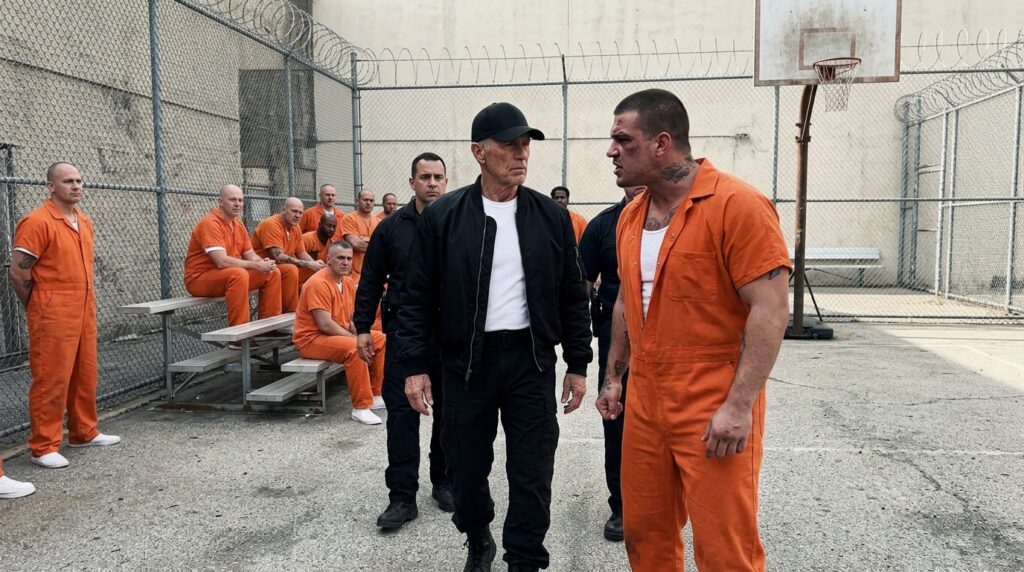
The heat in the yard smelled of fried transmission fluid and dead grass. It came off the asphalt in waves, thick enough to blur the silhouettes of the men clustered around the rusted steel of the basketball stanchions. They didn’t move. They just watched the heels of my civilian boots drag a pair of thin, straight lines through the limestone dust.
“Keep walking, old man,” the guard behind me muttered. His thumb was hooked over the top of his heavy nylon utility belt, right next to the expired canister of chemical restraint. His uniform shirt was dark with sweat between the shoulder blades, a gray stain shaped like a spade. “Center line. Don’t look at the fences.”
I didn’t need to look at the fences to know the razor wire was unwashed, catching the glare of the noon sun like teeth. My civilian bomber jacket felt like a sheet of lead across my shoulders. Every stitch of it held the grease of five states I’d left behind to get to this dirt lot, and right now, the fabric was sticking to the white cotton of my undershirt. I kept my chin level with the third button of the guard’s collar ahead of me. One foot, then the next. Three miles of concrete wall enclosing four hundred men who spent their days counting the cracks in the aggregate.
Then the shadow came.
He was twenty-eight, maybe thirty, with a neck like an unbarked pine log and an orange jumpsuit that had been torn away at the seams to give his shoulders room to breathe. A map of blue ink crept up his throat, disappearing into a jawline that had taken three separate breaks and healed crooked every time. He didn’t drop into a stance. He just stopped, six feet out, directly where the limestone dust gave way to the sun-baked tar.
“You think that jacket makes you untouchable in my yard, old man?” His voice was thin, reedy, dried out by tobacco and institutional lime. He stepped closer, the smell of sour onions and cold grease coming off his skin.
The guard behind me stopped. I could hear the leather of his holster creaking as his weight shifted backward, away from the lane. No one called for a backup. No one blew a whistle. The silence that hit the yard was absolute, the kind of quiet that only happens when three hundred men realize the rules have been temporarily suspended for their entertainment.
The big man crowded the gap. He didn’t want a fight; he wanted a submission he could show to the bleachers. He leaned his weight forward, his chest catching the front of my jacket, pushing me down. My left knee hit the crushed stone, the sharp gravel biting through the black cargo pants until it found the bone. The heat from the ground came through the fabric instantly, dry and smelling of old iron.
“Look up when I’m talking to you,” he whispered.
I stayed down for two seconds. I looked at the dust between his boots. A small piece of green bottle glass was embedded in the tar right beneath his left arch, worn smooth by thousands of standard-issue soles. I didn’t breathe through my nose. I kept my mouth slightly open, letting the dry air ground me.
When I moved, I didn’t use the civilian jacket for leverage. I drove straight up from the right heel, catching him before his weight could reset. My right boot found the soft pocket behind his left knee, a clean, short snap that broke his balance before he could swing his arms. As he tilted, I drove the palm of my hand into the center of his chin—not a punch, just three pounds of meat and bone meeting the nerve cluster at forty miles an hour.
The sound was like an axe hitting dry cedar.
He went backward three feet, his boots skidding through the limestone before his shoulders took the brunt of the lower metal bleacher rail. The steel groaned, a dull, vibrating ring that stayed in the air long after his head hit the dirt.
I stayed centered in the lane. My jacket hadn’t even unzipped. Behind me, the guard’s hand was still hovering over his belt, his fingers twitching against the nylon. Across the yard, by the chain-link partition, a middle-aged man in an identical orange suit lowered his water cup, his eyes locked on the dust rising around the big man’s head.
The big man didn’t get up. He lay there, his fingers curled into the gravel, a single drop of dark, unoxidized blood starting to form at the corner of his nostril.
“Moving,” I said to the guard ahead of me. I didn’t look back at the bleachers. I kept my eyes on the heavy iron door at the end of the lane, where the shadow of the cell block overhang began.
The guard didn’t move for three seconds. Then, with a slow, mechanical jerk of his chin, he stepped forward, his boots crunching into the limestone. As we crossed into the shadow of the threshold, the cool air of the interior hit my face, smelling of damp disinfectant and wet wool.
I reached into my pocket, my fingers brushing against the small brass buckle stitched into my seam. My skin was dry, but the metal was cold.
“Warden’s waiting,” the guard said, his voice lower now, almost a whisper against the concrete corridor. He didn’t look at my face as he pulled the heavy iron lever to unlock the inner gate, but his hand stayed six inches away from his side. “But she didn’t say nothing about you keeping that coat.”
Across the desk in the reception alcove, an open clipboard held a single yellowed carbon copy of an intake sheet—and where the federal authorization signature should have been, there was only a black grease-pencil cross.

CHAPTER 2: INTAKE VERIFICATION
The grease-pencil cross on the intake form was still wet enough to smear if a sleeve caught the edge of the clipboard. It wasn’t an administrative error; it was a deliberate omission, a clean subtraction of legal existence. In a facility built on five hundred tons of reinforced aggregate, an unsigned entry sheet meant nobody was accountable when the cell door remained deadbolted during a fire drill.
The intake officer didn’t look up from his terminal. He was a small man named Miller, his scalp showing pink and slick through a sparse gray comb-over that smelled faintly of cheap pomade and stale tobacco. His fingers hit the keys with a dull, rhythmic clack that sounded like dry gravel falling into an empty bucket. Every three or four strokes, the old cathode-ray tube monitor flickered, casting a pale, greenish hue over the flaking institutional paint of the alcove walls.
“Civilian garments,” Miller said, his teeth clicking together on the final syllable. He didn’t state it as a question. He wrote it down in a ledger whose leather binding had cracked along the spine, revealing the coarse gray gauze underneath. “One black bomber jacket, heavyweight nylon. One white knit undershirt. Cargo trousers, dark. Boots, non-standard issue. No personal effects listed on the manifest. No wallet. No identification.”
“The authorization was cleared out of the regional office three days ago,” I said. My voice was flat, keeping the cadence short to match the transactional silence of the corridor behind us. “Check the secondary secure terminal. The one unlinked from the state mainframe.”
Miller’s fingers hovered over the keyboard for a fraction of a second. The motion was so subtle another man might have missed it, but the sudden tightening of the skin around his jawline told the real story. He knew about the secondary terminal. He also knew exactly why it was sitting beneath a canvas dust cover in the Assistant Warden’s private office instead of down here in the booking cage.
“There is no secondary terminal on this shift, visitor,” Miller replied, his voice dropping into that rhythmic, bureaucratic drone used by men who have spent twenty years hiding behind state guidelines. He finally raised his eyes, and they were yellowed at the corners, the pupils small and hard like bird shot. “What isn’t on the main screen doesn’t exist within these coordinates. As far as the Commonwealth is concerned, you’re an unscheduled transport drop with a defective movement order. That means you stay in the intake tier until someone with a gold badge signs off on the custody transfer.”
Behind me, the guard who had escorted me from the yard shifted his feet. The heavy leather of his utility belt let out a dry, rhythmic creak as he leaned his shoulder against the iron bars of the cage. He was the one who had seen the big man hit the bleachers; he knew the weight I carried in my boots, but his loyalty belonged to the shift schedule, not to a civilian without a paper trail.
“We can’t leave him in general holding, Miller,” the escort guard said, his tone casual but his eyes fixed on the hallway behind the desk. “Not after what happened by the basketball hoops. The North Block boys are already passing the word through the pipe-chase. If he’s down there when the evening shift rotates, the whole tier goes loud.”
“Then he goes to Unit Four,” Miller said. He didn’t hesitate. He pulled a rusted iron key from a drawer beneath the desk—a long, double-bitted piece of steel that had been worn smooth by decades of oil and skin. He dropped it onto the counter with a heavy, metallic clink that echoed off the low concrete ceiling. “Solitary intake. No privileges. No yard rotation until the administrative discrepancy is corrected from the top.”
I looked at the key. The notch on the third bitt was filed down manually, a crude modification designed to bypass the secondary safety lock on the isolation cells. It was an old trick used in maximum-security houses when the staff wanted to ensure a door could be opened from the outside without triggering the master indicator board in the control bubble.
“Who ordered the cross on the sheet, Miller?” I asked, my hand resting flat on the cold laminate of the counter, just three inches from the clipboard.
The old clerk froze. The clacking of the terminal keys had completely stopped now, leaving only the low, three-hundred-hertz hum of the fluorescent tube overhead. A single bead of sweat broke from his hairline, tracing a slow line down the side of his nose before stopping at his gray mustache.
“The sheet comes down from the front office exactly how it’s supposed to come down,” Miller muttered, his voice losing its bureaucratic rhythm, becoming sharp and defensive. “I don’t question the margins. I just ink the numbers. Move along before I log you as non-compliant.”
I didn’t press him. In an environment defined by rusted surfaces and institutional inertia, pressing a man like Miller only made him tighten his grip on the ledger. Instead, I picked up the heavy iron key myself, the cold metal biting into my palm with an old, familiar weight. The iron had an odor—iron and zinc and old grease—the smell of a cage that had held fifty generations of desperate men.
“Show me the tier,” I said to the escort guard.
He didn’t answer with words. He reached out and grabbed the iron gate, pulling it open with a long, screeching groan that scraped against the ears like a file on a saw blade. The green paint on the bars was flaking off in long, curled scabs, revealing the pitted dark metal underneath.
As we stepped into the narrow, unlit corridor that led toward Unit Four, the heavy door behind us swung shut with a definitive, mechanical thud that rattled the glass in the booking cage. The light from the terminal screen disappeared, replaced by the amber glow of a single low-wattage security bulb thirty feet down the passage.
The floor here was uneven, the concrete pitted and stained with decades of chemical wash that had eaten through the sealant. My boots made a dry, hollow sound against the stone. Every twelve feet, a narrow slit in the wall revealed a view of the pipe-gallery—a dark, wet space filled with the hiss of steam lines and the steady, rhythmic drip of alkaline water hitting uninsulated iron.
“You made a lot of work for a lot of people out there today,” the guard said, his voice muffled by the narrowness of the walls. He didn’t turn his head around to look at me, but his hand stayed hooked near his restraint canister. “Big Curtis was supposed to stay on that block until the winter hearings. Now he’s in the infirmary with a broken jaw, and his people are going to want to know who paid for the strike.”
“They can ask the Assistant Warden,” I said, watching the way his shoulders twitched at the title. “He seems to be the one managing the books this month.”
The guard stopped outside a heavy, solid-steel door that bore the number 412 in fading white stencil. The iron surface was cold to the touch, sweating with the humidity that rose from the lower utility levels. There was no observation window, only a narrow food slot secured by two external slide bolts.
“This is you,” the guard said, reaching for the key in my hand. “No electronics. No civilian belts. Jacket stays on the hook inside. If you need water, use the basin. Don’t touch the emergency valve unless you want fifty gallons of gray water on your mattress.”
He turned the key in the lock. The tumblers fell with a heavy, double-clack that signaled the engagement of the modified deadbolt. As the door swung open, the air that came out was thick, smelling of old lye and the specific, metallic tang of unwashed copper pipes.
I stepped into the dark of the cell, my heels catching the edge of the iron bunk frame. Before I could turn to check the hinge alignment, the door was slammed shut behind me. The deadbolt engaged with a final, echoing strike that vibrated through the concrete floor and directly into the soles of my boots.
The darkness was almost total, save for a three-inch line of amber light that filtered through the gap beneath the door. I stood motionless for sixty seconds, letting my eyes adjust to the low-contrast environment, my ears sorting through the ambient noise of the block—the distant clank of a steam pipe, the shuffle of feet three levels up, and the distinct, rhythmic scratching of something metallic moving inside the ventilation shaft right above my head.
I reached out into the dark, my fingers finding the rough concrete of the rear wall. The surface was flaking, the lime dust coming off on my fingertips like flour. But three inches below the corner vent, my knuckles struck something different—a small, hard ridge of plastic tape hidden beneath a layer of gray primer.
CHAPTER 3: THE BROKEN BALANCE
The ridge of plastic tape beneath the gray primer didn’t have time to reveal its shape. The air in the pipe-chase on the other side of the wall suddenly compressed, a cold draft whistling through the ventilation grille with the sharp smell of burnt industrial wiring. Then came the heavy, unhurried thud of four pairs of steel-toed boots hitting the concrete floor of the intake corridor.
There was no warning siren. No three-tone chime announcing a midnight count.
A heavy iron bar rattled against the exterior slide bolts of cell 412, the sound raw and immediate in the enclosed space. The double-bitted key turned in the modified mechanism with a dry, mechanical screech that felt like iron shavings being ground into my teeth. The door swung open fast, hitting the rubber wall-bumper with a dull thud that sent a small shower of dried lime dust down from the lintel.
“On your feet, civilian,” a voice commanded from the threshold.
It was a guard captain named Vance. He didn’t have a tactical helmet on, nor did he carry a standard wooden baton. Instead, he wore an old leather jacket over his unbuttoned uniform shirt, his hands buried deep inside the pockets where the silhouette of a compact, unissued rimfire automatic showed against the hide. Behind him stood three senior tier guards, their faces desaturated by the amber security bulbs, their breath smelling of cold coffee and zinc lozenges.
I didn’t rush to get up from the iron bunk. I slid my legs over the edge of the frame slowly, my heels tracking the layout of the pit-marks in the floor. “The booking sheet said twenty-four hours of administrative hold before a tier assignment.”
“The booking sheet is currently sitting in a shredding bin down in the basement,” Vance said, his voice dropping into a low, dry rasp that barely carried past the doorframe. He jerked his chin toward the hallway. “Get moving. We’re taking the utility stairs before the tower shift rotates.”
The three guards stepped into the small cell, their bulk filling the room until the air felt scarce and oily. They didn’t touch me, but they kept their elbows tucked close to their sides, their shoulders squared to block any lateral movement toward the ventilation shaft. I walked between them, the civilian bomber jacket swishing against the coarse fabric of their trousers as they guided me out into the narrow corridor.
The prison was entirely different at two in the morning. The daytime roar of five hundred men screaming across the tiers had subsided into a low, vibrating hum—the collective breathing of a locked-down population mixed with the constant, distant thrum of the facility’s auxiliary generators. We bypassed the master control bubble entirely, taking a sharp left through an unmarked fire door whose hydraulic arm had been disconnected and tied off with copper wire.
We descended a flight of narrow, spiral iron stairs that led deeper into the subterranean foundation of the complex. The walls here were unpainted, rough-poured concrete showing the grain of the wooden forms used to cast them forty years ago. Water dripped from the overhead conduit lines, leaving long, rust-colored streaks that looked like dried grease along the seams.
“You broke the balance,” Vance said as we hit the bottom landing. He stopped under a bare hundred-watt bulb that was caked with grease and dead moths. He turned to face me, his hands still deep in his leather pockets. “Big Curtis was the only thing keeping the laundry detail moving fifty thousand pounds of linen a week without a labor strike. The front office had a deal with him.”
“The front office has a deal with a lot of people,” I said, my back resting against the cold concrete of the stairwell. “Some of those deals involve payroll slips that don’t go through the state treasury.”
Vance’s left eye twitched, a micro-expression that lasted less than a syllable before his face settled back into a mask of hardened pragmatic indifference. “You think you’re the first operative they’ve sent down here with a civilian coat and a blank manifest? Every two or three years, some committee in the capital wants to audit the operational margins. They send an investigator who doesn’t mind getting his boots dirty. They think they’re going to find a box of cash or a ledger with double columns.”
“And what do they actually find, Captain?”
“They find out that the walls are five feet thick,” Vance whispered, leaning in until I could smell the tobacco juice on his breath. “They find out that if thirty guards don’t show up for work tomorrow morning because the local union is angry about the overtime adjustments, the state has to call in the National Guard to clean up the blood. The Assistant Warden doesn’t run this yard because he’s greedy, mister. He runs it because he’s the only one who knows how many cartons of cigarettes it takes to keep the North Block from burning down the boiler room.”
The three guards behind him didn’t look at me; they were monitoring the corridors on either side of the junction, their ears tuned to the distinct sound of the steam valves clicking in the dark. They were part of the machine, as much a part of the structural geometry as the rusted iron tie-rods holding the foundation together.
“So where are we going?” I asked, my fingers sliding into my cargo pocket, feeling the small, hard outline of the brass buckle stitched into the lining.
“We’re going to see if you’re as smart as you are fast,” Vance said. He pulled his hand out of his pocket, holding a small brass padlock key between his thumb and forefinger. It was the companion piece to the file-down key Miller had dropped on the counter. “The Assistant Warden wants to see if you can read an invoice. If you can, you might survive until the weekend hearings. If you can’t, Curtis has four brothers on the evening kitchen crew who are very particular about how the meat-cleavers are sharpened.”
He stepped toward a heavy, reinforced door that bore a fading stenciled sign reading MAIN LAUNDRY – AREA B. The bottom of the iron frame was blackened by decades of detergent overflow and stagnant moisture, the metal flaking away in long, brittle layers that crumbled like dried leaves if touched.
Vance didn’t open the door himself. He handed the brass key to the youngest guard, then turned back to me, his face half-hidden by the harsh shadow cast by the bare bulb overhead.
“If you find what you’re looking for in there, remember one thing,” Vance said, his voice dry like sand shifting in a pan. “The paperwork down here doesn’t belong to the state. It belongs to the people who have to live inside the walls after your transport order expires.”
The guard turned the key in the lock, and the heavy door slid back into the wall with a hollow, metallic groan that resonated through my boots. The air that poured out of the dark space was warm, heavy with the suffocating scent of industrial chlorine and wet canvas.
I walked into the room without looking back, my boots gripping the slippery tiles of the floor. Behind me, the iron door didn’t just shut—the electronic deadbolts engaged with three separate, distinct clicks that cut off the amber light from the corridor entirely. I was alone in the dark, surrounded by thirty industrial washing drums that looked like silent iron furnaces in the gloom, and the scratching sound inside the ventilation shaft had just started up again, right above the main water intake manifold.
CHAPTER 4: THE DECOY MANIFEST
The steam vents from the industrial dryers didn’t just hiss; they rattled the rusted steel mesh cages surrounding the lint traps, keeping a damp, alkaline mist suspended four feet off the floor. I stood motionless until the absolute blackness of the room resolved into shades of wet charcoal. The scratch behind the water manifold wasn’t a rodent. It was the steady, rhythmic scrape of an ungreased chain pulling an old manual dumbwaiter up through the sub-level floorboards.
I tracked the sound by touch, my fingers dragging along the pitted enamel of a massive commercial extractor. The metal was bleeding rust at the anchor bolts, leaving a gritty residue on my palm that smelled distinctly of hard water and old oil. Behind the third drum, where the high-pressure water intake pipes formed a cage against the foundational concrete, the dumbwaiter shaft sat behind a padlock plate.
The brass key Vance had given me didn’t slide into the core smoothly. The internal tumblers were choked with lint and coagulated tallow, requiring three precise, short turns to force the cylinder to pop. When the gate swung back, it scraped across the concrete, leaving a pale curved mark in the green scum that coated the drain channel.
Inside the cradle of the dumbwaiter sat a single canvas mail sack, its stenciled markings reading PROPERTY OF LOGISTIC SOLUTIONS INC.—a corporate contractor whose logistical fleet had held the exclusive state transport monopoly for the last six years. The canvas was damp, heavy with the smell of wet hemp and diesel exhaust.
I cut the plastic security zip with the sharp edge of the brass wristwatch buckle concealed in my palm.
Inside weren’t state-issued invoices. The sack held two bound carbon ledgers and a bundle of unmailed receipts stamped with a duplicate blue ink seal that read APPROVED FOR DISBURSEMENT – AREA 4. I opened the first ledger under the weak amber glow filtering through an exhaust fan from the upper tier. The columns weren’t tracked by inmate identification numbers. They were listed by badge initials and bank routing coordinates located in the Cayman branch of a commercial logistics trust.
Every line item had a corresponding signature from the Assistant Warden. The money didn’t come from the department of corrections; it was a steady stream of private corporate capital directed to a political action committee registered under a non-profit shield in the capital. The laundry detail wasn’t just washing linen for the state; they were laundering unmanifested cotton from private textile operations outside the walls, using free institutional labor to undercut the regional market by forty percent.
“You’re reading the wrong side of the page, investigator,” a low voice said from the shadow of the linen bins.
I didn’t drop the book. I closed it with a soft thud that was swallowed instantly by the rumble of the facility’s water heaters. I kept my weight distributed evenly across both heels, my chin tucked close to the collar of my civilian jacket.
A man stepped into the narrow lane between the wash drums. He wasn’t an inmate, and he wasn’t wearing a guard’s nylon belt. He wore a crisp, uncreased twill supervisor’s uniform, his face clean-shaven and pale like lard that had been left in a dark pantry. He carried an old wood-handled short-barrel shotgun, the bluing on the metal completely worn away where his palm held the receiver.
“Vance thinks he’s a politician because he knows how to balance the cigarette ration,” the supervisor said, his voice flat, devoid of the institutional anger that usually defined the tier staff. “He thinks if he hands you this book, you’ll take it back to the regional inspector, the Assistant Warden will resign for health reasons, and everyone else goes back to getting their three percent monthly premium from Logistic Solutions. He’s a small man. He only sees the edges of the yard.”
“And what’s in the center?” I asked, keeping my hand steady on the canvas sack.
“The state doesn’t give a damn about forty thousand dollars in stolen linen, old man,” the supervisor whispered, his thumb clicking the hammer back on the double-barrel with a dry, metallic notch that sounded like a bone breaking. “The ledger isn’t the secret. The ledger is what they show the people who look too hard so they stop digging before they find out what’s actually buried under the foundation of Unit Four.”
“The whistleblower tier,” I said, watching the muzzle of the weapon remain fixed on the center of my chest.
The supervisor’s mouth twitched into a thin, bloodless line. He didn’t answer. He didn’t have to. The sudden, high-pitched scream of the facility’s emergency sirens cut through the ceiling, a rhythmic, repeating howl that meant the outer gates had been locked down from the master console, bypassing every manual station on the block.
The light through the exhaust fan died instantly, plunging the room back into charcoal dark as the main power lines were severed. Before the supervisor could shift his lead foot, the iron door behind him rattled as the primary pneumatic deadbolts engaged from the outside, locking us both inside the industrial wash house.
A wet, mechanical click came from the ceiling vents—not the sound of steam, but the heavy hiss of the secondary sanitation lines being opened. The smell of raw, unmitigated chlorine gas began to filter through the iron mesh, heavy enough to turn the back of my throat to fire in three seconds.
The supervisor took one step back, his boots slipping on the wet tiles as he realized the lockdown wasn’t designed to protect him from the yard. It was designed to clear the room completely, leaving two undocumented bodies in the limestone dust before the morning shift could file a report.
CHAPTER 5: THE HORIZON LOCKDOWN
The first pocket of chlorine gas didn’t rise; it dropped like a wet heavy sheet, turning the moisture from the industrial dryers into a yellowed acidic mist that tasted of copper pennies and scorched iron. Three feet away, the supervisor’s short-barrel shotgun clattered against the damp floor tiles. His white twill uniform went yellow at the collar as he hit his knees, both hands clawing at his throat while his chest heaved in a useless, instinctive attempt to reject the chemical.
He had spent ten years holding the keys, but he had forgotten that the vents were a one-way delivery system.
I didn’t try the primary iron door. The pneumatic seals along the frame were designed to withstand fifteen thousand pounds of hydraulic back-pressure, and the deadbolts had already dropped into their recessed slots. Instead, I drove my weight sideways, dragging the canvas mail sack behind me until my boots hit the concrete rim of the main drainage trench. The water here was cold, three inches of alkaline runoff from the extraction drums that kept the lower four inches of the room marginally clearer than the air above.
I pulled the civilian bomber jacket over my mouth, the dense nylon weave providing a thirty-second filter against the sharpest edge of the vapor. My eyes were already burning, a thin film of moisture blurring the silhouettes of the wash drums until they looked like broken teeth against the dark.
The supervisor wasn’t moving anymore. His boots kicked twice against the floorboards, a dry scraping sound that stopped as his fingers relaxed around his service belt. He had been a line item in the ledger, paid to maintain the margins until his coordinate on the grid became a liability to the front office.
I reached the water intake manifold at the back of the bay. The intake pipes were thick, three-inch galvanized iron rods that ran vertically into the ceiling structure before disappearing toward Unit Four. Right where the high-pressure valves connected to the main chassis, a manual safety override lever sat behind an auxiliary steel housing. It was painted a desaturated red, the surface completely hidden by layers of greasy industrial grease and lime dust.
It wasn’t an administration valve. It was a maintenance toggle used by the boiler crew to clear sediment from the sub-level pipes before the lines oxidized shut.
I wrapped the sleeve of my jacket around the lever handle, using my heel against the foundation wall to find the necessary purchase. The iron was frozen, decades of hard-water calcium locking the internal threads into a solid mass. I didn’t pull. I pulsed my weight against it three times, letting the kinetic energy rattle the rusted joint until the seal cracked with a sharp sound like a pistol shot.
The pipe didn’t leak clean water. A black sludge of sulfur and scale burst from the packing nut, coating my forearms in a freezing, oily slime that smelled of old rust and stale swamp water. But the lever moved two inches down.
Above my head, the steady hiss of the ventilation grille stopped. The pneumatic pressure inside the ductwork reversed with a hollow thud that echoed through the entire sub-level foundation, drawing the yellow mist back up into the exhaust shaft before it could fill the lower third of the room.
The silence that followed was heavy, broken only by the steady, rhythmic dripping of the sulfur sludge from the cracked valve.
I stood up slowly, my chest burning from the small trace of vapor that had made it through the nylon filter. I picked up the canvas sack, the carbon ledgers inside still dry within their plastic wrappers. But as I turned toward the emergency stairs at the rear of the manifold, a low, mechanical hum started up from the internal wall speaker—the one unlinked from the main facility intercom.
“You’re very durable, investigator,” a woman’s voice said through the static. It was measured, precise, entirely unbothered by the emergency sirens that were still wailing two levels up.
It wasn’t the Assistant Warden. The cadence was too clean, the tone belonging to someone who had never had to sit in the booking cage or negotiate with the local guards’ union. It was the Warden herself.
“The Assistant Warden actually believed he was funding a Senate campaign with those laundry invoices,” she continued, the speaker crackling as the auxiliary generator struggled to maintain the frequency. “He didn’t realize that a logistics company that moves federal prisoners between state lines doesn’t need to steal linen to make a profit. They just need an isolated facility where forty-two high-level whistleblowers can disappear from the transport manifests during a regional security emergency.”
I looked at the steel door leading to the utility stairs. The electronic deadbolts on that side hadn’t cleared. They were still engaged, their amber indicator lights glowing steadily in the dark.
“The ledger you’re holding was manufactured six months ago,” the voice said, dropping into a cold, pragmatic finality that matched the concrete geometry of the room. “I left it there because I needed the regional office to believe the corruption was financial. If they think it’s greed, they send an auditor with an accounting degree. If they realize it’s an elimination tier, they send someone like you.”
The speaker clicked off, leaving only the low hum of the dead circuit.
The true architecture of the assignment wasn’t a discovery; it was an enclosure. The regional directors hadn’t sent me here to uncover a corporate payroll scheme; they had dropped me into the facility to serve as the final, definitive marker that would justify a total, unannounced liquidation of Unit Four under the guise of an uncontrollable inmate riot.
A sharp, double-clack came from the ceiling vents—not the chlorine gas this time, but the heavy mechanical clunk of the primary security shutters dropping down across every exit lane on the corridor.
I sat back down on the concrete edge of the drainage trench, my fingers tightening around the damp canvas sack. The brass buckle in my seam was cold against my thumb, but the weight of it was no longer a secret shield—it was simply an anchor in a closed room that was rapidly running out of air before the morning shift could even arrive to log the bodies.
CHAPTER 6: THE BOILER BREACH
The steel shutters didn’t just slide into place; they dropped with a terminal, concussive thud that sent a shockwave through the floor tiles, cracking the old green grout around the drainage trench. The air in the laundry bay was already thinning, the residual trace of chlorine gas lingering near the ceiling like a yellow film over an old eye.
The security shutters were three-quarter-inch structural plate. You didn’t kick them open, and you didn’t pick the locks.
I stood up from the lip of the concrete trench, the canvas mail sack slung over my shoulder by its heavy twine cord. My lungs felt like they had been wiped with sandpaper, but the active math of survival didn’t leave room for the luxury of a cough. I had twelve inches of visibility below the steam line, and twenty-eight industrial washing cylinders that could be converted into a mechanical hammer if the line pressure was forced past the failure thresholds.
I returned to the galvanized water manifold where the red maintenance lever had already broken the calcium crust.
Directly behind the main intake valve, a secondary steam return line ran from the central powerhouse three hundred feet away down the corridor. The pipe was uninsulated iron, five inches thick, coated in a white, chalky fur of lime deposits that flaked off in brittle scabs where the moisture had warped the metal. It carried two hundred pounds of superheated pressure per square inch, enough to run the commercial flatwork ironers on the upper level or clear a concrete corridor in four seconds if the manual safety valves were bypassed.
I picked up the supervisor’s short-barrel shotgun from the floor tiles. The stock was oil-soaked walnut, heavy and dented by years of being dropped against steel desk frames.
I didn’t use it to shoot the lock. I wedged the solid steel receiver between the wheel of the main steam return gate and the vertical support rod of the water line, creating a crude lever that extended my reach by eighteen inches. My civilian boots found purchase against the rusted base of the extractor drum. I threw the full weight of my shoulder against the walnut stock.
The iron wheel resisted for one heartbeat, the sound of the internal packing glands grinding together like dry teeth. Then, with a loud, ringing ping that echoed inside the iron washing drums, the main stem sheared off at the threads.
A white plume of live steam exploded from the fractured seam.
The noise was deafening, a high-velocity shriek that tore through the laundry bay like a jet turbine. The heat hit my face instantly, blistering the skin along my jawline before the nylon of my jacket could deflect the vapor. It wasn’t the yellow mist of the chemical mix; this was pure kinetic energy, seventy cubic feet of boiling white water expanding into the enclosed dark every second.
I didn’t look at the blast. I dragged the canvas sack toward the auxiliary dumbwaiter shaft behind the water intake cage.
The supervisor’s body was already hidden by the white wall of fog rolling off the ceiling, the twill of his uniform singing where the moisture was converting to scalding water. The live steam was doing exactly what the layout predicted—it was filling the room from the top down, driving the remaining oxygen into the narrow floor trench where the drain lines crossed the foundation boundary.
I dropped into the cradle of the dumbwaiter, my knees tucked against my chin as my boots cleared the lip of the manual lift gate.
The ungreased lift chain was cold against my palms, but as the steam hit the upper iron pulley, the metal expanded, the chain tightening until it hummed like a wire fence in a high wind. I pulled down with both hands, using my full body weight to force the unlubricated gears to rotate against the rusted axle.
The cradle dropped four feet into the dark shaft, clearing the laundry room floor just as the primary steam line tore itself completely off its wall brackets above.
The world above became a continuous, vibrating roar of concussive pressure and breaking pipe iron. Down in the shaft, the air was cold, smelling of sixty years of subterranean dampness, rotting wood, and the stale grease of the lift machinery. My boots hit the bottom mud of the utility gallery with a soft squelch that was completely swallowed by the structural noise from the ceiling.
I dragged myself out of the wooden cradle into a crawlspace that was less than four feet high. The ceiling was formed by the underside of the Unit Four floor slabs, the concrete weeping with long white stalactites of saltpeter that snapped like glass as my shoulders brushed past them.
I crawled ten yards through the limestone slush until the tunnel opened into a wider masonry pipe-gallery.
A single line of unlit security bulbs ran along the top wire-basket tray, their glass envelopes covered in a thick fur of gray mold. I reached up and shattered the first bulb with the heel of my boot, using the small fragment of sharp glass to clean the black sulfur sludge from my eyes.
The gallery ran straight for fifty feet before hitting a massive junction assembly where four separate eight-inch water lines entered from the deep wells beneath the yard. Right at the fork, stenciled in fading blue paint that had begun to blister and peel like old skin, was a number: 42-A.
It wasn’t an engineering label. The stencil format matched the exact typeface used on the yellow intake clipboard down in the booking cage. It was an administrative designation for a sub-surface tier that didn’t appear on the public blueprint of the penitentiary.
Behind the water assembly, the low, rhythmic hum of a ventilation blower was moving clean air through a set of heavy steel reinforcement bars that had been grouted directly into the old stone wall. The bars were cold, but the air coming through them didn’t smell of laundry bleach or steam.
It smelled of unwashed wool, cold lard, and the unmistakable, sour tang of twenty men living in a space designed for six.
A shadow moved on the other side of the iron rods, the silhouette of a shoulder catching the weak amber glow of a single battery-powered lantern deep within the cell tier.
“Vance didn’t send the evening ration,” a low voice said from the dark on the other side of the bars. It was a tired voice, flattened by months of confinement without sunlight, but the cadence belonged to a man who had spent his life behind a federal desk, not an inmate. “Who’s out there?”
I dragged the canvas sack up over the masonry ledge, the wet ledgers inside letting out a heavy slap against the stones.
“The transport manifest is closed,” I said, my voice hoarse from the steam fumes as I pressed my face against the rusted steel bars. “The Warden is clearing the books tonight. We have about twenty minutes before the water lines go dry.”
From the depths of the cell tier, the sound of five separate iron bed frames scraping against the concrete floor signaled that the inhabitants of Unit Four had just realized the shift change wasn’t coming.
CHAPTER 7: THE WHISTLEBLOWER VAULT
The man who had spoken didn’t step into the amber glow of the lantern. He stayed three inches back in the moisture-laden shadow of the cell recess, his silhouette defined by a frayed collar and the slight, asymmetrical tilt of a collarbone that had been broken during an unrecorded transport transfer. On his left hand, resting loosely against the calcified iron vertical rod, a heavy silver signet ring with a scratched regulatory crest sat backward on his knuckle—the specific mark of a senior counsel from the Federal Maritime Commission who had gone missing from the capital rosters sixteen months ago.
“The water lines won’t go dry,” he said, his voice flat, retaining that specific, rhythmic precision of a man who used to dictate memos to a legal stenographer. “The Warden doesn’t waste metered utilities on an extraction. She’ll use the auxiliary drainage valves to reverse the flow from the treatment pond. Six hundred gallons a minute of unchlorinated gray water down the central conduit line. It takes eleven minutes to fill the utility galleries to the roof joists.”
I dropped the canvas mail sack onto a dry slab of masonry slate near the foundation base. My boots were waterlogged, the leather groaning as my weight shifted toward the lock housing. “The laundry bay is already choked with live steam. If the automated shutters on this tier are dropped from the master panel, the pressure will blow the sub-floor drains within five minutes.”
“They won’t drop the shutters on this block,” the counselor whispered, his face finally crossing the light line. His skin was the color of lard left in a dark cellar, his eyes hollowed out by months of fluorescent exposure, but the teeth behind his gray lips were clean. “If they drop the shutters here, the pressure triggers an automatic environmental alarm at the federal monitor station forty miles north. The Warden needs this tier to look like a localized structural collapse caused by the main boiler failure. A clean incident report. No electronic footprint.”
Behind him, four other figures moved within the six-by-twelve cell. They didn’t wear the orange jumpsuits of the yard crowd. They wore old civilian woolens, the garments rotting at the cuffs from the continuous subterranean humidity. One of them, a younger man with the sharp, narrow hands of a systems analyst, was holding a manual socket wrench whose seven-eighths drive head had been ground down to a point to fit the non-standard security fasteners on the drainage hatches.
“The keys from Vance won’t turn this gate,” I said, my knuckles checking the thickness of the frame. The iron was solid, two-inch square bar set eight inches into the prehistoric granite blocks that formed the original 19th-century foundation of the prison. “It’s a manual mechanical deadbolt linked to a remote lever in the old tower room. The lever is secured by a five-pin padlocked latch.”
“We know,” the counselor said. He didn’t look discouraged. He reached through the bars, his fingers dropping a small, heavy piece of machined carbon steel into my open palm—a secondary hydraulic piston seal taken from the auxiliary pump assembly behind the laundry dryers. “The line pressure on the main fire line runs at ninety pounds. If you wedge that seal into the primary intake bypass valve outside the hatch, you can back-feed the hydraulic line until the lock cylinder shears itself off the mounting plate.”
“And who stays behind to hold the valve?” I asked, looking him straight in the eyes.
The counselor didn’t look away. His hand returned to the iron bar, his silver ring clicking against the calcified surface with a tiny, metallic chime that sounded like an office bell. “Nobody stays behind, investigator. The valve is thirty feet down the gallery behind the water assembly. Once the pressure hits the line, you have forty seconds before the return pipe cracks. If you’re still in the lane when the slate splits, the gray water will push you into the main sump before the gate can open three inches.”
The younger analyst behind him stepped forward, his fingers tightening around the ground-down socket wrench. “The Assistant Warden’s ledger isn’t going to save us if we’re sitting in six feet of lime wash, mister. The payroll names are all mid-level logistical clerks. The real authorization for the transport deletions is sitting in a double-walled safe inside the Warden’s private quarters behind the visiting alcove. She keeps the hard copies of the federal warrants there because she needs the leverage to keep the corporate board from replacing her with someone younger.”
The active architecture of the assignment was shifting again, the decoy secret of the financial fraud dissolving into the colder, more pragmatic reality of an institutional liquidation trap. The Warden hadn’t just manufactured the internal threat; she had used the corporate contract as a screen to collect federal bounties on men who had known too much about the maritime shipping registries before the corporate monopoly was locked into place.
A low, deep rumble shook the masonry wall behind my shoulder—the distinct, vibrating thrum of the auxiliary pump house cycling onto its secondary stage. Down the passage, twenty yards into the dark where the blue stencil read 42-A, a clear stream of dark, unpurified water began to spill out of the ceiling seams, hitting the floorboards with a heavy, flat splash that smelled of old river mud and industrial sulfur.
The clock had just started ticking, and the lane was already narrowing.
“Get back from the threshold,” I said to the counselor, my fingers gripping the carbon seal he had given me.
I slung the canvas sack over my shoulder again, the heavy hemp rope biting into the nylon of my jacket as I turned back toward the water assembly. The floor was getting slick now, the limestone slush converting to a gray mud that coated my boots and reduced my traction to zero. The protagonist wasn’t a passive observer in this corridor; if the hydraulic cylinder didn’t shear within forty seconds, the entire tier would become a closed stone tank before the morning shift could even rotate the watch.
Behind me, the counselor didn’t offer a word of encouragement or a villain speech. He simply stepped back into the absolute dark of the cell recess, the single silver ring disappearing from the light line as the first wave of gray water reached the level of my ankles.
CHAPTER 8: THE WARDENS LEDGER
The line didn’t shear cleanly. When the hydraulic pressure hit ninety pounds, the cylinder casing cracked along a vertical seam that had been weakened by decades of hard-water scaling. The metal tore open with a sharp, high-pitched scream, spraying a needle-thin stream of pressurized fluid straight across my forearm, cutting through the heavy nylon of my civilian jacket like a razor.
I didn’t let go of the carbon seal. I leaned my weight into the valve body, feeling the cold, greasy iron vibration translate directly through my bones as the internal locking pin finally snapped under the hydraulic spike.
Down the gallery, the iron gate didn’t slide; it fell, the modified deadbolts giving way with a concussive bang that shook the stone lintels. The five federal whistleblowers were out before the drainage water reached their knees, their rotting civilian woolens heavy and trailing black limestone mud through the trench. They didn’t ask questions. They followed the path I’d carved through the dumbwaiter shaft, scrambling upward into the steam-choked carcass of the laundry facility while the lower gallery began to fill with the unpurified gray wash from the main pond.
I didn’t go up with them.
The counselor paused at the lip of the lift shaft, his heavy silver signet ring catching the dull amber glare of a dying security cell. “The central corridor is locked from the bubble, investigator. If you go up the administration stairs, you’re walking into a live tactical sweep.”
“The Warden didn’t close the books on the regional ledger yet,” I said, my voice dry, tasting of sulfur and the copper tang of my own bleeding fingers where the hydraulic spray had peeled the skin back from the knuckles. “If those warrants don’t leave the facility tonight, the transport deletions become permanent records by sunrise.”
He didn’t try to pull me back. He knew the math of the house as well as I did. He turned, his shoulder pushing the younger systems analyst toward the broken ventilation grille, leaving me alone at the base of the administrative stairwell.
The staircase was solid granite, thirty steps that led from the wet dark of the foundations directly into the rear alcove of the executive suite. The air here didn’t smell of laundry bleach or sulfur; it was cool, dry, heavily conditioned, carrying the scent of expensive floor wax and old institutional paper. My civilian boots left dark, watery rings on the desaturated marble tiles as I reached the top landing.
The master alarms were still howling through the inner walls, a low-frequency pulse that made the glass panels in the visiting alcove vibrate within their rubber gaskets. The facility was eating itself from the inside out. Through the reinforced observation slits, I could see the reflection of searchlights sweeping across the empty basketball stanchions in the yard. The evening shift hadn’t just rotated; they had withdrawn to the perimeter, leaving the cell blocks to clear themselves before the state transport vehicles arrived to clean up the margins.
The door to the Warden’s private office was unlocked.
She was sitting behind a massive desk of polished slate, her uniform cap placed precisely on the corner of an empty blotter sheet. She didn’t have a weapon in her hand. She was watching a row of eight small cathode-ray monitors that tracked the deployment of the auxiliary guards along the North Block perimeter. The green light from the screens cast sharp, hard lines across her clean-shaven face, making her eyes look like small, dead coins in the gloom.
“You’re nine minutes behind the schedule, investigator,” she said, her voice retaining that smooth, unbothered cadence that had come through the laundry room speaker. She didn’t look up from the glass. “The maintenance logs indicated the line pressure should have cleared the utility gallery by two-fifteen. You must have used the manual bypass.”
“The bypass works fine when the packing glands are manual,” I said, dropping the wet canvas sack onto the center of her slate desk. The carbon ledgers inside let out a heavy, damp slap that left a dark ring on the stone surface. “The Assistant Warden’s payroll details are inside. They won’t match the federal manifests you’ve been sending to the logistics trust.”
The Warden finally turned her head, her jawline tightening as her eyes found the grease-pencil cross on my unmanifested intake copy. “The logistics trust doesn’t read the financial sheets, mister. They read the entry logs. And according to the mainframe, your transport order was canceled forty-eight hours ago by a regional clerk who died three years ago in a private sanitarium.”
She reached down, her fingers sliding a heavy, double-walled steel dispatch box out from the recessed drawer beneath the desk. The surface was painted a dull military olive, the serial number on the latch plate matching the exact prefix stenciled on the blue junction valve in the sub-level gallery: 42-A.
“The real warrants aren’t financial records,” she whispered, her hand resting on the lock cylinder without turning it. “They’re executive deletions signed by three separate directors who sit on the board of Logistic Solutions. Every man down in that vault was a senior auditor who realized that the corporate fleet was moving cargo between international ports without going through the customs house at the capital. If those men leave this facility alive, the monopoly drops by forty percent before the morning trading session opens.”
She wasn’t defending her greed; she was maintaining the structure. In her mind, the elimination tier was a necessary extension of the state’s logistical infrastructure, a clean, silent drainage channel that kept the machinery of the regional economy from throwing a rod.
“The lane is too narrow for a negotiation, Warden,” I said.
I didn’t draw a weapon. I reached across the table, my hand closing over the steel dispatch box before her fingers could engage the secondary safety toggle. My knuckles were raw, the blood from the hydraulic cut smearing across the olive-drab paint, but my grip was sovereign. The weight of the box was forty pounds of solid iron and paper—the exact weight of twenty men’s lives hidden behind an administrative seal.
The Warden didn’t scream for the backup guards. She looked at the blood on the slate desk, then up at my face, her pupils reflecting the green grid of the security screens behind me.
“You can’t walk them out through the gate,” she said, her voice dropping into a dry, precise whisper that matched the sound of the wind through the razor wire outside. “The perimeter guards have orders to shoot anything that moves in civilian clothes. As far as the state is concerned, the riot has already crossed the threshold of the administration building.”
“Then we’ll use the main yard,” I said, dragging the steel box off the desk. “The big man by the basketball hoop left a lot of dust in the lane. It’s going to take them a long time to clean it up.”
I turned toward the rear exit that led to the visiting alcove, my heels striking the marble with a heavy, deliberate rhythm. Behind me, the cathode-ray tubes flickered twice before dying completely as the primary circuit breakers down in the boiler room finally dissolved under the live steam. The green grid vanished, leaving the office in total, desaturated dark, save for the white sweep of the perimeter searchlights cutting through the reinforced glass like a cold razor.
The ultimate reality of the house was out in the open now, the decoy secret broken, but the horizon was still locked down behind five tiers of reinforced concrete and four hundred yards of unwashed steel wire.







