
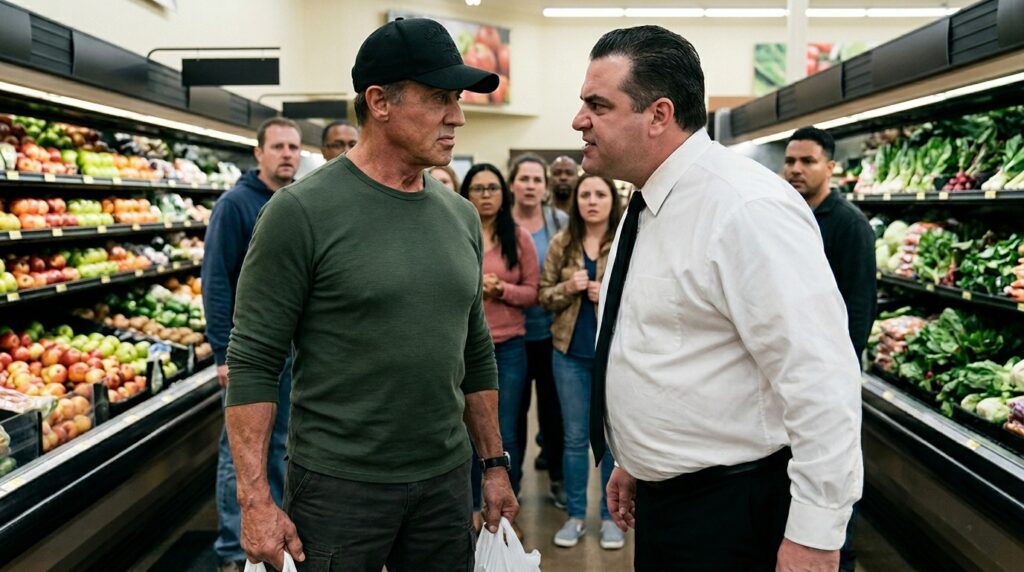
The Quiet Architecture of Survival: A Retired Veteran Struggles to Maintain His Cover Amidst Escalating Local Hostility
CHAPTER 1: THE WEIGHT OF A GROCERY BAG
The sound of the manager’s shoe scuffing the polished linoleum is the only warning I get. It is a wet, deliberate slide. When he shoulders into me, the weight is calculated—a challenge, not an accident. I feel the thin plastic handles of the grocery bag bite into my palm, the cold condensation of a gallon of milk sweating through the thin material. My pulse doesn’t spike; it steadies. It is a rhythmic, cold ticking in my ears, the metronome of a life spent in rooms where mistakes were measured in heartbeats.
“This isn’t the military, pal,” the manager whispers, his voice a tight, congested rasp against my ear. His breath smells of stale coffee and unwashed nerves. “You walk through my store, you follow the rules. You don’t just stand there like you own the aisle.”
I don’t look at him. I look at the pile of Granny Smith apples, their skins waxy and uniform. I am counting the tiles between his feet and the emergency exit. Six paces. The shoppers around us—a woman in a grey cardigan, a teenager with headphones dangling around his neck—have frozen. The store’s ambient hum, the low whine of refrigeration, seems to fall away.
“Check your inventory, sir,” I say. My voice is flat, a dead instrument.
He shoves me again, harder this time. My shoulder clips the edge of the produce case, the sharp metal grooving the skin beneath my windbreaker. A carton of eggs in my bag gives a soft, sickening crack.
The manager’s eyes are frantic, dancing with the pathetic thrill of a man who has finally found a target that won’t bite back. He leans in, his tie dangling perilously close to my face. “You’re nothing here. You’re just a ghost in a cheap hat.”
He reaches out to grab my collar, his fingers clawing at the synthetic fabric. It is a clumsy, amateur motion. My hands move before the logic of the action even catches up. I pivot on the ball of my left foot, letting the momentum of his push carry him past my center of gravity. My forearm connects with the bridge of his nose with a precise, clinical pop. He drops like a stone, the breath leaving him in a sharp, guttural wheeze that rattles the nearby displays.
The silence that follows is absolute. I stand over him, my knuckles throbbing, the broken milk carton leaking a slow, white puddle across the floor. Then, I see it. Through the glass doors, reflected in the storefront window, I catch the flash of a camera lens from a parked sedan in the lot. It isn’t a customer. It’s an observer, and they have been waiting for this exact moment.
The manager groans, rolling onto his side, but I am already looking at the exit. The trap didn’t close in the store; it closed the moment I walked in.

CHAPTER 2: THE ANATOMY OF A BREACH
The parking lot air is a sharp, jagged contrast to the humid, fluorescent warmth of the store. It smells of hot asphalt and the impending rain, a scent that triggers a visceral memory of tarmac in the desert. My lungs burn, not from the exertion—the scuffle had been a matter of seconds, a mechanical reflex—but from the sudden, chilling clarity of the mistake I just made.
I walk toward my car, a weathered sedan that blends into the sea of suburban malaise like a pebble in a stream. I do not run. Running is for the guilty. I am simply a man who had a bad day at the market. But my hands, buried deep in the pockets of my windbreaker, are trembling—not with fear, but with the cold, hard logic of a system being triggered.
I pass the parked sedan, the one where the lens had caught the light. It’s a nondescript silver compact, engine idling softly, tinted windows shielding the occupant. My peripheral vision tracks the slight dip of the vehicle’s suspension as it shifts, a subtle kinetic change that tells me exactly what they are doing: recording. Watching. Measuring.
The weight of the grocery bag is gone, discarded on the linoleum next to the manager’s broken nose. That loss sits heavy in my stomach. It was a mundane anchor, a prop in the theater of my retirement, and now the curtain has been torn aside. The manager had been the initial threat, a petty tyrant with a grudge, but he was too stupid, too uncoordinated to be the one who orchestrated this. He was the bait. And I, with my conditioned, involuntary precision, had snapped it up like a starving animal.
I reach my car and slide into the driver’s seat. I don’t start the engine immediately. I sit in the silence, listening to the metallic ping of cooling metal, the sound of a world that is supposed to be quiet. My dashboard clock reads 4:12 PM. By 4:20, the local police will be pulling into the lot. By 5:00, the security footage will be reviewed by people who know what a standard, trained counterstrike looks like. By 6:00, the “Quiet Life” won’t just be over; it will be a liability.
I reach into the glove compartment, my fingers grazing the rusted edge of the metal housing. I don’t open it. I simply rest my hand there, feeling the cold, familiar bite of steel. In my mind, I run the tactical board. If the manager was the pawn, the developer behind the retail expansion is the rook. They wanted the land—they’ve been sending flyers for months, offering insulting sums for the property I’ve carefully maintained as a monument to nothingness. Now, they have the leverage. A violent altercation, a public disturbance, a “dangerous veteran” caught on camera assaulting a store manager. It’s the perfect narrative to force a sale, or better yet, to ruin a reputation beyond repair.
But the camera lens. That wasn’t a corporate security scout. That was someone else, someone who understood how to stay out of sight, someone who was waiting for the exact moment the mask slipped.
I pull my hand back, leaving the compartment closed. I start the engine. The sound is a low, rough growl, like a machine that’s been neglected for too long. I pull out of the space, moving with a deliberate, unnatural smoothness that I know is a mistake, but I cannot help it. Every turn of the steering wheel is an assessment of the environment. The mirror check is not for safety; it is for coverage.
As I pull onto the main road, the silver sedan doesn’t follow. It stays in the lot, merging into the stream of traffic heading in the opposite direction. They didn’t need to follow me. They already know exactly where I live. They have known for years.
The realization hits with the force of a physical blow. The manager wasn’t the mystery; the manager was the catalyst, a blunt instrument used to check if the blade was still sharp. And now that they know it is, they won’t send another pawn. They will send the reality.
I drive home, the steering wheel vibrating under my palms, the scent of the dry, iron-rich earth filling the cabin. I turn down my street, a quiet row of suburban homes with manicured lawns and silent driveways. My house sits at the end of the cul-de-sac, a small, unassuming structure that I have kept in a state of perpetual, rust-free perfection.
I pull into the driveway and kill the engine. The silence that greets me is different now. It is no longer the silence of peace. It is the silence of an ambush.
CHAPTER 3: THE LAWYERS COLD CALL
I sit in the driveway for a long minute, watching the shadows lengthen across the cul-de-sac. The silence of the neighborhood, once a comfort, now feels like a held breath. My pulse is steady, barely registering the adrenaline of the store, but my mind is overclocking, mapping every blind spot in the street.
I move to exit the vehicle, but my hand stops on the door handle. There is a streak of white against the black glass of the windshield. A manila envelope, sealed with heavy adhesive, tucked firmly under the wiper blade.
I don’t reach for it immediately. I scan the perimeter first. The street is empty, save for a neighbor three doors down who is busy clipping his hedges with a mechanical precision that looks almost choreographed. No one is watching. No one is moving. I step out, the soles of my boots crunching on the dry, brittle leaves that have gathered near the curb. I reach for the envelope. It is heavy, weighted by something dense—a key, perhaps, or a stack of photographs.
I slide into the driver’s seat and lock the doors, pulling the envelope into my lap. I tear the edge with a calculated, swift motion. Inside is not a threat, but an invitation. A business card from a law firm—one I recognize from the local headlines as the primary legal counsel for the city’s largest developer—and a set of documents.
They aren’t legal summons. They are property surveys. The documents outline a “redevelopment initiative” for the cul-de-sac, showing a proposed grid of high-density commercial units that would swallow my home and the four adjacent lots. But there is a detail in the margins, hand-written in thick, black ink: a set of coordinates that point to an industrial warehouse on the edge of town, and the time, 11:00 PM tonight.
The “lawyer” who sent this, the man whose name is embossed on the card, is a ghost. I’ve heard his name in the periphery of local politics, a man who moves the chess pieces that no one else sees. He doesn’t want my house. He wants me to understand the hierarchy of the board.
The manager at the store was just the test. He was the low-level operative tasked with determining how much I was willing to sacrifice to keep my cover. By striking back, I hadn’t failed; I had passed the audition. They wanted to know if I was still a predator, and now that they know, they want to discuss terms.
I look at the house. It stands there, bathed in the sickly yellow glow of the streetlamp, a box of wood and drywall that I have spent three years turning into a fortress. It is not home. It is a bunker, and for the first time in three years, I feel the walls closing in.
I start the engine again. I don’t go inside. I turn the car around and head toward the edge of town. My movements are economical, devoid of unnecessary motion. I am no longer a retired veteran running errands; I am a man reclaiming a function he spent a lifetime trying to shed. The Rusted Truth is that you don’t retire from the things you’ve done; you only wait for them to find you again.
The drive to the warehouse takes me through the parts of the city that have been allowed to rot. The streets are lined with the shells of old manufacturing plants, the air thick with the smell of wet iron and industrial grease. I pull into the shadows a block away from the target, killing the lights.
The warehouse is silent, its windows shattered like jagged teeth. But there is a light—a single, flickering bulb near the loading bay. I step out of the car, my hand instinctively checking the empty holster at my side, a phantom limb that aches with the need for weight.
I walk toward the building, my footsteps silent on the oil-stained concrete. I reach the heavy metal door, its surface scabbed with rust, and pull. It groans, a protest of friction, and opens just wide enough to let me slip through.
Inside, the space is vast, cold, and hollow. At the center of the floor, sitting on a rusted folding chair, is a man in a charcoal suit. He is reading a newspaper. He doesn’t look up as I approach. He doesn’t need to. He has known I was here since I turned off my lights a block away.
“You have a very disciplined rhythm, Captain,” he says, his voice not carrying, but cutting through the dark with chilling clarity. “But you’re still a few seconds slower than you were in the service. Must be the quiet life.”
He folds the paper, setting it on the floor. His hands are clean, manicured, and terrifyingly calm. He is the mirror image of the manager, but where the manager was a blunt instrument, this man is the hand that wields the knife.
“The manager,” I say, my voice steady, though my muscles are coiled, ready to spring. “He wasn’t acting on a grudge.”
“He was acting on a suggestion,” the man replies, standing up. He is taller than he looks, with the lean, predatory build of someone who has never known physical hardship. “And you were the result. We needed to be sure. There are people who are very interested in what happens when you’re cornered. And now that we have our confirmation, we can move to the next phase of the acquisition.”
He steps into the light, and I see the glint of a digital recorder pinned to his lapel. This entire encounter, from the grocery store to this warehouse, is a product. A documentary of a dying animal being prodded in a cage.
“What do you want?” I ask.
“I want you to leave,” he says, smiling thinly. “But we both know you can’t. Not when they’re already on their way.”
He gestures to the ceiling, where the faint, high-pitched whir of a drone becomes audible.
CHAPTER 4: THE FREQUENCY OF THE HUNT
The drone’s hum is a dissonant vibration in my teeth, a synthetic hornet that knows exactly where I am. It isn’t just an observer; it’s a designation device, painting the floorboards around me with an invisible light. The lawyer in the charcoal suit doesn’t move. He simply watches me, his face a mask of detached interest, as if he’s waiting to see how long it takes for the gravity of the situation to settle.
I don’t waste a breath on a retort. I drop, my body hitting the concrete with the practiced efficiency of a man who has spent more nights in the dark than the light. The first suppressed crack of a rifle shot arrives a millisecond after the drone dips—the sound of air parting, followed by the dull thud of a round impacting the floor where my chest had been a second before.
“You really were one of the best,” the lawyer says, his voice oddly conversational over the rising whine of the turbine overhead. “It’s a shame. You could have been the one holding the remote.”
I roll behind a stack of rusted shipping crates, the corrugated metal flaking off under my hands like dried skin. The smell of oxidized iron fills the air, mingling with the sharp, electric tang of ozone. I am blind here, trapped in a cavern of shadows, but my ears are already mapping the room. The shooter is at the perimeter, likely perched on the catwalk above the loading bay. They aren’t trying to hit me; they’re trying to herd me.
I reach into my waistband and pull the multi-tool I always carry—a relic of a life that demanded repair. I wedge it into a gap in the shipping crate and lever it outward, creating a small, jagged aperture. I catch a glimpse of the lawyer. He is already backing toward a reinforced exit, his phone held to his ear. He isn’t the target; he is the bait, and I am currently doing exactly what the architect intended: running.
The realization is a cold, sharpening focus. If they wanted me dead, they wouldn’t have warned me with a drone. They wanted me to show my work. They wanted to see if the machine still functioned, if the reflexes were still hardwired into the bone. And now that they have their data, they are ready to decommission the hardware.
I move. I don’t go toward the exit. I go toward the rafters.
The vertical movement is harder than it was ten years ago. My shoulder, the one that clipped the produce case earlier, sends a sharp, white-hot line of protest down my arm. I ignore it. Pain is just a sensor, another input to be accounted for and dismissed. I scramble up the rusted ladder bolted to the side of the warehouse wall, the metal groaning under my weight.
From halfway up, I see the lawyer reach the door. He pauses, looking back at the dark, hollow belly of the building. He taps his watch. A signal.
The drone drops, its lights flashing red. It’s not just a camera anymore; it’s a localized EMP source, or perhaps a incendiary—something designed to clear the room. I don’t wait to find out. I launch myself from the ladder, catching the edge of a hanging work light. The chain whips, and I swing out into the center of the warehouse, a pendulum in the dark.
I drop, my boots finding purchase on the lawyer’s discarded folding chair, and I use the momentum to launch myself toward the perimeter wall, not the exit. I tear through a hanging tarp, the heavy canvas shredding like paper, and tumble into a dark, narrow utility tunnel that I’d noted during my initial assessment.
The air here is stale, thick with the scent of damp concrete and ancient dust. I don’t stop. I crawl through the darkness, the sound of the drone echoing off the high ceilings behind me, getting louder, angrier. It’s searching. It’s lost the target.
I emerge into an alleyway three hundred yards away, chest heaving, the night air freezing in my throat. I am alive, but I am compromised. My home is no longer a sanctuary; it is a marked grave. I look at my hands. They are stained with rust and grease, the dark grime of the warehouse.
The decoy secret—the development firm, the property dispute, the petty tyrants in suits—all of it is just the wrapper. They needed to move me, to force me out of the anonymity of the suburb and back into the circuit. But they aren’t the ones in control. They are just the janitors cleaning up a mess they didn’t make.
I reach into my pocket, my fingers brushing against the lawyer’s business card. I crumple it, the paper stiff and resistant. I have one move left, and it isn’t to run. It’s to go back to the beginning, to the only place where the truth is kept, even if it burns the world down to find it.
CHAPTER 5: THE FOUNDATION OF LIES
The walk back to my home is a ghost’s progression. I move through the suburban streets, staying in the deep pools of shadow cast by the oak trees. My house, when it finally comes into view, is not the sanctuary I believed it to be. It is a stage set, a meticulously maintained lie.
I don’t go through the front door. I go to the basement access, a hatch hidden under a thick layer of mulch and overgrown shrubs. I pry it open, the hinges screaming a protest in the quiet night, and descend into the cold, damp dark. The air here tastes of wet concrete and time. I’ve spent three years patching cracks, waterproofing the walls, ensuring that everything in this house was structurally sound, but I never looked at the structure.
I find the loose stone in the corner of the foundation, the one I had marked months ago when I was installing the sump pump. It hadn’t seemed like a secret then; it had seemed like a structural necessity. Now, I pry it loose. My fingers rake through the loose soil behind the block until they hit something hard and metallic.
It isn’t rust. It’s a waterproof case, sealed with a vacuum-lock. I pull it out, the weight of it defying its size. When I crack it open, the faint blue light of a data-key stares back at me. This isn’t just a key to a safe or an account; it is a proprietary drive, the kind used by the agencies that don’t officially exist.
The realization is a physical weight in my gut. My “retirement”—the quiet streets, the errands, the slow drift into anonymity—wasn’t a reward. It was a holding pattern. I wasn’t just hiding; I was being archived. And the “developer” who wanted this land wasn’t trying to build a shopping center. They were trying to reach the archives.
The sound of a vehicle engine turning over in the driveway above stops my heart. Then, the heavy thud of doors opening. Voices—measured, professional, the kind of voices that don’t speak, they announce. They aren’t trying to be quiet. They are here to collect.
I don’t have time to process the betrayal, the full, sickening scope of the trap. I have only the drive, the darkness, and the knowledge that every wall in this house is a potential firing position. I move to the sump pump, the only exit I have that doesn’t lead back up to the main floor. The pipes are narrow, intended for water, but they connect to the old storm drains that run beneath the entire suburb. It’s a claustrophobic crawl through the wet, black veins of the city, a path that requires the surrender of all civilian comforts.
As I squeeze into the pipe, the ceiling of the basement above vibrates with the sound of boots. They are checking the perimeter. They are efficient, precise, and entirely devoid of hesitation. I am no longer a veteran in a baseball cap; I am a ghost being hunted by the very machine I helped build.
I crawl through the muck, the water cold enough to numb my skin. The drive is in my pocket, the sharp corner digging into my hip, a constant, painful reminder of the truth. If they wanted to kill me, they would have done it in the warehouse. They didn’t because they need the key. And as long as I have it, I am the most valuable thing in this zip code.
I emerge from the storm drain near the edge of the industrial park, the smell of ozone and wet metal clinging to my clothes like a shroud. I stand in the dark, looking back at the distant silhouette of my house. A small, pinpoint flash of orange light blooms in the upper window—a tactical device, or perhaps just a match.
The house is gone. The facade is burned away. All that remains is the rusted truth, the cold reality of a life that was never my own. I have the data, but I have no leverage, and no place left to run. The horizon is closing in, and for the first time in sixty years, I don’t know who is holding the map.
CHAPTER 6: THE ARCHIVE OF A GHOST
I stand on the edge of the industrial park, the data-key cold and heavy in my palm. The skyline of the city is beginning to bleed grey with the coming dawn, a bruised, uninviting light that reveals the true desolation of this place. Below me, the storm drain empties into a canal of stagnant water, its surface scummed with oil and the debris of a thousand forgotten things.
I find a patch of dry, cracked earth beneath an overpass and sit, my back against a rusted support beam. The structure hums—a low, discordant vibration from the highway traffic overhead, a sound that mimics the drone I’d just escaped. I don’t look at the house anymore. It’s a blackened carcass, the fire surely consuming whatever trail I might have left, whatever evidence that I had ever been anything other than a name on a lease.
I insert the drive into my phone—a cheap, burner device I’d kept in my tactical kit, fully encrypted. The screen flickers, a series of cascading lines of green text washing over my face. It isn’t just data. It’s an audit. A complete, exhaustive record of my last three years. Every grocery store transaction, every late-night walk, every conversation I’d ever had in the “quiet” safety of my suburban bubble.
The realization is a slow, agonizing slide into clarity. I wasn’t just in witness protection; I was a live-fire experiment in long-term behavioral suppression. They didn’t want to protect me; they wanted to see if a man built for absolute violence could truly be erased, or if he would always, inevitably, reach for the knife.
I scroll further. The names, the dates, the “incidents”—the manager was just the final data point. I am a variable in a social engineering equation that has been running for a decade. The realization of Layer 2 hits, not as a shock, but as a dull, crushing exhaustion. I was never a person in their eyes. I was a weapon in a display case, and they had finally decided to take me out for a test.
A black sedan pulls into the alleyway. It doesn’t move fast; it glides, the engine nearly silent, its tires crunching softly on the broken glass. It stops twenty feet away. The driver’s door opens, and the man from the warehouse—the “lawyer”—steps out. He looks exactly as he had in the light of the warehouse, undisturbed by the night, unbothered by the violence.
He stands by the open door, watching me. He isn’t reaching for a weapon. He isn’t calling for backup. He is just waiting.
“It’s a fascinating read, isn’t it?” he asks, his voice carrying over the wind. “The story of a man who thought he could outrun his own shadow.”
“I’m not a man,” I say. My voice sounds unfamiliar, dry and brittle, like old parchment. “I’m a file.”
“Everyone is a file, Captain. You’re just the only one who didn’t know it.” He takes a step forward, his hands empty. “We’re not going to kill you. That would be a waste of the data. And we’re certainly not going to let you disappear again. We need you to go to the next stage.”
He tosses a new, clean phone onto the dirt at my feet. It glows, a stark, white light against the grime.
“The developer is gone. The house is a memory. But the asset? The asset is just beginning its next cycle.”
I look at the phone, then at the man. The Rusted Truth of it all is that there is no victory, no final stand, no grand escape. There is only the cycle. I pick up the phone. It vibrates in my hand—a notification, a new mission, a new life already scripted and waiting for me to step into it.
I look toward the rising sun, the light hitting the rusted steel of the overpass, turning it to the color of blood. I stand, my joints aching, my movements measured and precise. I don’t look back at the warehouse. I don’t look back at the ruins of my house. I walk toward the sedan, my posture the same as it was thirty years ago, the posture of a soldier who knows he has no home to return to, only the next objective.
I am not a hero. I am not a victim. I am the machine, and the machine has finally been turned back on.
CHAPTER 7: THE ARCHITECTURE OF COMPLIANCE
The apartment is a sterile, gray box, devoid of personality or history—a blank slate designed by people who value efficiency over comfort. Everything is mid-range, standard issue: the laminate flooring, the brushed-steel appliances, the scent of industrial-strength cleaner that never quite leaves the air. My new identity, “David Miller,” is equally vacant. A background fabricated in a matter of hours, populated with digital footprints that are as thin as the walls.
I stand at the window, watching the city traffic crawl through the intersection below. I am a project manager for a logistics firm—a position that grants me the mobility to move through the city, to monitor the nodes of the network they want me to inhabit.
There is a soft click at the door. I don’t turn. I know the rhythm of the footfalls. It is the handler, a woman whose name changes every time we speak. She enters, the air in the room shifting with her presence—a subtle, floral scent that feels out of place in this tomb of efficiency.
“The objective is in your inbox, David,” she says, her voice as smooth and polished as the glass on her watch. She doesn’t wait for me to look at her. She walks to the kitchen island, placing a thick, unmarked file next to a half-empty mug of coffee. “It’s a simple asset retrieval. You’re going to recover a document that was misfiled during the transition of the new infrastructure project.”
I turn, my movements deliberate. My face is a mask of professional apathy, the same mask I wore in the supermarket, the same mask I wore when I stood in the warehouse. She doesn’t notice the tension in my shoulders. She doesn’t look for it. To her, I am a functioning piece of equipment, and the equipment is currently running within acceptable parameters.
“And if I find that the file is not what I’m told?” I ask, my voice hitting the exact note of cautious curiosity.
She smiles, a brief, thin movement that never reaches her eyes. “Then you do what you’ve always done. You secure the asset and bring it to us. The complexity is for our concern, not yours.”
She turns to leave, but stops at the doorway. She adjusts her blazer, and for a fleeting second, I see it—a small, silver pin on her lapel. A stylized knot of wire, the same symbol I saw etched into the underside of the data-key I’d found in my old home.
“You’re doing well, David,” she says, her tone almost maternal. “It’s good to have you back in the cycle.”
She closes the door, and the sound of the deadbolt sliding home is a final, heavy punctuation mark. I walk to the file and open it. It isn’t a logistics report. It’s a dossier on a local activist, a woman who has been consistently disrupting the city’s development projects, the same projects that the previous “lawyer” was so keen to protect.
They aren’t just moving me back into the cycle; they are forcing me to target the very people who stand where I once stood—in the way of the machine.
I open my laptop. The screen is a harsh, artificial white. I don’t start the assignment. Instead, I begin to pull at the threads of the identity I’ve been assigned. I look for the gaps, the deliberate inconsistencies that might allow me to create a secondary, private channel. If they want me to be the weapon, they have to accept that a weapon can be pointed in more than one direction.
I am a ghost with a new name, but I am still the same piece of hardware. And I am tired of being an asset. I reach for the phone they provided, the one that serves as my leash, and I begin to dismantle its security protocols, one line of code at a time. The game has changed, but the board is still the same, and for the first time, I think I see a move that isn’t on their map.
CHAPTER 8: THE SHADOW IN THE LOBBY
The elevator descent is smooth, a hydraulic slide into the basement garage. My reflection in the brushed-steel doors is that of a stranger: a man in a crisp white shirt, hair trimmed to regulation, posture relaxed—too relaxed. I am playing the role of David Miller, logistics manager, with the same intensity I once applied to clearing rooms in the dead of night.
But beneath the shirt, my muscles are coiled, a constant, low-level hum of violence waiting for a target.
The garage is cavernous, a concrete bowl echoing with the dripping of coolant and the distant rumble of the city above. I walk to my vehicle, a nondescript sedan that has been wiped clean of every personal touch. I stop.
Ten feet away, a man is leaning against a support pillar, his back to me. He’s wearing a worn navy-blue baseball cap—not a brand new one, but one faded by years of sun and salt. It’s an identical model to the one I wore for three years in the suburbs. My breath hitches, a purely physical reaction that I suppress with a surge of cold, internal pressure.
He turns. He is older than me, his face a map of deep, jagged lines, his eyes clouded by a cataract or perhaps just the accumulated fatigue of a long, lost life. He doesn’t look at me like a handler; he looks at me like a mirror.
“You’re working for them now, David,” he says, his voice a gravelly, labored rasp that sounds like a rusted engine trying to turn over.
I don’t go for a weapon. I stay in the open, hands visible, my body weight shifted to the balls of my feet. “I don’t know who you are.”
“You don’t know who you are,” he corrects, pulling the cap from his head and turning it over in his hands. “That’s the beauty of the system. They move you from box to box until you forget you ever had a shape.”
He walks forward, and for a split second, I consider the distance. Four steps. I could close it before he finished his next sentence. I could neutralize the threat, report a breach, and solidify my standing with the handlers. But the man isn’t a threat; he’s an intrusion. He is a piece of the world that existed before the archive.
“Why are you here?” I ask, my voice stripped of the corporate artifice.
“To tell you that you aren’t the only file they have,” he says, stopping within arm’s reach. He reaches into his coat and pulls out a small, physical photograph—not digital, not encrypted, just a piece of chemical-treated paper. He presses it into my hand.
It’s a picture of the warehouse where I was prodded like a lab rat. But in the background, obscured by the shadows of the loading bay, are three other men. All of them are wearing the same faded cap. All of them are watching.
“They aren’t testing you, David,” he whispers, leaning in until I can smell the stale coffee and ozone on his breath. “They’re building a platoon of ghosts. And when they need to burn a bridge, they don’t send the handlers. They send us.”
A siren wails in the distance—a high, piercing sound that cuts through the stagnant air of the garage. It’s too close. The handler’s security team.
“The file they asked you to retrieve,” the man continues, his eyes searching mine, “it’s a list of locations. They aren’t misfiled documents. They’re the next sites for the ‘acquisition’. If you retrieve it, you’re not just an asset. You’re an accomplice.”
He turns and walks toward the shadows of the ramp, his gait heavy, the walk of a man who has lost his purpose but kept his pride. I stand there, the photograph burning a hole in my palm, the cold concrete beneath my boots feeling like the deck of a ship that’s already taking on water.
I look at the elevator. I could go back up, finish the assignment, and secure my position in the hierarchy of the archive. Or I could follow him, into the dark, and find out exactly how deep this graveyard goes.
I make my decision. I don’t go to the elevator. I follow the man into the concrete dark, the sound of my footsteps echoing against his, a rhythmic, synchronized march toward a truth I am finally, terrifyingly, ready to see.
CHAPTER 9: THE TERMINAL VELOCITY
The man in the faded cap disappears into the labyrinth of the city’s underbelly, but he leaves behind a phantom gravity. I don’t follow him anymore; I follow the logic he unveiled. The garage is silent, save for the rhythmic, distant thrum of the city’s lifeblood—the ventilation fans and the endless hum of the grid.
I don’t go back to the office. I don’t retrieve the file. Instead, I walk toward the center of the garage, to the main power terminal that feeds the entire logistics complex. I am a machine designed for precision, and for the first time, I am applying that precision to my own cage.
I pull the data-key from my pocket. It feels heavier now, a dense core of information that contains the blueprint of my own imprisonment. I don’t need to know what’s on it. I know what it is. It is the tether.
I break the casing of the power terminal. Sparks shower down, cold and white, stinging my hands. I don’t flinch. I use the multi-tool to bridge the connections, bypassing the security locks that the handlers have installed to monitor every ounce of power consumed by the building. My heart is a steady, rhythmic beat. I am not running anymore. I am disconnecting.
The security doors at the far end of the garage burst open. They aren’t subtle. They are the clean, professional operators I’ve seen in every peripheral vision check for the last three years. They stop, weapons drawn, scanning the shadows.
“Drop it,” the leader says. His voice is amplified by his gear, a hollow, electronic command. “Step away from the terminal, Miller.”
I don’t look at them. I look at the screen of the phone they gave me. It’s glowing with a red notification—Unauthorized Access Detected. The system is panicking. The handlers are waking up to the fact that their asset has gone rogue.
“My name is not David Miller,” I say, my voice steady, cutting through the silence of the garage.
I bridge the final connection.
The sound is not an explosion; it is a scream—a high, electrical whine as the entire grid of the complex dumps its load back into the system. The lights in the garage shatter, one by one, a cascade of glass and darkness. The operators scramble, their night-vision optics flaring, blinding them as the surge cascades through their own gear.
In the sudden, suffocating dark, I am the only thing that moves. I don’t run; I flow through the shadows, a ghost inhabiting the architecture of the very facility that was meant to hold me. I strike with the efficiency of a lifetime of training, a series of compact, controlled motions that neutralize the threat without a second of hesitation.
I leave them in the dark, bound and disconnected from the network. I walk out of the garage, the morning air hitting my face with a sharpness that feels like life.
I reach the street. The city is waking up. People are hurrying to offices, to jobs, to the lives they’ve been told to lead. I look at the phone in my hand, the screen dead, the tether severed.
The truth isn’t that I was a ghost. The truth is that for the first time in sixty years, I am invisible.
I walk away from the complex, my footsteps silent on the pavement. I don’t know where I am going, but for the first time, the destination is not on their map. I am the archive, and I have finally closed the file.







