
The Weight of the Oak: A Calculated Storm

CHAPTER 1: THE DRIVEWAY AMBUSH

“You have forty-eight hours to clear this eyesore, Mark. After that, the board seizes control of the property.”

The voice sliced through the heavy drumming of the rain, sharp and devoid of basic human warmth.

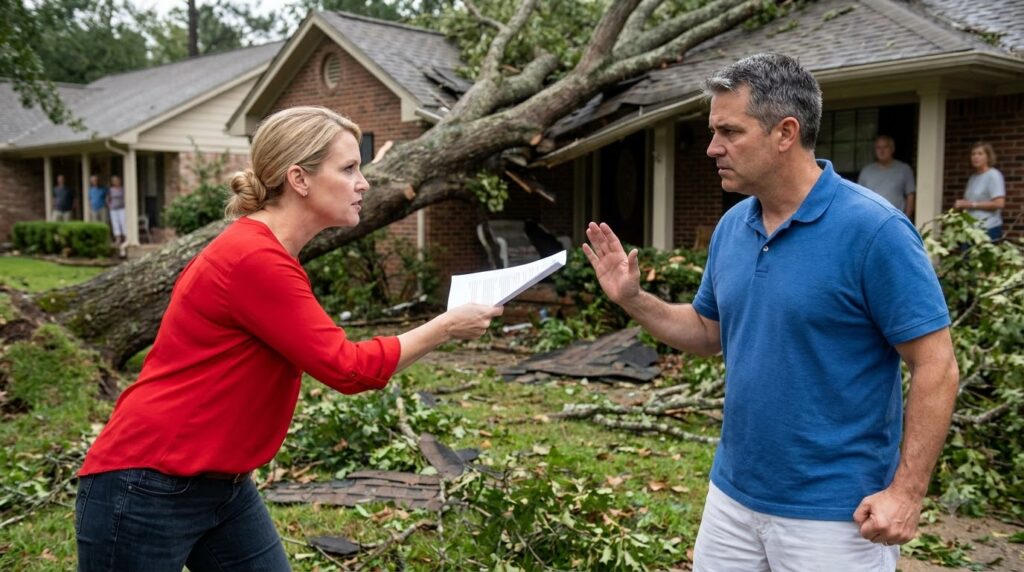
Mark Miller didn’t turn immediately. He kept his eyes locked on the catastrophic geometry of his ruined home. The century-old oak had cleaved the roofline with the precision of a butcher’s blade. Splintered trusses jutted into the gray, overcast sky like broken ribs. Cold rainwater poured through the shattered shingles, pooling onto the hardwood floors of his daughter’s bedroom somewhere in the dark interior. The air tasted of wet plaster, crushed pine needles, and the metallic tang of severed electrical wire.

He calculated the weight of the trunk. Three, maybe four tons of dead wood resting directly on the load-bearing walls. One wrong shift, and the second floor would completely pancake.

Only then did he turn.

Brenda Vance stood at the edge of his cracked concrete driveway. She held a clear plastic umbrella perfectly parallel to the ground. Beneath it, her bright red blouse was a startling, aggressive slash of color against the desaturated suburban devastation. Her blonde hair was pulled back so tightly into a bun that it pulled the skin taut at her temples, framing an angular face set in rigid, uncompromising lines.

She wasn’t looking at the destroyed roof. Her pale eyes were fixed entirely on the scattered branches muddying the pristine line of the sidewalk.

“Did you hear me, Mark?” Brenda asked, her voice carrying the transactional flatline of a predator evaluating an injured asset. “Section four, paragraph two of the bylaws. Catastrophic or not, visual blight is subject to immediate daily compounding fines.”

Mark tightened his jaw, feeling the abrasive grit of brick dust coating his stubble. He stepped down from the porch, his dark slip-on shoes sinking slightly into the saturated turf. He didn’t yell. He didn’t plead. In this neighborhood, under Brenda’s regime, empathy was a currency that had lost its value years ago. Every word was a chess move, and right now, she was pushing a pawn to see how he would defend the king.

“There’s three tons of oak resting on my joists, Brenda,” Mark said, keeping his tone dangerously level. His voice was a low rumble beneath the storm. “Heavy machinery can’t touch that trunk until the structural engineer clears the insurance claim. You know that.”

“The board doesn’t wait on insurance,” Brenda countered, taking a single, measured step forward. She kept the umbrella between them like a riot shield. “We are protecting the property values of Oak Ridge Lane. If you can’t afford the rapid-response crews, the HOA will hire them. And we will place a lien on this house by Friday for the cost.”

Mark stopped three feet from her. The chill radiating off the wet asphalt was absolute. He studied her face, looking for the usual self-righteous satisfaction, but he saw something else. A microscopic tightness around her mouth. A tremor in the knuckles gripping the umbrella handle. She was pressing too hard, too fast. She wasn’t just enforcing a rule; she was desperate to shift the financial liability of this specific tree onto him before the dust even settled.

He shifted his weight, his boot sliding against a mound of displaced earth near the massive, upturned root ball. Something hard scraped against his sole. Glancing down, shifting only his eyes, Mark caught the dull, oxidized glint of a buried surveyor’s pin wrapped in frayed copper wire, exposed by the torn earth. A pin that sat a full two feet on the wrong side of the property line.

Slowly, deliberately, Mark pivoted his boot, grinding the mud over the metal stake to hide it from her line of sight.

“I’ll handle the debris, Brenda,” Mark said softly, his eyes snapping back to hers.

Brenda offered a thin, bloodless smile. “See that you do. I’ll be back at noon with the official paperwork.”

She turned on her heel to leave, the wind whipping her coat open for a fraction of a second. Mark’s eyes locked onto her interior pocket. Tucked neatly against the lining was a folded document, the heavy rain bleeding the ink through the paper. It wasn’t HOA letterhead. It was a notice from Apex Fidelity—the community’s reserve bank. And stamped across the top, bleeding a harsh, unmistakable crimson into the wet white fabric, was the word: INSOLVENT.

CHAPTER 2: THE PERIMETER BLOCKADE

“You’re backing that rig off my street, son, or I’m calling the county marshal for commercial trespassing.”

The words cut through the roar of a diesel V8 idling at the mouth of the cul-de-sac.

Mark stepped out into the steady downpour, his dark slip-on shoes splashing through two inches of murky runoff. At the end of his driveway, a seventy-foot yellow crane truck—its hydraulic boom strapped down like a sleeping steel monster— sat deadlocked. Blocking its path was a white luxury crossover parked horizontally across the narrow asphalt throat of Oak Ridge Lane.

Beside the crossover stood Arthur Pendelton, the board’s treasurer, wearing an oversized yellow oilskin slicker that made his frail frame look like a collapsible umbrella. He had his phone pinned against his ear, but his glare was fixed squarely on the young contractor in the cab of the crane truck. Brenda stood three paces behind him on the curb, her arms crossed beneath her clear plastic umbrella, a silent orchestrator watching the trap snap shut.

Mark didn’t slow his stride. He moved with the quiet, deliberate momentum of a man who had calculated every step long before his boots hit the pavement.

“Move the vehicle, Arthur,” Mark said, his voice dropping below the rumble of the diesel exhaust.

“Can’t do it, Mark,” Arthur replied, though his eyes flicked nervously toward Brenda before settling back on Mark. “Unapproved heavy equipment over ten tons damages the shared asphalt. Section eight, clause C. Until the board reviews the axle-weight permit, no commercial rigs enter the lane.”

The crane driver leaned out of his cab, wiping rainwater from his brow with a greasy forearm. “Look, mister, I’m billing fifty bucks an hour just sitting here idling. You want this tree off your roof or not?”

“He wants it off,” Brenda interjected smoothly, stepping forward onto the asphalt. The rain hissed against her umbrella. “But he will follow community protocol to do it. The road is common HOA property, Mark. You don’t own the asphalt.”

Mark stopped two feet from the driver-side door of the crossover. Through the tinted glass of Arthur’s back seat, Mark caught the glint of a heavy metal binder resting on the leather interior—a thick, ledger-style folder bursting with red tabs. It was the same shade of crimson as the stamp he’d spotted in Brenda’s pocket twenty minutes ago.

He didn’t waste breath arguing about axle weights. Instead, Mark leaned close to Arthur, his tall frame blocking the man from Brenda’s direct line of vision.

“Your crossover is parked over a municipal fire hydrant, Arthur,” Mark said, his tone razor-sharp and completely void of anger. “You’re within three feet of the yellow curb line. That’s a Class 2 obstruction under county code. The crane driver doesn’t need your permission to clear a disaster zone, but if I call the fire marshal right now, they won’t just tow this car—they’ll cite the driver, the owner, and the party authorizing the obstruction.”

Arthur’s throat bobbed. He shifted his grip on his phone, the oilskin rustling loudly. “We’re… we’re just enforcing board policy…”

“Check the street sign behind you,” Mark pressed, taking a half-step closer, crowding Arthur’s personal space with cold, athletic precision. “Oak Ridge Lane is a dedicated township road. The HOA maintains the grass island, but the asphalt was deeded to the county in 1994. You don’t own the road, Arthur. Brenda does.”

Arthur blinked, his eyes darting toward Brenda in sudden doubt. “Brenda, is that—”

“Don’t let him lawyer you, Arthur,” Brenda snapped, her voice tightening as she recognized the shift in control. She took a sharp step into the street, her heels clicking against the wet pavement. “The HOA has an emergency easement over all access routes during a self-declared compliance review.”

“A self-declared review doesn’t override township traffic laws,” Mark said, turning his head slowly toward her. His dark hair was plastered to his forehead by the rain, but his eyes were cold and tracking every twitch in her face. “You’re holding up an emergency structural crew while three tons of timber are threatening to collapse a residential ceiling. If that roof gives way while you’re standing on this asphalt holding a paper permit rule, the claim won’t just hit the HOA insurance. It’ll hit you personally for tortious interference.”

Brenda’s jaw tightened until the bone showed white against her angular cheeks. For two seconds, the only sound was the deep, rhythmic thrum of the crane’s engine and the patter of rain on fiberglass.

“Arthur,” Brenda said through clenched teeth, her eyes locked on Mark’s. “Move the car.”

Arthur didn’t hesitate. He practically scrambled into the driver’s seat, started the engine, and pulled the crossover into a nearby driveway, his tires spinning briefly on the wet pavement.

The crane driver gave a short honk of his horn and shifted the heavy rig into gear, the huge tires crushing storm debris as the truck rolled past into Mark’s driveway.

Mark didn’t celebrate. He stood in the middle of the street, watching the crane maneuver into position. Beside him, Brenda remained motionless, her clear umbrella dripping onto the dark asphalt.

“You think you’re very clever, Mark,” she said, her voice dropping into a dangerous, quiet register that subtext alone carried. “You think a surveyor’s pin and a few legal threats give you leverage. But you don’t know what’s coming at noon.”

Mark turned his head slightly, keeping his body angled toward his house. “Noon is two hours away, Brenda.”

“And by five minutes past noon,” she whispered, her thin lips curving into a cold, transactional smile, “you’ll realize this tree is the least of your problems.”

She turned and walked away down the center of the street, her bright red blouse retreating like a drop of blood spreading across wet gray silk. Mark watched her go, his mind instantly recalculating. She wasn’t bluffing about noon. She was setting up a public spectacle.

He reached into his pocket, his fingers brushing the wet, heavy paper of his own file—the certified mail receipts from eight months ago, tucked safely inside a waterproof sleeve. But as he pulled his hand out, his thumb caught on a small piece of debris clinging to his palm from the driveway margin: a tiny, rusted copper staple, freshly sheared off an old surveyor’s boundary ribbon.

He looked down at the mud on his boots, then back toward the crushed roof. The crane’s hydraulic outriggers were extending, biting into his lawn. He had two hours to figure out what Brenda had hidden in that ledger—and why she needed him ruined before the bank called her bluff.

CHAPTER 3: THE PAPER STRIKE

“A hundred and fifty dollars a day, Mark. Retrospective to six o’clock this morning.”

The paper didn’t just hover in the space between them—Brenda driven it forward, snapping the single crisp white sheet through the humid post-storm air until the edge grazed the damp cotton of Mark’s blue polo shirt.

The rain had tapered to a thin, frigid needle-mist that coated the front lawn in a silver sheen. Around the perimeter of the cul-de-sac, porch lights flickered on. Figures in rain jackets moved toward the property lines: the Webbers from number forty-two, old man Henderson leaning heavily on his wooden cane at the curb, three younger mothers from down the block holding umbrellas over their children. They watched in silent, uneasy fascination as Brenda Vance staked her claim in the mud.

Mark didn’t flinch. He stood planted in his white shorts and dark slip-on shoes, his tall frame blocking the crushed facade of his house like a storm wall. He didn’t reach for the paper.

“Read the line item, Mark,” Brenda demanded, her voice cutting cleanly across the hum of the crane idling twenty feet behind them. Her bright red blouse was pristine, immune to the moisture, while her blonde hair remained pinned in its ruthlessly tight bun. “Unapproved structural modification and intentional accumulation of hazardous visual debris. You are in open breach of Section Nine.”

“Section Nine governs unpermitted construction, Brenda,” Mark said softly. His hands remained at his sides, fingers relaxed, though his shoulder muscles were knotted like cold iron. “Acts of God are governed by Municipal Emergency Code 104. You know the hierarchy.”

“Act of God?” Brenda let out a short, sharp laugh that carried no warmth, designed specifically for the neighbors standing along the curb. “This oak didn’t fall because of a gust of wind, Mark. It fell because you neglected the root system. You let water pool near the foundation line for three years. That makes this a structural maintenance failure. That makes it your personal liability.”

She thrust the document closer, forcing it toward his chest height again, her sharp fingernails digging into the edge of the sheet. The paper was unusually heavy—32-pound high-grade linen stock. The HOA’s standard administrative budget only covered cheap 20-pound copy paper. Someone had paid out-of-pocket to make this notice feel heavy, official, and crushing.

Mark looked down at the sheet. The text was printed in dense, black serif type, complete with a forged digital signature from the architectural review committee.

“Take it,” she spat, her angular face inches from his. Her pale eyes were wide, unblinking, fixed on his facial expressions to catch the first flicker of panic. “Sign the acknowledgment of receipt, or I post it directly to your front door and initiate the legal lien proceedings before the banks open tomorrow.”

Mark raised his right hand. He didn’t take the paper. Instead, he lifted a single, open palm, holding it in mid-air four inches from the document—a wall of absolute refusal.

“Put that notice away, Brenda,” he said. The tone wasn’t raised, but it carried a dense, resonant weight that made the nearest watching neighbors shift their weight on the wet grass. “We’re dealing with this first.”

He extended his index finger past her ear, pointing directly behind her at the massive, shattered trunk lying across his rafters like a fallen monument.

“There are seventy thousand dollars in structural damage sitting on my roof,” Mark continued, his eyes locking onto hers with a cold, calculating stillness. “My family is inside clearing water out of the drywall. The crane is lifting three thousand pounds of oak every twenty minutes. And you’re standing in my mud with a piece of heavy linen paper trying to manufacture a code violation.”

Brenda’s jaw worked silently for a fraction of a second. She felt the crowd behind her—felt the silence of twenty neighbors watching her authority being openly turned aside without a single raised voice.

“The paper is legal notice, Mark!” she snapped, her posture rigid as an iron bar. “You don’t get to choose when the rules apply!”

“The rules apply to everyone, Brenda,” Mark replied. He stepped forward—just half a pace—forcing her to take an involuntary half-step back to preserve her line of sight. “Including the board. That paper claims I altered the drainage around the root ball. Where’s your engineering report?”

“The report is being processed,” she lied smoothly, her hand tightening around the document so hard the heavy paper creaked.

“Which means you don’t have one,” Mark said. “Which means this notice is an administrative fiction designed to force a settlement before the insurance adjuster arrives at one o’clock.”

He looked past her shoulder to where Arthur Pendelton was standing by his crossover, nervously tapping a manila folder against his thigh.

“You’re in a hurry, Brenda,” Mark added softly, dropping his voice so only she could hear the subtext. “Why are you in such a hurry?”

A flare of raw, genuine malice flickered behind Brenda’s pale eyes. She pulled the document back, folding it once with a deliberate, sharp snap that sounded like a dry twig breaking.

“You want an engineering report, Mark?” she whispered, her voice laced with venom. “You want to play by the absolute letter of municipal law? Fine. I’ve already called the town code enforcement officer. He’s on his way right now.”

She leaned in, her red blouse almost brushing his blue polo. “When he sees what’s under that root ball, he won’t just fine you. He’s going to issue an immediate Order of Condemnation for this entire structure. You and your family will be off this lot by nightfall.”

She turned on her heel and walked away toward the curb, her white shoes cutting clean tracks through the damp grass. Mark stood motionless, watching her go.

He didn’t look at the neighbors. He looked down at his own hand, where a fine smudge of black printer toner from the edge of her linen paper clung to his index finger. He rubbed his thumb against it, feeling the distinct, waxy texture of an industrial thermal press—the kind used exclusively by commercial legal firms specializing in immediate asset seizure.

Brenda wasn’t just trying to collect a fine. She was setting up a paper trail to declare the entire parcel uninhabitable before anyone could dig three feet into the mud behind the fallen roots.

Mark turned back toward the house, his eyes scanning the gaping hole in his roof where the crane’s steel cables were tensioning against the timber. Time was no longer a negotiation. He had less than an hour before the town inspector arrived.

CHAPTER 4: THE DECOY AMBUSH

“Look at the timestamp, everyone. July fourteenth, two weeks before the storm.”

Brenda Vance’s voice rang across the wet pavement of Oak Ridge Lane like an iron bell.

She stood at the head of Mark’s driveway beside a portable aluminum easel that Arthur Pendelton had just unfolded on the damp concrete. Mounted on the easel was a stark, high-gloss eight-by-ten photograph encased in clear plastic. Around it, fifteen neighbors stood in a tight semicircle, their rain jackets rustling as they leaned forward to examine the image.

Mark stepped around the side of the crane, his wet shoes silent on the asphalt. He didn’t rush. He calculated the geometry of the gathering. Brenda had positioned the easel precisely where the streetlamp cast an harsh overhead light down through the fog, making the image pop with surgical clarity.

“What are we looking at, Brenda?” asked Henderson, leaning heavily on his wooden cane, his brow furrowed beneath his dripping rain cap.

“A deliberate breach of drainage compliance,” Brenda declared, her gloved index finger tapping the plastic sleeve with a sharp clack-clack. “This photograph was taken by an independent property auditor during our annual neighborhood perimeter check. Notice the soil line right here at the base of the oak.”

Mark reached the edge of the circle. The neighbors parted slightly, making room for him, their eyes darting between his calm, rain-streaked face and the glossy print on the easel.

He looked at the image. It showed the base of the massive oak tree—his oak tree—set against the brick facade of his house. A red digital line had been overlaid across the turf, tracing a distinct downward trench dug along the root flare. Beside the trench sat a yellow plastic shovel and a pile of freshly excavated clay. Printed in crisp white numbers across the bottom right corner was the timestamp: 07/14/2026 – 14:22:01.

“Mark altered the slope of his lawn,” Brenda announced, turning to face the crowd, her bright red blouse catching the glare of the overhead light. “He dug out the natural retaining ridge to extend his garden bed. By stripping away four inches of packed clay around the primary anchor roots, he exposed the root ball to subsurface water pooling. When the storm hit, the soil turned to liquid mud. The tree didn’t blow over—it slid out of the ground because he destroyed its structural support.”

A collective murmur rippled through the neighbors. Henderson squinted at the photo, his jaw tightening. “Damn it, Mark… you dug out the retaining line?”

“Look closely at the photo, Henderson,” Mark said quietly. He didn’t raise his voice, but the cold precision in his tone cut through the whispering crowd instantly.

He walked past Brenda, ignoring her sharp intake of breath, and stopped two inches from the easel. He didn’t touch the plastic, but his eyes locked onto the details of the glossy print with laser focus.

“The shovel in that picture is a heavy-duty fiberglass trenching spade with a blue handle,” Mark noted, his voice flat and analytical. “I don’t own a fiberglass spade. I own two flat steel shovels with weathered ash handles. They’re sitting in my garage right now behind the water heater.”

“You could have bought a new spade for the project and thrown it away,” Brenda countered immediately, her response rehearsed and lightning-fast. “The shovel isn’t the evidence, Mark. The altered soil grade is. The photo proves you modified the turf fourteen days ago.”

“Does it?” Mark asked. He leaned closer to the bottom corner of the print, where the red digital line intersected the shadow of the brick wall.

Something in the image didn’t align. The brickwork in the background showed clean, dry mortar lines—yet July fourteenth had been the day of the county flash flood, when three inches of rain had turned every driveway on Oak Ridge Lane into a river. More importantly, the shadow cast by the oak tree fell toward the north-northwest, an angle physically impossible at two o’clock in the afternoon during a midsummer sun arc.

It was a composite. A high-resolution overlay fabricated using an old baseline photo of his foundation from three years ago, stitched together with fresh trenching footage to manufacture a clear, defensible cause of failure.

Brenda had brought a pre-packaged crime scene to his front lawn.

“This photo is a complete fabrication,” Mark said, turning his head slowly toward the crowd. “The shadow angle puts the sun at seven in the morning, not two in the afternoon. And the mortar on those bricks is bone-dry on a day it rained three inches.”

“He’s deflecting!” Brenda raised her voice, stepping between Mark and the neighbors, thrusting her hands out to hold their attention. “He knows that if the town inspector sees this evidence, the liability falls entirely on his shoulders! He’s trying to drag the whole community into his financial disaster!”

“Show them the original digital file, Brenda,” Mark pressed, taking a step toward her, his tall frame blocking the streetlamp light so her shadow stretched long and dark across her own easel. “Not a printed sheet inside a plastic sleeve. Show us the EXIF metadata on a phone right now.”

Brenda’s pale eyes flashed with a sudden, vicious spark. She didn’t reach for her phone. Instead, she reached into her jacket pocket and pulled out a fresh, folded sheet of paper—this one bearing a bright yellow municipal seal.

“I don’t need to debate photoshop theories with you, Mark,” she hissed softly, her voice dropping so only he and the nearest neighbors could hear. “The town code inspector just pulled into the lane. And I’ve already submitted this photograph directly into his official pre-inspection record.”

At the mouth of the cul-de-sac, a white municipal pickup truck with amber lights flashing on the roof slowly rolled to a stop behind the crane.

Mark looked at the flashing amber lights reflecting in the wet mud at his feet. The trap had sprung. Brenda hadn’t just created a decoy secret to fool the neighbors—she had entered a falsified evidence file into a public government record before he could even lay a tape measure across his lawn.

He reached into his pocket and touched the waterproof sleeve holding his three certified mail receipts. The fake photo was a powerful shield, but it relied entirely on one fundamental assumption: that the tree belonged to Mark Miller in the first place.

“Let him inspect it,” Mark said, his jaw locked, his eyes cold as flint. “Let him inspect every single inch.”

CHAPTER 5: THE MUNICIPAL ESCALATION

“Officer Vance, municipal code division. Clear the driveway perimeter.”

The driver’s door of the white pickup swung open with a heavy metallic click, and Inspector David Vance stepped directly into the cold slurry of mud and crushed gravel. He wore a high-visibility yellow storm jacket over a dark blue uniform, a heavy brass clipboard held flat against his chest under a protective vinyl flap.

A cold murmur ran through the assembled neighbors. Henderson took two steps back onto the grass, while Arthur Pendelton subtly shifted his posture to align himself behind the officer.

Brenda was at the inspector’s side before his boots fully planted on the asphalt. She moved with effortless precision, handing him a printed plastic sleeve containing the fake trenching photograph.

“Inspector,” Brenda said, her voice dropping into a smooth, practiced cadence of administrative cooperation. “I am Brenda Vance, president of the Oak Ridge Community Association. As I noted in our emergency filing forty-five minutes ago, we have documented an illegal structural modification at this parcel that directly precipitated the collapse of the timber onto the roof.”

Inspector Vance—no relation to Brenda, though his sharp, official eyes held the same institutional detachment—didn’t offer a handshake. He took the plastic sleeve, glanced at the glossy 8×10 print, and then looked past her shoulder toward the crushed roof of Mark’s home.

“Mr. Miller?” Inspector Vance called out, his eyes sweeping the perimeter until they locked onto Mark standing beside the crane’s stabilizer arm.

Mark stepped forward into the flashing amber light of the municipal truck. His blue polo was soaked through across the shoulders, the frigid rain running in steady trickles down his forearms.

“I’m Mark Miller,” he said. He kept his hands visible, loose, and steady at his sides. “I’m in the middle of emergency stabilization to secure the structural load before the interior joists sheer.”

“Stabilization stops if there’s an active hazard violation, Mr. Miller,” Inspector Vance stated, unclipping a heavy digital camera from his tactical vest. “The HOA has submitted photographic evidence showing an unpermitted excavation along the primary root flare. Under Township Ordinance 18-B, if an owner-caused soil modification causes a structural collapse, I am required to issue an immediate stop-work order and declare the dwelling unsafe for habitation.”

“Check the site before you sign the order, Inspector,” Mark said, his voice flat, razor-sharp, and unyielding. “Don’t judge a property from a three-inch glossy print provided by a party with a direct financial conflict of interest.”

Brenda let out a small, sharp breath of indignity. “Conflict of interest? We are protecting community safety! Inspector, the photo speaks for itself. The slope was cut—”

“I inspect physical ground, Mrs. Vance, not photo paper,” Inspector Vance cut in firmly, silencing her with a single raised finger. He turned his gaze back to Mark. “However, the digital filing creates an immediate legal presumption. If I find fresh excavation or disturbed clay within four feet of that root ball, I’m slapping a red placard on your front door within five minutes.”

Mark didn’t blink. He reached into his pocket and shifted his fingers against the waterproof sleeve holding his certified receipts. He could feel the trap closing around him. If Inspector Vance posted the red placard right now, the crane operator would be legally forced to shut down the V8 diesel engine, leaving three tons of dead oak resting directly over his daughter’s bedroom ceiling while the rain continued to pour inside.

Worse, Mark caught a glimpse of what lay tucked beneath the vinyl flap of the inspector’s clipboard: a pre-printed, red municipal stop-work placard, already filled out in black marker with Mark’s address and signed in advance—a speed of bureaucratic execution that only occurred when someone inside the municipal office had been tipped off hours before the storm even hit.

“Follow me to the root ball then, Inspector,” Mark commanded, turning on his heel and leading the officer directly into the mud zone beside the massive, upturned root system.

Brenda followed three paces behind, her heels sinking into the soft turf, her sharp eyes fixed on Mark’s back like a hawk tracking prey. Arthur Pendelton hovered at the edge of the lawn, holding his breath as the neighborhood crowd leaned over the property line to watch.

The root ball was an absolute wall of torn earth, six feet high and tangled with thick, fibrous tendrils coated in gray clay. The rain pooled in the deep crater left by the uplifted soil, creating a swirling brown pool that lapped against the shattered edge of the lawn.

Inspector Vance knelt at the margin of the crater, his yellow jacket rustling as he pointed his digital camera downward. “Right here,” he muttered, zooming in on a freshly cut edge of clay. “Looks like a shovel cut along the southern margin.”

“That’s not a shovel cut,” Mark said, stepping right to the edge of the crater, his dark slip-on shoes submerging an inch into the mud. “Look at the striations in the clay. Those are mechanical teeth marks from a trenching machine.”

Brenda’s jaw tightened. “Which proves you brought heavy equipment onto the lawn!”

“I don’t own a trenching machine, Brenda,” Mark replied, his eyes fixing on her with cold, predatory calculation. “And three weeks ago, the HOA hired Apex Environmental to lay the new fiber-optic conduit along the common greenbelt.”

Inspector Vance stopped clicking his camera. He lowered the lens and looked up from the mud, his brow furrowing as he processed the statement. “Fiber-optic conduit?”

“Check the boundary marker, Inspector,” Mark pressed, his voice dropping into a register of absolute command. “Before you pull out that red placard in your clipboard, run your tape from the street curb. That trenching line isn’t on my property. And neither is that tree.”

Brenda’s face went entirely pale, the crimson color draining from her cheeks until she looked as cold as the rain falling around them. She stepped forward, her umbrella tilting wildly in the wind. “The boundary line is well beyond the oak, Inspector! He’s trying to confuse the issue!”

Inspector Vance stood up, wiping mud off his knee with a gloved hand. He reached into his tactical vest and pulled out a heavy steel surveying tape reel.

“Nobody moves,” the inspector said, his voice dropping into the cold, authoritative tone of a state official about to execute a binding legal measurement. “I’m pulling the township grid tape right now.”

Mark stood his ground in the pouring rain, watching the inspector walk toward the curb. He knew the victory wasn’t won yet—the fake photograph had failed to trigger an immediate shutdown, but the red placard was still tucked inside the clipboard, waiting for one single inch of error.

CHAPTER 6: THE BOUNDARY COLLAPSE

The heavy steel tape snapped out with a sharp metallic rasp, zipping eighteen feet straight through the mud from the brass curb monument.

Inspector Vance locked the reel with a thumb-click. He didn’t look up immediately. He dropped to one knee in the wet grass, his yellow jacket rustling as he pressed a steel plumb bob directly against the exposed surveyor’s pin that Mark had uncovered beneath his boot hours earlier.

The silence on Oak Ridge Lane was total. The crane’s diesel engine thrummed in the background, but along the sidewalk, twenty neighbors stood frozen in the rain. Brenda Vance hadn’t moved an inch, though her knuckles were white where she gripped the handle of her umbrella.

Inspector Vance straightened up slowly. His face was a mask of cold municipal neutrality as he turned to look at the massive, torn root ball.

“The property line sits exactly twenty-two feet and three inches from the street curb,” Inspector Vance said, his voice carrying clearly across the quiet cul-de-sac. “The center of this oak’s root mass sits twenty-four feet, six inches back.”

Arthur Pendelton blinked, his hand pausing mid-air over his manila folder. “Wait… twenty-four feet?”

“Which puts the trunk two feet and three inches inside the designated township greenbelt easement,” Inspector Vance stated flatly. He turned to Brenda, his cold eyes locking onto hers. “This tree is not on Mark Miller’s lot. It sits entirely on HOA common ground.”

A sharp, collective gasp rippled through the neighbors. Henderson let out a dry, breathy cough of realization, while Mrs. Webber leaned over her porch rail, her phone raised to record the street.

“That’s… that’s impossible!” Brenda’s voice cracked for the first time, the rigid composure shattering into a high, strained register. “The lot lines were redrawn during the 2018 repaving! The HOA deeded that strip back to the individual parcels!”

“The township never approved or recorded any such amendment, Mrs. Vance,” Inspector Vance replied, unclipping the red municipal stop-work placard from his clipboard and ripping it in half with a single, brutal tear that echoed like a pistol shot across the lawn. “Which means your violation notice is legally void. Mr. Miller has no obligation to clear this timber, nor is he subject to any daily fines.”

Brenda stood paralyzed as the shredded red paper fluttered down into the muddy puddle at her feet. “Inspector, you can’t just—”

“I can, and I am,” the inspector cut her off. He turned to Mark. “Mr. Miller, your emergency stabilization crew is cleared to continue. In fact, under Municipal Code 80-A, because this hazard originated on common HOA land and collapsed onto private residential property, the responsibility for full structural abatement and home restoration falls 100% on the property owner of origin.”

“The HOA,” Mark said softly.

“The HOA,” Inspector Vance confirmed.

Brenda’s chest rose and fell in rapid, shallow breaths. “We don’t have the authorization for an emergency private contractor claim! The board has to vote! The insurance adjuster hasn’t—”

“I’m not done, Brenda,” Mark interrupted, his voice dropping into a quiet, deadly register of absolute vindication.

He reached into his soaked blue polo pocket and pulled out the waterproof sleeve he had been holding all morning. He unsealed the plastic slide and withdrew three crisp, white cards—each stamped with a red postmaster seal and a bold, dark signature across the delivery line.

He didn’t hand them to Brenda. He handed them directly to Inspector Vance.

“Check the dates on those certified mail receipts, Inspector,” Mark commanded, his tall frame towering over Brenda as she shrank back a half-step. “Ten months ago, six months ago, and ninety days ago. Three separate written notices sent to the HOA board warning them that the greenbelt oak was rotting internally at the base and posing an immediate structural threat to my home.”

Inspector Vance reviewed the receipts, his eyes widening slightly as he recognized the official postal tracking numbers and the clear, legible signature on the return card: Brenda Vance.

“You were formally notified of a hazardous common-element tree three times in writing, Mrs. Vance,” Inspector Vance said, his tone shifting from administrative detachment to severe legal gravity. “And you failed to perform preventative maintenance?”

“It was a budgetary decision!” Brenda shouted, her eyes darting frantically toward the crowd of neighbors who were now murmuring in open anger. “The reserve fund couldn’t prioritize arbor maintenance when we had asphalt sealing—”

“Check the survey map, Brenda,” Mark said, taking one final, crushing step toward her until he was standing directly between her and the neighbors. “That root ball isn’t on my land—it’s on yours. You didn’t ignore my letters because of asphalt sealing. You ignored them because you’ve been harvesting fines from this neighborhood to hide the fact that the HOA reserve fund is dead empty.”

Brenda froze. The rain dripped off her nose, but she didn’t wipe it away. Her eyes locked onto Mark’s with a mixture of terror and pure, unadulterated hatred.

“You came here to fine me for debris, Brenda,” Mark said, his voice ringing out across the street like a final judgment, “but now your board is paying for my new roof.”

Inspector Vance pulled a fresh, yellow citation book from his belt. “Mrs. Vance, I am issuing an immediate Municipal Class 1 Citation against the Oak Ridge Community Association for willful neglect of a known common hazard. The township is placing a mandatory hold on all HOA bank accounts until full restitution for Mr. Miller’s repairs is secured.”

Behind her, Arthur Pendelton dropped his manila folder. The ledger burst open on the wet asphalt, spilling dozens of red-stamped bank notices across the street—including the white Apex Fidelity notice with its bold, crimson stamp: INSOLVENT.

The neighbors surged forward toward the driveway, their voices rising into an angry chorus as the truth swept through the crowd like wildfire. Brenda stood alone in the center of the storm, her clear umbrella tilting in the wind, her authority completely, irrevocably destroyed.

Mark turned his back on her. He walked up his driveway toward the crane operator, raising a single hand to signal the crew. The heavy V8 engine roared to life, the steel cables tightening as the massive oak trunk was lifted clear of his roof.

CHAPTER 7: THE LEDGERS EDGE

The giant steel cable groaned under seventy tons of hydraulic tension, the braided wire snapping taut against the rain-slick bark of the fallen oak.

With a deafening, metallic thrum that vibrated straight through the damp asphalt, the massive trunk lifted free of Mark’s shattered roofline. Rain immediately surged into the open gap where the rafters had been crushed, but the weight was gone. The framing of the home gave a sharp, wooden groan as the load-bearing studs expanded back into place, freed from three tons of crushing timber.

Mark stood on his driveway, the cold rain washing the brick dust and mud from his forearms. He didn’t look up at the crane’s boom as it swung the timber slowly toward the flatbed. His eyes were locked on the street.

Across the wet pavement of Oak Ridge Lane, the paper storm had settled into the mud. Dozens of white financial sheets—spilled from Arthur Pendelton’s dropped binder—lay plastered against the dark asphalt like fallen leaves.

The neighbors weren’t looking at Mark anymore. They had surrounded Brenda Vance and Arthur in a tight, furious circle. Old man Henderson held one of the soaked bank notices at arm’s length, his eyes wide behind his rain-spotted glasses as he read the numbers aloud to the crowd.

“Three hundred and forty thousand dollars?” Henderson’s voice trembled with raw, unadulterated shock. “The reserve fund had three hundred and forty thousand dollars last March! Where is the money, Brenda?”

“There… there were unbudgeted legal fees,” Arthur stuttered, backing up until his spine hit the hood of his crossover. His face was gray, the oilskin slicker hanging off his slumping shoulders like a limp yellow rag. “We had to retain counsel for the municipal drainage dispute… and the management audit…”

“You spent our reserve fund fighting lawsuits to cover up your own accounting errors?” Mrs. Webber demanded, stepping directly into Brenda’s path as the HOA president attempted to retreat toward her car. “My roof needs reshingling, Brenda! We’ve paid six hundred dollars a quarter for twelve years!”

Brenda didn’t answer. Her plastic umbrella had tipped backward in the wind, the clear canopy catching the rain like a bowl, but she didn’t seem to notice. Her bright red blouse was soaked through now, clinging dark and heavy to her chest. Her blonde bun had unraveled, strands of wet hair plastered across her pale, hollow cheeks.

She reached for the handle of her car door, her fingers slick with rainwater, slipping twice off the chrome.

“You’re not driving anywhere, Mrs. Vance,” Inspector Vance said, stepping around the side of his municipal truck with a fresh clipboard in hand. Beside him stood a second officer—a deputy marshal who had just pulled onto the lane in a dark sedan with strobe lights silent against the fog. “The county prosecutor’s office has just issued an emergency freeze on all association assets and records. We need you to surrender the board ledger and keys immediately.”

Brenda turned slowly. The cold, transactional mask that she had worn like armor for six years was completely gone, replaced by the naked, frantic calculation of an animal cornered against a fence.

“This is a civil matter,” she whispered, her voice cracking against the hiss of the rain. “The board has immunity under Section Twelve… you can’t freeze the accounts…”

“Section Twelve doesn’t cover criminal fraud, Brenda,” Mark said.

He walked down the driveway, his dark slip-on shoes stepping over the shredded remnants of her fake violation notice. He stopped four feet from her, his tall frame cutting off the grey daylight behind her. His blue polo was drenched, his jaw set like iron, but there was no anger in his face—only the cold, absolute clarity of a man who had calculated every move to its final checkmate.

“You knew the tree was rotting ten months ago,” Mark said, his voice dropping into a low, resonant register that carried over the idling crane engine. “You knew if it fell, the HOA would have to pay for the removal out of a reserve fund you had already drained. So you prayed it wouldn’t fall on your house. And when it fell on mine, you tried to ruin my family to save yourself from a forensic audit.”

Brenda looked up at him. Her lips trembled, but no words came out. The fake photograph, the heavy linen paper, the red stop-work placard, the legal threats—every weapon she had forged to protect her empire had been turned around and driven deep into her own foundation.

The deputy marshal stepped forward, opening a heavy leather folder. “Brenda Vance, you are being served with a formal summons to appear before the county grand jury regarding the misappropriation of community association funds.”

He pressed the white document into her limp hand. She didn’t hold it; her fingers remained open, and the paper slipped through her wet palm, falling into the muddy gutter at her feet.

Along the curb, the neighbors watched in silence. No one spoke for her. No one stepped forward to help her as the deputy marshal escorted her to the passenger seat of the township sedan. Arthur Pendelton sat on the curb with his head in his hands, surrounded by the floating, crimson-stamped bank notices.

Inspector Vance walked over to Mark, handing him a duplicate copy of the official municipal abatement order.

“The township contractor will be here in an hour to tarp the roof, Mr. Miller,” the inspector said, offering a curt, respectful nod. “All costs are billed directly to the county lien fund, which will be recovered from the HOA’s frozen assets. Your home will be restored.”

“Thank you, Inspector,” Mark said quietly.

The municipal truck and the deputy’s sedan pulled out of the cul-de-sac, their amber and blue lights fading into the gray afternoon fog. One by one, the neighbors walked back to their homes, their low murmurs filling the quiet street as the full weight of Brenda’s fall settled over Oak Ridge Lane.

Mark stood alone on his front lawn. The crane had finished moving the heavy trunk to the flatbed, and the crew was winding up their steel cables. The air tasted clean now—free of the waxy printer toner and the stale, suffocating pressure of false authority.

He looked up at his house. The roof was shattered, the rafters splintered, and the rain was still falling inside his daughter’s bedroom. It would take months of work to rebuild the timber, the drywall, and the plaster.

But as Mark looked down at his boots, stepping over the exposed surveyor’s pin in the mud, he knew the foundation hadn’t shifted an inch. He walked up the steps, pushed open his front door, and went inside to help his family rebuild.

Similar Posts

Leave a Reply

Your email address will not be published. Required fields are marked *






