The Cold Geometry of Roadside Justice on a Sun-Bleached County Highway
CHAPTER 1: THE ACCUSATION ON ROUTE 9
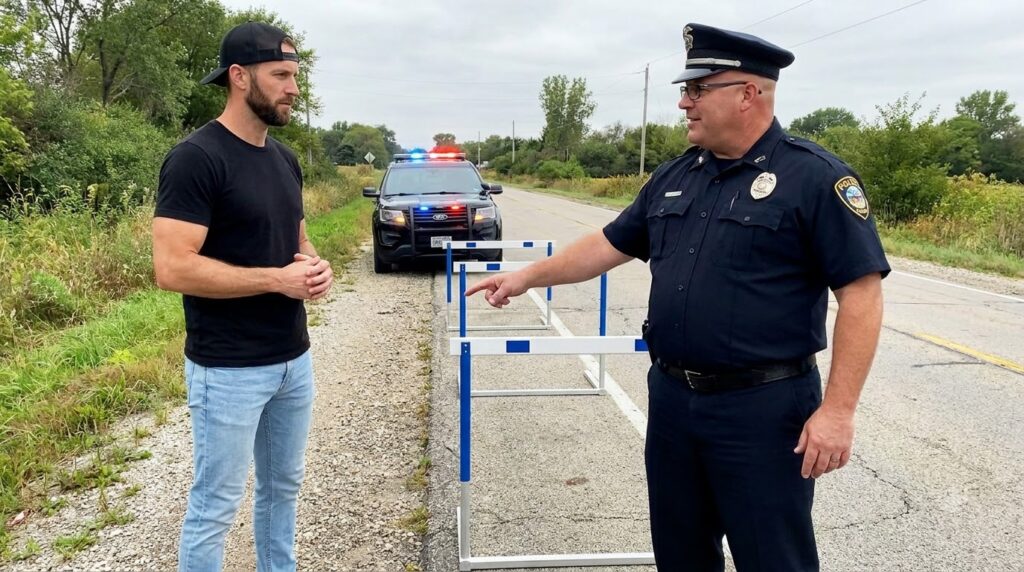
The red-and-blue strobes cut through the afternoon heat shimmer in long, rhythmic slashes, painting the dry grass along the county shoulder in cold pulse-beats.
“Step out of the vehicle. Right now.”
Officer Vance did not wait for the door to swing fully open. He stood in the kill-zone of the Ford’s frame, his heavy chest wedged tight inside a dark navy uniform shirt that strained against every brass button. His rectangular glasses dipped slightly on a bridge slick with sweat, but his eyes stayed locked on Miller’s hands.
Miller didn’t rush. He let his boot hit the loose gravel with a flat, deliberate thud, feeling the crunch of red dirt beneath scuffed leather. He kept his fingers spread flat against his light blue jeans—open, visible, empty.
“You were drifting over the fog line for half a mile,” Vance said, his voice carrying the practiced volume of a man accustomed to speaking over idling diesel engines. He stepped closer, his duty belt squeaking under the weight of his sidearm, radio, and double-cuff pouch. “Smell anything on your breath, son?”
“Water and stale coffee, Officer,” Miller replied. His voice was a flat line, smooth and ungrooved as polished granite. He adjusted the brim of his backward cap with two fingers, keeping his elbows wide and clear of his waistband. “Shift ended twenty minutes ago at the gravel pit.”
Vance smiled, a tight, thin parting of lips that held no heat. He reached back, resting a heavy palm on his holster strap, his thumb tapping a steady rhythm against the hard plastic retention lock. “We’ll see about that. You’re moving sluggish. Eye tracking is loose.”
Behind them, a two-ton grain truck slowed on the asphalt, its engine brake letting out a low, coughing rattle as the driver leaned out the window to stare. Vance’s shoulders expanded, his posture tightening as the audience gathered. He didn’t just want a traffic ticket; he wanted the shoulder to feel like a courtroom where he held the gavel.
“I’m completely sober, Officer,” Miller said, watching the way Vance’s eyes flicked toward the passing truck, calculating the audience count. “I’m happy to take a breathalyzer right here.”
“I determine the sequence of this stop, driver,” Vance snapped, stepping directly into Miller’s personal space until the heavy scent of synthetic gun oil and stale peppermint filled the air between them. He gestured toward the rear of his cruiser with a thick, stiff finger. “You don’t dictate procedure to me. Walk to the trunk.”
Miller didn’t argue. He calculated the distance to the cruiser’s rear bumper—eight paces through loose gravel—and moved with slow, unhurried precision. On the far side of the road, a blue sedan pulled off into the dirt, its driver pulling out a phone to record through the windshield.
Vance popped the cruiser’s trunk with a heavy mechanical latch. Instead of a standard breathalyzer case or an eye-tracking light, his thick hands reached deep into the dark recess and pulled out a set of bright, high-visibility blue-and-white PVC pipes stacked in a fitted nylon bag.
“We’re going to test your coordination, driver,” Vance said, unzipping the bag with a sharp, metallic tear that cut through the idling rumble of the cruiser’s engine. “And we’re going to do it where everyone can see.”
Miller watched the officer snap the plastic joints together, his eyes narrowing as he recognized the lightweight track-and-field hurdles. The blue paint was fresh, but near the lower joint of the first crossbar, a tiny white label had been roughly peeled away, leaving behind a sticky rectangle of grey adhesive and a faint, silver-stenciled set of initials: M.H.S. ATHLETICS.
CHAPTER 2: THE TACTICAL ASSESSMENT
“M.H.S. Athletics,” Miller said. He didn’t raise his voice, but he dropped the words with the cold, measured weight of an anchor hitting shallow water.
Officer Vance’s hand froze on the second PVC crossbar. For a fraction of a second, the heavy officer’s jaw set hard, the muscles along his cheek tightening until his rectangular glasses shifted slightly on his sweaty nose. The red-and-blue strobes from the cruiser’s lightbar swept across his face, throwing sharp, jagged shadows into the deep folds around his mouth.
“What did you say?” Vance’s voice dropped an octave, losing its rehearsed, authoritative projection and hardening into something darker, nastier.
“The stencil on the lower elbow,” Miller said, keeping his hands loosely clasped at waist height. He didn’t point. He didn’t step closer. He stood his ground in the loose shoulder gravel, feeling every individual stone beneath the thick rubber soles of his work boots. “Millersburg High School. That’s fifteen miles back up Route 9.”
Vance straightened up, his heavy torso rising with a stiff, deliberate motion that made his leather duty belt creak like dry timber. He didn’t look down at the stencil. Instead, he reached into his breast pocket and pulled out a worn, black leather folder, snapping it open to reveal a laminated single-sheet document stamped with a faded county crest.
“This is an official department-sanctioned pilot program,” Vance barked, stepping directly into Miller’s line of sight to block the view of the hurdles. He held the laminated sheet three inches from Miller’s face, the glare of the strobe lights reflecting off the thick plastic sleeve. “Field-administered motor-skills evaluation under State Statute 4-10-B. Authorized equipment for specialized traffic enforcement.”
Miller didn’t blink. He read the header on the laminated sheet in the flashing red light. The crest at the top was real enough, but the text below it was printed on standard inkjet paper, the edges slightly misaligned where it had been slid into the pouch. Below the text was a printed signature line, but the ink wasn’t blue or black pen—it was a fuzzy pixelation from a scanned image file.
“I’m familiar with standard field sobriety protocols, Officer,” Miller said, his eyes shifting from the paper back to Vance’s damp, flushed forehead. “Horizontal gaze nystagmus. The nine-step walk-and-turn. The one-leg stand. None of them involve jumping track-and-field equipment on a public highway shoulder.”
“You don’t dictate the evaluation parameters!” Vance stepped forward, his heavy belly brushing against the front of Miller’s black T-shirt. The smell of stale peppermint and synthetic oil was suffocatingly close. “You drifted over the fog line. You showed delayed response time when I initiated emergency equipment. You are displaying verbal combativeness and slurred articulation. You will perform the physical agility demonstration, or you will be placed under immediate custodial arrest for operating under the influence and refusal to submit to testing!”
Down the road, the blue sedan idling on the shoulder rolled its driver’s side window down another inch. A arm extended past the side mirror, holding a black smartphone with a dual-lens camera ring pointed straight at the two men. Vance’s eyes darted toward the phone, a flick of calculation passing behind his rectangular lenses. He didn’t tell the driver to move along. He didn’t shine his tactical flashlight at the camera. He squared his shoulders, turned his profile toward the oncoming traffic, and swelled his chest until the brass buttons on his navy uniform strained against their threads.
“You think this is a game, driver?” Vance called out, his voice suddenly booming again, loud enough to carry over the rumble of passing semi-trucks. “You think you can endanger the citizens of this county and then debate law enforcement on the side of the road?”
Miller stayed silent. He felt the cold air moving off the asphalt as the sun dipped lower behind the pine ridge, turning the sky a deep, bruised violet. He recognized the play now. Vance wasn’t running a standard traffic stop. He was staging a show. Every movement the officer made was exaggerated, positioned for maximum visibility from the passing lanes and the recording phone twenty yards away.
“I’m asking for a standard breathalyzer,” Miller said quietly, keeping his tone so low that Vance had to lean in to hear it over the traffic. “Bring out the Intoxilyzer 8000. Take my breath sample. Put it on official record.”
“The portable breath unit is undergoing routine calibration at the district station,” Vance countered immediately, his voice sharp and dismissive. He gestured dramatically toward the assembled blue-and-white PVC hurdles sitting in the dust. “This is the authorized field evaluation tool available on this unit today. You will clear the three low-impact hurdles to demonstrate lower-body motor control, spatial awareness, and neurological response speed.”
Miller looked down at the hurdles. They were seven inches high, cheap hollow plastic weighted down at the bases with bags of play-sand zip-tied to the joints. The setup was absurd, illegal, and completely improper for any legitimate police department in the state. But Vance held the badge, the sidearm, and the immediate authority on this unlit stretch of Route 9.
If Miller refused, Vance would cuff him, tow his truck, and lock him in a county holding cell for twenty-four hours before a magistrate ever saw the paperwork. The arrest would stand on the public blotter, even if the charges were dropped a month later.
“You want me to jump those?” Miller asked.
Vance smiled again—that same thin, cold parting of the lips. He stepped back, gesturing to the course with a sweeping, theatrical wave of his arm. “I want you to follow lawful orders, driver. But since you seem to have doubts about the safety and feasibility of the state-approved motor-skills test…”
Vance unclipped his heavy leather flashlight from his duty belt and tossed it onto the hood of his cruiser with a loud clack. He adjusted his glasses, hitched his heavy belt up over his hips, and planted his scuffed boots into the gravel shoulder.
“Listen up,” Vance announced, his voice booming out toward the recording phone in the blue sedan. “Watch me clear these hurdles, then you repeat it.”
CHAPTER 3: THE UNSANCTIONED STAGE
Vance turned his back on Miller with a heavy, performative snap of his shoulders. He took three deliberate, stomping steps back along the gravel line, positioning himself five yards in front of the first hurdle.
Miller didn’t move an inch. His posture stayed rooted in the red dirt, arms hanging loosely at his sides, fingers relaxed. He kept his eyes locked on the officer’s hips. In the gravel pit, when a ten-ton loader operated on loose stone, you didn’t watch the bucket—you watched the center of gravity. Vance was carrying nearly three hundred pounds on a five-foot-ten frame, most of it settled high around his chest and midsection. His double-thick duty belt pinched his waist like a steel hoop, restricting the natural sway of his pelvis. Every step he took in his polished, thick-soled patrol boots transmitted a sharp, rigid shock straight up his spine.
Across the asphalt, two more vehicles hit their brakes. A dark pickup truck with a contractor’s rack pulled onto the far shoulder, its hazard lights blinking in orange, rhythmic bursts that clashed with the cold blue strobes of the cruiser. The driver leaned his elbow out the window, pointing a thick finger toward the roadside setup.
Vance noticed. He squared his shoulders toward the oncoming traffic, his rectangular glasses catching the glare of the setting sun and turning into two opaque silver discs.
“Observe the stance,” Vance commanded, his voice booming across the open shoulder like a drill sergeant on a parade deck. He raised his hands to chest level, curling his fingers into stiff, rigid fists. “Clean posture. Vertical spine. Fluid weight transfer.”
Miller’s gaze drifted past the officer’s heavy thigh to the rear bumper of the patrol car. Mounted just below the trunk latch, hidden beneath the shadow of the rear license plate frame, sat a tiny rectangular box. It wasn’t standard department equipment. It was a matte-black wireless action camera, its tiny glass lens glinting with a single pinprick of green LED light.
The camera wasn’t recording to a dashcam hard drive inside the cabin. It was pointed at a forty-five-degree angle—framed perfectly to capture both the hurdle layout and Miller’s standing position in the same shot.
Miller felt a cold, sharp clarity settle in his chest. The laminated paper in Vance’s pocket was a decoy, a quick distraction meant to look official if someone skimmed it through a window. The hurdles weren’t an enforcement tool; they were a prop. Vance had created a theatrical trap designed to produce a specific outcome—a civilian faltering, arguing, or stumbling on camera while a uniformed officer asserted absolute dominance.
“When I give the command,” Vance barked, stepping his left boot forward into the gravel with a heavy crunch, “you will duplicate this movement exactly. Do not hesitate. Do not deviate.”
“Officer,” Miller said, his voice flat, cutting cleanly beneath the rumble of an approaching flatbed truck. “The gravel shoulder is tilted at a six-degree grade toward the drainage ditch. The bases of those PVC pipes aren’t level.”
Vance didn’t turn his head. He didn’t even glance down at the dirt. “The terrain reflects real-world operational conditions, driver. Excuses indicate impairment.”
“It’s a liability,” Miller added softly.
Vance scoffed, a short, wet sound that rattled in his throat. He hitched his duty belt up another inch, the heavy leather making a sharp, protesting squeak against his hip bones. He shifted his weight to his back foot, coiling his heavy frame like a spring that had long lost its temper.
“Watch and learn,” Vance said.
He took his first explosive stride forward. His heavy boot drove into the loose gravel, spraying a shower of gray stone against the plastic base of the first hurdle. His arms pumped hard, the navy fabric of his uniform sleeves stretching taut over his thick biceps.
For two paces, his momentum carried him straight ahead. But as he planted his left foot to launch his three-hundred-pound frame over the seven-inch plastic bar, the loose stone beneath his heel gave way. The six-degree slope took its toll. His left ankle rolled inward with a sharp, visible twist, his body weight tilting heavily toward the ditch.
Vance tried to compensate. He threw his right leg forward in a desperate, lunging kick to clear the bar.
The toe of his heavy patrol boot caught the top edge of the blue-and-white PVC pipe.
The impact wasn’t a clean brush. It was a solid, uncompromising collision. The cheap plastic joint snapped with a crack that sounded like a small-caliber pistol firing in the open air. The zip-tied sandbags tore loose from the frame, spraying fine gray dust across the asphalt.
Vance’s balance disintegrated instantly. His arms flew wild, his fingers clawing at the empty air as gravity seized his heavy upper body. He didn’t clear the hurdle. He took the entire frame down with him, his chest crashing forward into the dirt with a sickening, flat thud that shook the loose gravel beneath Miller’s boots.
The officer rolled violently onto his right shoulder, his rectangular glasses flying off his nose and skittering five feet across the highway shoulder before coming to a stop against the rear tire of his own cruiser. He ended up flat on his back in the weeds, tangled in the broken white piping, his peaked cap knocked askew over one ear, his heavy belly heaving as he gasped for the air knocked clean out of his lungs.
The silence that followed was absolute.
The engine of the blue sedan across the road kept idling, but the arm holding the smartphone didn’t shake. The contractor in the pickup truck froze, his mouth slightly open. The flashing red-and-blue strobes continued their cold, mindless dance across the scene, illuminating the shattered plastic and the heavyset officer pinned beneath his own trap.
Miller didn’t laugh. He didn’t smile. He took one slow, deliberate step forward, his work boots clearing the broken PVC joints lying in the dust. He stopped three feet from the fallen officer, looking down into the cloud of red dust settling over Vance’s polished badge.
“Officer,” Miller said, his voice low, steady, and entirely devoid of malice. “Are you okay?”
CHAPTER 4: THE DECOY AND THE DOUBLEDOWN
Vance’s chest rose and fell in short, shallow gasps, his navy uniform shirt stained dark with sweat and red roadside grit. For three full seconds, he lay paralyzed among the snapped PVC joints, his left boot still hooked through the shattered elbow of the first hurdle.
Miller didn’t reach down. He didn’t offer a hand, nor did he step back into the safety of his truck’s shadow. He stood precisely where he was, three feet away, his thumbs tucked lightly into the top seam of his jeans, keeping his hands open, calm, and unmistakably passive.
Slowly, Vance’s fingers clawed into the dry dirt. His face, flushed a deep, mottled purple, twisted as he pushed his heavy torso off the gravel. He didn’t look at Miller. He looked straight at the blue sedan parked across the shoulder, where the glint of the smartphone camera lens still caught the blue strobe reflections.
“Interference,” Vance wheezed, his voice thick with gravel dust and mounting fury. He kicked his leg loose from the broken plastic with a wild, clumsy thrash, scrambling onto his knees. His peaked cap tumbled into the ditch behind him, forgotten. “You… you obstructed a law enforcement demonstration.”
“I stayed six feet back, Officer,” Miller said, his tone unhurried, razor-sharp in its neutrality. “You lost your footing on the grade.”
Vance hauled himself to his feet, his hands trembling as he brushed furiously at the dirt caked across his chest and duty belt. The impact had displaced his holster, canting the heavy Glock sideways against his hip. His rectangular glasses lay crushed beneath the rear tire of his cruiser, one arm snapped clean off at the hinge. Without them, his eyes squinted into tight, furious slits against the fading sunlight.
“You tampered with the equipment,” Vance snarled, stepping forward until his chest almost touched Miller’s shoulder. His breath smelled of bitter bile and iron. He reached down and snatched the black leather binder off the hood of his cruiser, grabbing the laminated sheet he had flashed earlier. “This is a state-level pilot evaluation! Section 4-10-B! You altered the structural tension on the primary barrier!”
Miller watched the officer’s shaking fingers. As Vance gripped the binder, the laminated paper shifted in its sleeve, revealing a second document tucked directly behind it. It was another printed page, but this one didn’t feature a fake county seal. It was a brightly colored graphic page printed with a bold heading: OFFICER VANCE’S HIGHWAY DISCIPLINE: ROAD ACCESS DEMONSTRATIONS, complete with a scannable QR code and a follower handle printed in thick black ink across the bottom margin.
Miller’s eyes locked onto the handle for a split second before Vance caught the direction of his gaze and slammed the binder shut with a loud, violent leather slap.
The decoy was clear. The official-looking laminated sheet was Vance’s shield—the paper he would show any casual supervisor or angry motorist to claim he was executing a legitimate, authorized pilot program. He was using the illusion of state authority to turn the highway shoulder into a personal arena.
“I didn’t touch your equipment, Officer,” Miller said softly, his voice cutting through Vance’s heavy breathing. “And that camera under your rear bumper caught every inch of your approach.”
Vance froze. The color drained from his nose and cheeks, leaving his bruised skin a pale, waxy gray. His eyes darted toward the rear tire of the patrol car, where the tiny black action camera sat clamped against the frame, its green LED still pulsing steadily in the shadows.
“You’re going against the hood,” Vance whispered, his hand dropping toward his cuff pouch with a sudden, twitching desperation. “Right now. Hands behind your back.”
“On what charge?” Miller asked. He didn’t move toward the hood, nor did he pull away. He simply shifted his weight onto his back heel, lowering his center of gravity just enough to anchor himself against a sudden shove.
“Failure to comply! Resisting a lawful evaluation! Operating under the influence!” Vance lunged forward, grabbing at Miller’s left forearm with a heavy, sweaty grip.
“Check your rear-view, Vance!”
The sharp bark of an air-horn cut across the highway from fifty yards out.
A second law enforcement vehicle—a high-clearance, solid gray Ford Expedition bearing the official gold-leaf star of the County Sheriff’s Patrol Division—pulled onto the shoulder behind Miller’s truck. Its heavy steel grill guard scattered the loose gravel as it came to a smooth, controlled halt, its amber and white overhead lights flashing in a slow, authoritative pattern that instantly washed out the frantic red-and-blue strobes of Vance’s cruiser.
The driver’s door opened with a slow, heavy creak. A tall, silver-haired man in a crisp tan uniform hat stepped down onto the asphalt, his eyes sweeping over the broken PVC piping, the crushed glasses in the dirt, and Vance’s hand clamped around Miller’s sleeve.
Senior Sergeant Hayes had arrived.
CHAPTER 5: THE COLLAPSE OF THE STAGE
Senior Sergeant Hayes didn’t hurry. His long, measured stride carried the weight of thirty years on county asphalt—a slow, relentless march that made the loose gravel beneath his boots sound like grinding teeth. He paused at the rear bumper of Vance’s cruiser, his grey eyes dropping briefly to the crushed, armless frames of Vance’s rectangular glasses ground into the red dirt.
Vance’s hand twitched, his fingers releasing Miller’s forearm as if the denim had suddenly turned red-hot. He took two fast, clumsy steps backward, his chest heaving under his dirt-caked uniform shirt as he attempted to pull his heavy frame into a parade-rest posture.
“Sergeant,” Vance rasped, his voice cracking on the second syllable. He wiped a hand across his sweaty forehead, smearing a streak of fine roadside grit across his temple. “I didn’t dispatch an assistance request, sir. I have the situation on Route 9 under complete tactical control.”
Hayes didn’t answer immediately. He stopped three feet from the broken, scattered blue-and-white PVC piping. He reached out with the tip of his polished boot, nudging a shattered elbow joint. The cheap plastic rolled hollowly into the ditch.
“Control,” Hayes repeated. It wasn’t a question. His voice was a low, raspy drawl, dry as sun-bleached pine. He looked up, his gaze sweeping from Vance’s disheveled uniform down to Miller, who remained standing rooted to his spot, hands open at his sides. “Is that what we’re calling this, Officer Vance?”
“The suspect was non-compliant during a specialized motor-skills evaluation, Sergeant,” Vance blurted out, his speech accelerating into a frantic, defensive rattle. He snatched the black binder off the cruiser’s hood and shoved it forward with both hands. “State Statute 4-10-B. Pilot field testing for motor-control impairment. He refused the primary barrier test and tampered with the setup, causing a structural failure.”
Hayes took the binder. He didn’t open it. He held it by the spine, letting his thumb trail across the worn leather edge until it caught the corner of the laminated sheet sticking out from the top pocket. With a flick of his wrist, he pulled the sheet out.
Miller watched Hayes’s face closely. The senior officer’s jaw didn’t clench; his eyes simply narrowed as he read the fuzzy, pixelated signature block at the bottom of the page.
“Statute 4-10-B,” Hayes said quietly, folding the paper once and sliding it into his own breast pocket without another word. “That’s the county code for agricultural right-of-way weed abatement, Vance. Did you think I forgot the book I helped write twenty years ago?”
Vance’s mouth opened, then snapped shut. A dark, ugly shade of red flooded his neck, crawling up beneath his jawline like a rash. “Sergeant, there’s an administrative context—”
“Shut up,” Hayes said. The words weren’t loud, but they fell with the finality of a iron gate dropping into a stone groove.
Hayes turned his back on Vance completely, stepping toward Miller. The senior officer looked at Miller’s dust-dusted work boots, the backward baseball cap, and the steady, unblinking focus in his eyes.
“You the driver of the Ford?” Hayes asked.
“Yes, sir,” Miller replied. “Jacob Miller. I’m on my way home from the gravel pit.”
“You been drinking today, Mr. Miller?”
“No, sir. I offered Officer Vance a breathalyzer three times. He told me the portable unit at his station was out for calibration.”
Hayes let out a short, dry breath through his nose. He reached down to his own duty belt, unclipped a small, heavy silver cylinder no larger than a flashlight, and snapped a fresh, sealed plastic mouthpiece onto the tip. He held it out toward Miller.
“Breathe deep, keep it steady until it double-beeps,” Hayes instructed.
Miller didn’t hesitate. He stepped forward, took a full lungful of the pine-scented evening air, and blew a firm, continuous stream into the tube. The unit chirped once, hummed for two seconds, and emitted a clear, high-pitched double-tone.
Hayes flipped the digital screen toward Vance. The red LED numbers glowed brightly against the darkening sky: 0.00%.
“Clean as mountain water,” Hayes murmured.
“He could be under the influence of an illicit central nervous system depressant, Sergeant!” Vance interjected, stepping toward them with his fists clenched at his waist. “The physical demonstration was necessary to establish neurological degradation!”
Miller took a half-step sideways, pointing a calm finger toward the rear bumper of Vance’s cruiser. “Sergeant, before you make any decisions, you might want to look at the magnetic mount clamped beneath Officer Vance’s rear plate. And if you pop his trunk, take a look at the inventory tags under the electrical tape on that nylon gear bag.”
Vance’s head snapped toward Miller, his eyes wide with pure, unadulterated shock. His breath hitched in his throat as Hayes slowly turned his head to look at the rear of the patrol car.
Miller’s tactical calculation had landed. He hadn’t just survived the trap; he had systematically dismantled the mechanism in front of the highest authority on the road.
CHAPTER 6: THE TACTICAL REVERSI
Hayes didn’t ask Vance for permission. He stepped past the heavyset officer with an unhurried, heavy stride that kicked up a faint cloud of red dust against the cruiser’s rear tire.
Vance made a sharp, involuntary twitch forward, his fingers clawing at the empty air near his duty belt before his brain caught up with the reality of Hayes’s rank. “Sergeant, that’s personal gear! That’s an auxiliary safety recording device for officer protection!”
Hayes ignored him completely. He leaned his tall frame over the rear bumper of the patrol car, his gloved fingers reaching directly into the dark recess beneath the license plate bracket. With a firm, metallic snap, his hand emerged holding the matte-black rectangular action camera. The small green LED on its side flicked to red as Hayes turned the housing over in his palm, his thumb tracing the magnetic rubber base.
“Personal gear,” Hayes repeated, his voice flat as a dry lake bed. He pressed the quick-release latch on the side of the casing. The waterproof door popped open with a quiet click, revealing a high-capacity memory card locked in the primary slot—and tucked right beside the battery cell, a small plastic sleeve holding two additional micro-SD cards, each marked with a neat strip of blue masking tape.
Miller watched Vance’s face. The officer’s jaw had slackened, his eyes staring blankly at the tiny plastic sleeve in Hayes’s gloved palm. The confidence that had filled his chest ten minutes ago had completely drained out, leaving behind a hollow, sweat-slicked panic.
“You’ve been busy on this stretch of Route 9, haven’t you, Vance?” Hayes asked softly. He didn’t wait for an answer. He turned to Miller, his grey eyes assessing the younger man with a quiet, unyielding scrutiny. “Mr. Miller, step over to my vehicle, if you would.”
Miller nodded, taking a deliberate step back from the broken PVC piping scattered across the shoulder. He walked slowly toward the gray Expedition, keeping his hands unclenched and visible. Every instinct forged in the gravel pit told him to stay calm, let the physical evidence speak, and refrain from giving Vance a single thread of reactionary anger to pull on.
“I didn’t touch his equipment, Sergeant,” Miller said as he reached the side of the Expedition. “He set the hurdles up on a six-degree grade without leveling the sandbag bases. When he ran the demonstration to show me how it was done, his boot clipped the top rail.”
“I saw the plastic from two hundred yards out,” Hayes said, his voice dropping so only Miller could hear him over the idling rumble of the V8 engine. “I know what a track-and-field barrier looks like. I coached the hurdles at Millersburg High for twelve years before my knee gave out.”
Miller let out a quiet breath, feeling a subtle release of tension in his shoulders. “The stencil on the elbow joint said M.H.S. Athletics.”
Hayes let out a short, cold sound that was more exhaled air than a laugh. He looked back over his shoulder at Vance, who was currently standing frozen in the gravel, trying desperately to wipe the caked dust off his uniform trousers with trembling, filthy hands.
“He took them out of the secondary shed behind the bleachers three weeks ago,” Hayes said, his tone laden with a heavy, bitter disappointment. “Claimed he was borrowing them for a community safety presentation at the middle school. Principal called my office yesterday asking when they were coming back.”
The picture locked into place with absolute, crystalline clarity. There was no department mandate, no administrative pilot program, no legitimate traffic safety trial. Vance had stolen school athletic gear, staged illegal roadside obstacle courses, and recorded drivers under the threat of false arrest to build content for his hidden channel. The laminated sheet in his folder wasn’t an official document—it was a cheap shield meant to buy him ten seconds of hesitation from motorists who didn’t know the state code.
Across the asphalt, the driver in the blue sedan lowered his smartphone, realizing the show on the shoulder had shifted from an aggressive police stop to an internal department execution.
Hayes turned back to Vance, his posture locking into a rigid, unbending line. “Officer Vance.”
Vance swallowed hard, stepping forward on trembling legs. “Sir?”
“You’re going to stand right where you are,” Hayes commanded, pointing a long, gloved finger at the gravel shoulder. “You are not going to touch that cruiser. You are not going to touch your duty belt. You are going to stand in that dirt until Deputy Miller arrives with the transport unit.”
Vance’s face went completely white. “Transport unit? Sergeant, I’m on active patrol—”
“You were on active patrol,” Hayes corrected, his voice cutting through the evening air like a cold blade. “Now you’re the subject of an internal investigation for official misconduct, destruction of public property, and unauthorized use of department equipment.”
Hayes turned back to Miller, reaching into his pocket and pulling out his official business card. He pressed it into Miller’s palm.
“Mr. Miller, you’re free to go,” Hayes said, his tone shifting back to a respectful, professional cadence. “I’ll need a formal statement from you at the district station tomorrow morning, but for tonight, drive safe. And accept my personal apology for what happened on this highway.”
Miller looked down at the crisp white card in his hand, then back at Vance, who stood frozen in the dirt, surrounded by the broken, cheap plastic of his own unravelling ambition.
“Thank you, Sergeant,” Miller said quietly.
He turned toward his Ford truck, ready to leave the sun-bleached asphalt of Route 9 behind him.
CHAPTER 7: THE OFFICIAL INTERVENTION
Miller’s fingers rested against the sun-warmed handle of his Ford’s driver-side door, but he didn’t pull it open yet.
Down the eastern curve of Route 9, a third set of strobes broke through the dusk—the solid blue-and-white bar of a standard county transport sedan. Its tires whined against the asphalt as it decelerated sharply, pulling in behind Hayes’s Expedition with a crunch of heavy gravel that scattered loose stones against the ditch.
Hayes didn’t move away from Vance. He stood anchored to the shoulder, his hands rested flat across his thick leather duty belt, watching Deputy Miller—a younger officer with sharp, unblinking eyes—step out of the transport unit with a clipboard clamped under his arm.
“Sergeant,” Deputy Miller said, taking in the scene with a quick, tactical sweep: the shattered blue-and-white PVC joints, Vance’s sweat-streaked face devoid of glasses, and the civilian Ford idling cleanly in the gravel. “Dispatch relayed the priority summons.”
“Take his sidearm, Deputy,” Hayes instructed, his voice ringing flat and absolute across the unlit highway. “Unclip his radio. Place his primary belt items in your trunk, and escort Officer Vance into the rear compartment of your unit.”
Vance’s head snapped toward Hayes, his jaw twitching violently. “Sergeant Hayes, listen to me for one second! I have four years of unblemished service in this county! You are taking the word of an uncooperative gravel-pit worker over a sworn deputy on an active traffic stop!”
“I’m taking the word of a zero-point-zero-zero breath test,” Hayes replied without raising his voice. He reached into his pocket and held up the plastic sleeve containing the extra micro-SD cards seized from the camera. “And I’m taking the word of a stolen track-and-field barrier with Millersburg High stenciled under the tape. Hand over your sidearm, Vance. Don’t make Deputy Miller take it off your hip.”
Vance’s chest heaved. For three seconds, his body stiffened as if he meant to argue, his eyes flicking frantically from Hayes to the young deputy stepping up on his left flank. But the physical reality of two ranking officers framing him against his own patrol car crushed whatever resistance he had left.
His shoulders slumped forward. His heavy torso sagged, his stomach pushing over his pinched belt buckle as he unsnapped the thumb-break on his holster with a wet, shaking click. He handed his weapon to the deputy butt-first, his chin sinking toward his collarbone.
Deputy Miller secured the sidearm, took Vance’s arm in a firm, escort-style grip, and guided the former instructor toward the back door of the transport sedan. Vance’s boots dragged through the gravel, kicking against the broken plastic frame he had assembled less than twenty minutes ago to humiliate a stranger.
Hayes turned away as the transport door slammed shut with a heavy, metallic thud. He walked back toward Miller’s Ford, his boots crunching methodically against the shoulder.
“You handled yourself with rare discipline tonight, Mr. Miller,” Hayes said, looking Miller straight in the eye through the open truck window. “Most men would have yelled. Most men would have given him the excuse he was fishing for.”
“I knew what he wanted,” Miller said, resting his forearm on the window frame. “If I gave him heat, he gets to call it disorderly conduct. If I stay flat, he has to stand on his own footing.”
“And his footing was rotten,” Hayes agreed quietly. He pointed a finger at the white business card sitting on Miller’s dashboard. “Don’t forget tomorrow morning. Eight-thirty sharp at the district courthouse. District Attorney will want your signature on the formal complaint before we file the administrative dismissal.”
“I’ll be there, Sergeant,” Miller said.
“Get some rest, Jacob,” Hayes said, giving the roof of the Ford two solid, respectful pats with the flat of his palm. “Route 9 is clear.”
Miller turned the key. The Ford’s V8 engine rumbled to life, smooth and steady. He shifted into gear and pulled off the shoulder, his tires rolling over the last stray piece of blue PVC pipe, crushing it into the dust as he entered the open lane. In his rear-view mirror, the flashing lights of the county vehicles receded into the dark, leaving the quiet highway behind him.
CHAPTER 8: THE FINAL RECKONING
The marble hallway of the Millersburg County Courthouse smelled of industrial floor wax, old parchment, and wet wool. High overhead, narrow arched windows let in long, pale shafts of eight-o’clock sunlight, cutting through the cool morning air and illuminating the fine dust floating above the polished stone.
Miller sat on the far end of a heavy oak bench outside Courtroom 3B. His backward baseball cap was gone, replaced by a dark hair trim, a clean-shaven jaw, and a collared flannel shirt buttoned neat at the cuffs. His scuffed work boots rested flat on the marble floor, motionless.
In his hands, he held a single, stiff manila folder.
Inside lay the official incident report compiled by Senior Sergeant Hayes—eight pages of razor-sharp procedural analysis that systematically disassembled every action Vance had taken along Route 9. Glued to the third page was a high-resolution photographic print of the stolen track-and-field hurdle, its peeled adhesive showing the silver-stenciled M.H.S. ATHLETICS stamp beneath. Beside it was the forensic transcript of the seized micro-SD cards, documenting three months of predatory roadside stops, staged confrontations, and monetized video uploads.
The heavy brass latch of Courtroom 3B clicked open.
Assistant District Attorney Sarah Vance—no relation to the officer, though the stark coincidence had drawn a dry, rare smirk from Sergeant Hayes earlier—stepped out into the hallway. Her heels made sharp, rhythmic clicks against the stone as she walked directly toward Miller, a second, thicker binder tucked under her arm.
Hayes followed half a step behind her, his crisp tan uniform immaculately pressed, his silver hair catching the morning light.
“Mr. Miller,” the prosecutor said, her voice crisp, precise, and devoid of wasted cadence. “We just concluded the preliminary administrative hearing with the magistrate.”
Miller stood up, bringing his full height to bear with the unhurried, measured posture that had defined his survival on the highway shoulder. “Is it done?”
Hayes took a step forward, his grey eyes carrying a quiet, ironclad satisfaction. “Vance surrendered his POST certification ten minutes ago to avoid a felony indictment for grand larceny of school district property and falsification of official state records. His badge is on my desk. His patrol car is back in the motor pool pool, stripped of every piece of unauthorized gear.”
Miller looked down at the manila folder in his hands. The physical reality of the threat—the looming arrest, the ruined reputation, the threat of a night in a county cell—had evaporated into the cold, sterile air of the courthouse corridor.
“What about the videos?” Miller asked softly.
“Subpoena served on the hosting platform at six this morning,” Prosecutor Vance replied, her pen clicking as she signed the bottom of a blue disposition form. “Every file seized, every channel account terminated, and all advertising revenue frozen for restitution to the school district. You won’t find a single frame of your face on any server.”
Across the wide hallway, a side door opened near the bailiff’s station.
Vance stepped out into the corridor accompanied by a union defense attorney. He wasn’t wearing his navy uniform anymore. He wore a ill-fitting grey suit jacket over a wrinkled white shirt, his neck unbuttoned, his rectangular glasses replaced by a cheap pair of drugstore reading frames resting crooked on his nose. Without the badge, the duty belt, and the flashing strobes of his cruiser, he looked strangely diminished—a heavy, middle-aged man whose artificial authority had collapsed the second it met real friction.
Vance caught Miller’s gaze across the marble floor. For two seconds, the former officer froze, his jaw tightening, a faint flicker of his old, arrogant heat flaring behind his eyes.
Miller didn’t glare. He didn’t smile. He didn’t drop his chin or offer a mocking nod. He simply looked straight through Vance with the unyielding, calm discipline of a man who had stood his ground, trusted the truth, and let the adversary destroy himself against his own trap.
Vance looked down first. His shoulders sagged as his attorney pulled him toward the side exit, his heels shuffling awkwardly across the polished stone until the heavy oak doors swung shut behind him.
Hayes looked down at Miller’s hands, resting the flat of his palm against the manila folder. “You gave us a textbook case, Jacob. Clear, calm, unshakeable. If every civilian handled authority with your level of discipline, half my job would be unnecessary.”
“I just wanted to get home from my shift, Sergeant,” Miller said quietly.
“And you did,” Hayes said, offering a firm, dry hand. “Route 9 is yours again. Drive safe.”
Miller shook the sergeant’s hand with a firm, solid grip. He turned, walked past the high marble pillars, and stepped out through the heavy double doors of the courthouse into the crisp, bright morning sun.
The air was clean. The sky above the pine ridge was a clear, unblemished blue. Miller pulled his truck keys from his pocket, the metal cold and familiar against his palm, and walked toward his Ford parked in the open lot, the road ahead wide, quiet, and completely free.