
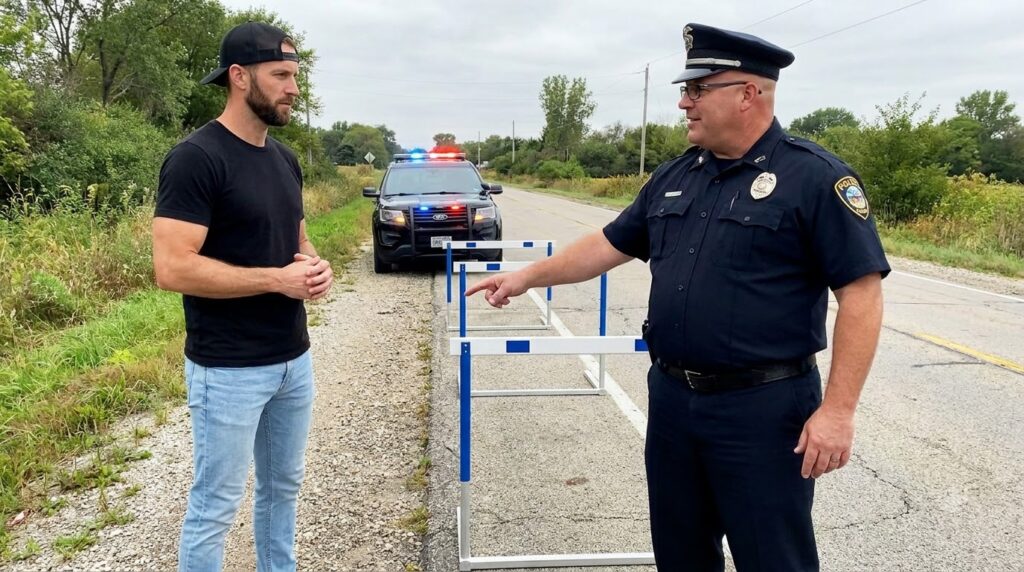
CHAPTER 1: THE ACCUSATION ON ROUTE 9
The red-and-blue strobes cut through the afternoon heat shimmer in long, rhythmic slashes, painting the dry grass along the county shoulder in cold pulse-beats.
“Step out of the vehicle. Right now.”
Officer Vance did not wait for the door to swing fully open. He stood in the kill-zone of the Ford’s frame, his heavy chest wedged tight inside a dark navy uniform shirt that strained against every brass button. His rectangular glasses dipped slightly on a bridge slick with sweat, but his eyes stayed locked on Miller’s hands.
Miller didn’t rush. He let his boot hit the loose gravel with a flat, deliberate thud, feeling the crunch of red dirt beneath scuffed leather. He kept his fingers spread flat against his light blue jeans—open, visible, empty.
“You were drifting over the fog line for half a mile,” Vance said, his voice carrying the practiced volume of a man accustomed to speaking over idling diesel engines. He stepped closer, his duty belt squeaking under the weight of his sidearm, radio, and double-cuff pouch. “Smell anything on your breath, son?”
“Water and stale coffee, Officer,” Miller replied. His voice was a flat line, smooth and ungrooved as polished granite. He adjusted the brim of his backward cap with two fingers, keeping his elbows wide and clear of his waistband. “Shift ended twenty minutes ago at the gravel pit.”
Vance smiled, a tight, thin parting of lips that held no heat. He reached back, resting a heavy palm on his holster strap, his thumb tapping a steady rhythm against the hard plastic retention lock. “We’ll see about that. You’re moving sluggish. Eye tracking is loose.”
Behind them, a two-ton grain truck slowed on the asphalt, its engine brake letting out a low, coughing rattle as the driver leaned out the window to stare. Vance’s shoulders expanded, his posture tightening as the audience gathered. He didn’t just want a traffic ticket; he wanted the shoulder to feel like a courtroom where he held the gavel.
“I’m completely sober, Officer,” Miller said, watching the way Vance’s eyes flicked toward the passing truck, calculating the audience count. “I’m happy to take a breathalyzer right here.”
“I determine the sequence of this stop, driver,” Vance snapped, stepping directly into Miller’s personal space until the heavy scent of synthetic gun oil and stale peppermint filled the air between them. He gestured toward the rear of his cruiser with a thick, stiff finger. “You don’t dictate procedure to me. Walk to the trunk.”
Miller didn’t argue. He calculated the distance to the cruiser’s rear bumper—eight paces through loose gravel—and moved with slow, unhurried precision. On the far side of the road, a blue sedan pulled off into the dirt, its driver pulling out a phone to record through the windshield.
Vance popped the cruiser’s trunk with a heavy mechanical latch. Instead of a standard breathalyzer case or an eye-tracking light, his thick hands reached deep into the dark recess and pulled out a set of bright, high-visibility blue-and-white PVC pipes stacked in a fitted nylon bag.
“We’re going to test your coordination, driver,” Vance said, unzipping the bag with a sharp, metallic tear that cut through the idling rumble of the cruiser’s engine. “And we’re going to do it where everyone can see.”
Miller watched the officer snap the plastic joints together, his eyes narrowing as he recognized the lightweight track-and-field hurdles. The blue paint was fresh, but near the lower joint of the first crossbar, a tiny white label had been roughly peeled away, leaving behind a sticky rectangle of grey adhesive and a faint, silver-stenciled set of initials: M.H.S. ATHLETICS.








