
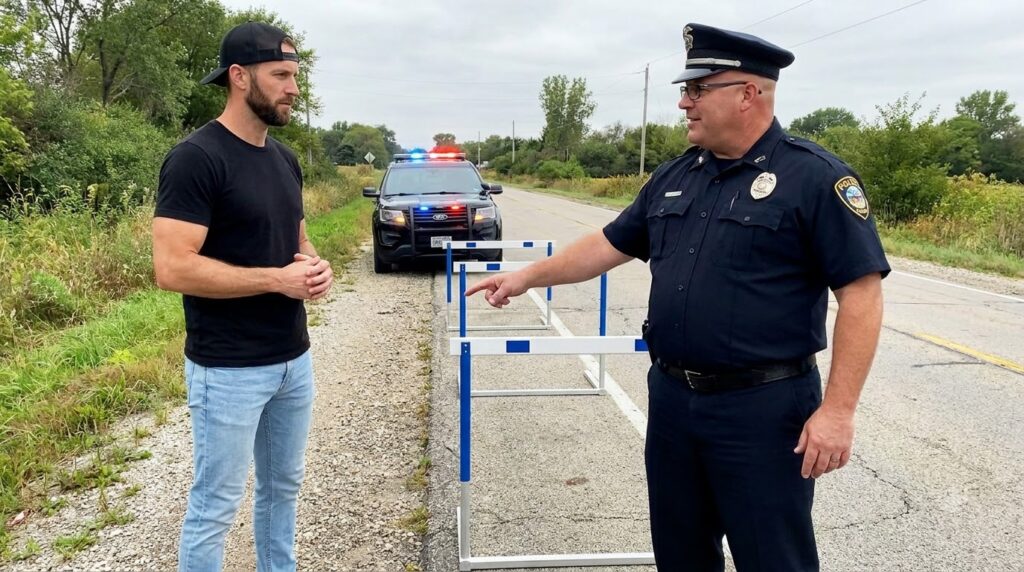
CHAPTER 6: THE TACTICAL REVERSI
Hayes didn’t ask Vance for permission. He stepped past the heavyset officer with an unhurried, heavy stride that kicked up a faint cloud of red dust against the cruiser’s rear tire.
Vance made a sharp, involuntary twitch forward, his fingers clawing at the empty air near his duty belt before his brain caught up with the reality of Hayes’s rank. “Sergeant, that’s personal gear! That’s an auxiliary safety recording device for officer protection!”
Hayes ignored him completely. He leaned his tall frame over the rear bumper of the patrol car, his gloved fingers reaching directly into the dark recess beneath the license plate bracket. With a firm, metallic snap, his hand emerged holding the matte-black rectangular action camera. The small green LED on its side flicked to red as Hayes turned the housing over in his palm, his thumb tracing the magnetic rubber base.
“Personal gear,” Hayes repeated, his voice flat as a dry lake bed. He pressed the quick-release latch on the side of the casing. The waterproof door popped open with a quiet click, revealing a high-capacity memory card locked in the primary slot—and tucked right beside the battery cell, a small plastic sleeve holding two additional micro-SD cards, each marked with a neat strip of blue masking tape.
Miller watched Vance’s face. The officer’s jaw had slackened, his eyes staring blankly at the tiny plastic sleeve in Hayes’s gloved palm. The confidence that had filled his chest ten minutes ago had completely drained out, leaving behind a hollow, sweat-slicked panic.
“You’ve been busy on this stretch of Route 9, haven’t you, Vance?” Hayes asked softly. He didn’t wait for an answer. He turned to Miller, his grey eyes assessing the younger man with a quiet, unyielding scrutiny. “Mr. Miller, step over to my vehicle, if you would.”
Miller nodded, taking a deliberate step back from the broken PVC piping scattered across the shoulder. He walked slowly toward the gray Expedition, keeping his hands unclenched and visible. Every instinct forged in the gravel pit told him to stay calm, let the physical evidence speak, and refrain from giving Vance a single thread of reactionary anger to pull on.
“I didn’t touch his equipment, Sergeant,” Miller said as he reached the side of the Expedition. “He set the hurdles up on a six-degree grade without leveling the sandbag bases. When he ran the demonstration to show me how it was done, his boot clipped the top rail.”
“I saw the plastic from two hundred yards out,” Hayes said, his voice dropping so only Miller could hear him over the idling rumble of the V8 engine. “I know what a track-and-field barrier looks like. I coached the hurdles at Millersburg High for twelve years before my knee gave out.”
Miller let out a quiet breath, feeling a subtle release of tension in his shoulders. “The stencil on the elbow joint said M.H.S. Athletics.”
Hayes let out a short, cold sound that was more exhaled air than a laugh. He looked back over his shoulder at Vance, who was currently standing frozen in the gravel, trying desperately to wipe the caked dust off his uniform trousers with trembling, filthy hands.
“He took them out of the secondary shed behind the bleachers three weeks ago,” Hayes said, his tone laden with a heavy, bitter disappointment. “Claimed he was borrowing them for a community safety presentation at the middle school. Principal called my office yesterday asking when they were coming back.”
The picture locked into place with absolute, crystalline clarity. There was no department mandate, no administrative pilot program, no legitimate traffic safety trial. Vance had stolen school athletic gear, staged illegal roadside obstacle courses, and recorded drivers under the threat of false arrest to build content for his hidden channel. The laminated sheet in his folder wasn’t an official document—it was a cheap shield meant to buy him ten seconds of hesitation from motorists who didn’t know the state code.
Across the asphalt, the driver in the blue sedan lowered his smartphone, realizing the show on the shoulder had shifted from an aggressive police stop to an internal department execution.
Hayes turned back to Vance, his posture locking into a rigid, unbending line. “Officer Vance.”
Vance swallowed hard, stepping forward on trembling legs. “Sir?”
“You’re going to stand right where you are,” Hayes commanded, pointing a long, gloved finger at the gravel shoulder. “You are not going to touch that cruiser. You are not going to touch your duty belt. You are going to stand in that dirt until Deputy Miller arrives with the transport unit.”
Vance’s face went completely white. “Transport unit? Sergeant, I’m on active patrol—”
“You were on active patrol,” Hayes corrected, his voice cutting through the evening air like a cold blade. “Now you’re the subject of an internal investigation for official misconduct, destruction of public property, and unauthorized use of department equipment.”
Hayes turned back to Miller, reaching into his pocket and pulling out his official business card. He pressed it into Miller’s palm.
“Mr. Miller, you’re free to go,” Hayes said, his tone shifting back to a respectful, professional cadence. “I’ll need a formal statement from you at the district station tomorrow morning, but for tonight, drive safe. And accept my personal apology for what happened on this highway.”
Miller looked down at the crisp white card in his hand, then back at Vance, who stood frozen in the dirt, surrounded by the broken, cheap plastic of his own unravelling ambition.
“Thank you, Sergeant,” Miller said quietly.
He turned toward his Ford truck, ready to leave the sun-bleached asphalt of Route 9 behind him.








