
CHAPTER 5: THE COLLAPSE OF THE STAGE
Senior Sergeant Hayes didn’t hurry. His long, measured stride carried the weight of thirty years on county asphalt—a slow, relentless march that made the loose gravel beneath his boots sound like grinding teeth. He paused at the rear bumper of Vance’s cruiser, his grey eyes dropping briefly to the crushed, armless frames of Vance’s rectangular glasses ground into the red dirt.
Vance’s hand twitched, his fingers releasing Miller’s forearm as if the denim had suddenly turned red-hot. He took two fast, clumsy steps backward, his chest heaving under his dirt-caked uniform shirt as he attempted to pull his heavy frame into a parade-rest posture.
“Sergeant,” Vance rasped, his voice cracking on the second syllable. He wiped a hand across his sweaty forehead, smearing a streak of fine roadside grit across his temple. “I didn’t dispatch an assistance request, sir. I have the situation on Route 9 under complete tactical control.”
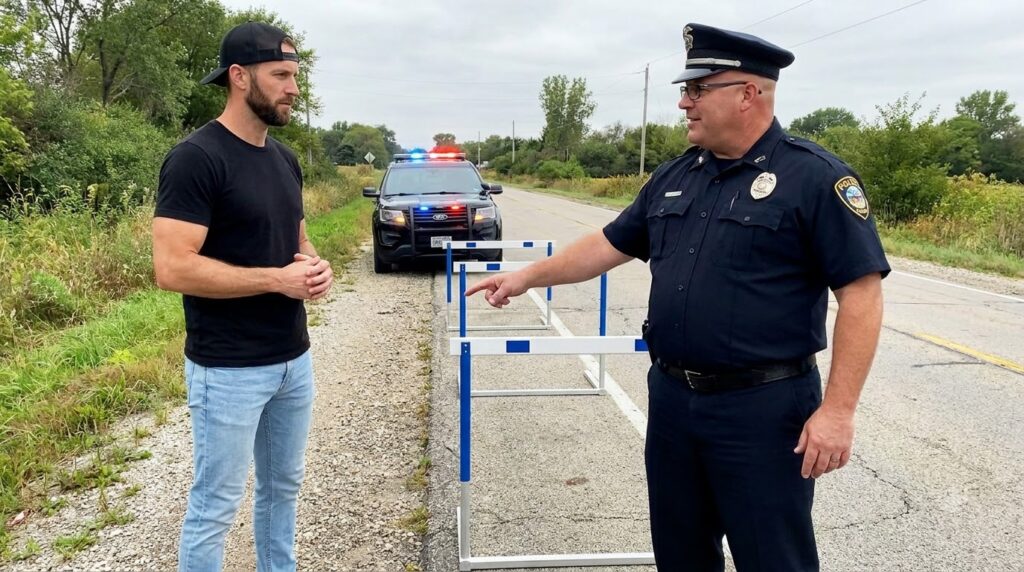
Hayes didn’t answer immediately. He stopped three feet from the broken, scattered blue-and-white PVC piping. He reached out with the tip of his polished boot, nudging a shattered elbow joint. The cheap plastic rolled hollowly into the ditch.
“Control,” Hayes repeated. It wasn’t a question. His voice was a low, raspy drawl, dry as sun-bleached pine. He looked up, his gaze sweeping from Vance’s disheveled uniform down to Miller, who remained standing rooted to his spot, hands open at his sides. “Is that what we’re calling this, Officer Vance?”
“The suspect was non-compliant during a specialized motor-skills evaluation, Sergeant,” Vance blurted out, his speech accelerating into a frantic, defensive rattle. He snatched the black binder off the cruiser’s hood and shoved it forward with both hands. “State Statute 4-10-B. Pilot field testing for motor-control impairment. He refused the primary barrier test and tampered with the setup, causing a structural failure.”
Hayes took the binder. He didn’t open it. He held it by the spine, letting his thumb trail across the worn leather edge until it caught the corner of the laminated sheet sticking out from the top pocket. With a flick of his wrist, he pulled the sheet out.
Miller watched Hayes’s face closely. The senior officer’s jaw didn’t clench; his eyes simply narrowed as he read the fuzzy, pixelated signature block at the bottom of the page.
“Statute 4-10-B,” Hayes said quietly, folding the paper once and sliding it into his own breast pocket without another word. “That’s the county code for agricultural right-of-way weed abatement, Vance. Did you think I forgot the book I helped write twenty years ago?”
Vance’s mouth opened, then snapped shut. A dark, ugly shade of red flooded his neck, crawling up beneath his jawline like a rash. “Sergeant, there’s an administrative context—”
“Shut up,” Hayes said. The words weren’t loud, but they fell with the finality of a iron gate dropping into a stone groove.
Hayes turned his back on Vance completely, stepping toward Miller. The senior officer looked at Miller’s dust-dusted work boots, the backward baseball cap, and the steady, unblinking focus in his eyes.
“You the driver of the Ford?” Hayes asked.
“Yes, sir,” Miller replied. “Jacob Miller. I’m on my way home from the gravel pit.”
“You been drinking today, Mr. Miller?”
“No, sir. I offered Officer Vance a breathalyzer three times. He told me the portable unit at his station was out for calibration.”
Hayes let out a short, dry breath through his nose. He reached down to his own duty belt, unclipped a small, heavy silver cylinder no larger than a flashlight, and snapped a fresh, sealed plastic mouthpiece onto the tip. He held it out toward Miller.
“Breathe deep, keep it steady until it double-beeps,” Hayes instructed.
Miller didn’t hesitate. He stepped forward, took a full lungful of the pine-scented evening air, and blew a firm, continuous stream into the tube. The unit chirped once, hummed for two seconds, and emitted a clear, high-pitched double-tone.
Hayes flipped the digital screen toward Vance. The red LED numbers glowed brightly against the darkening sky: 0.00%.
“Clean as mountain water,” Hayes murmured.
“He could be under the influence of an illicit central nervous system depressant, Sergeant!” Vance interjected, stepping toward them with his fists clenched at his waist. “The physical demonstration was necessary to establish neurological degradation!”
Miller took a half-step sideways, pointing a calm finger toward the rear bumper of Vance’s cruiser. “Sergeant, before you make any decisions, you might want to look at the magnetic mount clamped beneath Officer Vance’s rear plate. And if you pop his trunk, take a look at the inventory tags under the electrical tape on that nylon gear bag.”
Vance’s head snapped toward Miller, his eyes wide with pure, unadulterated shock. His breath hitched in his throat as Hayes slowly turned his head to look at the rear of the patrol car.
Miller’s tactical calculation had landed. He hadn’t just survived the trap; he had systematically dismantled the mechanism in front of the highest authority on the road.








