
The Quiet Line on the Asphalt: When Suburban Property Limits Turn into Criminal Liability
CHAPTER 1: THE WEIGHT OF THE NOTE
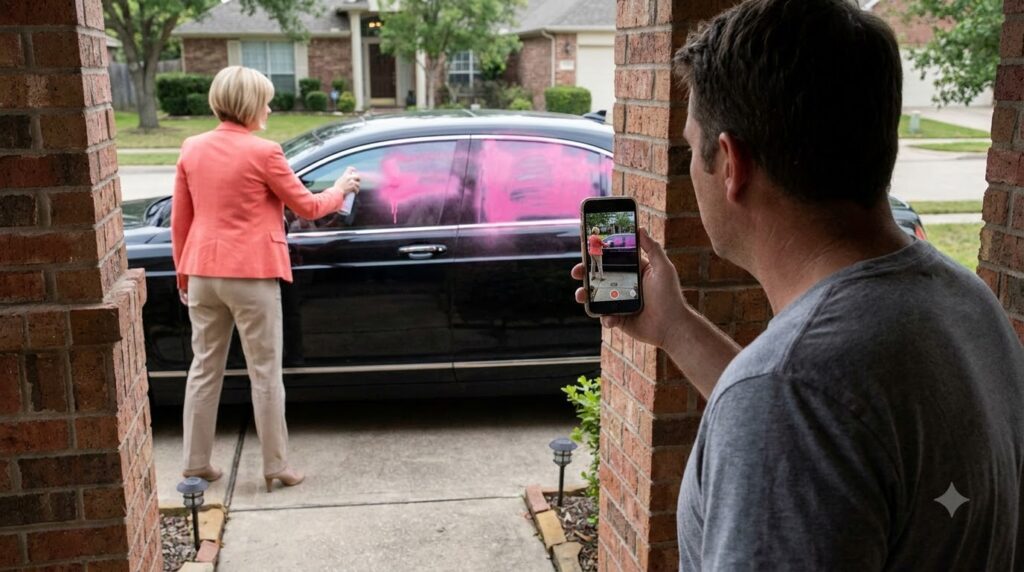
The aerosol hiss was the only sound cutting through the humid July heat, followed immediately by the dull, liquid impact of bright pink paint striking five-thousand-dollar glass.
I didn’t move. My spine remained pressed against the rough, sun-baked edge of the red-brick porch column, my right thumb resting lightly on the record button of the smartphone held at chest height. Through the three-inch gap between the brick and the decorative wrought-iron railing, the frame was clean: twenty-eight millimeters, high-definition, capturing every aerosol particle floating in the daylight.
Evelyn Vance stood on the concrete in her nude heels, her coral blazer sharp against the dull gray of my driveway. Her short blonde bob didn’t have a strand out of place. In her right hand, held with the precise, practiced grip of someone executing a civic duty, was a pink industrial aerosol can. The wet pigment dripped down the passenger-side window of my black sedan, pooling along the rubber door seal in thick, unnatural beads.
“This will teach you not to park here again,” she said. Her voice wasn’t a scream. It was a tight, clipped, suburban declaration—the tone of a woman who had spent twenty years running committee meetings and assumed the universe logged her preferences as law.
She lowered the can, her pearl earrings catching the sun as she turned her chin toward her own manicured lawn. She thought the driveway was empty. She thought the heat had driven everyone behind triple-pane glass and central air.
I stepped out from behind the column.
I didn’t rush. I didn’t raise my voice. The concrete beneath my boots was hot enough to bleed through the rubber soles, but my hands stayed dead steady on the phone casing. I kept the lens pointed directly at her face, then swept it down to the dripping pink glass, then back to the aerosol nozzle still glinting wet in her right hand.
“I recorded every second of that,” I said.
Evelyn’s heel caught the lip of the expansion joint as she froze. For two full seconds, the only movement on the street was the slow, steady drip of pink enamel falling from the side mirror onto the clean asphalt below. Her eyes dropped to the black screen of my phone, where the small red recording timer kept ticking upward.
She didn’t apologize. She didn’t drop the can. Instead, her fingers tightened around the aluminum cylinder, her knuckles turning chalk-white against the coral fabric of her sleeve.
“You’re on common easement,” she said, her voice dropping an octave into something thin and reedy. “This driveway is subject to board oversight, Arthur. I warned you on Tuesday.”
“It’s private property,” I said, my finger tapping the screen once to lock the focus on her face. “And that’s a felony damage threshold.”
She reached into her blazer pocket with her free hand, pulling out a thick manila folder stamped with a faded blue seal—the same seal she had used to intimidate delivery drivers for three blocks in either direction. “I have the authorization,” she snapped, stepping toward the bumper. “The board signed off on abatement.”
I looked down at the edge of the paper sticking out of the folder. The letterhead was crisp, but the signature at the bottom was written in dark blue ballpoint pen—a signature I had seen on three fake warning letters left under my windshield wipers over the last six months.
A car slowed down on the main road, its tires grinding softly against the loose gravel at the curb. Across the street, the blinds on the Miller house twitched upward.
Evelyn stepped closer, her heels clicking sharp against the concrete, her eyes fixing on the phone in my hand with a cold, desperate calculation. “Give me the phone, Arthur,” she whispered. “We can settle the fine right now.”

CHAPTER 2: SHADOW ON THE ASPHALT
“The fine isn’t yours to collect, Evelyn,” I said. My voice barely carried past the hood of the sedan, but it didn’t need to. The phone remained wedged between my thumb and forefinger, perfectly steady, framing the coral edge of her sleeve against the wet pink ruin on my glass. “And the board didn’t sign that paper.”
She took one half-step back, her nude heel grinding a fleck of loose gravel into the driveway expansion joint. Her eyes darted toward the street, checking the empty asphalt before snapping back to the lens. The composure she wore like armor—the sprayed bob, the pearl studs, the neat, tailored lines of her blazer—cracked just enough to show the twitch in her jaw.
“I have served on the architectural review committee for nine years,” she said, her chest heaving behind the cream blouse. “This neighborhood operates on standards, Arthur. You park a black commercial-looking vehicle across the easement line, you drag down the appraisal value of every parcel on this block. I am executing an abatement order.”
“You’re spraying industrial aerosol on private property,” I replied. “And that blue stamp on your folder was retired by the township three years ago.”
Her fingers twitched around the manila folder. I saw the edge of the paper inside—it wasn’t official bond stock. It was standard twenty-pound printer paper, slightly warped along the margin where cheap inkjet ink had dried too fast. The logo at the top was a low-resolution scan of the old suburban covenant crest, the edges pixelated and bleeding gray into the white margin.
She had spent six months dropping those sheets into my locked mailbox. First came the friendly reminders on green paper, politely requesting that I park my work vehicle inside the closed garage. Then came the yellow warnings, claiming daily fines of fifty dollars were accruing against my parcel deed. Then came the white typed sheets with the blue seal, alleging an imminent tow order authorized by the board.
I had taken every single one of them down to the management office on Oakridge Drive. The property manager, a tired guy named Miller who smelled like stale filter coffee and burnt dust, hadn’t even looked up from his monitor when I slid the second notice across his desk. We don’t issue pink slips for driveway overhangs, Arthur, he had muttered, stamping a blue FILED mark across the corner without looking. Evelyn’s been writing those on her home computer since her husband passed. Just throw ’em in the recycle bin.
I hadn’t thrown them away. They were stacked in a neat, chronological pile inside the glove box of the black sedan—seven months of documented paper trail waiting for the moment she moved from paper to paint.
“Give me the phone,” Evelyn repeated, her tone dropping the official cadence entirely. It was low now, raspy, stripped of the rehearsed HOA authority. She reached out with her left hand, her long, manicured nails hovering inches from the screen. “You don’t understand how this looks. You don’t live here the way I live here.”
“Don’t touch the phone, Evelyn.”
“I built this block!” Her voice cracked, a sharp, ugly sound that echoed off the brick facade of my porch. “When my late husband and I broke ground in ninety-four, there was nothing here but clay and pine trees. We set the rules. We kept the trailers out. We kept the cheap work trucks off the street. You buy in three years ago, you bring your black cars and your late hours, and you think you can just ignore the covenants?”
“The covenants allow two personal vehicles on the concrete apron,” I said. “Section 4, Paragraph B. I read them before I signed the deed.”
“The apron ends at the expansion seam!” She pointed the pink aerosol can toward the ground, the tip glistening with fresh pigment. “Two inches of your rear tire are sitting over the easement line. That makes it common land. That makes it mine to regulate!”
The absurdity of it hung in the hot air between us—a sixty-year-old woman in a three-hundred-dollar blazer standing on sun-caked concrete, arguing over two inches of black rubber while aerosol fumes settled into the hedge row.
Down the block, a garage door hummed as it began to roll upward on its tracks. The metallic rattle cut through the humid stillness of the street. Evelyn heard it too. Her head snapped toward the noise, her eyes widening as she recognized the gray SUV idling in the driveway three houses down.
“Put the phone away, Arthur,” she whispered, her hands dropping to her sides, though the spray can remained gripped in her right fist like a weapon she had forgotten how to holster. “We can talk about the repair. I know a guy in detailing down on Highway 9. He owes me a favor. He’ll take the paint off before it cures.”
“It’s oil-based enamel, Evelyn,” I said, looking down at the heavy, chemical sheen pooling along the wiper blades. “It’s already curing in the sun.”
I didn’t lower the phone. I shifted my weight back, feeling the solid, unyielding heat of the red-brick column behind my shoulder. The red recording timer on the screen crossed the three-minute mark.
“You’re making a mistake,” she said, her voice turning cold again, the desperate edge hardening back into the rigid malice that had governed the neighborhood for thirty years. “The board will back me. They always back me.”
“Then let’s wait for the deputy,” I said, hitting the speaker icon on the screen as the dispatch operator’s voice crackled through the small phone speaker into the quiet driveway.
CHAPTER 3: THE SETUP AT THE COLUMN
“Oakridge County Sheriff’s Dispatch, what is the address of your emergency?” The tinny voice cut through the heavy afternoon air, vibrating against the speaker grid of my phone.
“Four-twelve Meadowlark Lane,” I said without taking my eyes off Evelyn. “I need a deputy en route for an active property damage incident. Non-violent, but the suspect is still on site.”
Evelyn didn’t run. That would have required admitting the reality of the street, and Evelyn Vance lived entirely within the legal fortress she had spent thirty years constructing out of covenants and lawn regulations. Instead, her spine snapped straight, her chin lifting as if she were addressing a rowdy floor at an annual homeowners’ meeting.
“I am not a suspect, Arthur,” she said, her voice rising to meet the phone speaker. “Dispatch, this is Evelyn Vance, former president of the Meadowlark HOA Architectural Committee. I am executing a lawful abatement action against an unauthorized commercial vehicle parked on a restricted easement.”
“Ma’am, please let the caller speak,” the dispatcher responded, the static crackling over the line. “Sir, is anyone injured?”
“No injuries,” I said. “The neighbor just sprayed oil-based aerosol paint across the windshield and side glass of my sedan. I have the entire act captured on video from five feet away.”
Evelyn’s eyes narrowed into thin slits. The spray can in her right hand dipped an inch, its plastic nozzle still wet with bright magenta paint that dripped onto the toes of her nude heels. She didn’t notice the stain. Her focus was entirely on the manila folder clutched under her left arm.
“He’s recording without consent!” she shouted toward the phone, taking a aggressive step toward the porch steps. “He hid behind his brick pillar like a coward! He baited me into this!”
“Ma’am, step back from the vehicle,” the dispatcher’s voice turned flat, professional, and entirely unimpressed by her committee credentials. “Unit 412 is approximately four minutes out. Sir, keep your distance and stay on the line.”
“I’m on my porch,” I replied, my voice dropping into the quiet, measured cadence I used when securing job sites. “I’m not moving.”
I didn’t need to move. The physical environment was already doing the work. The midday sun hit the sedan’s glass at a forty-five-degree angle, baking the fresh enamel directly into the factory tint. The chemical smell of solvent floated up through the porch railings—sharp, pungent, and impossible to mistake for anything other than deliberate sabotage.
Evelyn shuffled her feet, the gravel crunching under her soles. For the first time, a flicker of genuine calculation replaced the blind outrage in her eyes. She looked down at the manila folder in her hands, her thumb tracing the edge of the cheap inkjet printout. On the brass clip securing the top of the file, a small metal key tag rattled—a heavy, weathered brass disc stamped with the number 14.
It was an old postal box key tag. The kind used for private drop boxes at the commercial print shop down on County Route 9.
“You think you’re clever because you bought a camera,” she muttered, stepping sideways to block the driver’s side mirror from my angle. “You think a cell phone video overrides thirty years of community standards. The board holds a master easement on this entire apron. I have the signed authorization right here.”
“Then show it to the deputy when he pulls up,” I said.
I shifted my thumb slightly on the screen, adjusting the zoom to capture the brass tag dangling from her clip. The number 14 was unmistakable, scratched deep into the tarnished metal.
Three months ago, when the first anonymous citation had appeared under my wiper blade, I had noticed the same faint purple ink stain along the top margin—the distinctive mark left by the high-volume laser printers at the Route 9 copy center. The board didn’t use Route 9. The board used the municipal printing office in the township basement, where every official notice was embossed with a raised seal.
Evelyn had been running her own private postal box. She wasn’t just writing fake citations; she was receiving mail there, acting as a self-appointed gatekeeper, intercepting complaints before they ever reached Miller’s desk at the management office.
“This entire neighborhood is deteriorating because people like you refuse to follow the rules,” she said, her voice dropping into a tight, raspy cadence. She tapped the manila folder against her hip, the papers rustling in the dry heat. “You park here. Then the people at four-eighteen start leaving their boat on the grass. Then the renters at four-twenty-two stop mowing their back lot. It starts with one vehicle, Arthur. It always starts with one vehicle.”
“It starts with the deed, Evelyn,” I said. “And my deed says private parcel up to the curb line.”
Down the block, the low, mechanical rumble of a Ford Police Interceptor engine rounded the corner of Meadowlark Lane. The white hood gleamed under the streetlights, its roof lightbar dark but its grill lights flashing silent yellow warnings as it slowed down beside the curb.
Evelyn didn’t turn around immediately, but her posture stiffened. She pulled the manila folder tighter against her coral blazer, covering the brass key tag with her palm, while the pink aerosol can dangled from her fingers like a piece of evidence she suddenly realized she couldn’t hide.
The cruiser’s door opened with a heavy, metallic latch sound, and a pair of black leather boots planted themselves firmly on the hot asphalt.
CHAPTER 4: THE HISS OF THE AEROSOL
Deputy Hayes stepped off the hot tarmac, his heavy duty belt creaking as he adjusted his stance between the nose of his patrol car and the rear bumper of my sedan. His eyes—squinting against the glare bouncing off my hood—swept the three-foot gap separating Evelyn Vance from the passenger doors. He didn’t ask what smelled like wet synthetic lacquer. The heavy chemical fumes hung over the concrete like a cloud of warm vapor.
“Evelyn,” Hayes said, nodding once. His tone wasn’t hostile, but it carried the flat, worn-down cadence of a man who had answered six civil nuisance calls on this exact block during the July heatwave. “Put the aerosol down on the hood. Right there on the clean spot.”
Evelyn didn’t move the can. Her fingers remained clamped around the pink metal cylinder, her knuckles showing pale through her manicured skin. “Deputy, I am performing an official abatement under the architectural covenants of Meadowlark Estates. Arthur has been served three written notices regarding his commercial easement obstruction. He refused to comply.”
“Put the can down, Evelyn,” Hayes repeated, his voice dropping an octave into a low, non-negotiable hum. He took two steps forward, his boots making a dry rasp against the loose gravel scattered along the expansion joint. “I’m not going to ask you a third time.”
Her jaw tightened, the coral fabric of her blazer bunching around her shoulders as she set the pink can onto the dry corner of the hood. The plastic nozzle left a tiny ring of wet magenta pigment on the clear coat before sliding an inch down the slope.
“Now,” Hayes turned toward me, his hand resting casually over his belt buckle. A thick, worn silver seal ring glinted on his left ring finger—an old county sheriff’s association band with its enamel face scratched down to the bare nickel. “Arthur. You said on the call you have video.”
“Four minutes and twelve seconds,” I said, staying anchored beside the brick column. “Continuous shot. From the moment she walked onto the concrete apron with the can raised to her boast right after she finished the glass.”
“He was hiding!” Evelyn blurted out, her arm swinging upward as she thrust the manila folder directly toward Hayes’s chest. “He set a trap! He deliberately left the vehicle over the easement line to provoke a confrontation! Look at the board authorization! Look at the signature!”
Hayes didn’t reach for the folder immediately. He looked at the passenger side window first. The paint was thick, running in heavy, opaque rivers down the glass and pooling inside the rubber weather-stripping at the base of the door frame. A few stray droplets had splattered across the polished door handle.
“You sprayed the glass, Evelyn,” Hayes said quietly, finally taking the manila file from her fingers. “Whether he parked on the grass, the easement, or the roof of your house, you can’t take an aerosol can to a thirty-thousand-dollar vehicle.”
“It is an abatement!” She slapped her palm against the top of the file clip, rattling the brass postal key tag stamped with the number 14. “The committee voted on this last Tuesday! Look at page two! The board granted emergency enforcement authority for chronic easement violations! That is an official document from the Meadowlark HOA!”
Hayes flipped the cover open. I watched his eyes track the top line of the paper.
From where I stood behind the porch railing, I could see the thick black header printing. It wasn’t the pixelated home-printed sheet I had expected. It was a heavy, formal document stamped with a red-ink municipal registration seal along the right margin, titled BOARD RESOLUTION 204: SPECIAL ABATEMENT AUTHORITY FOR PRIVATE ACCESS EASEMENTS.
A tight knot formed in my stomach. The paper looked real. The red stamp wasn’t a cheap inkjet scan; it had the faint bleed and heavy edge-line of an official county clerk’s endorsement stamp.
“See?” Evelyn’s voice rose, sharp and triumphant, as she took half a step toward the patrol car. “The board authorized self-help abatement for any vehicle obstructing emergency turnarounds! He’s been blocking the fire lane for six months! That resolution gives the committee full legal authority to mark and neutralize non-compliant equipment!”
Hayes frowned, his thumb tracing the red stamp at the bottom of the page. “This has a township docket number on it, Evelyn.”
“Because it was ratified at the municipal court!” she declared, her eyes snapping toward my phone with a cold, predatory flash. “I am acting as an officer of the corporation! He isn’t recording a crime, Deputy! He’s recording a lawful administrative remedy!”
I shifted my grip on the phone, the metal casing suddenly feeling ice-cold against my palm despite the heat. The resolution looked ironclad. If Evelyn actually possessed an authorized municipal docket number granting her committee self-help abatement rights over the driveway line, the police couldn’t treat this as simple criminal vandalism—it would instantly collapse into a civil property dispute.
“Let me see the docket number,” I said, stepping down from the porch onto the first concrete step.
“Stay right there, Arthur,” Hayes raised a hand, his eyes still fixed on the red ink on the paper. “Evelyn… where did you get this seal?”
Evelyn didn’t blink. Her chin remained lifted, her hands folding neatly over her waist. “From the township clerk’s office on Friday afternoon. Signed by Board President Miller himself.”
I looked from the red stamp on the document down to the brass tag dangling from her clip—the key tag for Box 14 at the Route 9 print shop. The decoy was perfect. She had presented a fully ratified municipal resolution right in front of the deputy, turning my ironclad video of a crime into what appeared to be a legally sanctioned administrative enforcement.
“Show him the video, Arthur,” Evelyn whispered, a thin, ruthless smile cutting across her pale lips. “Show the deputy how you recorded an official board officer executing a public nuisance abatement.”
CHAPTER 5: THE VERTICAL LENS
Deputy Hayes held the paper against the hood of the patrol car, his thumb smoothing down the crease right over the red ink seal. The midday heat radiating off the engine block made the air between us shimmer.
“Arthur,” Hayes said, his tone shifting into that flat, procedural drone police officers use when they are trying to back out of a civil swamp. “This resolution bears a township clerk docket stamp. Docket 18-B. If the board filed an administrative abatement lien under township ordinance four years ago, they have self-help remedies for access clearance.”
“Look at the stamp alignment, Deputy,” I said, stepping off the bottom porch stair onto the gravel margin. The dust beneath my boots felt bone-dry. “Look at the ink on the docket line.”
Evelyn didn’t move an inch. Her posture remained rigid, her chin tilted at the precise angle of a woman who believed the entire legal system had been constructed specifically to validate her driveway boundaries. “The document is on file at the clerk’s office, Hayes. He can challenge the lien in municipal court on Monday. In the meantime, the abatement stands.”
“The document is a decoy,” I said, pointing my phone lens down toward the folder held in Hayes’s hands. “She bought that seal at an antique auction or ordered a custom rubber stamp online. Township clerk seals don’t use double-spaced typewriter font on the docket line. They haven’t used typewriter keys since nineteen ninety-eight.”
Hayes hesitated. His thumb lifted off the paper, his eyes narrowing as he leaned closer to the red ink.
“That’s absurd!” Evelyn’s voice cracked, a high, sharp sound that sliced through the hum of the cicadas in the maple tree. “I am a former officer of the association! I have maintained the legal archives for Meadowlark Estates since the subdivision was chartered!”
“Which is exactly where you got the old letterhead,” I replied, keeping my voice steady, transactional, and devoid of the anger rising in my chest. “You took blank archival bond paper out of the committee safe when your term ended. You’ve been typing your own resolutions in your kitchen for three years.”
“You’re fabricating!” she snapped, reaching out as if to snatch the folder back from Hayes. “Deputy, he’s defaming me! He’s trying to evade a lawful easement penalty by accusing me of a forgery!”
Hayes blocked her hand with a slow, heavy sweep of his forearm. The movement wasn’t violent, but the weight of his leather sleeve carried the full, unyielding authority of the county sheriff’s department.
“Evelyn, step back,” Hayes said quietly. He didn’t look up from the page. “Arthur… if this document is fraudulent, that’s a state offense for tampering with public records. But if I dispatch a unit to verify a docket number on a Saturday afternoon, and the clerk’s office is closed until nine A.M. Monday, I can’t impound her or arrest her on the spot for property damage without a supervisor’s sign-off.”
Evelyn let out a short, triumphant breath. The pale, thin smile returned to her mouth, tight and merciless. “You hear that, Arthur? The law doesn’t run on your phone camera. You can sit on your porch all weekend and watch the paint cure on your windshield.”
The trap felt suffocating. The decoy document had done its job: it had created just enough procedural doubt to freeze Hayes in his tracks, pushing a clear-cut act of criminal vandalism into the slow, agonizing gears of Monday morning bureaucracy.
“She doesn’t get to walk away with the evidence, Deputy,” I said, my finger tapping the screen to lock the focus directly on her face. “You haven’t checked the video yet.”
“I don’t need to check the video to see the paint, Arthur,” Hayes muttered, rubbing the back of his neck where the sun had turned his skin a deep, leathery red. “I see the paint. The issue is whether she acted under color of board authority.”
“Watch the first thirty seconds,” I insisted, turning the screen toward him. “She didn’t just spray the glass. Watch what she does right before she pulls the trigger.”
Hayes took a half-step toward me, leaning over the hood of the sedan. Evelyn’s hand twitched toward her side, her fingers clawing at the fabric of her coral blazer as if she wanted to reach out and smash the glass screen in my hands.
On the five-inch display, the high-definition footage played in real-time. The frame showed Evelyn stepping off her manicured lawn, checking both directions of the street, and pulling the aerosol can from a paper grocery bag hidden behind her hedge—a bag that was still sitting at the base of her mailbox thirty feet away.
“Look at her left hand,” I whispered, pointing to the bottom corner of the video playback. “She isn’t holding an official abatement order. She pulls a blank sheet out of her blazer, crumples it up, and drops it into her own trash bin before she ever touches my car.”
Hayes froze. His eyes tracked the movement on the screen.
“She didn’t bring the folder out here to execute a resolution,” I said, the words falling cold and heavy onto the hot concrete. “She brought the folder out here after I called out from behind the brick column. She went back to her porch, grabbed her decoy file, and walked back over to give you an excuse when you pulled up.”
Evelyn’s breath hitched. The pale composure on her face didn’t just crack—it shattered completely, leaving her mouth open in a soundless, desperate gasp as Hayes slowly turned his head to look at her.
CHAPTER 6: THE UNFOLDING DEFLECTION
Evelyn didn’t drop her hands, but the blood drained from her face so fast her skin took on the color of wet newsprint. Her eyes darted from the smartphone screen in my grip to Deputy Hayes’s face, searching for the familiar deference she had commanded across neighborhood committee tables for twenty-five years.
“That… that clip proves nothing,” she stammered, her right heel digging into the expansion joint as she tried to adjust her stance. “I was disposing of an unrelated notice before initiating abatement! The board resolution remains valid! You cannot invalidate an administrative action because of the order of operations, Deputy!”
“Evelyn,” Hayes said, his voice dropping into a quiet, dangerous register. He didn’t look at the paper in his left hand anymore; his fingers clamped around the folder cover, bending the cheap cardboard until the staples popped. “You told me you carried this resolution onto the driveway when you initiated abatement.”
“I had it on my person!” she insisted, her voice climbing into a sharp, thin screech that made the Miller house blinds across the street twitch wider. “It was in my blazer pocket! The video doesn’t show my left pocket! You’re taking his framing as gospel!”
“I have the continuous shot from the moment you crossed the property line,” I said, keeping my thumb resting over the screen. “You didn’t reach into your blazer until I stepped out from behind the column. You walked up with nothing in your hands except the pink can.”
“Because I didn’t need to brandish the document at an empty car!” She pointed a trembling, manicured finger at my chest. “You lay in wait behind that brick pillar! You knew I was coming out to enforce the easement! You deliberately engineered a confrontation so you could record it and slander me!”
“I stood on my porch,” I said. “On private parcel land. While you brought industrial aerosol onto my driveway.”
Hayes turned the manila folder over. As he did, the movement dislodged a small, folded slip of paper tucked into the interior sleeve—a yellowed, smudged carbon receipt with jagged tear-lines along the top edge. He pulled it out with two fingers, holding it up against the blinding glare of the afternoon sun.
It was an order receipt from Quick-Print Solutions on County Route 9, dated three days prior. The itemized line read: Custom Rubber Stamp – Township Docket Header (1 Cst). Below it, printed in faded blue ink, was the customer name: E. Vance.
The decoy document didn’t just crack; it disintegrated on the hot asphalt between us. The red stamp wasn’t a historical artifact or an old archival relic from her days on the committee. She had commissioned the stamp herself forty-eight hours ago, explicitly to manufacture a legal defense for the vandalism she planned to carry out on my car.
Evelyn stared at the yellow carbon slip in Hayes’s fingers. Her mouth opened, then closed, her lips working silently against the dry heat. The rigid, imperious posture that had governed Meadowlark Lane for decades collapsed inward, her shoulders slumping inside the tailored coral blazer.
“Evelyn,” Hayes said, pulling his leather notepad from his breast pocket and clicking his pen. “I’m securing this folder and the aerosol can as evidence in a criminal property damage investigation. You need to step back to your porch right now.”
“You… you can’t confiscate my committee records,” she whispered, her voice stripped of its crisp authority, sounding frail and reedy against the distant hum of traffic on the highway. “The board owns those records.”
“The board didn’t order a forged municipal stamp at a commercial print shop, Evelyn,” I said, stepping down onto the driveway concrete, the heat radiating off the black paint of my sedan reaching my face. “And the board isn’t going to pay for six thousand dollars in custom glass restoration and body re-spraying.”
“I was protecting the neighborhood,” she muttered, her eyes fixed on the wet pink streaks drying into permanent, opaque scars across my windshield. “I was keeping the standards up. If I didn’t do it, nobody would.”
“You weren’t protecting anything,” I said, keeping my phone pointed directly at her as she took her first backwards step toward her lawn. “You were just damaging property you didn’t own.”
Across the street, a car door slammed shut. Neighbor doors were opening up and down the block, figures stepping out onto their front stoops into the heavy July air as the white-and-blue sheriff’s cruiser sat idling on the curb, its lightbar reflecting off the ruined glass of my sedan.
CHAPTER 7: THE WITNESS ASSEMBLY
The slammed car door echoed down Meadowlark Lane like a crack of dry timber breaking in the heat.
I didn’t lower my phone. The camera was still running, its frame widening just enough to capture Deputy Hayes slipping the yellow carbon receipt inside his leather citation book. Beside him, Evelyn Vance stood frozen on the edge of my lawn, her nude heels sinking half an inch into the soft, sun-warmed turf.
From across the street, Tom Miller crossed the asphalt. He didn’t rush, but his heavy work boots made a sharp, rhythmic slapping sound against the blacktop. He wore a faded grease-stained t-shirt and work shorts, his phone held upright in his right hand, the camera lens pointed directly at Evelyn’s coral blazer.
“Saw the whole thing from my porch, Deputy,” Miller said as he reached the curb, his voice raspy from decades of diesel fumes and cigarette smoke. He didn’t look at Evelyn; his eyes went straight to the bright pink enamel dripping off my windshield. “She walked up with the paper bag, pulled the can out, and sprayed Arthur’s glass. Didn’t even look around.”
Evelyn’s head snapped toward him, her lips pulling back over her teeth. “Tom, you stay out of this! You know nothing about the architectural covenants on this easement!”
“I know you put three fake notices on my utility trailer last April, Evelyn,” Miller said, his tone flat, unbothered, and utterly devoid of the fear she usually extracted from the street. “Claimed the county was going to impound it. I called the sheriff’s department that afternoon, and they told me nobody by the name of Vance had authority to tag vehicles on a private driveway.”
Down the block, Mrs. Gable stepped off her front porch, her walker clicking against the sidewalk slabs as she moved closer to my driveway apron. Behind her, two younger guys from the rental house at 422 stood by their mailbox, their arms crossed, watching the deputy take notes with quiet, satisfaction-filled grins.
The quiet terror Evelyn had cultivated over twenty-five years—the threat of fines, the implication of municipal influence, the constant subtle harassment at the mailbox—was evaporating under the noon sun. Without the illusion of board authority, she was just an angry woman in an expensive blazer holding a can of spray paint on another man’s property.
“Deputy,” I said, stepping closer to Hayes so my voice remained clear on the phone recording. “I want to file a formal complaint for criminal mischief and intentional property damage. The estimate for replacing the thermal glass and stripped window seals on this sedan will exceed three thousand dollars.”
Hayes nodded, his pen scratching against the lined paper of his report pad. “Class A misdemeanor threshold is fifteen hundred in this state, Arthur. Over twenty-five hundred pushes it into felony property damage territory.”
Evelyn let out a choked, ragged breath. “Felony? Are you insane? It’s paint! It washes off!”
“It’s oil-based enamel, ma’am,” Hayes said, looking up from his pad with a cold, unyielding stare. “It’s cured on tinted auto-glass in ninety-degree heat. And you bought the custom stamp to manufacture a fake authorization.”
He stepped away from the car, pointing toward the front porch of her house. “Evelyn, go stand on your porch and wait for me there. Do not touch your vehicle. Do not go inside. If you walk away from this site before I finish writing this citation, I will place you under custodial arrest right now.”
She looked around the driveway. She looked at Miller, who kept his phone raised, recording her every move. She looked at Mrs. Gable, who shook her head with slow, disgusted disappointment. She looked at the two young men by the mailbox, who were whispering to each other while staring at the pink-stained luxury sedan.
The public authority she had spent thirty years manufacturing had collapsed into a crowd of neighbors watching her receive a criminal citation on the very driveway she claimed to own.
Her shoulders trembled under the coral blazer. Without saying another word, she turned her back on the sedan, her nude heels clicking softly against the concrete as she began the long, silent walk up her front walkway.
“Arthur,” Hayes turned back to me, tearing a white carbon copy from his pad and handing it across the hood. “Keep that video file backed up on a cloud server. The state’s attorney is going to want it on Monday morning.”
CHAPTER 8: THE PRICE OF CONCRETE
The white carbon copy of the citation felt surprisingly heavy between my fingers, the thin paper warm from the hood of the patrol car where Deputy Hayes had pressed his ballpoint pen down to the yellow backing.
I folded the sheet once, crisp and straight along the margin, and slipped it into the back pocket of my jeans. The afternoon heat had reached its peak, baking the chemical solvent smell of the pink enamel deep into the rubber door seals of my black sedan. Across the street, the tires of Hayes’s Interceptor crunched over the gravel as he backed out of Evelyn’s driveway, leaving her standing alone on her elevated porch under the shadow of her gabled roof.
She hadn’t gone inside. She stood behind her white wrought-iron porch railing, her arms folded tightly across the coral blazer, watching the street through the oversized lenses of her sunglasses. But her chin was no longer tilted up. The rigid, unyielding posture that had policed every square inch of Meadowlark Lane for twenty-five years had broken into something small, defensive, and isolated.
Tom Miller walked back over to my side of the concrete apron, his hands jammed into the pockets of his heavy canvas shorts. He looked down at the bright magenta paint running across the passenger glass, then up at Evelyn’s porch.
“She’s going to get the bill from the county prosecutor before the paint even finishes drying,” Miller said, shaking his head. “Hayes didn’t just write her up for criminal mischief. He tagged the custom stamp as a fraudulent instrument. That’s a state filing, Arthur.”
“It was never about the driveway,” I said, my thumb tracing the edge of my phone screen where the continuous four-minute video file was already locked into three separate cloud drives. “It was about making sure nobody questioned the line.”
“Well, the line’s marked now,” Miller muttered, pointing a grease-stained finger toward the concrete expansion seam separating our parcels. “And everybody on this block knows who owns what side.”
Mrs. Gable gave a slow nod from her walker at the edge of the lawn before turning back toward her stoop. Down the block, the two younger guys from 422 were already heading back to their garage, but the shift in the air was permanent. The silent compliance Evelyn had relied on—the quiet fear that a single phone call from her kitchen could ruin a homeowner’s resale appraisal—was gone. The street belonged to the deeds now, not her committee folders.
I walked up the three steps to my porch and sat down on the top riser, leaning my back against the sun-baked red brick of the column.
From here, the perspective was clean. The black sedan sat squarely on the concrete apron, completely within the legal boundaries of my deed, the pink streaks across the glass glinting like an undeniable record under the harsh July sun. Down on the sidewalk, the pink aerosol can sat sealed inside a clear plastic evidence bag on the hood of my work bench, waiting for Monday morning’s court filing.
Evelyn turned her back on the street, her heels making a faint, hollow clicking sound against her porch tiles as she finally retreated behind her front door. The heavy oak door shut with a dull, final thud that barely carried past her lawn.
I looked down at my phone one last time, tapping the screen to confirm the file upload was complete. The recording was saved, the carbon receipt was logged, and the driveway was clear.
The line on the asphalt hadn’t moved an inch, but the price of trying to enforce a lie had just been billed in full.







