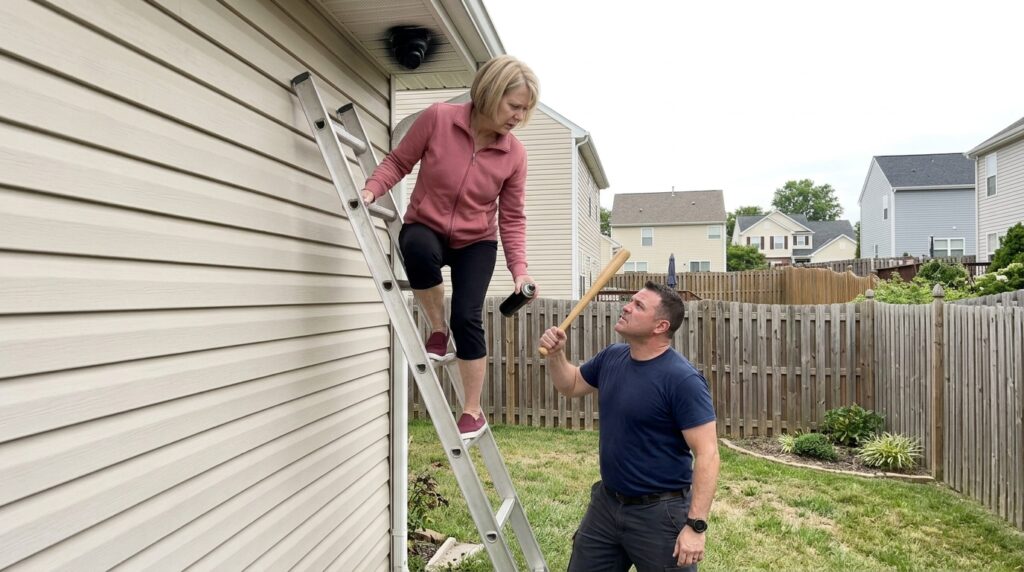
The Line We Draw in the Rust: A Suburban Boundary War
CHAPTER 1: THE HISS AT THE SOFFIT
The sharp, pressurized hiss of an aerosol can against vinyl siding wasn’t a sound that belonged in a quiet Tuesday morning.
Mark didn’t rush. Rushing led to mistakes, and after four months of handwritten notes tucked under his windshield wipers and anonymous calls to code enforcement, he knew the value of deliberate movement. He reached for the ash baseball bat resting beside the back door—a solid, unpolished length of timber he kept for clearing brush—and stepped onto the gravel path of his side yard. He didn’t raise it. He kept it low, angled flush against his dark work pants, the weight resting easy in his right palm.
The smell hit him before the visual did: acrid, chemical, and thick in the humid air between the two houses.
Standing on the third rung from the top of a dark aluminum extension ladder was Evelyn Vance. Her short blonde bob was stiff against the slight breeze, her rose-pink zip sweatshirt bright against the pale gray vinyl of Mark’s house. In her right hand, wearing a thin coating of dark mist across her knuckles, she held a can of flat black enamel spray paint. The nozzle was pressed flat against the clear acrylic shell of his exterior dome security camera.
A wet, dark ring of paint expanded across the soffit, dripping onto the siding below.
“Get down now,” Mark said. His voice was flat, devoid of the anger she was likely bracing for. “Leave my camera alone.”
Evelyn flinched, her burgundy slip-on shoe slipping a fraction of an inch on the aluminum rung before her left hand gripped the rail. She turned her head just far enough to glare down at him, her lips pressed into a thin, white line.
“This is an illegal surveillance apparatus,” she snapped, though her voice lacked its usual booming cadence. “It’s pointed directly at my side garden. I’ve filed three complaints with the board.”
“You’re four feet over the property line, Evelyn,” Mark said, stepping closer until he stood beside the ladder’s rubber feet. He raised the wooden bat slowly, not toward her, but bringing the barrel across the ladder’s bottom rail in a steady, physical block that anchored the aluminum to the turf. “And that camera is mounted on my home. Come down.”
“I am exercising right of abatement!” Her knuckles were white against the spray can. “You don’t own the easement strip. The 2009 covenant clearly states—”
“The survey stake is six inches behind your left heel,” Mark cut in, his eyes locked on her face. “You’re on private land, destroying private property. Step down, or the sheriff reviews the cloud feed while you’re still up there.”
Evelyn stared at him, her chest heaving under the pink fleece. For three seconds, the only sound was the faint hum of an idling lawnmower two streets over. Then, with a stiff, furious jerk of her wrist, she lowered the paint can to her hip, her gaze dropping to the wooden bat braced across the ladder base.
“Fine,” she spat, her burgundy shoe reaching down for the next rung. “I’m coming down now. But you haven’t won anything, Mark. I have the signed documentation right here in my pocket.”
Mark didn’t shift his stance. He reached into his dark pants with his free hand, pulled out his smartphone, and tapped the screen. The notification on his lock screen was already glowing red: Motion Detected – Side Yard Camera – Cloud Sync Complete.

CHAPTER 2: THE FOOT AT THE BOUNDARY
Evelyn’s burgundy shoe struck the damp turf with a sharp, heavy thud. Her ankles wobbled slightly on the uneven grade, but she caught herself against the aluminum rail of the ladder, her face flushed dark under her stiff blonde hair. She didn’t let go of the aerosol spray can. She held it close to her ribs like a stolen trophy, her thumb still smudged with a wet sheen of black enamel.
Mark didn’t back off. He shifted the ash bat half an inch, keeping the heavy barrel firmly pressed against the rubber foot of the extension ladder. The aluminum groaned against the vinyl siding overhead—a sound of metal grinding on plastic that made the air between them feel raw and tight.
“You’re trespassing, Evelyn,” Mark said. His voice was lower now, barely carrying past the narrow gap between their rooflines. “Take your ladder off my house.”
“This isn’t your house to isolate, Mark,” she hissed, taking one step back toward her own lawn, though her heels stayed stubbornly planted on his side of the property line. She reached her free hand deep into the oversized pocket of her rose-pink sweatshirt, her fingers rustling against heavy paper. “You think a plastic dome on a piece of trim gives you authority over this corridor? You’ve been running a surveillance campaign against my family for four months.”
“I put a camera on my soffit because someone cut three feet off my blueberry hedge and dumped two bags of quick-lime along my foundation,” Mark replied. He didn’t look at the paper she was beginning to pull from her pocket. He kept his eyes on her hands—one clutching the spray can, the other grasping a yellowed, multi-folded sheet of bond paper. “The camera stays. The paint comes off.”
“The camera is an illegal apparatus,” she spat, her voice rising as she caught sight of old Mr. Henderson leaning over his porch railing three houses down. The sound of her voice was calculated, pitched to draw eyes to the driveway gap. “I have the 2009 covenant right here. Signed by the developer. A three-foot shared foot-traffic and utility easement running from the curb line to the rear fence! You don’t own this strip, Mark. You never did.”
She thrust the folded paper toward his chest.
Mark didn’t reach for it. The paper was worn at the creases, the edges soft and frayed from years of being folded and refolded into folders and coat pockets. At the top, in faded blue ink, he could see the header of the old neighborhood association logo—a developer’s draft layout from before the subdivision was handed over to the county.
“The county survey was completed three weeks ago,” Mark said quietly. “The surveyor drove three steel pins into the ground. One is right behind your left heel.”
Evelyn didn’t look down. “A private surveyor doesn’t override a recorded covenant!”
“A draft covenant that was never ratified by the county clerk doesn’t give you the right to climb my wall with a paint can,” Mark said. He reached down with his left hand, his thumb sliding across the glass face of his phone. The screen flickered, showing the cloud storage dashboard. The thumbnail for the 8:14 AM clip was already processed—a clean, high-definition freeze-frame of Evelyn’s face, three inches from the lens, her right index finger pressing down on the black spray nozzle. “The video is already off the local drive, Evelyn. It auto-synced to the server the second the motion sensor tripped.”
Evelyn’s eyes flicked to the dark screen of his phone. A tiny muscle in her jaw jumped, the rigid confidence in her posture wavering for a fraction of a second as she realized the dark dome overhead was no longer the only place that image existed.
“You think you’re clever with your little gadgets,” she said, her voice dropping into a harsh, tight whisper as she took another half-step back toward the boundary line. “You think you can just drive steel stakes into the dirt and erase fifteen years of how this street operates? That paper is signed. It’s signed by Arthur Vance.”
“Arthur Vance was your husband,” Mark said. “He didn’t own my lot in 2009, and he didn’t sign a deed for the county.”
“He maintained this path!” she shouted, her voice snapping back into its loud, public register as a silver sedan slowed down on the street, the driver leaning over the passenger seat to stare at the ladder leaning against Mark’s siding. “He laid the gravel! He kept the weeds down when the previous owner let it rot! This is community property, and I will not be spied on in my own side garden by a man who bought his way onto this block four years ago!”
She raised the spray can again, not toward the camera, but pointing the brass nozzle directly at Mark’s chest like a weapon.
Mark didn’t flinch. He brought the ash bat up six inches—not a swing, just a steady raising of the timber to block the line between the nozzle and his shirt. The heavy wood felt solid in his grip, cool and dry against his palms.
“Put the can down, Evelyn,” Mark said, his voice dropping into a register that was deadly quiet. “Or I call the deputy while you’re standing on my grass holding the evidence.”
Evelyn held the can steady for three long seconds, her pink sweatshirt rising and falling with her heavy breathing. Across the street, a car door slammed shut, and the crunch of footsteps on gravel signaled that they were no longer the only ones standing in the morning air.
CHAPTER 3: THE SIDEWALK TRIBUNAL
The gravel crunched under the heavy, deliberate tread of Arthur Miller, who lived two doors down in the house with the unpainted porch rails. He didn’t stop until he reached the edge of Mark’s driveway apron, his hands jammed deep into the pockets of his oil-stained canvas work jacket. Behind him, a woman in a floral housecoat stopped short on the public sidewalk, her phone held high in both hands, recording the space between the houses.
Evelyn didn’t back away when Miller appeared. Instead, her spine snapped straight, her chin lifting as if she had just been handed a microphone.
“Art, look at this,” she called out, her voice reverberating between the vinyl siding of Mark’s house and her own brick foundation. She waved the yellowed, multi-folded paper in the air like a battle flag. “Look at what he’s doing! He’s mounted an active optical monitoring system right on the property seam, pointing directly into my side yard, and now he’s threatening me with a weapon!”
Mark didn’t shift his stance or lower the ash bat from its angled barrier position. “He’s recording the fence line, Art. And she just spent two minutes spraying black enamel over the camera lens.”
Miller’s gaze drifted slowly from Mark’s face, down to the wooden barrel braced across the ladder feet, and then up the vinyl wall to the dark soffit, where the acrylic dome camera was smeared with a glistening, wet coat of black paint. A single droplet hung from the bottom rim, falling with a tiny plip onto the dry mulch below.
“That’s a fifty-dollar camera, Evelyn,” Miller said, his voice raspy from forty years of shop smoke. “And you’re standing four feet past your own grass.”
“It’s not his grass!” Evelyn’s voice shrilled, cutting through the low hum of a passing delivery truck. She took two fast steps toward Miller, holding the yellowed document out so close to his face that the paper fluttered in the breeze. “Read it! It’s the 2009 Developer Covenant! Section 4, Paragraph B. A three-foot foot-traffic and maintenance easement reserved for the enjoyment and upkeep of the adjoining parcel! Arthur signed it. The original developer signed it. It’s a matter of public record!”
Miller squinted, leaning back slightly to read the faded blue typescript. Mark watched the older man’s eyes track across the paper. There was a dark, official-looking red wax impression stamped into the bottom right corner—a seal that looked old, heavy, and indisputably legal at a casual glance.
“Looks like a covenant, Mark,” Miller muttered, his brow furrowing as he looked back toward the side yard. “If there’s an easement on the deed, he can’t block foot traffic.”
Evelyn turned back to Mark, a sharp, triumphant smile breaking across her narrow face. “You hear that? It’s an easement. You don’t have the legal right to bolt surveillance equipment inside a shared access corridor. You’re violating the covenants of this entire neighborhood!”
“The covenant was never filed with the county,” Mark said, his voice dead level. “Show him the back of the page, Evelyn.”
Evelyn’s smile froze. Her hand twitched, her fingers tightening so hard around the paper that the bottom edge crumpled against her palm.
“Show him the stamp from the County Recorder,” Mark repeated, stepping forward just enough to force her back another foot toward her ladder. “Show him why there’s no page and book number on the margin.”
“It doesn’t need a county stamp to be binding between neighbors!” she yelled, her voice cracking as she shoved the paper back into her sweatshirt pocket. “It’s a neighborhood agreement! It’s been respected for fifteen years until you bought this house and started acting like you owned the dirt under our feet!”
From the sidewalk, the woman in the floral housecoat lowered her phone slightly, looking between Evelyn’s flushed, furious face and the blackened camera overhead.
“He’s got a right to protect his siding, Evelyn,” the woman called out, her voice loud enough to carry down the street. “You can’t just climb a ladder onto another man’s wall with a spray can.”
“He put a camera on my window!” Evelyn screamed back, turning on the sidewalk witness with venom. “He looks into my kitchen! Every time I wash dishes, that red light is blinking at me!”
Mark reached into his dark pants pocket, brought his phone up, and turned the screen toward Miller and the woman on the sidewalk. “The camera is angled fifteen degrees down, tracking purely the four-foot grass strip between the two foundations. It doesn’t see her kitchen. It sees my survey stakes.”
He tapped the screen. The cloud portal app opened instantly, displaying the live view from his front porch camera, which showed the driveway, and the archived thumbnail from the side yard camera right before the lens went black. In the thumbnail, Evelyn’s face was zoomed in close, her eyes wide, the aerosol nozzle aimed squarely at the glass dome.
“That video isn’t on my hard drive,” Mark said to Miller. “It’s on a secure server. And the sheriff is going to want to see it the moment he pulls up.”
Evelyn backed away another step, her heels finally crossing the turf line onto her own property. She clutched the spray can against her hip, her eyes darting from Miller’s skeptical expression to the woman still filming from the sidewalk.
“Call them,” she said, her voice dropping into a tense, shaking whisper. “Call the sheriff. Let’s see what the deputy says when I show him the covenant Arthur left me.”
“I don’t have to call him,” Mark said, looking past her toward the street as a white-and-blue patrol cruiser turned the corner, its roof lights flashing silently in the morning sun. “He’s already turning into the driveway.”
CHAPTER 4: THE CLOUD AND THE COVENANT
The white-and-blue patrol cruiser rolled to a halt against the curb, its tires crunching softly over the dry gravel. Deputy Miller—no relation to Art—swung his boots onto the pavement, his duty belt clinking with a rhythmic metallic weight. He adjusted his flat-brimmed hat, his eyes taking in the scene with the cold, practiced neutrality of a county officer who had answered fifty boundary calls in this township alone.
“Morning,” Deputy Miller said, stepping into the space between the driveway and the lawn. He didn’t look at Mark’s wooden bat first. He looked at the aluminum ladder leaning against the siding, the black paint dripping down the gray vinyl, and the spray can still clutched in Evelyn’s hand. “Someone want to tell me why we’re spraying paint on private structures on a Tuesday?”
“Deputy, I am the property representative for the neighborhood association,” Evelyn blurted out instantly, taking three fast steps toward him. She held out the yellowed 2009 document, the edges trembling in her hand. “This man has mounted an illegal surveillance camera inside a shared three-foot utility and foot-traffic easement. I was exercising my right under neighborhood covenants to abate an unlawful invasion of privacy.”
Deputy Miller didn’t reach for the paper immediately. He looked at Mark. “You own the house, sir?”
“I do,” Mark said. He lowered the ash bat entirely now, resting the knob on the turf beside his boot. “The land was surveyed three weeks ago by County Certified Surveyors. The steel pin is right there by her left foot. The camera is mounted entirely on my soffit, four inches inside my lot line.”
“He’s lying!” Evelyn snapped. “Arthur Vance—my late husband—signed this covenant with the developer in 2009! There is a recorded three-foot easement along this foundation!”
“May I see the paper, ma’am?” Deputy Miller asked, his tone dropping into a low, measured monotone.
Evelyn thrust the document forward with a sharp nod of vindication, casting a triumphant glance toward Art Miller and the neighbor across the street. “Read Section 4. It grants explicit access for maintenance, drainage, and utility control. It’s signed by the original owner and stamped with the covenant seal!”
Deputy Miller unfolded the sheet against the warm hood of his cruiser. Mark stepped up to the fender, keeping a two-foot boundary between himself and Evelyn.
“Look at the bottom left corner, Deputy,” Mark said quietly, tapping the glass of his phone. “She’s been showing everyone that paper for six months to justify cutting my hedges and climbing my wall. But look at what’s attached behind the main page.”
Deputy Miller turned the heavy bond paper over. Stapled to the back was a smaller, yellowed grid map, hand-drawn in faded black ink. Running along the bottom border of the diagram, half-obscured by a fold, was a faint, purple-ink stamp that read: DRAUGHT / NOT RECORDED – RETURN TO COUNTY CLERK (REJECTED).
Evelyn’s face drained of color as the officer’s thumb traced the purple ink.
“This isn’t a recorded deed easement, ma’am,” Deputy Miller said, his eyes scanning the faded text. “This is a proposed draft from 2009. The county clerk rejected the filing because the adjacent lot owner—the person who sold to Mr. Mark here—never signed it. It’s an unnotarized draft.”
“No!” Evelyn’s voice shrilled, her fingers clutching at her pink sweatshirt. “Arthur signed it! The developer signed it! That red seal—”
“The red seal is a notary seal from a private bank, ma’am, not a county record stamp,” the deputy interrupted flatly. He looked up from the hood, his gaze shifting to the black paint smeared across Mark’s security camera. “This document gives you zero legal authority to step onto this gentleman’s property, let alone climb a ladder onto his home.”
“He was spying on me!” she yelled, her voice breaking into a harsh, frantic pitch as she pointed a finger at Mark. “He’s got a camera pointed at my window! I have a right to privacy!”
“I don’t need to guess where the camera was pointed, Deputy,” Mark said calmly. He tapped the cloud app on his screen and turned the display toward the officer. “The camera auto-synced the footage to a secure cloud server four seconds before the lens went dark. Watch the timestamp.”
Deputy Miller leaned over the phone. On the crisp, high-definition screen, the video played in real-time: Evelyn’s face filling the frame, her eyes narrowed in anger, her rose-pink sweatshirt clearly visible as she raised the black spray can, aimed the nozzle directly at the lens, and fired a continuous stream of paint until the screen dissolved into pure blackness.
The silence on the driveway was absolute. Art Miller shifted his weight, letting out a low, slow whistle through his teeth.
Deputy Miller looked up from the screen, his face completely unreadable. He turned slowly toward Evelyn, his hand moving to the leather notebook on his duty belt. “Ma’am, set the spray can down on the hood of my car. Right now.”
CHAPTER 5: THE WEIGHT OF THE STEEL PIN
Evelyn’s fingers trembled as she set the aerosol can onto the white hood of the patrol car. The metal tin made a hollow, metallic clatter against the painted steel, rolling two inches until Deputy Miller’s gloved palm caught it. The black nozzle left a tiny, greasy smudged crescent on the police cruiser’s finish.
“Step back over to your driveway, ma’am,” Deputy Miller said, his tone dropping from polite caution to a cold, administrative authority. He pulled a yellow-handled citation book from his rear pocket, the vinyl cover cracked at the hinge. “Do not go back near that ladder, and do not cross this grass line again today.”
“You’re making a mistake, Officer,” Evelyn said, her voice shaking with a dangerous mixture of panic and righteous rage. She didn’t move her feet from Mark’s side of the boundary. “That document—”
“That document was rejected by the county clerk in May of 2009,” Deputy Miller interrupted without looking up from his notepad. “Which means it carries the exact same legal weight as a paper napkin. You crossed onto this man’s deeded parcel, placed an aluminum extension ladder against his dwelling wall, and used aerosol paint to intentionally disable his personal property.”
Mark stood two paces back, his boots anchored beside the narrow dirt trench where his boundary hedge used to grow. The weight of the ash bat in his hand felt less like a weapon now and more like an anchor, grounding him against the rising tension on the driveway. He watched Evelyn’s jaw tighten, the pale skin beneath her eyes blotching red as her neighborly facade dissolved completely.
“I’ve lived on this court for twenty-two years!” she shouted toward the sidewalk crowd, her voice carrying over the low hum of the idling patrol engine. “My husband built that path! We poured the gravel! You think a newcomer with a three-hundred-dollar surveyor map gets to erase twenty years of shared neighborhood usage?”
“I think the county map determines where your taxes stop and his begin, ma’am,” Deputy Miller said flatly. He clicked his ballpoint pen, the sharp sound cutting through her outcry. “Now step back onto your property, or I will cite you for obstructing an official investigation on top of the property damage.”
Instead of stepping back, Evelyn’s eyes darted down to the base of the ladder, where the rubber feet bit into Mark’s turf. “He altered the ground! He dug up Arthur’s boundary markers last month! Look right there at the corner—he buried his own fake pins!”
Mark didn’t wait for the deputy to ask. He stepped toward the ladder’s base, pointing the wooden tip of his bat down at the earth six inches from Evelyn’s burgundy shoe. “The county surveyor didn’t bury fake pins, Evelyn. They drove four-foot rebar stakes into the bed-soil and capped them with yellow plastic tags. The cap is sitting right under that clump of crabgrass.”
Deputy Miller walked past Evelyn, stepping deliberately over the invisible line into Mark’s side yard. He unclipped a small flashlight from his tactical vest and clicked it on, angling the beam down into the roots. The bright LED light caught the reflective yellow rim of the surveyor’s cap buried flush with the soil line, stamped with the official registration number of the licensed county land engineer.
Just two inches beside the yellow cap, half-concealed under a severed oak root, lay an old, rusted iron pipe—the informal marker her late husband had hammered into the dirt fifteen years ago without a official survey, encroaching a full three feet onto Mark’s deeded parcel.
“There’s your husband’s pipe, ma’am,” Deputy Miller said, pointing the beam directly at the rusted iron. “And there’s the legal county boundary. Your husband’s pipe was three feet over the line. Every foot of gravel you poured, every foot of hedge you cut, was done on this property.”
Evelyn stared down at the bright yellow plastic cap gleaming in the flashlight beam. The absolute, unyielding reality of the steel stake buried in the dirt hit her like a physical blow. For the first time since she had climbed the ladder, the furious momentum in her chest seemed to stall.
“Arthur… Arthur said the developer agreed,” she whispered, her voice suddenly sounding thin and brittle in the open morning air.
“The developer draft was rejected,” Mark said softly, keeping his voice steady and devoid of mockery. “Arthur knew it was rejected in 2009. That’s why he never filed the deed amendment.”
Evelyn took a slow, unsteadied step backward, her burgundy shoe finally retreating across the boundary line onto her own concrete walkway. Her hand reached out blindly, gripping the brick corner of her house as if the earth beneath her feet had suddenly tilted.
Deputy Miller clicked off his flashlight and flipped open his citation booklet against his thigh. “Mr. Mark, I’m going to need a formal estimate of the damage to the camera and siding for the report. Ma’am, stay right where you are. I’m issuing a criminal citation for misdemeanor vandalism and criminal trespass.”
Mark looked up at the dark, paint-coated dome under his soffit, then back to the shaken woman standing on her own porch steps. The war over the three-foot strip was over, recorded in ink, carbon paper, and cloud storage—but as Deputy Miller began writing on the yellow pad, the sharp crunch of a second vehicle pulling up to the curb made Mark turn his head.
CHAPTER 6: THE EVIDENCE ON THE HOOD
The second vehicle—a dark grey county utility truck with yellow flashing hazard lights—idled against the curb, its diesel engine rattling the dry leaves in the gutter. A tall man in an orange high-visibility vest stepped out, carrying a heavy leather-bound binder and a brass-capped measuring rod.
Mark recognized the broad, sun-cured face instantly. It was Frank Vance—no relation to Evelyn, despite the shared surname that had confused the county tax office for a decade—the chief surveyor for the township’s building and zoning department.
“Saw the patrol car from the main road, Deputy,” Frank said, his boots crunching over the gravel as he approached the hood of Miller’s cruiser. He didn’t look at Evelyn, who had frozen on her porch steps. His eyes went straight to the aluminum extension ladder still resting against Mark’s vinyl siding. “Got a call from dispatch twenty minutes ago about a boundary disturbance on Court 4.”
“You’re just in time, Frank,” Deputy Miller said, gesturing to the yellowed document resting on the hood next to the spray can. “Ms. Vance here was claiming a 2009 recorded easement granted her access to climb this wall and disable the homeowner’s security camera.”
Frank pulled off his leather work gloves and picked up the folded bond paper. He glanced at the faded blue typescript, his thumb running over the red wax impression at the bottom corner. A grim, knowing smile flickered across his weathered face.
“Arthur Vance’s famous draft,” Frank said, shaking his head slowly. He opened his own leather binder, flipping through plastic-sleeved county master plats until he landed on a high-resolution, color-coded map stamped with the county seal. “I’ve answered questions about this piece of paper three times since 2011. Arthur tried to submit this draft right after the developer went bankrupt. He wanted a recorded foot-path to reach his rear shed without walking around his own garage.”
“It was a legal agreement!” Evelyn yelled from the porch, her voice cracking as she took a desperate step down toward the driveway. “The developer signed it!”
“The developer signed a preliminary request, Evelyn,” Frank replied, his tone dry, precise, and completely stripped of emotion. “The county zoning board formally rejected the petition on May 14, 2009. The reason is right here in the red margin note: Failure to secure required consent from adjoining title holder. The previous owner of Mark’s lot refused to sign away three feet of his land. Arthur knew that. He received the rejection letter by certified mail.”
Evelyn’s hands clutched the railing of her porch steps so tightly her knuckles turned chalk-white. She opened her mouth to speak, but no sound came out.
Frank turned the master plat map around on the hood of the cruiser, pointing a calloused finger at the crisp red line separating the two parcels. “This red line is the deeded boundary recorded in Book 412, Page 88. Mark’s property extends four feet past his foundation. The camera, the soffit, the siding, and the dirt beneath that ladder belong 100% to this house. There is no easement, no shared pathway, and no public corridor.”
Deputy Miller nodded once, his pen scratching across the yellow citation form with methodical, unhurried strokes. “That makes it clean-cut, Frank. Appreciate the physical confirmation.”
Mark stepped up to the cruiser, his thumb tapping his phone screen to bring up the cloud portal interface. “Deputy, I’ve already flagged the timestamped video file from the cloud server. The clip includes the two minutes prior to her climbing the ladder—where she sets up her own phone on her porch to record herself ‘removing the illegal device’—and the exact moment she sprayed the lens.”
Deputy Miller looked up from his pad, a thin, ironic line forming at the edge of his mouth. “She filmed herself doing it?”
“She wanted proof for her HOA complaints,” Mark said quietly. “She built her own paper trail.”
Deputy Miller tore the top carbon-copy sheet from his pad with a sharp, tearing sound that echoed in the quiet street. He walked over to the edge of Evelyn’s porch steps, holding out the yellow paper alongside a formal notice of trespass.
“Ms. Evelyn Vance,” Miller said, his voice ringing out clearly for Art Miller, the neighbor across the street, and the gathering onlookers on the sidewalk. “You are hereby cited for misdemeanor property destruction under County Code 804, and formally served with a notice of criminal trespass. If you set foot on Mr. Mark’s deeded parcel or touch any fixture attached to his home again, you will be arrested on the spot.”
Evelyn reached out with a trembling hand, taking the yellow form without looking the deputy in the eye. The arrogance that had fueled her climb up the extension ladder had vanished, replaced by the cold, public reality of a recorded criminal record.
“Mr. Mark,” Deputy Miller turned back to the driveway, “I’ll need you to come down to the station tomorrow with the repair invoice for the soffit and the camera replacement. We’ll attach it to the court file for restitution.”
“I’ll have the surveyor’s certified plat attached as well, Deputy,” Frank added, snapping his binder shut with a heavy leather thud.
Mark looked at the dark paint dripping from his camera, then down at the ash bat resting against his boot. The boundary was no longer just a line drawn in the dirt—it was locked in county ink, backed by law, and witnessed by every house on the court.
CHAPTER 7: THE UNSEALED LEDGER
Frank Vance reached back into his utility truck’s cab, pulling a heavy manila envelope with a brass clasp from his visor pocket. He didn’t hand it to Evelyn, who remained frozen on her porch steps clutching the citation like a death warrant. He walked it straight to the hood of the cruiser, laying it flat under Deputy Miller’s pen.
“There’s one more piece of county record you need for your file, Deputy,” Frank said, his broad thumb popping the metal clasp open. “Arthur Vance didn’t just get rejected for lack of neighbor consent back in 2009. The county clerk attached a formal cease-and-desist warning because Arthur tried to submit a modified survey sketch with forged property lines.”
Mark watched the paper slide onto the hood. It was a copy of the original 2009 rejection memo, written in thick red clerk’s ink across the official letterhead. The note was brutal in its clarity: Applicant attempted to alter deeded boundaries without adjoining owner’s signature. Filing invalidated permanently under County Code 402. No easement exists or will be recognized.
“She knew,” Mark said softly, his gaze shifting to Evelyn.
Evelyn’s head snapped up, her lips trembling as her eyes darted between Frank and the red-inked memo lying open on the cruiser hood. The neighbors on the sidewalk—Art Miller, the woman with the phone, and two others who had walked down from the corner—stared at her in dead silence. The narrative of the grieving widow defending her late husband’s peaceful path was gone. In its place stood fifteen years of deliberate, calculated encroachment.
“Arthur… Arthur told me it was just a paperwork delay,” she stuttered, her voice thin, high, and stripped of all authority. “He told me the county was just being slow…”
“Arthur received this certified notice on June 2, 2009,” Frank said flatly. “His signature is on the return receipt attached to page two. He knew he didn’t own a single inch past his brick foundation. And when you brought this draft out every time a new owner moved in, you were relying on people being too polite or too intimidated to spend six hundred dollars on an official survey.”
Deputy Miller folded the certified copy and tucked it inside his citation book alongside the spray can and Mark’s cloud video report. “This goes straight to the prosecutor’s office, Ms. Vance. It establishes clear intent and premeditation for the trespass and destruction.”
“Deputy,” Mark said, stepping toward the extension ladder still propped against his home. “I’m going to remove this ladder from my siding now.”
“Go ahead, Mr. Mark,” Miller nodded. “It’s evidence of trespass, but we’ve got the photos and cloud video locked.”
Mark set the ash bat down on his own grass, took two firm steps to the dark aluminum ladder, and gripped the side rails. The metal was cold under his hands, coated in a fine layer of gray dust from his siding. With a slow, deliberate lift, he pulled the rubber feet off his soil and lifted the top rungs clear of his soffit. He didn’t drop it. He carried the heavy aluminum frame across the four-foot grass strip and laid it down flat on Evelyn’s side of the concrete walkway.
Evelyn watched the ladder land on her grass with a dull, hollow metallic thud. She didn’t move to touch it.
“The spray paint on the soffit will take two hours to scrape,” Mark said, looking her directly in the eyes. “The camera lens is ruined, but the cloud replacement is already ordered. You’ll get the invoice through the county court.”
Evelyn didn’t answer. She took two steps back, opened her front door, and slipped inside without another word, the heavy oak door clicking shut behind her.
Deputy Miller closed his notepad, slid it into his tactical vest, and looked around the quiet driveway. Art Miller gave Mark a brief, respectful nod before turning to walk back to his workshop, while the woman on the sidewalk lowered her phone and headed back down the court, already whispering to her neighbor.
“I’ll have the formal incident report ready by tomorrow afternoon, Mr. Mark,” Deputy Miller said, stepping back into his cruiser. “If she steps one inch over that yellow survey cap, call dispatch immediately.”
“Thank you, Deputy,” Mark said.
As the patrol cruiser and the county utility truck pulled away from the curb, the street returned to its quiet Tuesday rhythm. Mark walked over to the corner of his house, reaching down to touch the cold, hard yellow plastic cap of the surveyor’s steel stake buried in the turf. The line was clear, documented, and unbreakable.
CHAPTER 8: THE LINE WRITTEN IN REBAR
The tail lights of the patrol car flickered red against the asphalt at the end of Court 4 before turning onto the main avenue, the distant rumble of the cruiser’s V8 fading into the quiet rustle of morning air through the maple canopy.
Mark stood alone in the four-foot grass strip between the two houses. The silence that settled over the narrow yard was different now. It was no longer the restless, watchful quiet of a space under siege, but the heavy, settled peace of a boundary that had finally been drawn in steel, recorded in county ink, and witnessed before the whole neighborhood.
He walked over to the soffit under his eaves. The acrylic dome of his security camera remained coated in a thick, matte-black crust of drying aerosol paint. A few dark droplets had run down the vinyl siding, leaving three thin, vertical trails across the pale gray plastic before hardening against the trim.
Mark reached into his pocket, pulled out his smartphone, and opened the cloud storage app one last time. The dashboard displayed the auto-archived file from 8:14 AM, locked securely in the cloud server: Incident File #804 – Side Yard Camera – Permanent Preservation. Beneath it, the app was already displaying a live status alert from his front porch camera and a delivery tracking confirmation for the replacement dome unit scheduled to arrive by Thursday.
He slipped the phone back into his pocket, gripped the handle of the ash baseball bat resting against his leg, and walked it back to the rear threshold of his kitchen door. He set the unpolished timber back inside the doorframe where it belonged—not as a weapon for an impending clash, but as an ordinary tool resting beside his yard gloves and garden shears.
Returning to the side yard, Mark knelt in the grass near the foundation. He pulled a small wire brush and a rag from his work apron. The yellow plastic cap of the county surveyor’s rebar stake was still visible where Deputy Miller’s flashlight beam had illuminated it—three inches beneath the soil surface, right where the grass met the gravel edge.
Mark brushed away the loose topsoil and dry crabgrass roots clinging to the cap, exposing the crisp, embossed lettering stamped into the plastic: REGISTERED LAND SURVEYOR – PARCEL BOUNDARY #412-88. Beside it, the rusted, unofficial iron pipe Arthur Vance had hammered into the dirt fifteen years ago sat useless, half-choked by dead roots and dry earth, stripped forever of its false authority.
Across the narrow gravel path, the shades of Evelyn’s house remained pulled tight. Her dark aluminum extension ladder lay flat on her lawn where Mark had set it, its rungs glistening under the morning sun. There were no voices, no rustling curtains, and no handwritten notes tucked under his wipers.
Mark took a clean rag, dampened it with mineral spirits from his work shed, and began carefully wiping the dark paint runs off his vinyl siding. The enamel came away in sticky, black ribbons under his thumb, revealing the clean, undamaged gray plastic beneath. It was slow, tedious work, but every stroke of the cloth smoothed away the marks of a four-month war that had finally come to an end.
When the siding was clean, Mark stood up, wiped his hands on his dark work pants, and looked down the long, straight line of his side yard from the front driveway curb to the back cedar fence. The steel stake buried in the dirt didn’t move, didn’t argue, and didn’t fade under pressure. It simply held the line.