
CHAPTER 5: THE WEIGHT OF THE STEEL PIN
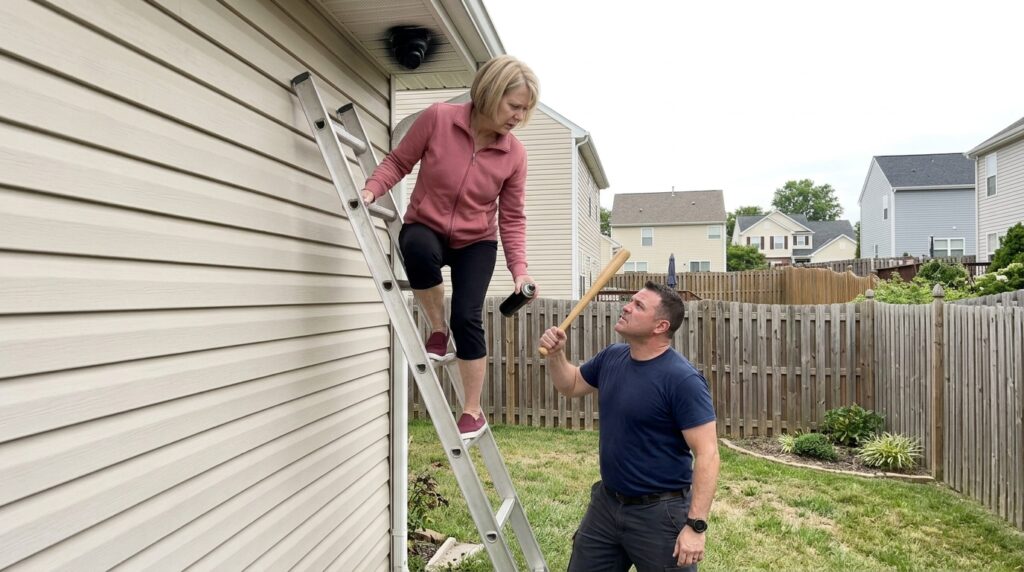
Evelyn’s fingers trembled as she set the aerosol can onto the white hood of the patrol car. The metal tin made a hollow, metallic clatter against the painted steel, rolling two inches until Deputy Miller’s gloved palm caught it. The black nozzle left a tiny, greasy smudged crescent on the police cruiser’s finish.
“Step back over to your driveway, ma’am,” Deputy Miller said, his tone dropping from polite caution to a cold, administrative authority. He pulled a yellow-handled citation book from his rear pocket, the vinyl cover cracked at the hinge. “Do not go back near that ladder, and do not cross this grass line again today.”
“You’re making a mistake, Officer,” Evelyn said, her voice shaking with a dangerous mixture of panic and righteous rage. She didn’t move her feet from Mark’s side of the boundary. “That document—”
“That document was rejected by the county clerk in May of 2009,” Deputy Miller interrupted without looking up from his notepad. “Which means it carries the exact same legal weight as a paper napkin. You crossed onto this man’s deeded parcel, placed an aluminum extension ladder against his dwelling wall, and used aerosol paint to intentionally disable his personal property.”
Mark stood two paces back, his boots anchored beside the narrow dirt trench where his boundary hedge used to grow. The weight of the ash bat in his hand felt less like a weapon now and more like an anchor, grounding him against the rising tension on the driveway. He watched Evelyn’s jaw tighten, the pale skin beneath her eyes blotching red as her neighborly facade dissolved completely.
“I’ve lived on this court for twenty-two years!” she shouted toward the sidewalk crowd, her voice carrying over the low hum of the idling patrol engine. “My husband built that path! We poured the gravel! You think a newcomer with a three-hundred-dollar surveyor map gets to erase twenty years of shared neighborhood usage?”
“I think the county map determines where your taxes stop and his begin, ma’am,” Deputy Miller said flatly. He clicked his ballpoint pen, the sharp sound cutting through her outcry. “Now step back onto your property, or I will cite you for obstructing an official investigation on top of the property damage.”
Instead of stepping back, Evelyn’s eyes darted down to the base of the ladder, where the rubber feet bit into Mark’s turf. “He altered the ground! He dug up Arthur’s boundary markers last month! Look right there at the corner—he buried his own fake pins!”
Mark didn’t wait for the deputy to ask. He stepped toward the ladder’s base, pointing the wooden tip of his bat down at the earth six inches from Evelyn’s burgundy shoe. “The county surveyor didn’t bury fake pins, Evelyn. They drove four-foot rebar stakes into the bed-soil and capped them with yellow plastic tags. The cap is sitting right under that clump of crabgrass.”
Deputy Miller walked past Evelyn, stepping deliberately over the invisible line into Mark’s side yard. He unclipped a small flashlight from his tactical vest and clicked it on, angling the beam down into the roots. The bright LED light caught the reflective yellow rim of the surveyor’s cap buried flush with the soil line, stamped with the official registration number of the licensed county land engineer.
Just two inches beside the yellow cap, half-concealed under a severed oak root, lay an old, rusted iron pipe—the informal marker her late husband had hammered into the dirt fifteen years ago without a official survey, encroaching a full three feet onto Mark’s deeded parcel.
“There’s your husband’s pipe, ma’am,” Deputy Miller said, pointing the beam directly at the rusted iron. “And there’s the legal county boundary. Your husband’s pipe was three feet over the line. Every foot of gravel you poured, every foot of hedge you cut, was done on this property.”
Evelyn stared down at the bright yellow plastic cap gleaming in the flashlight beam. The absolute, unyielding reality of the steel stake buried in the dirt hit her like a physical blow. For the first time since she had climbed the ladder, the furious momentum in her chest seemed to stall.
“Arthur… Arthur said the developer agreed,” she whispered, her voice suddenly sounding thin and brittle in the open morning air.
“The developer draft was rejected,” Mark said softly, keeping his voice steady and devoid of mockery. “Arthur knew it was rejected in 2009. That’s why he never filed the deed amendment.”
Evelyn took a slow, unsteadied step backward, her burgundy shoe finally retreating across the boundary line onto her own concrete walkway. Her hand reached out blindly, gripping the brick corner of her house as if the earth beneath her feet had suddenly tilted.
Deputy Miller clicked off his flashlight and flipped open his citation booklet against his thigh. “Mr. Mark, I’m going to need a formal estimate of the damage to the camera and siding for the report. Ma’am, stay right where you are. I’m issuing a criminal citation for misdemeanor vandalism and criminal trespass.”
Mark looked up at the dark, paint-coated dome under his soffit, then back to the shaken woman standing on her own porch steps. The war over the three-foot strip was over, recorded in ink, carbon paper, and cloud storage—but as Deputy Miller began writing on the yellow pad, the sharp crunch of a second vehicle pulling up to the curb made Mark turn his head.








