
CHAPTER 4: THE CLOUD AND THE COVENANT
The white-and-blue patrol cruiser rolled to a halt against the curb, its tires crunching softly over the dry gravel. Deputy Miller—no relation to Art—swung his boots onto the pavement, his duty belt clinking with a rhythmic metallic weight. He adjusted his flat-brimmed hat, his eyes taking in the scene with the cold, practiced neutrality of a county officer who had answered fifty boundary calls in this township alone.
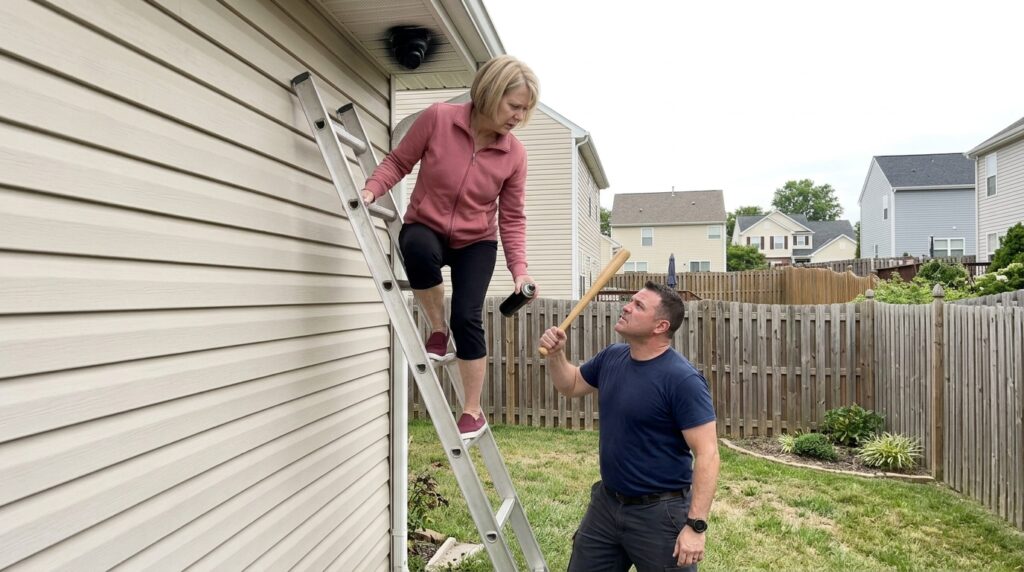
“Morning,” Deputy Miller said, stepping into the space between the driveway and the lawn. He didn’t look at Mark’s wooden bat first. He looked at the aluminum ladder leaning against the siding, the black paint dripping down the gray vinyl, and the spray can still clutched in Evelyn’s hand. “Someone want to tell me why we’re spraying paint on private structures on a Tuesday?”
“Deputy, I am the property representative for the neighborhood association,” Evelyn blurted out instantly, taking three fast steps toward him. She held out the yellowed 2009 document, the edges trembling in her hand. “This man has mounted an illegal surveillance camera inside a shared three-foot utility and foot-traffic easement. I was exercising my right under neighborhood covenants to abate an unlawful invasion of privacy.”
Deputy Miller didn’t reach for the paper immediately. He looked at Mark. “You own the house, sir?”
“I do,” Mark said. He lowered the ash bat entirely now, resting the knob on the turf beside his boot. “The land was surveyed three weeks ago by County Certified Surveyors. The steel pin is right there by her left foot. The camera is mounted entirely on my soffit, four inches inside my lot line.”
“He’s lying!” Evelyn snapped. “Arthur Vance—my late husband—signed this covenant with the developer in 2009! There is a recorded three-foot easement along this foundation!”
“May I see the paper, ma’am?” Deputy Miller asked, his tone dropping into a low, measured monotone.
Evelyn thrust the document forward with a sharp nod of vindication, casting a triumphant glance toward Art Miller and the neighbor across the street. “Read Section 4. It grants explicit access for maintenance, drainage, and utility control. It’s signed by the original owner and stamped with the covenant seal!”
Deputy Miller unfolded the sheet against the warm hood of his cruiser. Mark stepped up to the fender, keeping a two-foot boundary between himself and Evelyn.
“Look at the bottom left corner, Deputy,” Mark said quietly, tapping the glass of his phone. “She’s been showing everyone that paper for six months to justify cutting my hedges and climbing my wall. But look at what’s attached behind the main page.”
Deputy Miller turned the heavy bond paper over. Stapled to the back was a smaller, yellowed grid map, hand-drawn in faded black ink. Running along the bottom border of the diagram, half-obscured by a fold, was a faint, purple-ink stamp that read: DRAUGHT / NOT RECORDED – RETURN TO COUNTY CLERK (REJECTED).
Evelyn’s face drained of color as the officer’s thumb traced the purple ink.
“This isn’t a recorded deed easement, ma’am,” Deputy Miller said, his eyes scanning the faded text. “This is a proposed draft from 2009. The county clerk rejected the filing because the adjacent lot owner—the person who sold to Mr. Mark here—never signed it. It’s an unnotarized draft.”
“No!” Evelyn’s voice shrilled, her fingers clutching at her pink sweatshirt. “Arthur signed it! The developer signed it! That red seal—”
“The red seal is a notary seal from a private bank, ma’am, not a county record stamp,” the deputy interrupted flatly. He looked up from the hood, his gaze shifting to the black paint smeared across Mark’s security camera. “This document gives you zero legal authority to step onto this gentleman’s property, let alone climb a ladder onto his home.”
“He was spying on me!” she yelled, her voice breaking into a harsh, frantic pitch as she pointed a finger at Mark. “He’s got a camera pointed at my window! I have a right to privacy!”
“I don’t need to guess where the camera was pointed, Deputy,” Mark said calmly. He tapped the cloud app on his screen and turned the display toward the officer. “The camera auto-synced the footage to a secure cloud server four seconds before the lens went dark. Watch the timestamp.”
Deputy Miller leaned over the phone. On the crisp, high-definition screen, the video played in real-time: Evelyn’s face filling the frame, her eyes narrowed in anger, her rose-pink sweatshirt clearly visible as she raised the black spray can, aimed the nozzle directly at the lens, and fired a continuous stream of paint until the screen dissolved into pure blackness.
The silence on the driveway was absolute. Art Miller shifted his weight, letting out a low, slow whistle through his teeth.
Deputy Miller looked up from the screen, his face completely unreadable. He turned slowly toward Evelyn, his hand moving to the leather notebook on his duty belt. “Ma’am, set the spray can down on the hood of my car. Right now.”








