The Concrete Line: Where Working-Class Sweat Meets Suburban Overreach in the Dusty Sun

CHAPTER 1: TRAPPED ON THE ROOF

“You put that ladder back right now, Mark, or I swear to God I’m calling the county marshal!”

The voice drifted down from the roofline like grit off an unpaved road—high, strained, and raw with authority that had lost its traction.

Mark didn’t answer. His scuffed work boots stayed planted on the sun-baked concrete of his driveway, five feet from the side wall of his garage. The heavy aluminum extension ladder felt cold and greasy under his bare palms, the frame vibrating slightly as he dragged it another two feet, the bottom feet scraping a jagged grey line across the driveway pad.

He laid it flat along the foundation wall. Out of reach. Dead weight.

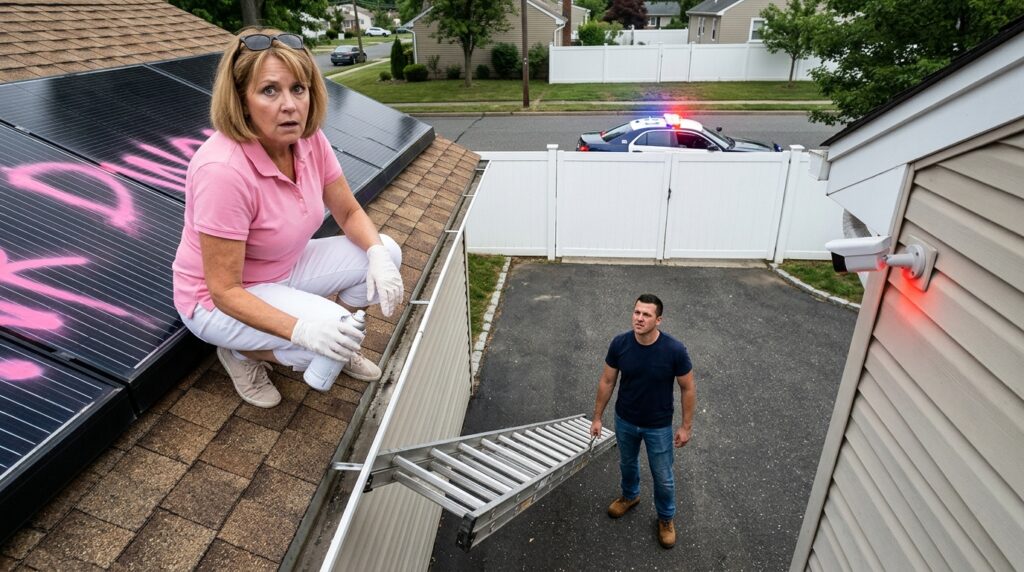
Above him, the asphalt shingles of the lower eave groaned under white latex-soled shoes. Brenda Vance stood crouched near the edge, her stiff blonde bob haloed by the flat, white glare of the two-o’clock sun. Her pink polo shirt was dark with sweat at the armpits, and her white trousers carried a long streak of grey grit across the left knee. In her gloved right hand, she still held a single aerosol can of pink industrial paint, its plastic tip wet with wet foam.

Directly behind her, the glass faces of three brand-new solar panels showed long, crude slashes of bright magenta—hot pink paint running down black photovoltaic glass, pooling in the aluminum drainage tracks Mark had bolted down himself just three weekends ago.

“Mark! I’m talking to you!” Brenda’s voice cracked, her hand shaking as she pointed the paint can down at his forehead. “This isn’t a game! These panels are an unapproved architectural modification! You received three written notices!”

Mark wiped a smear of axle grease from his forearm onto his navy T-shirt. He didn’t raise his voice. He didn’t step closer to the eave. He looked past her shoulder to the small white dome mounted beneath the roof fascia—the blue status LED glowing steady in the harsh daylight, its wide-angle lens pointed directly at her white gloves and the ruined glass.

“Notice didn’t come from the city, Brenda,” Mark said. His tone was flat, heavy with the dust of ten-hour shifts at the machine shop. “City issued the permit. State law says you can’t touch ’em.”

“State law doesn’t run this cul-de-sac!” she hissed, taking a half-step forward before her eyes caught the drop—twelve feet down to hard concrete—and her knees buckled back into a crouch. “Put the ladder back! My ankles are locked up!”

“Stays right where it is.”

“I’ll have you cited for false imprisonment! I’ll have the board foreclose on this lot!”

Mark didn’t argue. He reached into his pocket, pulled out a small black key fob, and pressed the center button twice. High on the garage eave, the surveillance camera emitted a short, dual-tone beep. Across the fence, in the front yard two doors down, a front door clicked open. Old man Henderson stepped out onto his porch, his hand shading his eyes as he looked toward the sound of scraping metal.

Beyond the cedar boundary fence at the end of the driveway, a low red-and-blue light began to flash against the dry leaves of the oak tree. The silent alarm had already hit the township dispatch.

Mark crossed his arms over his chest, his work boots immovable on the hot driveway. “Go ahead and call the marshal, Brenda. Cops are already at the curb.”

Want to continue to Scene 2 and see Brenda’s reaction as the police arrive?

Yes
CHAPTER 2: DEAD WEIGHT ON THE CONCRETE

“Mark! You put that aluminum back against this eave or I swear to God I’ll have the sheriff put you in cuffs before dinner!”

Brenda’s voice didn’t carry the sharp, clipped authority she used at the annual community association meetings. It rattled. Her white latex gloves gripped the edge of the aluminum drip edge so tight the rubber stretched thin over her knuckles, picking up grey oil and grit from the thirty-year-old asphalt shingles. On her knees, two feet from the gutter, she looked smaller, her stiff blonde bob flattened against her forehead by the August humidity.

Mark didn’t raise his eyes from the base of the ladder. He kicked the lower rung with the steel toe of his work boot, making the heavy double-extension frame settle flat against the foundation line, wedged between two concrete cinder blocks and his stack of dry oak firewood.

“Cops are already turning onto the avenue, Brenda,” Mark said. His voice was a flat, low hum, the same voice he used when a spindle on the lathe ran three-thousandths off tolerance and needed to be scrapped. “You’re twelve feet up. Roof’s hot. Paint’s wet. I’d sit real still if I were you.”

“You dragged a ladder out from under a woman on private property!” Her voice hit a high, screeching register that made old man Henderson pause on his porch two doors down. He adjusted his straw hat, leaning over his porch rail to get a clearer view through the gap in the privacy fence. “That’s assault! That’s reckless endangerment!”

“You’re on my deed, Brenda. The city inspector stamped the solar permit last Thursday. It’s taped right inside the side garage window.” Mark gestured with a thumb toward the glass pane six inches from where the ladder had been resting. “Permit’s legal. State statute seven-twelve says no neighborhood board can block residential clean energy upgrades.”

“That statute doesn’t apply to historic overlay zones!” She shifted her weight, the rubber soles of her white sneakers squeaking against the hot granules of the shingles. The white aerosol can in her hand gave a soft, metallic rattle as her fingers twitched around the cap. Fresh pink foam bubbled from the tip, dripping once, twice, onto the dark tempered glass of the middle panel. “We passed the amendment in ’98! No glass reflective surfaces visible from the public thoroughfare!”

Mark crossed his arms. The heat off the driveway asphalt was rising through the soles of his boots, baking the denim of his jeans. “This street wasn’t platted until 2002, Brenda. There was no ’98 amendment for this section.”

Brenda’s mouth opened, then snapped shut like a spring-loaded latch. For a fraction of a second, her eyes darted toward the side of the house—not toward the street where the red-and-blue strobe lights were now painting the dry leaves of the oak tree, but down toward the electric meter box mounted beside the garage side door.

Mark caught the look. He didn’t move toward the meter, but his mind flagged the quick, guilty tilt of her chin.

Beside the grey metal meter enclosure, tucked deep into the narrow gap where the conduit pipe met the cedar siding, a folded strip of yellow carbon paper stuck out an inch into the sunlight. It wasn’t the standard white city inspection card. It was old, yellowed at the edges, folded four times into a tight square.

“I have the authority,” Brenda stammered, her voice dropping a full octave as the low, heavy rumble of a Ford Crown Victoria engine slowed at the mouth of his driveway. The tires crunched over the loose gravel near the curb. “The board signed the order yesterday. We have a mandate to protect property values on this block. Do you have any idea what these… these industrial monstrosities do to the appraisal floor?”

“Appraisal floor?” Mark let out a short, dry sound that wasn’t quite a laugh. “My property tax went up six hundred bucks last spring because you voted to widen the drainage ditch behind your lot. My panels cut my electric bill eighty percent. That’s math, Brenda. Not appraisal talk.”

The police cruiser stopped ten feet short of the driveway apron, its engine idling with a deep, mechanical thud. Through the windshield, Officer Miller—a guy Mark knew from the local hardware store’s Saturday morning contractor counter—looked up through the driver’s side glass, his brow furrowed as he took in the scene.

The black photovoltaic array slashed with neon pink.

The white-gloved woman crouched on the roof edge with an aerosol can.

The heavy extension ladder laid flat on the concrete out of reach.

And Mark, standing in his navy work shirt, arms folded, unmoving as a fence post.

Officer Miller killed the siren, cut the engine, and opened his door. The heavy latch clicked in the silent driveway.

“Mark,” Miller called out, resting one hand on the frame of his open door, his eyes scanning the eave. “Looks like you got a bird stuck up on your roof.”

“Not a bird, Miller,” Mark said, not taking his eyes off Brenda. “Just an unapproved inspector.”

Brenda leaned forward over the gutter, her face flushed red under her oversized sunglasses. “Officer! Officer, arrest this man immediately! He trapped me up here! He pulled the ladder away while I was performing official community maintenance!”

Miller stepped out into the dust of the driveway, his boots crunching on the gravel. He didn’t draw his belt, but he didn’t smile either. He looked at the ladder flat against the woodpile, then up at the glowing blue eye of Mark’s security camera on the fascia.

“Official maintenance with a can of pink Krylon, Brenda?” Miller asked softly, pulling his notebook from his breast pocket. “You want to tell me how that works before I call the ladder truck?”

CHAPTER 3: THE GLASS AND THE CAMERA

“Official maintenance?” Officer Miller walked past the front bumper of his cruiser, his heavy leather duty belt creaking against the starched polyester of his uniform. He stopped at the edge of the concrete pad, taking in the full arc of the damage—the bright pink Krylon enamel drying into tacky, plastic skin across four hundred square feet of black solar glass. “Brenda, I’ve lived in this county forty-two years. I haven’t seen the HOA board do emergency maintenance on a man’s roof since the eighty-nine hail storm, and even then they didn’t bring spray paint.”

“He altered the architectural footprint without prior committee review!” Brenda’s voice cracked higher, her white-gloved hand tightening so hard around the aerosol can that the thin metal rim creaked. “The color code for roof-mounted fixtures in Sector Four is dark bronze or matte charcoal! Look at those frames! They’re anodized silver!”

“They’re standard aluminum, Brenda,” Mark said, his tone low and unhurried. He didn’t shift his stance. His boots stayed planted three inches from the garage wall, keeping his body positioned squarely between the roofline and the flattened ladder on the woodpile. “Factory anodized. Grounded to county electrical code. The city building inspector passed the bonding wire two hours after the racking was bolted down.”

“City code doesn’t override restrictive covenants!” Brenda leaned forward over the gutter, her white pants smearing fresh grey grit off the asphalt shingles. “Officer, tell him! Tell him he has to put the ladder back! My blood pressure is spiking! If I faint up here and fall, his insurance won’t cover a dime—I’ll sue his estate into probate!”

Miller didn’t reach for the ladder. Instead, he pulled a small black digital camera from his utility belt, flicked the lens cover open, and aimed it straight up at the eave. The shutter clicked three times in rapid succession—the sharp, artificial sound cutting through the humid afternoon silence.

“You’re not falling, Brenda. Not unless you keep bouncing around on those fifteen-year-old architectural shingles,” Miller said, taking two steps toward the side of the garage to get a wider angle on the roof. “And far as the ladder goes, Mark didn’t push you up there. You brought it, set it on his private driveway, and climbed it without a permit or a warrant. That makes it a tool of trespass.”

“Trespass?” Brenda gasped, her oversized sunglasses sliding down the bridge of her nose. Behind the tinted plastic, her eyes were bloodshot, surrounded by deep, dark circles that her foundation couldn’t quite mask. “I am the vice president of the Oakridge Estates Property Owners Association! I have an easement right!”

“Utility easement extends five feet from the curb line,” Mark said, pointing a grease-stained finger toward the green transformer box sitting near the sidewalk. “You’re twenty-two feet inside my boundary line, standing on my rafters.”

Miller unclipped a small microphone from his shoulder, pressed the talk button, and spoke in a low, even cadence. “Dispatch, this is Unit Four. I’m on scene at 1412 Elmwood. Requesting a ladder unit from Township Fire Station Two for a non-injury removal at roof height. Also notify Code Enforcement—got a willful criminal mischief in progress involving property damage over fifteen hundred dollars.”

“Criminal mischief?” Brenda’s voice lost its sharp edge, dropping into a panicked, breathy squeak. “Miller! Bob Miller! I’ve known your mother for thirty years! We were on the library committee together!”

“And my mother pays her property taxes and doesn’t climb onto her neighbor’s roof with a can of paint, Brenda,” Miller replied, his pen moving smoothly across the yellow grid of his field notepad. He didn’t look up from his writing. “You’re over the state felony threshold for malicious destruction of property the second that paint hit the tempered glass. Those panels aren’t cheap.”

“Nine hundred apiece,” Mark added quietly. “Four panels impacted. Plus labor, mounting rails, and re-wiring if the solvent ate through the junction seals on the backboards.”

Brenda’s jaw worked silently. Her eyes flicked frantically from Miller’s pen down to Mark’s face, then landed once more on the side wall of the garage—specifically on the electric meter box where the faded yellow strip of carbon paper remained wedged behind the conduit. Her knee twitched, a nervous, involuntary jerk that sent a small shower of loose roof granules skittering down the incline and splashing into the plastic gutter.

Mark caught the movement. While Miller stepped back toward the cruiser to talk to the fire dispatch, Mark took a slow, deliberate step toward the side door of the garage, as if adjusting his posture. His eyes narrowed on the yellow paper.

It wasn’t a standard city notice. The paper was dry, brittle, and faded to the color of old straw, but he could clearly see three red stamp marks on the exposed edge: SUB-COMMITTEE ACTION, followed by a handwritten date that looked like OCT 14 1998, and a bold, black signature in the bottom corner that matched the looping handwriting on the handwritten notes Brenda had been dropping in his mailbox for the past two weeks.

A 1998 sub-committee notice. Placed on a house that wasn’t built until four years later.

Mark’s mind began calculating the mechanical line of it. Brenda hadn’t just come here in a sudden burst of self-righteous neighborhood anger over solar panels. She had brought a pre-dated, long-repealed charter clause, printed on obsolete multi-part carbon forms, and hidden it behind his own electric meter before climbing his roof. She was creating a paper trail—a fake record of long-term non-compliance.

“Miller,” Mark called out softly, not taking his eyes off the yellow paper.

The officer looked over from the driver’s door of his car. “Yeah, Mark?”

“When the fire truck gets here, tell ’em to park in the street. I want Code Enforcement to take a real close look at my meter base before anybody touches this side of the house.”

Brenda’s head snapped toward Mark, her face draining of what little color remained under her tan. “That’s private board correspondence!” she yelled, her voice trembling now with genuine, unscripted fear. “You have no right to tamper with association records!”

“It’s on my meter base, Brenda,” Mark said, his voice dropping into that cold, unyielding register that meant the lathe was set and the cut was already under way. “And anything attached to my house belongs to the investigation now.”

CHAPTER 4: THE WITNESSES AT THE CURB

The low, hydraulic groan of air brakes vibrated through the soles of Mark’s boots before the engine even turned the corner.

Station Two’s pumper truck rounded the bend of Elmwood Avenue, its yellow enamel cab glinting through the heat shimmer rising off the asphalt. It rolled to a heavy crawl behind Officer Miller’s cruiser, its diesel idle chugging like a freight train idling on a siding. Behind it, two more cars slowed along the curb—a silver minivan driven by Sarah Jenkins from number 1408, and a rusted pickup with a mower trailer belonging to the lawn crew Brenda had hired three weeks ago to measure fence heights.

The quiet of the cul-de-sac collapsed into the raw friction of public exposure.

On the front lawn across the street, old man Henderson stepped down off his porch, his wooden cane thumping against the sun-baked turf. He didn’t cross the property line, but he didn’t stay back either. He stood right at his mailbox, leaning his elbows on the cedar post, his faded eyes locked on Brenda’s crouching form twelve feet up on the roof edge.

“Mark!” Sarah called out through her open minivan window, her phone held shoulder-high, the black glass screen reflecting the noon glare. “Is she… is she spray-painting your solar array?”

Mark didn’t look back at the street. His gaze remained pinned to the roofline, his boots firmly gripping the driveway concrete. “Ask her, Sarah. She brought the Krylon.”

Brenda shrank back three inches, her knees digging into the hot asphalt shingles. The oversized sunglasses slipped lower down her nose, revealing pale, wet skin around her eyes. She gripped the aerosol spray can against her pink polo shirt, trying to slide it behind her back, but the bright pink paint wet on her white latex gloves smeared across her midsection, leaving a stark, bloody-looking drag mark across the fabric.

“Don’t you record me, Sarah!” Brenda shrieked, her voice cracking against the rumble of the fire truck’s idling diesel. “I am conducting an official architectural inspection under authority of the executive board! Turn that camera off!”

“You’re on my property, Brenda,” Sarah called back, her thumb clicking the record button. Her voice carried the tight, built-up venom of three years’ worth of fifty-dollar fines for trash cans left out two hours past sunset. “And you’re standing on Mark’s roof in white gloves like a burglar! What executive board? The annual meeting isn’t until November!”

Officer Miller stepped back toward the middle of the driveway, waving his hand to direct the engine to hold its position near the hydrant. The driver, a thick-necked lieutenant named Davis, leaned out his cab window, taking in the scene with a slow, disbelieving shake of his head.

“Unit Four,” Davis shouted down over the diesel thrum. “You need a basket, or can we just pitch a ten-foot folding ladder against the fascia?”

“Don’t pitch anything against my gutters, Davis,” Mark said, his voice cutting clean and flat through the noise. “She brought her own extension ladder. It’s lying right there by the woodpile. She can use her own gear when she comes down into cuffs.”

“Cuffs?” Brenda’s head snapped toward Lieutenant Davis, her chin quivering. “Lieutenant! Tell them! I am the vice president! I have administrative immunity for code enforcement!”

Davis snorted, pulling his sunglasses down to his neck. “Brenda, the fire department doesn’t enforce HOA rules, and we don’t rescue people who climb onto private roofs to do graffiti. You want down, you talk to Miller.”

Miller didn’t engage in the shouting. He pulled a yellow roll of heavy plastic crime scene tape from his trunk, tied one end to the wooden fence post by Mark’s driveway apron, and walked the bright yellow band across the concrete to the corner of the garage.

The tape snapped tight in the hot breeze—POLICE LINE DO NOT CROSS—barricading Brenda’s ladder, Mark’s electric meter, and the base of the garage wall inside a formal perimeter.

A collective murmur drifted over from the curb. Three more neighbors had gathered near Henderson’s mailbox—the young couple from 1416 who Brenda had cited for having a toddler’s plastic sandbox in their fenced backyard, and the retired mechanic from the corner lot whose vintage truck had been fined as an ‘unlicensed visual nuisance.’ They didn’t shout. They just stood shoulder-to-shoulder in the heat, watching the white-gloved enforcer of Oakridge Estates sweat on an open roof in front of an active police tape.

Brenda looked at the yellow tape, then down at Miller’s steady, unblinking glare. Her shoulders slumped. The arrogant, upright posture that had dominated every neighborhood assembly for a decade seemed to deflate, leaving her looking small, frail, and utterly stranded under the brutal August sun.

“Mark,” she whispered, her voice dropping into a desperate, hollow rasp that barely reached the driveway. “Please. Just put the ladder up. My knees are going out. We can talk about the panels in private.”

Mark took half a step forward, his work boots stopping precisely one inch short of the yellow police tape. He didn’t look at her face; he looked at the wet pink streaks drying into a rubbery ruin over four thousand dollars’ worth of clean-energy glass.

“We’re not talking in private anymore, Brenda,” Mark said softly. “The whole block is watching.”

CHAPTER 5: THE PAPER TRAIL IN THE CONDUIT

Officer Miller crouched by the grey metal casing of the electric meter, his heavy leather duty belt creaking as he rested his forearms on his knees. He didn’t touch the yellow paper immediately. He pulled a fresh pair of blue nitrile gloves from his tactical pocket, snapping them over his fingers with a sharp, rubbery sound that carried up toward the lower roof.

Above them, Brenda shifted her posture again, her sneakers squeaking against the grit. Her face was slick with sweat, her oversized sunglasses dangling by one earpiece from her left ear. “Miller, don’t you touch that! That is board property! It’s an administrative record!”

“It’s stuffed behind a residential utility box inside a marked crime scene, Brenda,” Miller said without looking up. He reached out with two gloved fingers, pinching the exposed corner of the yellow document.

Mark stepped closer, his heavy work boots stopping two inches from the yellow police tape. The afternoon heat radiating off the garage siding smelled of hot cedar and dry dust. “She put it there right before she set up the ladder, Miller. I saw her hand come back from that corner when I walked out of the garage.”

Miller pulled slowly. The paper gave a stiff, dry rasp as it slid out from the narrow gap between the galvanized steel conduit and the cedar boards. It wasn’t just a single sheet. It was a four-part carbon document, faded to the color of corn husks, stiffened by age and heat.

Miller unfolded it on his knee. The top banner was stamped in dark blue ink: OAKRIDGE ESTATES ARCHITECTURAL REVIEW BOARD – SPECIAL ENFORCEMENT NOTICE.

“Look at the date line,” Mark said, leaning over the tape. His eye caught the dark, typewriter-pressed numerals. “Look at the year.”

Miller ran a blue-gloved thumb along the top margin. “October 14, 1998. Provision 4-B: Mandatory Removal Order for Non-Compliant Exterior Reflective Structures.” Miller paused, his eyes flicking up to the electric meter, then to the house itself. “Mark, when did you say this lot was surveyed?”

“Platted in 2001. Foundation was poured in March of 2002,” Mark said, his voice dropping into a low, hard rasp. “This house didn’t exist in ninety-eight. This whole subdivision was still an oak grove owned by the county rail authority.”

“That’s a master charter clause!” Brenda shouted down, her voice thin and ragged, vibrating with a panic that was no longer about the twelve-foot drop to the driveway. “The 1998 charter covers the entire regional tract! It carried over when the developer bought the parcel!”

“No, it didn’t,” Miller said softly. He turned the document over. On the back of the third carbon page, stamped in faint red ink that had faded to rust, was a municipal seal: REPEALED – TOWNSHIP ORDINANCE 402-A – JANUARY 2004.

Mark felt a cold, sharp focus settle behind his ribs. The math of the situation wasn’t just about an entitled neighbor throwing a fit over glass panels on a roofline. It was a calculated, pre-printed paper setup. Brenda hadn’t pulled a random notice out of her house this morning. She had gone into an old archive, pulled a voided, twenty-eight-year-old carbon form that had been legally dead for over two decades, signed her own name at the bottom under ACTIVE ENFORCEMENT OFFICER, and wedged it into his meter box before climbing the roof with a spray can.

She was intentionally creating a legal record of long-term non-compliance—a paper trail designed to make it look like Mark had ignored decades of board notices.

“Why?” Mark asked, looking up directly into Brenda’s eyes.

Brenda pulled her knees in tight against her chest, her pink polo shirt ruined with bright pink paint smears across her stomach. She didn’t answer. She turned her head away, staring out toward the curb where Sarah Jenkins and old man Henderson were watching every movement through the lens of a smartphone camera.

“If an HOA places three consecutive uncorrected structural violation notices on a property deed in this township,” Miller read slowly from the notes at the bottom of the form, “the board gains the right to file an automatic lien for architectural remediation… and attach daily compound fines to the property tax assessment.”

Mark looked at the yellow paper in Miller’s hand, then back up at the roof. “A lien. She wasn’t trying to make me take the panels down. She was trying to build a foreclosure file.”

Miller carefully folded the carbon form along its original creases, slipped it into a clear plastic evidence bag, and sealed the top with a strip of red tape. He stood up, his face grim as he looked up at the lower eave.

“Brenda,” Miller said, his tone no longer that of a friendly neighborhood officer, but of an arresting deputy laying down a federal chain of custody. “Code Enforcement is turning onto the street right behind the fire truck. When you come down off that roof, you’re not going home to write fines. You’re coming to the station for fraud, forgery, and felony property destruction.”

Brenda’s mouth opened, but no sound came out. The aerosol can slipped from her limp, white-gloved fingers. It hit the asphalt shingles with a dull thud, rolled down the five-foot slope, and plunged off the edge, crashing onto the concrete driveway right at Mark’s boots with a sharp, metallic ring.

A single drop of bright pink paint splattered across the toe of Mark’s work boot. He didn’t step back. He stood his ground, watching the fire truck’s heavy folding ladder begin to uncoil over the fence.

CHAPTER 6: THE DESCENT AND THE STEEL

The heavy aluminum rungs of Station Two’s folding ladder hit the fascia board with a hollow, metallic thud that shook a shower of dried pine needles from the gutter.

Lieutenant Davis guided the ladder tip until the rubber bumpers locked against the drip edge, three feet to the left of the ruined solar panels. “Step down slow, Brenda,” Davis called up from the driveway, his boots planted wide on the concrete. “One rung at a time. Keep your hands on the rails, not on the rungs.”

Brenda didn’t move for three long seconds. Her face had gone the grey-white color of dry lime. The white latex gloves on her hands were torn at the palms, stained with black roof grit and hot pink paint. When she finally shifted, her right knee buckled slightly, her sneaker dragging across the shingles with a dry, scraping rasp before finding the top aluminum rung.

Down on the concrete, Officer Miller waited beside the yellow police tape. He didn’t offer a hand as her feet touched the driveway pad, but he stepped directly behind her, cutting off any path toward her SUV parked two doors down.

At the curb, a dozen phones recorded the moment. Sarah Jenkins had stepped off the grass and onto the asphalt apron, her camera held steady. Old man Henderson didn’t say a word, but his wooden cane tapped a slow, steady rhythm against the curb post as Brenda reached the ground.

“Turn around, Brenda,” Miller said softly. The tone wasn’t harsh, but it carried the weight of an iron latch dropping into a groove.

“Miller… please,” Brenda whispered, her voice barely carrying over the slow chug of the pumper truck’s diesel engine. Her oversized sunglasses hung askew from her left ear, revealing the red, puffy skin around her eyes. “My wrist joints… I have arthritis. We can do this in the back of your car without the…”

“Hands behind your back,” Miller repeated, pulling a pair of polished steel handcuffs from his utility belt. The ratcheting mechanism gave two short, sharp clicks as he adjusted the loops.

Brenda’s shoulders caved. She turned slowly, her white pants smeared with grey roof dust across the knees and butt, the back of her pink polo shirt soaked through with dark sweat. Miller brought her wrists together, the steel cuffs clicking shut with a dry, definitive metallic snap.

As Miller guided her toward the rear door of the Crown Victoria, her leather clip portfolio—the one she had jammed between her arm and torso while climbing down—slipped out from under her armpit. It hit the concrete driveway, popping open its brass latch.

A sheaf of white and yellow papers fan-folded across the hot asphalt, right at Mark’s boots.

Mark didn’t cross the yellow line, but he squatted down, his work boots flexing as his eyes scanned the top page that had slid face-up onto the concrete.

It wasn’t an HOA charter page. It wasn’t a city ordinance or a meeting agenda.

It was a formal Notice of Pre-Foreclosure Sale from a regional mortgage servicing office, addressed directly to Brenda Vance at 1404 Elmwood Avenue. Attached to the back was a letter on thick bond paper bearing a corporate letterhead: APEX HORIZON ACQUISITIONS LLC. The opening paragraph offered a fifteen percent finder’s fee for any contiguous suburban parcels placed under active municipal or HOA encumbrance prior to auction.

Mark’s chest tightened. The decoy secret—the idea that Brenda was just an arrogant neighborhood dictator enforcing a dead 1998 rule to assert power—shattered in an instant.

The 1998 form behind his meter hadn’t been about neighborhood pride or architectural control. It was a tool. If she could attach enough illegal fines and liens to Mark’s property deed, it would trigger a default clause on his mortgage, driving his property into distressed acquisition right alongside her own failing estate.

Mark stood up slowly, the sun beating hot against the back of his neck. He looked past Officer Miller, past the flashing red-and-blue lights, straight at Brenda as Miller opened the rear car door for her.

“It wasn’t about the solar panels at all, was it, Brenda?” Mark asked, his voice low, hard, and quiet. “You’re broke. And you were trying to drag my house down with yours.”

Brenda didn’t look back. She ducked her head, her blonde bob falling forward to hide her face, and slid into the back seat of the cruiser as Miller closed the heavy door with a solid, echoing thud.

CHAPTER 7: THE ARCHIVE IN THE MUNICIPAL BASEMENT

The heavy rear door of the Crown Victoria clicked shut, the sound muffled by the thick rubber seals, before Officer Miller’s cruiser backed down the driveway and turned onto Elmwood. The flashing red-and-blue strobe lights faded off the dry oak leaves, leaving the suburban cul-de-sac in a strange, ringing silence.

Mark didn’t linger on the concrete. He carefully gathered the scattered papers from Brenda’s fallen leather portfolio, placing them flat inside his own steel clipboard box. He locked his garage side door, pulled his truck out into the street, and drove straight down to the Township Municipal Building on 5th Street.

An hour later, Mark sat across from Thomas Vance—no relation to Brenda, though the shared surname had caused two decades of bureaucratic confusion—the head of the Regional Building and Code Enforcement Division.

The basement room smelled of stale filter coffee, ozone from an old laser printer, and fifty years of acid-free paper stored in metal filing cabinets.

“She used the 1998 form because she knew our digital database only goes back to 2002,” Vance said, turning a blue-gloved finger over the yellow carbon copy Miller had surrendered to evidence. “This specific form—Form 4-B—was rendered completely void when the county reorganized the utility easements twenty-two years ago. It has zero legal standing.”

Mark leaned forward, his heavy forearms resting on his knees. “She didn’t care about legal standing in court, Thomas. She cared about timing.”

“Explain,” Vance said, adjusting his reading glasses.

Mark pulled the second set of documents from his steel box—the bond paper sheets bearing the embossed logo of APEX HORIZON ACQUISITIONS LLC that had fallen out of Brenda’s portfolio on his driveway. He laid them side-by-side with his city building permits.

“Look at paragraph three,” Mark pointed with a calloused index finger. “Apex Horizon wasn’t just offering a finder’s fee for encumbered lots. Brenda’s nephew is a junior partner at Apex. She defaulted on her mortgage in February. Her home goes to sheriff’s sale in ninety days.”

Vance’s eyebrows pulled together as he scanned the text. “She was trying to trigger a bulk acquisition.”

“She needed three adjacent properties flagged with active, uncorrected structural liens,” Mark said, his voice dropping into a hard, measured rhythm. “If she could place three liens under the old ’98 charter rules, Apex Horizon had a contractual right to buy the debt bundles from the servicing bank at a forty percent discount. They’d wipe her mortgage clean as a finder’s fee, force me and Henderson out through foreclosure, and rezone the three contiguous lots for high-density townhouses.”

Vance sat back in his swivel chair, the leather creaking under his weight. He looked at the heavy brass corporate seal stamped on the bottom of the Apex agreement, then at the bright pink paint splatter still clinging to the toe of Mark’s work boot.

“This isn’t an HOA dispute,” Vance said softly. “This is mail fraud, falsification of municipal records, and predatory real estate racketeering.”

“And property destruction,” Mark added. “Four panels at nine hundred dollars each, plus the labor to tear out the damaged mounting rails.”

Vance picked up a red rubber stamp from his desk inkpad, brought it down on the top of Mark’s file with a sharp, echoing THUMP, and slid the folder into a heavy red hanging jacket labeled PROSECUTORIAL REFERRAL.

“Code Enforcement is freezing every notice Brenda Vance ever issued in Oakridge Estates,” Vance declared, looking Mark dead in the eye. “Every fine, every lien warning, every architectural citation going back five years is being audited by the county prosecutor’s office starting at eight o’clock tomorrow morning.”

Mark stood up, his joints popping slightly in the cool basement air. He picked up his steel clipboard. The weight in his chest—the anger that had burned since he caught the first glimpse of pink aerosol spraying over his hard-earned investment—had settled into something cold, steady, and clean.

“Tell the prosecutor I’ve got four thousand dollars in clean-energy receipts waiting for his restitution order,” Mark said, turning toward the door. “And tell him my camera recorded every second of it in 4K.”

CHAPTER 8: THE LINE ON ELMWOOD AVENUE

The late afternoon sun dipped behind the treeline at the edge of the cul-de-sac, casting long, cool shadows across the concrete driveway. The air had lost its suffocating humidity, replaced by a dry, evening breeze that smelled faintly of cut grass and warm asphalt.

Mark stood on the side pad near his garage door, his work boots planted near the wooden sawhorses he’d set up an hour ago. On the horses rested the first replacement panel—sleek, jet-black tempered glass held in a heavy anodized aluminum frame, unblemished by paint or grit. Beside it sat a tube of outdoor silicone sealant, a caulking gun, and his socket wrench set.

The street was quiet now. The fire truck and police cruisers were long gone, leaving only the dark tire marks on the gravel near the apron to mark where Brenda Vance’s authority had collapsed.

A soft crunch of gravel made Mark turn his head.

Old man Henderson walked slowly down the edge of the asphalt, his wooden cane clicking rhythmically against the driveway curb. He stopped three feet short of the concrete, leaning both hands on the curved handle of his stick as his faded blue eyes looked up at the roofline.

“Installer coming back out to help you rack ’em, Mark?” Henderson asked, his voice a dry, gravelly rasp.

“Doing it myself,” Mark said, wiping his thumb across the clean glass frame. “Racking’s simple once the wiring harness is pinned. County inspector’s coming back Friday morning just to sign off on the replacement serial numbers.”

Henderson nodded slowly, his eyes shifting down to the electric meter box where the faded yellow paper had been pulled hours ago. “Sarah says the county prosecutor froze all the HOA fines across the whole subdivision. Said they’re reviewing three years of records.”

“Five years,” Mark corrected softly. “Thomas Vance at Code Enforcement is running every violation notice Brenda ever wrote through the fraud division.”

“Five years,” Henderson repeated, letting out a short, breathy exhale that sounded like a quiet laugh. He adjusted his grip on his cane, looking down the street toward Brenda’s house—the shutters closed, the driveway empty, a single yellow county notice taped across the front screen door. “She made my wife cry over a potted fern on the porch three winters ago, Mark. Said it was a fire hazard. We paid a hundred and fifty bucks just to keep the peace.”

“You won’t be paying it back,” Mark said, turning a bolt in the aluminum mounting bracket with his fingers until it caught the thread. “She’s got a public defender now, and Apex Horizon dropped her contract the second Miller filed the police report.”

Henderson stood silent for a long moment, watching Mark work. The sun sank lower, painting the black glass of the solar panels in long streaks of deep indigo and gold—clean, reflective, and unbroken.

“You’re a hard man, Mark,” Henderson said softly, though there was no edge in his voice. “Most folks would’ve screamed. Or pushed that ladder down.”

“Pushing the ladder gets you charged with assault, Henderson,” Mark said, picking up his wrench and setting the socket over the head of the bolt. He tightened it until the steel gave a single, solid CLICK. “Taking the ladder away just leaves her where she put herself.”

Henderson smiled, a slow, creased folding of his weathered skin, and took two steps back toward his lawn. “Suppose that’s right. Evening, Mark.”

“Evening, Henderson.”

Mark watched the old man walk back toward his porch before turning back to his work. He lifted the heavy glass panel off the sawhorses, carrying it steadily in both hands as he walked toward the garage side wall. The metal frame felt solid, cool, and permanent against his palms.

He looked down at the concrete driveway—at the clean grey surface where the ladder had been dragged, where the line had been drawn, and where the cul-de-sac had finally found its peace.

Similar Posts

Leave a Reply

Your email address will not be published. Required fields are marked *