The Weight of a Single Line: How an Old Mechanic and a Supermarket Standoff Tested the Limits of Small-Town Order
CHAPTER 1: The Weight of Steel and Pastel
The fluorescent lights at Greenfields Market hummed with a dry, persistent frequency that Arthur Hayes had learned to tune out thirty years ago on factory floors. To him, the store was simply a coordinate on a weekly map—get the eggs, get the sourdough, get back to the gravel silence before the afternoon wind came down off the ridge. His hands, deep in the pockets of his canvas jacket, still carried the faint, ingrained blue of old diesel stains beneath the thumbnails. He stood at register four, his wire basket resting quietly on the worn rubber belt, waiting for the register to clear.
Then came the scuff of leather heels against linoleum, sharp and rhythmically forced, like a drill instructor measuring cadence on a parade ground.
A heavy cart loaded with artisanal cheese wheels and oversized boxes of organic flour nudged hard against his right hip. Arthur did not turn his head immediately. He felt the dull press of wire against canvas, felt the deliberate intrusion of space that belonged to no one but the person standing inside it.
“Excuse me,” Brenda Vance said. Her voice carried the bright, artificial resonance of a woman accustomed to speaking into committee microphones without amplification. “Some of us have actual responsibilities to coordinate for the community hall in twenty minutes. If you could slide that basket down to the express lane on the far side, it would save everyone a great deal of unnecessary friction.”
Arthur turned his head slowly through the thick lenses of his spectacles. Brenda stood framed in pastel coral, her blazer stiff with starch, her chin lifted at an angle that assumed compliance was a natural law of the municipality. Her fingers gripped a clipboard handle as if it were a field marshal’s baton.
“The express lane is twelve items or fewer, ma’am,” Arthur said. His voice was a low, gravel-lined scrape that barely rose above the hum of the dairy coolers. “This is register four. My turn is next.”
Brenda’s smile did not reach her sunglasses. It tightened into a porcelain line, brittle and defensive. “I am well aware of what register this is. However, our volunteer coalition has a standing priority arrangement with store management for Wednesday staging. Surely a local resident wouldn’t want to hold up youth athletics over a loaf of bread.”
“I’m not holding up anything,” Arthur said, his posture settling another fraction of an inch into the concrete floor. “I’m standing in line.”
The cashier, a young man with a name tag askew and eyes fixed firmly on the belt mechanism, swallowed hard and tapped his screen, pretending the air between them was entirely transparent. Brenda raised her register voice half an octave, ensuring the shoppers browsing the magazine racks thirty feet away caught the frequency.
“It is this exact kind of stubborn disregard for collective harmony that makes town errands so exhausting,” she announced to the open aisle. “Some of us actually contribute to this community instead of just taking up space.”
A murmur drifted from register five. A woman in a matching volunteer visor offered a sharp, sympathetic head-shake toward Brenda’s cart, while two college students near the display tables drifted closer, hands sliding into their pockets to ready their phones. The air in the aisle grew heavy with the specific, metallic taste of public theater. Brenda reached out with a manicured nail and tapped twice against the wire rim of Arthur’s basket.
“Just move it down one slot, sir,” she whispered, her tone dropping into a poisonous intimacy. “It isn’t difficult to be a neighbor.”
Arthur did not move his basket. He kept his hands in his pockets, feeling the solid weight of his truck keys against his thigh. He looked past Brenda’s shoulder toward the service desk, where Maya Lin was currently leaning over a stack of manifest forms, her expression flat and observant.
“My basket stays right where it is,” Arthur said quietly. “If you’ve got business with the manager about lane scheduling, I suggest you take it to the office instead of leaning on my groceries.”
Brenda’s face flushed a mottled, angry pink, the color rising straight from her starched collar. “I am documenting this obstruction right now,” she snapped, whipping her phone from her pocket and raising the lens. “Let’s see how cooperative you feel when the merchant association hears about this kind of aggressive behavior in a family market.”
Arthur watched the glass of the phone lens catch the harsh overhead glare, wondering silently what kind of man spent his life trying to manage other people’s grocery carts, and what secret erosion made them need it so badly.

CHAPTER 2: The Plat Beneath the Clipboard
The flash of the phone screen was a sharp, digital prick in the flat fluorescent glare of register four. Arthur didn’t blink. He watched the red indicator light pulse once, twice, recording his silence like a ledger entry waiting to be audited. Behind Brenda Vance, the young cashier looked down at his belt mechanism as if hoping the conveyor would simply open up and swallow the entire register bay.
“You’re making a record of the wrong thing, missus,” Arthur said. His voice was a slow, flat scrape of gravel, untouched by the panic Brenda clearly expected to extract.
Brenda lowered the phone four inches, her hand trembling slightly with the tight, coiled energy of a woman whose authority had never been publicly questioned by someone wearing a grease-stained jacket. Her nostrils flared, catching the scent of the cool air drifting from the dairy bunkers twenty feet away. “This isn’t a record, Mr. Hayes. This is accountability. When the association reviews the commercial easement access logs next Tuesday, they’ll see exactly who chose to obstruct community infrastructure.”
Arthur shifted his weight half an inch. Underneath his thumb in the pocket of his canvas jacket, his truck key felt cold and heavy against his thigh. He caught a flash of white paper wedged into the pocket of Brenda’s starched clipboard—not a grocery list, not a bake sale roster, but a folded municipal plat diagram with red ink notation circling the western border of Lot 91. The same western border where his uncle’s old logging road met the county right-of-way.
“Easement’s four miles north past the old mill,” Arthur said evenly. “You’re standing on aisle four.”
“For now,” Brenda snapped, her composure fracturing at the edges into sharp, glassy splinters. She turned her back abruptly, her pastel blazer stiffening as she yanked her heavy cart away from the conveyor with a screech of rubber wheels against linoleum, abandoning her artisanal cheeses and organic flour right where they sat. She didn’t march toward the exit; instead, she veered toward the customer service counter where Maya Lin was still sorting manifest forms, her voice rising immediately in a high, carrying pitch. “Maya! I want this individual’s vehicle license number logged for corporate review. He is operating an unpermitted blockade on common access paths.”
Maya didn’t look up from her papers right away. She finished writing a line, capped her pen with a crisp click, and finally raised her eyes. The silence in the aisle had shifted from rubbernecking curiosity to a heavy, waiting stillness. Shoppers in adjacent lines lowered their bags, their attention hooked by the raw friction of an institutional bully losing her grip on the room.
Arthur reached out, lifted his carton of eggs and his single loaf of sourdough, and placed them into his wire basket. He didn’t rush. Every movement was economic, stripped of wasted motion, shaped by decades of repairing heavy iron in sub-zero sheds where haste only broke knuckles.
As he walked past the service counter toward the sliding glass exit doors, Brenda was leaning over the high laminate counter, her finger jabbing at a laminated store policy sheet. “The municipal development board has a vested interest in unhindered circulation,” she was telling Maya, her voice dropping into a conspiratorial hum that was meant to sound official. “If Greenfields wants its commercial zoning permits renewed next quarter, management needs to understand who actually represents the property owners around this lake.”
Arthur paused just before the automatic doors parted. He didn’t look back at Brenda, but he saw the reflection in the glass: Maya Lin standing completely still behind the counter, her expression hardening into a sharp, unreadable mask as she stared down at the municipal plat snippet now visible on the edge of Brenda’s clipboard.
The glass doors slid open with a pneumatic sigh, letting in a sudden breath of dry, late-afternoon wind that smelled of hot asphalt and distant pine resin. Arthur stepped out into the gravel parking lot, his boots crunching down with familiar, rhythmic weight. Across the asphalt, Brenda’s beige SUV sat idling, its exhaust pipe puffing thin grey rings into the heavy air. But as Arthur reached his truck and tossed his basket onto the passenger seat, he noticed a second vehicle parked two stalls down—a clean, unmarked pickup with county surveyor plates resting flat against the dashboard.
The driver wasn’t looking at him. He was looking at a folded map spread across the steering wheel, tracing a red line that ran straight from the municipal office down to the water’s edge.
CHAPTER 3: The Cold Iron of the Threshold
The gravel lot of Greenfields Market was cooling as the sun dipped behind the timberline of the ridge, casting long, bruised shadows across the rows of parked sedans. Arthur did not linger by the bed of his truck. He slid behind the wheel, turned the ignition, and let the old diesel settle into its familiar, rhythmic deep-throat thrum. The engine vibration traveled up through the floorboards, steady and unhurried, reassuring him of mechanical certainty in a world suddenly cluttered with paper documents and red ink lines.
As he pulled out onto the county road, turning south toward the lake, his eyes flicked once to the rearview mirror. The unmarked county pickup remained parked two stalls down, its driver still leaning over the steering wheel, head bowed toward the spread of the map. Arthur’s jaw tightened. Municipal surveyors didn’t spend three hours staring at plats for a simple grocery lane dispute unless the lane wasn’t a grocery lane at all.
The drive home took twelve minutes. The road narrowed as it wound away from the asphalt grid, turning into packed dirt and crushed stone that hugged the western boundary of the state forest. By the time Arthur cut the engine beneath the thick pine canopy of Lot 91, the air had taken on the sharp, metallic chill of early evening.
He didn’t go inside the cabin immediately. Instead, he walked the perimeter of the gravel drive, his boots sinking slightly into the damp moss at the edge of the tree line. His uncle had laid down heavy cedar ties along this western edge back in seventy-four, marking the legal boundary of the homestead before the county carved out the upper access road. Everything inside those ties was private, unencumbered land—or so the deed in his trunk had stated when he signed the probate papers two years ago.
Yet, hanging from a low-hanging pine branch just three feet inside his property line, a small yellow tag fluttered in the evening breeze.
Arthur stopped. He reached out with grease-darkened fingers and plucked the tag from the twig. It was a standard municipal survey marker, stamped with a serial number and a handwritten notation in faded black ink: R-91 Easement Appended – Phase III Access.
The silence of the woods felt heavier now, stripped of its absolute innocence. Someone had crossed his line while he was in town buying eggs. Not Brenda Vance with her clipboards and pastel blazers, but someone with a steel tape measure and a hammer.
He pocketed the marker, walked back to the porch, and opened the heavy oak door. The interior was dim, smelling faintly of old paper, cedar shavings, and cold coffee left in a ceramic mug on the workbench. He didn’t turn on the overhead light. Instead, he dropped his canvas bag on the kitchen table, pulled an old metal lockbox from the bottom shelf of the pantry, and flipped the brass latches.
Inside rested his uncle’s original surveyor’s ledger, bound in cracked calfskin, along with the complete architectural blueprints of the cabin’s foundation and the surrounding drainage ditches. He flipped the pages until he found the page dated August 1976, where a hand-drawn topographical ink map detailed every rock, culvert, and property peg on the parcel.
A shadow fell across the threshold of the open front door.
Arthur didn’t look up from the ledger, even as the floorboards beneath the porch groaned under the weight of a slow, deliberate footstep. He kept his eyes fixed on the ink lines, his thumb tracing the worn edge of the paper where the county road was supposed to stop three hundred yards north of his dock.
“You’ve got a lot of nerve walking up here after dark, Maya,” Arthur said, his voice flat and unyielding as he turned the page.
From the doorway, the assistant store manager stepped out from the dim light of the porch, her jacket zipped against the mountain chill, her eyes sharp and completely unafraid as she looked around the cluttered, quiet room.
CHAPTER 4: The Ledger and the Lease
The shadows in the workshop lengthened as the single overhead lamp hummed against the timber joists, throwing harsh amber light across the open pages of the surveyor’s ledger. Arthur didn’t reach for a weapon, nor did he stand up to block the doorway. He simply let his thumb rest against the yellowing crease of the 1976 property map, his eyes fixed on the young assistant manager who had just walked uninvited into his sanctuary.
Maya Lin didn’t flinch under his gaze. She closed the heavy oak door behind her with a soft, decisive click that muffled the distant hoot of an owl from the timberline. Her fingers were tucked deep into the pockets of her winter coat, but her eyes were alive with the restless calculation of someone who had spent too many hours balancing books that didn’t add up.
“You leave your gate unlatched on a Tuesday night, Mr. Hayes,” Maya said, her voice dropping into a low, controlled register that carried no trace of retail customer-service cadence. “For a man who values his privacy, you’re remarkably careless with your hardware.”
“The gate latch is rusted. Takes two hands to drop the pin,” Arthur replied, his voice a steady gravel rasp. “If someone wants in bad enough to work for it, a pin won’t stop them. You didn’t drive five miles out of town after closing just to talk about gate maintenance.”
Maya walked slowly toward the workbench, her boots clicking against the bare pine planks. She didn’t look at the tools or the stacked spare parts; she looked straight down at the open ledger, her gaze pausing on the red ink notations and the faded boundary markers drawn by his uncle’s hand.
“Brenda Vance wasn’t running a bake sale today,” Maya said quietly. She pulled a folded sheaf of papers from her coat pocket and tossed them onto the workbench beside the ledger. They slid across the scarred wood and came to a stop against Arthur’s coffee mug. “She was running an audit. Not for the community hall, and not for youth athletics. The municipal development board filed a commercial right-of-way petition three days ago. They need a forty-foot access corridor running straight through the western corner of Lot 91 down to the public boat launch.”
Arthur didn’t touch the papers. He already knew what they said; the yellow survey tag in his pocket felt heavy and hot against his lining. “Greenfields Market isn’t a municipal office.”
“No, but the plaza property is owned by a shell corporation registered to Brenda’s husband,” Maya said, her tone sharpening with an edge of quiet frustration. “And the regional commercial zoning permit depends entirely on the town council approving the new parking corridor expansion. An expansion that requires carving up unceded private lots to bypass the state forest restriction.”
Arthur looked up from the ledger, his heavy brows lowering over his spectacles. “And you’re telling me this because?”
“Because I spent six years watching my older brother lose his farm to the exact same crowd of civic improvement boards who used eminent domain loopholes and fabricated easement claims,” Maya said, her chin lifting slightly. “Brenda thought she could bully you out of line at register four to establish a public-use precedent. If you yield an inch of that access path under pressure, their legal team uses your compliance as proof of a permissive right-of-way. In two months, county bulldozers are clearing a commercial parking access right across your dock.”
The room grew very still. The hum of the single overhead lamp seemed to drop an octave, vibrating through the floorboards. Arthur stared at the young woman, seeing past the retail name tag and the corporate uniform to the cold, hard logic of someone who had decided to cross the line because she was tired of watching people get ground down by institutional machinery.
“You took a risk coming out here, Maya,” Arthur said softly. “Brenda’s husband sits on the town planning commission. If they trace this visit back to you, you won’t just lose your job at Greenfields. You’ll find every health inspector and code enforcement officer in the county auditing your apartment by Friday.”
“Let them try,” Maya said, her eyes flashing with a sharp, cold resolve. “I kept the security footage from register four. The unedited version where Brenda shoves her cart into your hip and explicitly threatens your property access. It’s sitting on a thumb drive in my glove box right now.”
Arthur reached out, his grease-stained fingers finally picking up the municipal papers on the workbench. He flipped them open, scanning the signatures at the bottom. There was Brenda’s looping, aggressive handwriting, alongside a signature he recognized from the county tax assessor’s office—the exact same office where the unmarked county truck had originated that afternoon.
“Paperwork,” Arthur muttered, shaking his head. “Always starts with paper before it ends with iron.”
“Paper can be answered,” Maya said, leaning forward against the edge of the workbench. “Especially if you have the right tool to tear it up.”
Before Arthur could answer, a sharp, metallic ring cut through the silence of the cabin—the brass ship’s bell hanging by the lakeside gate, echoing down the birch path with a single, clear, undeniable note.
CHAPTER 5: The Line in the Gravel
The single metallic note of the bell hung in the humid evening air, dying away slowly against the thick wall of pine and birch. Arthur didn’t move from the workbench, but his eyes locked onto the small monitor screen mounted above the corner shelf. The infrared camera trained on the lakeside path flickered to life, casting a ghostly green luminescence across the dim timber walls of the workshop.
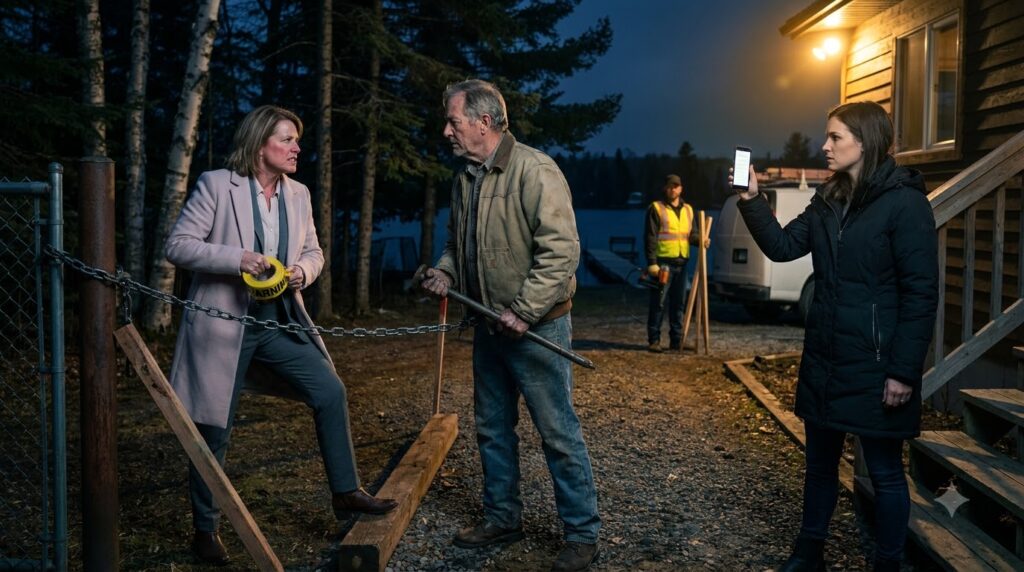
On the screen, two figures stood just beyond the boundary wire. One was Brenda Vance, wrapped in her pastel coat, her hands clutching a fresh roll of yellow municipal warning tape. Beside her stood a man in a heavy utility jacket, holding a pneumatic staple gun and a wooden stake bearing an official county zoning seal.
“Looks like your midnight visitors didn’t wait for morning office hours,” Maya said, her voice dropping to a sharp whisper as she stepped closer to the screen. “They’re staking the forty-foot corridor right through your boat berth.”
Arthur let out a slow, heavy breath, the sound rasping softly through his teeth. He reached down to the lower shelf of the workbench, his fingers closing around the cold, checkered steel handle of an old grease gun before moving past it to the master switch of the property’s security system.
“They aren’t waiting because they think a retired mechanic in a canvas jacket won’t risk the paperwork,” Arthur said. He walked toward the heavy oak door, his boots hitting the floorboards with a deliberate, rhythmic heaviness. “Paperwork is their weapon. Iron and property lines are mine.”
He stepped out onto the porch, Maya close behind him. The cool night air hit his face like a damp towel, carrying the sharp scent of cedar and wet earth. Down by the gate, the beam of a high-powered flashlight cut through the darkness, sweeping across the lower dock where his electric boat, Ghost, rested quietly in its slip like a dark panther waiting for release.
“Mr. Hayes!” Brenda’s voice sliced across the water, amplified by the natural acoustics of the cove. “We are executing an emergency municipal right-of-entry notice under Section 12-B of the county development code! Step away from the gate or face immediate citation for obstruction of public works!”
Arthur didn’t answer right away. He walked down the wooden steps, his boots crunching steadily into the gravel driveway. The utility worker raised his staple gun, aiming it at the lower trunk of an oak tree just inside Arthur’s property line, preparing to drive the first wooden stake deep into the living wood.
“You drive that stake one inch past my cedar ties,” Arthur said, his voice carrying effortlessly across the twenty yards of open gravel, “and I’ll file a criminal trespass warrant with Deputy Howard before you reach your truck.”
Brenda lowered her flashlight, her face contorting into an expression of tight, desperate fury as she stepped past the open gate frame. “You don’t own the lake, Arthur! You don’t own the path! The county has already approved the access corridor for community safety and commercial infrastructure! Your little private kingdom is over!”
She took two aggressive steps forward, her boot crossing the rusted iron marker that designated the true homestead boundary—stepping squarely past the line where municipal authority ended and private law began.
Arthur stopped ten feet from her, his hands tucked quietly into the pockets of his canvas jacket. He didn’t raise his voice, and he didn’t reach for a phone. He simply looked past her shoulder at the utility worker, who had frozen with the staple gun half-raised, suddenly realizing that the survey stakes in his hand didn’t match the actual plat lines recorded at the county courthouse.
“You should have checked the second page of that surveyor’s ledger, Brenda,” Arthur said softly, his eyes locking onto hers with a cold, steady weight. “The one where my uncle deeded the entire shoreline access to the state wildlife trust back in nineteen-eighty. There’s no municipal easement to claim. There’s only a federal violation for tampering with protected wetlands.”
Brenda’s breath hitched. For a fraction of a second, the iron-clad certainty in her posture fractured, revealing the raw, panicked realization that her manufactured crisis had just run headfirst into a legal wall she couldn’t bully her way around.
CHAPTER 6: The Collapse of the Pastel Line
The utility worker lowered the pneumatic staple gun an inch, the heavy metal tool dragging against his thigh as he looked from Brenda Vance back to Arthur Hayes. The silence that settled over the gravel drive was thick and jagged, broken only by the distant, rhythmic slap of lake water against the lower dock timbers.
“That’s a bluff,” Brenda spat out, her voice rising in a jagged, thin screech as she clutched the yellow warning tape tighter against her chest. Her knuckles were white, the pastel fabric of her coat shivering slightly in the damp night air. “There’s no federal trust. The county planning commission cleared this corridor six days ago. You’re just an old hermit trying to lock up common water access!”
Arthur didn’t blink. He kept his hands in his pockets, his posture grounded like a heavy-iron lathe bolted to a concrete floor. “Deputy Howard is twenty minutes away from his substation on the north ridge,” Arthur said, his gravel voice cutting cleanly through her panic. “He’s got the county plat maps in his trunk, and he knows the difference between an official zoning order and a private real estate stunt pulled by a planning commissioner’s spouse.”
At the mention of the deputy’s name, the utility worker took half a step backward, his boots sliding softly on the loose gravel. He dropped the wooden stakes onto the ground with a dull thud. “Look, lady, I’m just hired out by the commercial development group to drop perimeter markers. If there’s an active title dispute or a wildlife trust injunction on this parcel, my liability insurance isn’t covering a federal trespass.”
“You stay right where you are!” Brenda hissed, whirling on the worker. “We have a signed municipal memorandum!”
“You’ve got a piece of paper printed out of a shell corporation’s office printer,” Maya Lin said, stepping out from the dim shadow of the porch steps into the amber glow of the floodlight. She held up her phone, the screen glowing bright enough to illuminate the sharp lines of her face. “And I’ve got the timestamped digital audio recording of your husband telling the zoning board yesterday morning that the access road across Lot 91 was being expedited ‘before the owner realizes what hits him.’ Want me to play it for the deputy when he pulls up the drive?”
Brenda stared at Maya, her jaw working silently as the structural foundation of her entire administrative performance cracked down the middle. For twenty years, she had weaponized clipboards, pastel blazers, and committee titles to bend neighbors into compliance. But intimidation only worked against people who cared about social permission. Against an old mechanic who valued iron and silence, and a young retail manager who understood corporate ledgers, her performance was nothing more than noise against a brick wall.
The utility worker turned on his heel, walked back to the passenger door of his van, and climbed inside without another word. The engine roared to life, tires spitting gravel as he threw the vehicle into reverse, spun around in the narrow clearing, and vanished up the dark birch lane, leaving Brenda standing alone under the harsh floodlight.
Brenda looked from the empty space where the van had been back to Arthur. Her face was mottled red and white, her sunglasses slipping crookedly down the bridge of her nose. “This isn’t over,” she whispered, her voice cracking with humiliated fury. “The association will fine you out of existence. We’ll seize the dock, we’ll block your power, we’ll—”
“You’ll do what every bully does when the ledger doesn’t balance,” Arthur interrupted quietly. “You’ll pack up your clipboards and go find someone else to bother.”
Without waiting for another syllable, Arthur reached out and pulled the heavy steel gate shut, dropping the heavy iron pin into its concrete-anchored slot with a solid, echoing clank.
Brenda stumbled backward off the property line, her heel catching on a exposed root as she retreated up the dark road toward her idling beige SUV. The red taillights flared in the distance, cutting a desperate path through the trees before disappearing into the blackness of the ridge.
Maya let out a long, slow breath, her shoulders dropping five inches as the tension finally drained out of the clearing. She looked over at Arthur, a faint, tired smile touching the corners of her mouth. “Well,” she said softly. “That’s one way to handle committee business.”
Arthur turned back toward the warm, amber light of the cabin workshop, his boots crunching rhythmically against the stone. “It’s the only way that lasts,” he said. “Come on inside. The coffee’s still warm, and we’ve got a final ledger to close.”
CHAPTER 7: The Weight of Silence
The amber light from the single workbench lamp cut across the grain of the oak table, catching the edges of the open ledger where Arthur’s uncle had inked the property boundaries half a century ago. Maya Lin sat on the wooden stool across from him, her hands wrapped around a heavy ceramic mug of black coffee, watching the steam rise in slow, twisting ribbons toward the timber rafters. Outside, the lake lay flat and dark under the late-autumn stars, unbroken by lanterns, clipboards, or the hum of unauthorized utility vans.
“She won’t be back,” Maya said quietly, her voice carrying the flat certainty of someone who understood how corporate balance sheets dealt with failed investments. “Her husband’s planning commission seat relies entirely on keeping commercial development quiet. If Deputy Howard pulls that audit trail on the shell corporation, the whole parking corridor project gets buried under a stack of state fraud investigations.”
Arthur didn’t look up from the ledger immediately. He picked up a small oil stone, running his thumb lightly across its smooth, gray surface before setting it back down beside his tools. “People like Brenda don’t stop because they learn a lesson,” he said, his gravel voice steady and measured. “They stop because the cost of making noise finally outweighs the profit of breaking rules.”
He reached out and closed the heavy calfskin cover of the ledger with a dull, satisfying thud that echoed off the pine walls. The physical weight of the past—and the boundaries built to protect it—settled back into its proper place. For two years, he had lived on this remote acreage believing that silence was something you simply inherited when you walked away from the noise of the world. Tonight, sitting under the dim rafters with a grease-stained jacket and a cup of cold coffee, he understood the truth: silence wasn’t a given gift. It was an iron fence, maintained daily, held together by people willing to stand their ground when the world tried to crowd them out.
Maya set her mug down on the workbench, stood up, and zipped her coat against the lingering chill of the mountain night. She walked toward the heavy oak door, pausing with her hand resting on the latch.
“I’ll handle the inventory logs at Greenfields tomorrow morning,” Maya said, her eyes catching the amber reflection in the window glass. “If anyone asks about Brenda’s disappearance from the schedule, I’ll tell them she decided to take an extended leave of absence for personal restructuring.”
Arthur offered a rare, faint tightening at the corners of his mouth—not a smile, exactly, but the mechanical acknowledgment of a job well done. “Drive safe, Maya. Watch the deer on the upper ridge road.”
The door clicked shut, sealing out the night air with a solid, airtight seal. Arthur walked to the window, peering out toward the lower dock where his electric boat, Ghost, rested quietly in its slip, its charging light glowing a steady, peaceful blue against the dark water.
The morning would come with its own chores—a loose hinge on the boathouse, a fresh cup of coffee to brew, and perhaps a visit from Dennis the raccoon looking for scraps on the porch. But for tonight, the gravel lane was quiet, the gates were locked, and the world had finally learned where the line was drawn.