The Weight of Earth and Metal Measured in the Dirt of an Unyielding Border

CHAPTER 1: THE EDGE OF THE WIRE

“Stop crossing my fence line and digging without my permission!”

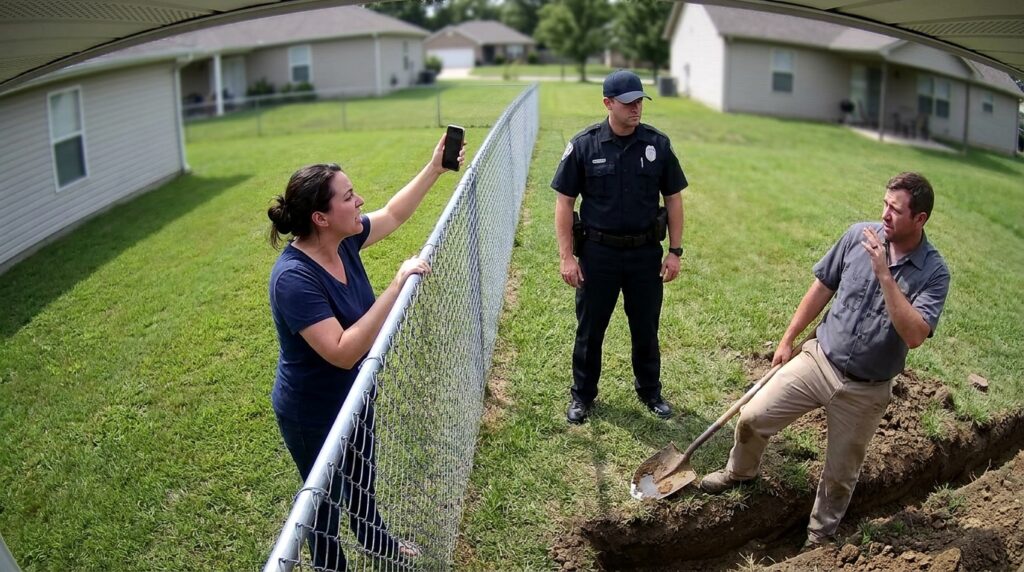
Brenda’s voice shattered the quiet morning, sharp enough to cut through the low thrum of a distant lawnmower three doors down. She stood planted on the opposite side of the chain-link fence, her navy shirt pulled taut across her shoulders as she leaned into the top rail. The rusted wire mesh groaned, bowing inward under her weight. In her right hand, her smartphone was thrust forward, its camera lens pointed straight at my face like the barrel of a loaded gun.

I didn’t answer right away. I let the square spade sink two inches into the dark, heavy clay at my boots, then slowly straightened my back. The leather of my tool belt creaked against my hips. Dust and dried mud coated the knees of my tan work pants, the rough canvas stiffened by hours of kneeling in damp soil.

“Morning, Brenda,” I said, keeping my voice low, flat, and grounded in the dirt. “I’m working on the drainage line for Mr. Henderson. The slope requires a six-inch trench right along this run to pull the standing water away from his basement before the afternoon rain hits.”

“I don’t care about your slope, and I don’t care about his basement!” Her dark hair was slipping from a tight clip at the back of her head, loose strands whipping across her forehead as she jabbed a finger through the diamond-shaped gaps in the fence. “You are digging into my root bed. Look at that dirt—you’re piling contaminated sludge six inches from my property line. You pack up your shovels, or I’m calling the city inspector and having your truck towed off this street.”

I looked down at the trench. The cut was clean, six inches wide, framed by the straight steel edge of my spade. On my side of the fence, the dirt was dark, rich, and cold. On her side, a row of withered hydrangeas sagged against the galvanized posts. I hadn’t touched a single root on her side of the wire. But Brenda wasn’t looking at the roots. She was looking at the territory.

“I’m within the municipal easement, Brenda,” I said, stepping back just enough to keep my hands broad, open, and visible in her camera frame. “The setback for this lot gives us twelve inches from the post line. I checked the county plat map before I unloaded the truck this morning.”

“You don’t own this land!” She stepped closer, her hip slamming into the metal rail so hard the whole twenty-foot section rattled. The screen of her phone flickered, catching the harsh glare of the early sun. “You think because you put on a tool belt you can come into my backyard and tear up my foundation? You contractors are all the same—reckless, arrogant, and dirty.”

She tapped her phone screen rapidly with her thumb, bringing the speaker up to her ear without breaking eye contact. Her eyes were wide, bright with the sharp, toxic energy of someone who had been waiting all week for a reason to exert control.

“Yes, 911 dispatch?” Brenda spoke directly into the microphone, her tone instantly shifting into breathless, performative panic. “I need an officer at 412 Maple Street immediately. There’s an unidentified man trespassing on my property, digging up my yard, and refusing to leave. He’s threatening my home foundation, and I feel unsafe.”

She hung up, bringing the camera back up to lock onto my face, a thin, triumphant smile touching the corners of her mouth.

I didn’t move. I felt the cold knot in my stomach—the old, heavy weight of an accusation taking root. But my hand didn’t tremble as I reached down, pulled my small steel trowel from my belt loop, and looked at a small, discolored patch of crabgrass buried right at the base of her middle fence post.

Underneath that grass, choked by thirty years of rot and dirt, was a piece of painted iron that Brenda didn’t know existed.


CHAPTER 2: THE COLD ARCHIVE OF THE DIRT

The click of Brenda’s smartphone screen hung in the humid air like a snapped dry branch. She didn’t drop her phone. She held it steady at chest height, her thumb hovering over the screen, her dark eyes tracking my hands as I knelt on the sun-baked clay.

Across the fence line, her breathing came short and shallow, rattling in her chest. She wanted a retreat. She wanted me to toss my spade into the back of the Ford, slam the tailgate, and leave her master of this six-foot strip of weeds. Instead, I pressed the pad of my left thumb into the dirt, feeling the sharp, jagged corner of iron buried beneath the dead sod.

“You’re making a mistake, mister,” she said, her voice dropping out of the shrieking register into something colder, laced with the bitter confidence of a woman who had the city’s authority on speed dial. “They’re five minutes away. When the squad car turns onto Maple, you’ll be on the pavement in handcuffs.”

I didn’t look up at her. Looking at her gave her leverage; it made it a duel of tempers, and temper was a luxury I couldn’t afford on a fifty-dollar-an-hour utility contract. Three years ago, over in Guilford County, an home-owner named Gable had claimed I cut his primary fiber line on purpose out of spite. He’d yelled just like Brenda, made his calls, and by the time the state board finished their audit, six months of my life and eight thousand dollars in legal retainers were gone. The board cleared me, but the stain on a license doesn’t wash out with a letter of exoneration. You learn to record everything. You learn that the earth is the only witness that doesn’t lie under oath.

“I’m not leaving the site, Brenda,” I said, my thumb tracing the rough, pitted top of the square iron stake. It was encrusted with rust, flakes of ancient orange paint clinging to the corners like dried lichen. “The permit is taped to the driver’s side window of my truck. The job order is logged with the county public works desk. If I pull off this job now, Mr. Henderson’s foundation takes four hundred gallons of runoff by six o’clock tonight.”

“Mr. Henderson is eighty-two years old and doesn’t know what day of the week it is!” she snapped, her knuckles turning white around the casing of her phone. “You took advantage of an old man who can’t read a plot plan!”

“He read it fine,” I said.

I pulled my yellow work clipboard out from the leather pouch on my hip. The plastic sleeve was smudged with grease and clay, but inside lay the blueprint copy I’d pulled from the register office at seven this morning. Tucked behind the blue line drawings was a faded document I’d found in Henderson’s kitchen folder—a photocopy of an old property survey from 1994. Across the top margin, someone had drawn a faint, jagged line in red grease pencil, making a small crosshatch pattern near the rear boundary. I hadn’t made sense of that mark when I checked in at dawn, but holding the clipboard against my knee now, the pattern mirrored the exact curve of Brenda’s sagging chain-link fence.

“Look at the fence, Brenda,” I said, keeping my tone flat, stripped of anger.

“I know what my fence looks like!”

“Look at the posts,” I insisted, standing up slowly. The joint in my right knee popped, a dull ache radiating down my calf. I pointed a dirt-stained finger down the line toward the rear property corner where an overgrown wild rose bush choked the wire mesh. “Your posts aren’t set in poured concrete footings. They’re driven straight into the soft topsoil on five-foot centers. Someone pushed this line out thirty years ago to save a row of silver maples that died before I was born.”

She stiffened, her chin jerking up. For a fraction of a second, something shifted behind her eyes—a flicker of calculation, the sharp, cold recognition of a name or a date she hadn’t expected me to know. She pulled her phone back half an inch, her arms drawing in close against her navy shirt.

“My father put that fence up in ninety-two,” she said, her voice tight, transactional. “He built it with the previous owner. They had a written understanding.”

A written understanding. The phrase hung between us, heavy and stale. In the world of suburban real estate, a “written understanding” tucked away in a shoe box meant nothing against a recorded deed, but the confidence in her voice wasn’t performance anymore. She believed it. She believed her father’s hand on a piece of paper carried the weight of law.

“An agreement doesn’t change the plat unless it’s filed with the clerk, Brenda,” I said softly.

“It’s filed where it needs to be,” she spat, her defensive posture snapping back like a compressed spring. “You think you’re smart because you carry a clipboard? You’re a hired hand digging a ditch. You don’t know this neighborhood, you don’t know this land, and you certainly don’t know who you’re dealing with.”

From two blocks over, the faint, wailing rise of a municipal siren broke through the humid stillness. It was high-pitched, warbling—the sound of a city unit navigating the morning school zone traffic on Oak Street.

Brenda smiled then. It wasn’t a pleasant sight; it was the sharp, narrow grimace of a trap springing shut.

“That’s Officer Miller,” she said, resting her forearm on the top rail of the chain-link wire, the rusted mesh biting into her skin. “He lives four doors down on the corner. He knows who lives here, and he knows who doesn’t.”

I didn’t move toward my truck. I didn’t reach for my keys. I stepped back to the edge of my trench, picked up my square spade by the ash handle, and wiped a smudge of damp clay off the steel face with my sleeve.

“Good,” I said, looking down at the red pencil mark on the old survey sheet tucked under my thumb. “Let’s see what Officer Miller thinks about the iron in the dirt.”

CHAPTER 3: THE CALL ON MAPLE STREET

The siren cut out two streets over, leaving behind a sudden, heavy quiet. The air smelled of damp earth and ozone, the sky above the neighborhood shifting from hazy morning grey to the bruised purple of an advancing summer storm front. Across the fence, Brenda didn’t relax her grip on the smartphone. If anything, the silence made her lean further into the rail, her chest pressed against the wire until the galvanized diamonds left indented red lines across her navy T-shirt.

“He’s turning the corner now,” she said, her voice dropping into a tight, rhythmic cadence. “You still have time to take your shovels and go, mister. Once he steps into this yard, it’s off my hands.”

I didn’t answer. I reached down to the pocket of my canvas work vest and pulled out my digital level and a roll of high-visibility orange marking tape. If this was going to be an official record, I needed every measurement locked down before the first drop of rain turned the trench into mud. I snapped the level onto the steel spine of my spade, checking the angle of the cut.

“You’re real proud of that little tool belt, aren’t you?” Brenda mocked, her phone tracking my hands as I wrapped a strip of orange vinyl around a wooden locator stake and drove it twelve inches back from the trench line. “You think having a piece of tape makes you legitimate. My husband paid eight thousand dollars to have this yard graded ten years ago. We put in the retaining wall, we put in the drainage bed along the garage, and we maintained this fence line. You don’t just walk in with a spade and tell people where their property ends.”

“I’m not telling you where it ends, Brenda,” I said, my thumb scraping against the coarse edge of the surveyor’s tape. “The county surveyor told both of us forty years ago when they drove the pins.”

“County papers don’t account for real life!” she snapped, her knuckles turning grey against the plastic casing of her phone. “My father lived in this house until the day he died. He sat right there on that back porch with old man Henderson back in ninety-four. They drank iced tea, they walked this exact boundary, and they agreed on where the fence went. They signed a piece of paper, put it in the safe, and that was that. You don’t get to erase thirty years of history because you have a job ticket.”

I caught the detail as it landed. A piece of paper in a safe. The red grease pencil mark on Henderson’s old schematic—the strange, hand-drawn crosshatch near the rear boundary—suddenly aligned with her words. It wasn’t an official revision; it was an informal marker for a private deal made between two men over thirty years ago.

“Did your father file that paper with the Register of Deeds?” I asked, looking her dead in the eye.

Her mouth tightened into a hard, thin seam. Her shoulders twitched upward, a micro-reaction that told me everything her phone camera was trying to hide.

“It didn’t need to be filed,” she said, her voice hardening. “It was an agreement between neighbors. Respectable people don’t go running to the courthouse every time they set a fence post.”

“Respectable people do if they want the fence to stay legal when the property changes hands,” I said softly.

Before she could spit back an answer, the heavy crunch of gravel signaled the arrival of a vehicle in the front driveway. A white-and-blue municipal cruiser pulled onto the shoulder of Maple Street, its engine idling with a low, mechanical thrum that vibrated through the damp soil beneath my boots. Through the narrow gap between the houses, I saw the driver’s door swing open.

Brenda didn’t wait. She turned away from the fence line, stepping around her wilted hydrangeas, her posture straightening instantly as she called out over the gate.

“Over here, Officer Miller! In the back! He’s still digging!”

I didn’t chase her to the gate. I stayed right where I was, grounded in the clay beside my trench. I reached into the shallow hole I’d cleared at the base of the middle post, using the edge of my trowel to scrape away another half-inch of packed soil. Beneath the rust-flaked iron pin I’d found earlier, my steel blade scraped against something else—something solid, metallic, and flat.

It wasn’t a root, and it wasn’t a stone. It was a secondary surveyor’s marker: a heavy steel spike notched on four sides, capped with a tarnished brass tag buried three inches below the dirt level. Someone had buried it deep on purpose, hiding the true monument line right under the sod.

I wiped the grit off the top of the brass cap with my thumb, revealing the faint, stamped numbers of an official county survey registration.

The front gate unlatched with a sharp metallic clatter, and heavy boot heels began crunching down the concrete walkway toward the backyard.

CHAPTER 4: THE MONUMENT IN THE CLAY

The latch clicked open with a harsh, ungreased snap that echoed down the alley between the houses. Heavy leather boots crunched over the gravel pathway, slow and deliberate, the measured tread of a patrol officer who had walked this exact block a thousand times.

I didn’t rise immediately. I stayed on one knee in the soft, dark soil, my fingers cupped around the tarnished brass cap I’d unburied beneath the rust. The stamped numbers—NC-SR-8842—were cut clean into the metal, still sharp under thirty years of packed mud. I pulled a small, stiff-bristled wire brush from my vest pocket and made two firm passes across the brass face, clearing away the fine silt until the county seal caught the gray storm light filtering through the trees.

“Mark Vance?”

The voice was even, mid-thirties, flat with the neutral weight of someone used to settling arguments over loud music and property lines. Officer Miller stopped five feet back, his dark uniform immaculate, his duty belt squeaking faintly as he shifted his weight. His cap shadowed his eyes, but his gaze swept the scene with practiced efficiency: the straight cut of the six-inch trench, the spade resting upright in the soil, my yellow clipboard lying open on the dry canvas sheet, and Brenda standing four feet behind him on her side of the chain-link, her smartphone still held at chest level like a raised shield.

“Officer,” I said, rising smoothly to my feet. I wiped my clay-stained palms against the sides of my work pants, keeping my hands low, open, and still. “Appreciate you coming out.”

“He’s destroying my foundation, Jim!” Brenda interjected, stepping up until the chain-link wire groaned against her navy shirt. She pointed her phone screen toward Miller’s face, her voice tight with urgent escalation. “I called dispatch fifteen minutes ago. He refused to stop digging, he’s piling contaminated runoff dirt against my property line, and he’s completely ignoring the boundary agreement my family has had on this lot since nineteen ninety-four!”

Officer Miller didn’t look at her phone. He didn’t raise his voice. He kept his eyes on me, his boots planted firmly in the grass on Mr. Henderson’s side of the property line.

“Mr. Vance,” Miller said, nodding once toward the trench. “Let’s start with the basics. Are you performing work under a municipal permit?”

“Yes, sir,” I said, stepping back two paces to give him a clear view of the work zone. I pointed toward my truck parked at the curb. “Public Works Permit number 409-B, pulled yesterday morning at seven-fifteen. It’s taped to the driver’s side wing window. I’m installing a standard three-inch perforated PVC drain line to pull standing water off Mr. Henderson’s rear foundation wall and route it down to the municipal storm sewer at the street.”

“And the digging?” Miller asked, his eyes dropping to the straight, spade-width channel. “Is any part of this trench or your equipment crossing the fence line?”

“Not an inch,” I replied. “The trench is set six inches off the wire mesh. Every shovelful of dirt has been placed on Mr. Henderson’s side of the line.”

“That fence is the line!” Brenda shouted, her voice rising an octave as she jabbed a finger toward the galvanized top rail. “Jim, you know this neighborhood! My father built that fence thirty years ago with old man Henderson! They sat at the kitchen table, they mapped out the boundary, and they put the fence right where it belonged. He has no right to come in here with a shovel and re-interpret where my yard begins!”

Officer Miller turned his head slowly toward Brenda. He didn’t argue, but the posture of his shoulders remained strict, neutral, and unmovable.

“Ms. Miller,” he said, his tone measured. “If there’s an easement or a private boundary dispute, that’s ultimately a civil matter for the county magistrate. My job right now is to ensure there’s no active trespass, no damage to public infrastructure, and no breach of the peace.”

“It’s not a civil matter when a stranger digs up my property!” she insisted, her knuckles turning bone-white around her phone. “I have the agreement in my house! My father kept it in the fireproof safe in the study! A signed, written agreement shifting the line six inches north to protect the old maple roots! I can go get it right now!”

There it was. Layer one unlocked, spoken aloud in front of law enforcement. A thirty-year-old handwritten document, tucked away in an iron box, born from a neighborly compromise that had long outlived the trees it was meant to save.

I didn’t interrupt her. I stepped back toward the middle fence post, reached down with my trowel, and pointed at the gleaming brass cap I had just brushed clean.

“Officer,” I said quietly, “before Ms. Miller goes inside to look for her paper, I think you should look at the ground.”

Miller stepped forward, his heavy boots coming to a stop right at the edge of the trench. He leaned down, his dark cap tipping forward as his eyes locked onto the exposed brass tag embedded in the hard clay.

“That’s a county surveyor’s monument pin,” I said, my voice steady against the rising wind. “Stamped NC-SR-8842. It marks the official, registered property corner between Lot 12 and Lot 13. And as you can see, officer, that brass pin sits six inches inside Brenda’s fence line.”

Miller squinted, his fingers resting casually on his duty belt as he evaluated the line between the brass tag and the galvanized post above it.

Brenda went dead silent behind the fence, her phone slowly dropping two inches from her chest.

CHAPTER 5: THE WEIGHT OF THE SURVEY

Officer Miller didn’t rush his assessment. He lowered his heavy frame into a disciplined squat at the edge of the trench, his leather duty belt creaking against the stiff fabric of his trousers. His gloved thumb reached down, brushing away a fine dusting of dry gray clay from the brass rim. The stamped letters—NC-SR-8842—glinted dull and unyielding under the dark underbelly of the incoming storm clouds.

He pulled a small steel measuring tape from his belt, hooked the tab on the edge of the brass cap, and pulled the yellow rule straight back toward the center of Brenda’s middle fence post.

“Six and a quarter inches,” Miller said softly. He didn’t look up at Brenda yet. He let the tape snap back into its casing with a sharp clack. “Six and a quarter inches to the north.”

“Jim, listen to me,” Brenda’s voice cracked, losing its sharp, authoritative edge and replacing it with a strained, desperate pitch. She stepped up until her knees pressed against the lower rail of the chain-link, her fingers hooking into the wire mesh like a prisoner at a gate. “I told you, my father and Mr. Henderson had a signed agreement. It’s in the safe! They moved the fence line thirty years ago because of the old silver maples. It’s been in that exact spot since I was eight years old!”

“Ms. Miller,” Officer Miller said, standing up with a slow, deliberate motion that carried the full weight of his uniform. “An informal agreement between neighbors doesn’t alter a registered county plot unless it’s executed as a deed amendment and recorded with the Registrar.”

“It was recorded!” she blurted out, her face flushing a deep, mottled red under her dark hair. “My father took it to the county courthouse in ninety-five! He paid the fee!”

I reached into my pocket, my fingers brushing the edge of the yellow clipboard where Henderson’s old schematic lay flat.

“If he took it to the courthouse, Brenda,” I said, keeping my voice level, “then there’s a filing stamp on it. But the county GIS system updated its digital boundary overlays three weeks ago for the new stormwater utility district. If a deed amendment had been registered in ninety-five, this brass pin would have been pulled or re-capped as an secondary marker. It wasn’t. It’s listed as the primary monument.”

Brenda stared at me, her eyes wide, her jaw trembling slightly. For a second, the aggressive enforcer of the neighborhood vanished, leaving behind a woman terrified that the physical world beneath her feet was sliding six inches to the left.

“Go get the paper, Ms. Miller,” Officer Miller instructed, his voice flat, neutral, and unmovable. “If you have a stamped copy of a recorded easement or a deed adjustment, I’ll review it right now and pause Mr. Vance’s work until the city attorney can look at it. But if you don’t have a county filing stamp on that document, this brass pin is the legal boundary.”

“I’ll get it,” she hissed, letting go of the fence so fast the wire rattled along its entire thirty-foot run. “I’ll be back in two minutes. And you stay out of my dirt, contractor!”

She turned on her heel and marched toward her back porch, her sneakers slapping against the wet grass as the first heavy raindrops began to spot the gray concrete of her patio.

I looked at Officer Miller. He looked down at the brass pin, then over at my trench.

“You’re cutting it close to the line, Vance,” Miller noted, pulling a small notebook from his breast pocket.

“I have to, officer,” I replied, pointing to the slope of the yard. “If I move the pipe four inches south, the gravity feed loses its fall. The water will back up into Mr. Henderson’s window well instead of draining to the street. I’m staying within the six-inch buffer, but I need every inch of this setback to make the grade work.”

“I know,” Miller said, looking over his shoulder toward Brenda’s house. “I’ve lived on this block eight years. Every time it pours, her yard sheds three hundred gallons right into Henderson’s basement. She knows it, too.”

He paused, clicking his pen.

“She’s going to bring out a piece of paper, Vance. What happens if it has a stamp on it?”

I leaned my spade against the fence rail, feeling the first cold drop of rain hit the back of my neck.

“If it’s stamped by the county, I pack my gear and file a dispute hold with Public Works,” I said firmly. “I don’t break the law for a job. But if it’s not stamped, officer… I’m laying this pipe before the mud buries that pin again.”

The back door of Brenda’s house slammed open, the sound cracking across the yard like a rifle shot.

CHAPTER 6: THE STAMP IN THE SHADOWS

The back door crashed against the house siding, a sharp wooden crack that made a pair of sparrows burst out of the overgrown boxwood hedge. Brenda marched back down the porch steps, her sneakers cutting track marks through the wet lawn. In her left hand, she gripped a heavy, yellowed manila folder, clutching it to her chest as if protecting it from the fine mist that was turning into a steady, cold drizzle.

“Here it is,” she panted, her voice tight, triumphant, and strained as she skidded to a halt on her side of the fence. “I told you. My father didn’t lie. He kept every receipt, every survey, every scrap of paper.”

She pulled a single sheet of heavy bond paper from the folder. The edges were browned and brittle with thirty years of age, folded into crisp thirds that groaned as she snapped it open against the chain-link wire.

Officer Miller stepped up to the mesh, his dark uniform cap shedding rain droplets onto his shoulders. He reached his gloved hand through the diamonds of the wire, taking the paper by its edge. I stepped in beside him, my boots sinking half an inch into the softening clay at the trench wall.

“Read it, Jim,” Brenda demanded, her phone still raised in her other hand, recording Miller’s face. “Nineteen ninety-four. Signed by my father, Thomas Miller, and Arthur Henderson. They explicitly agreed to establish the fence boundary six inches north of the original plat line to preserve the silver maple root structure and prevent soil erosion between the lots.”

Miller held the paper flat against his clipboard to shield it from the rain. I leaned over his shoulder, my eyes scanning the faded typewriter font. The signatures were there—dark blue ink, heavy pressure on the strokes. Beside Arthur Henderson’s signature was a hand-drawn sketch, identical to the red grease pencil crosshatch on the schematic in my own folder.

It was real. It was a genuine, executed neighbor agreement from 1994. The decoy secret stood bare in the gray daylight: a private pact born of good intentions, preserved in a fireproof safe for three decades.

“It’s signed,” Officer Miller acknowledged, his voice quiet, steady, and analytical. He turned the paper over.

On the back of the sheet, tucked into the bottom left corner, was a faint, purple-ink rectangle.

“Look at the seal, Officer,” I said, pointing a muddy fingernail at the smudged lettering inside the purple box.

Miller squinted, his thumb wiping a drop of rainwater off the paper’s plastic sleeve. The stamp read: WAKE COUNTY REGISTER OF DEEDS – RECEIVED FOR FILING NOV 12 1995. But right across the center of the purple rectangle, two thick lines of red grease pencil had been drawn in a bold, crosswise X. Beneath it, in tiny, hurried cursive, was a clerk’s note: REJECTED – INCOMPLETE LEGAL DESCRIPTION. DEED AMENDMENT REQUIRED. NOT RECORDED.

The air went still between us, save for the patter of raindrops hitting the galvanized fence rail.

“What does that mean?” Brenda demanded, her voice losing its sharp edge, her eyes darting between Miller’s face and the back of the paper. “What are you looking at?”

Officer Miller raised his head slowly. The neutral, professional mask of a veteran patrolman remained firmly in place, but his tone carried a cold, unshakeable finality.

“Ms. Miller,” Miller said, handing the paper back through the chain-link mesh. “Your father brought this agreement to the county courthouse in November of ninety-five. The Registrar of Deeds rejected the filing because it wasn’t drafted as a formal deed amendment with a certified legal description. It was never recorded.”

“No,” she whispered, her fingers crumpling the edge of the yellowed paper. “No, he paid the fee. He told me it was settled!”

“He might have thought it was, or he might have intended to fix the filing and never got around to it,” I said softly, stepping closer to the fence. “But without that county seal, Brenda, this piece of paper is just a thirty-year-old promise between two men who don’t own the lot anymore. The legal boundary remains where the county set it—at the brass pin buried six inches on your side of the wire.”

Brenda’s phone lowered until the screen pointed straight down into the mud. Her chest heaved under her navy shirt, her face pale against the dark background of her wet lawn. The weight of thirty years of false certainty collapsed in a single second, crushed not by shouting or fists, but by two lines of red grease pencil on the back of an unrecorded page.

Officer Miller clicked his pen shut and slid his notebook into his breast pocket.

“Ms. Miller,” Miller said firmly, looking her straight in the eye. “Mr. Vance is operating under a valid municipal permit on a legally established setback. Not only is his work fully compliant, but according to the official county monuments, this entire run of chain-link fence sits six inches inside Mr. Henderson’s property line. It constitutes an unpermitted encroachment.”

Brenda stood frozen, the rain dripping from the ends of her dark hair, unable to utter a single word.

CHAPTER 7: THE RETREAT AT THE BOUNDARY

The rain picked up, fat cold drops drumming against the galvanized mesh and slanting across the narrow corridor between the two backyards. Across the street, the low hum of a lawnmower sputtered and died as a neighbor pulled his machine into an open garage, turning on his heel to watch the patrol car’s flashing overhead lights reflected in the wet asphalt of Maple Street.

Brenda stood motionless, her fingers still loosely hooked into the wire mesh. The yellowed paper, limp now from the dampness in the air, fluttered in her left hand. The dark blue ink of her father’s signature bled slightly into the pulp of the page where a raindrop hit the margin.

Officer Miller pulled his heavy leather radio harness straight, his eyes fixed on Brenda with the unyielding authority of a man backed by three hundred pages of municipal code.

“Ms. Miller,” Miller said, his voice cutting clearly through the rustle of the wet oak leaves overhead. “I am instructing you right now to step back from this fence and cease interfering with Mr. Vance’s work. He holds a valid permit issued by the city. If you continue to obstruct this site or attempt to misuse the emergency dispatch system to resolve a property line dispute, I will issue a citation on the spot for misuse of 911 services under County Code 14-A.”

Brenda’s jaw worked silently. She looked down at her smartphone, still held in her right hand, its black screen reflecting the grey sky above. The performative rage that had carried her across her yard twenty minutes ago had drained away, leaving only the hollow, shivering reality of a woman standing in the rain, caught in an overreach every person on the block could see.

“He’s digging up my yard,” she whispered, though the words lacked all conviction now. It was the instinct of a person who had never been told no within the borders of her own street.

“He is working six inches inside Mr. Henderson’s legal boundary,” Miller corrected, his tone leaving no room for negotiation. “In fact, Ms. Miller, based on the location of that brass monument pin, your fence is currently encroaching six inches onto Mr. Henderson’s parcel. If Mr. Henderson or his estate chooses to file a boundary correction order with the county building inspector, you will be legally required to remove or relocate this entire thirty-foot run of chain-link at your own expense.”

A quiet rustle came from the porch behind me. Old Mr. Henderson, wrapped in a faded wool cardigan, had pushed open his screen door. He stood leaning on his aluminum cane, his pale eyes tracking the scene from under his bushy eyebrows. He didn’t shout. He didn’t throw his hands up. He just watched Brenda with the quiet, tired sadness of an old neighbor who had lived through thirty years of minor aggressions over lawn clippings and hedge lines.

Brenda looked from Officer Miller to me, then past my shoulder toward Mr. Henderson on the porch. Across the street, two more neighbors stood under the overhang of a carport, their eyes pinned to her back fence. The social currency she had spent years building through noise complaints and sidewalk policing had evaporated in ten minutes over a strip of wet dirt.

“This isn’t over,” she managed to say, though her voice was barely louder than the rain hitting the fence rail.

She didn’t wait for a response. She turned, her sneakers squelching in the mud she had churned up along her flowerbeds, and walked toward her back steps. She didn’t march this time. Her shoulders were hunched against the rain, her head bowed as she clutched the ruined 1994 agreement to her chest. She climbed the wooden steps, pushed her back door open, and stepped inside. The slam of the door was softer this time, muted by the steady, pouring rain.

Officer Miller turned back to me, taking a deep breath of the damp, pine-scented air. He unclipped his pen and flipped his notebook shut, tucking it into his breast pocket under his yellow rain slicker.

“You good to finish the line, Vance?” Miller asked, looking down at the narrow trench where the water was already beginning to pool against the exposed clay.

“I am, officer,” I said, reaching down to grab the handle of my spade. “I’ll have the gravel bed laid and the pipe capped before the heavy downpour hits.”

“Good,” Miller said. He stepped over the trench, his boots leaving clean impressions in the wet grass. He paused, looking toward the porch where Mr. Henderson stood. He gave the old man a brief, respectful nod, then looked back at me. “If she comes back out or tries to touch your tools, call the desk directly. Don’t use 911. Just give them my unit number.”

“Understood. Thanks for your time, Officer.”

Miller walked back down the side gravel path, his boots crunching steadily until the front gate clicked shut behind him. A moment later, the patrol car’s engine revved softly, its tires splashing through the standing water on Maple Street as it pulled away from the curb.

I stood alone in the backyard, the rain falling steady and cold against my vest. I reached into my tool belt, pulled out the digital level, and set it on the bottom of the cut. The display glowed bright green in the gray light: a quarter-inch drop per foot, sloping cleanly toward the street.

I picked up the spade, drove the steel edge into the dark clay, and got back to work.

CHAPTER 8: THE SECURED LINE

The sky opened fully, a solid sheet of gray summer rain drumming against the canvas bed-liner I’d stretched over the open trench. Water hissed as it struck the hot hood of my Ford parked at the curb, but down in the narrow earth channel along the fence, the current moved precisely where it was supposed to go.

I knelt in the mud, my hands slick with PVC primer and purple cement. The chemical smell rose sharp and hot against the cool, wet air, cutting through the heavy scent of churned clay. I slid the three-inch perforated pipe into the coupling, giving it a quarter-turn until the plastic locked tight against the stop ring.

Behind me, the brass monument pin—NC-SR-8842—lay clean and exposed in its bed of soil. I reached into my canvas bucket, scooped two heavy handfuls of angular washed river stone, and poured them gently around the brass cap. The gray gravel settled around the metal, protecting the stamped numbers from the rain without burying the monument under loose dirt. Over the top, I tapped a bright orange surveyor’s protective cap into the clay—a permanent, unshakeable landmark sitting exactly six and a quarter inches inside Brenda’s sagging wire.

The back curtains of the house across the fence remained drawn tight. No phone lenses peeked through the blinds. No voices called across the property line. The silence on Brenda’s side of the wire was complete, heavy, and final.

Across the yard, old Mr. Henderson pushed his screen door open again. He had replaced his cardigan with a thick yellow rain jacket, his aluminum cane clicking against the wet concrete of his porch steps as he shuffled down the walk toward the trench. He stopped two feet back, leaning heavily on his cane, his pale eyes following the smooth, continuous slope of the perforated pipe running down toward the street outlet.

“You got the pitch right,” the old man said, his voice raspy, weathered by eighty-two years of Carolina winters.

“Quarter-inch per foot, Mr. Henderson,” I replied, smoothing the last bed of gravel over the pipe before laying down the filter fabric. “The water from her roof will hit this stone bed, drop straight into the perforations, and flow out to the gutter before it ever touches your cellar wall.”

He looked at the orange surveyor’s cap sitting near the base of the chain-link fence. His hand tightened slightly on the curve of his cane.

“Tom Miller was a good neighbor for a long time,” Mr. Henderson said quietly, his gaze resting on the rusted wire. “When he asked me to shift that fence back in ninety-four so he wouldn’t have to cut down those silver maples, I told him sure. Neighbors help neighbors. I signed his paper right there at my kitchen table.”

He shook his head slowly, a faint, tired smile touching his lips.

“I didn’t know he never filed it with the county,” he continued. “And when those maples died ten years ago, Brenda just kept acting like that fence was built on God’s own word. She forgot that the land wasn’t hers to take—it was just borrowed on good faith.”

“Good faith only works when both sides remember the truth, Mr. Henderson,” I said, rising to my feet and wiping the wet clay from my knees. “The county records don’t care about memory. They care about what’s stamped in the iron.”

“That they do, son,” the old man nodded, reaching into his jacket pocket and handing me a dry, folded check. “That they do.”

I took the check, checking the amount—paid in full, exactly to the penny of the original estimate—and slid it into my waterproof pouch.

I picked up my spade, scraping the caked clay off the steel blade with the edge of my trowel. The metal clanged clean and clear in the rain. I packed my level, my tape, and my wire brush into the leather tool pouch, hoisted my gear onto my shoulder, and walked down the side path toward my truck.

As I unlatched the front gate, I looked back one last time. The rain was pouring steady and hard now, sheets of water cascading off Brenda’s roof and splashing onto the lawn. But instead of pooling into a muddy swamp along Mr. Henderson’s foundation wall, the runoff hit the washed stone, vanished into the filter fabric, and poured cleanly out of the PVC drain at the curb, rushing down toward the municipal storm drain in a steady, unbroken stream.

The line was drawn. The earth was settled. And the truth, buried six inches deep in the clay, remained right where it belonged.

Similar Posts

Leave a Reply

Your email address will not be published. Required fields are marked *