The Unwritten Law of Maplewood Drive and the Silent Boundary at the Curb

CHAPTER 1: THE NOTICE ON THE GLASS

The air on Maplewood Drive smelled of cut fescue and warm asphalt. Arthur Miller killed the engine of his Ford F-150, letting the key rest in the ignition while the tired V8 shuddered to a stop. His forearms ached—a deep, familiar burn from six hours spent re-leveling Mrs. Higgins’s rotting back porch steps. Forty years as an electrician meant his joints knew every variation of atmospheric pressure, and today the humidity hung heavy, promising rain that wouldn’t fall until nightfall.

He reached for his canvas tool wrap on the passenger seat, but stopped.

Glaring through the dust-filmed windshield was a square of neon-green paper tucked beneath the driver’s side wiper blade.

Arthur didn’t rush. He opened the cab door, the hinges groaning softly in the July heat, and set his work boots onto the street. The curb felt solid underfoot—concrete he had watched the city pour back in the summer of ninety-four when the township modernized the drainage lines.

He pulled the paper from beneath the rubber blade. The handwriting was jagged, pressed so hard into the cheap cardstock that the ballpoint pen had nearly torn through the fiber: PRIVATE PROPERTY ACCESS. NO OVERNIGHT TRUCK STORAGE. FINAL WARNING BEFORE TOW.

Across the double-lane street, behind the manicured boxwood hedges of 145 Maplewood, a vertical blind twitched.

Arthur smoothed the green paper against his thigh, his calloused thumb tracing the sharp ink marks. He didn’t look up at the window. He didn’t need to. Brenda Vance had lived in the two-story split-level for eighteen months, but she had managed to measure every square foot of the neighborhood with a surveyor’s tape of grievances.

The front door of his own home creaked open. Clara stepped onto the porch, wiping her hands on a linen dish towel. Her long, light-brown hair was pulled back loosely, gray silvering the temples in soft streaks that caught the afternoon sun. She didn’t ask about the green paper. She had seen the pink ones last month, and the yellow ones the week before that.

“Higgins’s steps held?” she asked, her voice low enough to keep from carrying across the street.

“Twisted cedar,” Arthur said, tossing the neon note into the empty bed of his truck alongside a rusted pipe wrench. “Took three shims and a galvanized bracket, but she won’t go through ’em now.”

“She called twice,” Clara said, coming down the two concrete steps to stand near the edge of their lawn. Her eyes drifted past Arthur, taking in the pristine, empty fifty feet of street space in front of Brenda’s driveway. “Said Brenda went door-to-door yesterday asking who gave you permission to park the utility trailer near the cul-de-sac.”

Arthur turned slowly, his eyes narrowing against the glare reflecting off the chrome trim of Brenda’s oversized SUV parked in her driveway. The vehicle was pulled in so far it nearly touched her garage door, leaving the entire paved apron bare, as if the concrete itself were an exhibit in a museum.

“Public street,” Arthur murmured, reaching into his blue polo pocket for his copper measuring tape out of sheer habit, feeling its worn brass edge. “City owns six feet from the asphalt centerline to the grass line. Always has.”

“She doesn’t care about the city code, Artie,” Clara said quietly. She stepped closer, her hand resting lightly against his forearm, feeling the tension locked beneath his skin. “She cares about who has to ask who.”

Before Arthur could answer, a metallic click echoed across the quiet street. Brenda Vance stepped onto her porch, holding a black leather-bound binder under one arm. Her bright pink shirt was a violent streak of color against the cream vinyl siding of her house. She didn’t wave. She didn’t smile. She stood at the top of her steps, adjusted her sunglasses, and looked directly down her driveway toward Arthur’s truck, her posture as rigid as a fence post set in wet cement.

Arthur held her gaze for two long seconds, his face impassive, before turning his back to the street and walking up his walkway beside his wife.

CHAPTER 2: THE THIRTYYEAR GRAIN

“She’s documenting the tires now, Artie.”

Clara stood by the kitchen window, her reflection ghosting over the screen where the mid-afternoon sun hit the glass. Her hand rested on the frame, thumb rubbing a smooth patch of wood where the paint had worn down to the bare pine over thirty years of watching the street.

Arthur didn’t look up from the kitchen table. He had his steel-cased multimeter open, checking the continuity on an old brass desk lamp he’d pulled from Mrs. Higgins’s porch pile. The needle flickered, steady and true, before dropping back to zero.

“Let her document,” Arthur said. His voice was like stones rolling in a wooden bucket—dry, slow, settled. “Tires are rubber. The street is asphalt. Neither one belongs to her.”

“She’s got a camera on a tripod,” Clara said gently. She wasn’t frightened—she had raised three boys in this house through school board fights, septic line backups, and the long strike of ’98—but her voice carried the thin, frayed tension of a wire pulled just past its tolerance. “Right at the edge of her lawn. Aimed straight at the F-150.”

Arthur set the copper leads down on the table. The brass lamp gave a tiny, metallic ring as it settled against the formica. He looked at his hands—the pale scar across his left knuckle where a live line had caught him during the storm of ninety-two, the dark grease permanently ground into the whorls of his thumbs.

Thirty years ago, when the developer had cleared the oak grove to lay the foundation for Maplewood Drive, Arthur had been thirty-two. He remembered the smell of the raw earth, the churned clay sticking to his work boots while the township crews laid the six-inch water mains. He had helped wire six of the seven original houses on this side of the cul-de-sac. He knew where the junction boxes were buried under the sod; he knew which houses had four-inch sewer lines and which had six; he knew that the oak roots near the corner had already lifted the curb line by two inches before Brenda Vance was even old enough to hold a clipboard.

He stood up, his knees popping softly in the quiet kitchen. “I’m going to the garage.”

“Artie,” Clara warned, turning from the window. The light caught the soft lines around her eyes—lines he had watched deepen over three decades of quiet evenings on the back porch. “Don’t go crossing the street.”

“I’m not crossing anything,” he said, touching her shoulder as he passed. The fabric of her patterned blouse was soft, worn thin from a hundred wash cycles. “Just getting a bracket.”

The garage smelled of engine oil, dry cedar, and thirty years of accumulated hardware. Pegboards lined the back wall, holding wrenches, saws, and spools of copper wire arranged by gauge. It was a library of honest labor, every tool hanging from a hook Arthur had screwed into the studs himself.

He walked past the utility trailer to the heavy steel workbench in the corner. Beneath the bench sat a stack of gray metal filing boxes—the kind the city used before everything was moved to glowing screens.

He pulled out the bottom box, the steel sliding with a dry raspy scrape against the concrete floor. Inside were rolled blueprints, handwritten receipts, and faded permits from the ninety-four street overhaul. He unrolled the top sheet—a yellowed site map showing the original plot lines for Maplewood Phase II.

Tucked into the corner of the box, wedged behind a stack of township tax receipts, was a small, oxidized metal junction cover. Scratched onto its underside in grease pencil was a set of numbers: E-145-B. Beneath it lay a torn scrap of faded blue paper—a fragment of a survey map showing a shaded ten-foot strip running parallel to the curb line across from his house.

Arthur touched the frayed paper with the tip of his thumb. He remembered the surveyor who had drawn those lines—an old man named Miller who smoked a pipe and measured every pin twice. Brenda Vance thought she was fighting for a parking spot. She had no idea what was buried beneath the grass.

A shadow fell across the garage floor.

Arthur didn’t jump. He rolled the blue scrap back into the paper bundle, laid the metal cover over it, and turned around slowly.

Brenda stood just outside the open garage door, anchored on the gravel apron of his driveway. She was holding a heavy black camera with a telephoto lens, her pink top practically glowing against the gray concrete. Her face was set in a tight, triumphant mask, her blonde hair tucked neatly behind her ears.

“You’re storing commercial equipment on a residential driveway, Mr. Miller,” she said, her voice carrying that clipped, practiced cadence of someone reading from a mental checklist. “That trailer has been parked behind your truck for more than seventy-two hours without an active work permit displayed.”

Arthur stepped toward the doorway, stopping two feet short of the threshold. He didn’t raise his voice. He didn’t raise his hands. He simply stood in the shadow of his own eaves, looking down at her with the quiet weight of a man who knew every nail in the framing above their heads.

“The trailer’s on my property line, Brenda,” he said softly. “And the truck is on the public street.”

“Not for long,” Brenda said, her fingers tightening around the rubber grip of her camera. “I spoke with the county clerk this morning. That curb space sits within the original developer’s private access easement for Lot 12. My lot. You’re parking on my access zone, Arthur.”

Arthur looked past her, toward the pristine white house across the street, then back to the sharp line where his driveway met the public street. He reached into his pocket, his calloused fingers finding the smooth, worn brass of his measuring tape.

“You ought to check the date on that easement, Brenda,” Arthur said.

Brenda’s eyes narrowed behind her sunglasses, her grip on the camera twitching slightly as if she hadn’t expected him to have a name for the paper she was holding. “I don’t need to check dates. The deed speaks for itself.”

“Deeds change when the city pours concrete,” Arthur said quietly, stepping one inch closer to the light. “And I was holding the tape when they poured it.”

CHAPTER 3: CONES ON THE ASPHALT

“You think forty years of grease and gravel gives you a deed, Mr. Miller?”

Brenda’s voice snapped across the three feet of sun-baked driveway like a dry branch breaking. She didn’t lower her camera. The black lens clicked once, twice—capturing the edge of Arthur’s work boots, the open garage door behind him, and the faded registration sticker on his utility trailer.

Arthur didn’t flinch. He stayed planted in the doorway shadow, feeling the dry heat radiate off the asphalt against his shins. “I don’t need a deed for a street the county paved, Brenda. And taking pictures of my boots isn’t going to widen your driveway.”

Brenda let the heavy camera rest against her bright pink top, her jaw set in a hard, pale line. “We’ll see what the township zoning board says when they view the access photos at Thursday’s hearing. You have three hours to clear your truck off the Lot 12 frontage before I exercise private obstruction remedies.”

She turned on her heel, her sneakers squeaking sharply on the hot concrete as she marched across the road. Arthur watched her go, his thumb tracing the worn knurling of the tape measure in his pocket. She didn’t return to her porch. Instead, she popped the hatch of her oversized SUV, reached deep into the cargo bed, and dragged out three heavy, neon-orange traffic cones—the thick, industrial rubber kind used by municipal road crews.

With deliberate, heavy steps, Brenda placed the first cone precisely eight inches from the curb line, directly in front of Arthur’s driver-side door. The second went behind his rear bumper. The third she slammed down in the center of the street lane, effectively boxing his Ford F-150 into a artificial construction zone.

Across the street, the overhead garage door of 142 lowered three inches, a neighbor’s silhouette pausing behind the glass pane before pulling back into the dark.

Arthur stepped fully out of the garage shadow and onto the gravel. The sun hit his face, hot and unforgiving. He walked down the incline of his driveway, his boots crunching on the loose stone, until he stood at the edge of his lawn, right where his Bermuda grass met the concrete curb.

Brenda stood beside her third cone, arms crossed tightly over her pink top, her chin tilted up in challenge. “Private access marker,” she called out, her voice loud enough to ring off the vinyl siding of the surrounding split-levels. “Touch those markers and it’s interference with private property enforcement.”

Arthur looked down at the base of the middle cone. Baked into the heavy black rubber ring at its base was a raised, faded serial number: PROPERTY OF TOWNSHIP PUBLIC WORKS – DIST 4. It was chipped at the corner, scraped down to the pale orange vinyl underneath—the exact style of cone the county had left behind when they resurfaced the drainage culverts seven years ago.

“You got those out of the township dump pile behind the water treatment plant,” Arthur said softly. He didn’t raise his voice to match her public projection. He kept it level, grounded in the quiet air between them. “Frank Higgins threw six of those out when they decommissioned the old culvert crew.”

Brenda’s posture stiffened by a fraction of a millimeter. Her fingers dug deeper into the fabric of her sleeves, though her chin remained locked high. “They are designated safety barriers marking a disputed access zone. You move them, Arthur, and I call the non-emergency line for public nuisance and vehicle obstruction.”

From the front porch steps behind him, the screen door clicked. Clara walked down the concrete path, her canvas garden gloves tucked into the apron of her patterned dress. She didn’t look at Brenda. She walked straight to Arthur’s side, her arm brushing his faded blue sleeve. Her skin felt cool despite the ambient heat, a steady anchor beside his tense shoulder.

“The roast is in the slow cooker, Artie,” Clara said quietly, her eyes fixed on the distant line of trees at the end of the cul-de-sac where the pavement ended. “Mrs. Higgins called again. She wants to know if you left your pipe wrench on her porch railing.”

Arthur looked down at his wife. The gray at her temples looked almost silver in the harsh glare of the two o’clock sun. He could feel the pulse ticking in his jaw, the old, stubborn instinct to step into the street, pick up the forty-pound rubber cone, and hurl it straight into the back of Brenda’s open SUV.

Instead, he reached into his pocket and pulled out his copper measuring tape.

He didn’t open it. He just held the heavy brass casing in his palm, letting the weight of it settle his hand.

“I left the wrench in the truck bed,” Arthur told Clara softly. Then he looked across the orange cone at Brenda. “I’m leaving the truck right where it sits, Brenda. The sun goes down at eight-twelve tonight. You want to leave township markers on a public road after dark, you better make sure your streetlights are working.”

Brenda didn’t answer. She took two steps backward toward her driveway, her eyes darting briefly to the old serial number stamped on the rubber base of the cone. For a split second, the rigid certainty in her face wavered—just enough for Arthur to see the sharp, desperate paranoia underneath. She wasn’t just defending a driveway; she was terrified of losing control of the only piece of ground she thought she owned.

She turned and walked quickly up her porch steps, the heavy front door slamming shut behind her with a dull, hollow thud that echoed down the quiet length of Maplewood Drive.

Arthur looked down at the orange cone again, then at the quiet houses lining the street. Behind three different sets of curtains, the fabric shifted slightly as watching eyes pulled back.

“She brought out the deed copy this morning,” Clara said quietly, her hand slipping into his free palm. “I saw her showing it to the mailman.”

“Let her show it,” Arthur said, turning his back on the street and guiding Clara back up their walkway. “A piece of paper doesn’t move a concrete curb.”

CHAPTER 4: THE TORN ORDINANCE

The paper felt thin and stiff in Arthur’s right hand, three crisp sheets of white municipal bond stapled at the corner, fresh from the public library’s laser printer. Title 14, Chapter 3, Section 82: Public Right-of-Way and Street Margin Rights.

He didn’t wait for Clara to finish pouring the evening iced tea. He walked straight down his porch steps, across the heat-baked asphalt of Maplewood Drive, and up the three brick steps of 145.

He didn’t knock softly. He struck the solid oak door twice with his knuckles, the sound echoing flatly through the quiet cul-de-sac.

A curtain twitched in the side window before the brass deadbolt slid back with a heavy, metallic latch. Brenda Vance stood in the cool opening of her foyer, her eyes sharp behind wire-rimmed glasses. She wasn’t wearing her pink top now; she had changed into a dark navy blouse, her hair pulled into a tight, slicked-back ponytail that pulled the skin over her cheekbones taut.

“You’re trespassing, Arthur,” she said instantly, her hand resting flat against the edge of the door.

“It’s a public sidewalk, Brenda,” Arthur said, holding his voice at an even, low pitch. He extended his hand, holding the three stapled sheets out in the space between them. “I brought you the township parking ordinance. Page two, paragraph four. It’s marked in yellow.”

Brenda looked down at the white paper, her nostrils flaring slightly. She didn’t take it. Instead, she reached into the pocket of her navy trousers and pulled out a folded piece of heavy yellowed onion-skin paper—a copy of the original 1978 developer’s land plot. A bold, hand-drawn line in red grease pencil ran across the front margin of Lot 12, explicitly labeled Ten-Foot Private Ingress/Egress Utility Reserve.

“I don’t need your library printouts,” Brenda said, her voice dropping into a razor-thin whisper. “This is the original subdivision deed filed with the county clerk before your house was even framed. Lot 12 holds the primary private easement for the entire curb line. The road was built over my grant.”

She tapped the red pencil line with a manicured fingernail—the physical decoy she had clung to for eighteen months, the document that gave her righteousness its spine.

Arthur looked at the red line on the brittle yellow sheet. He recognised the typeface—old IBM Selectric—and he knew the name at the bottom of the seal. But he also knew what happened sixteen years after that paper was signed.

“Read the township code, Brenda,” Arthur insisted, pushing the white paper forward until the edge brushed her knuckles. “Whatever easement was drafted in ’78 got superseded when the county dedicated the right-of-way. You don’t own the curb.”

Brenda’s eyes flashed with a sudden, cold fury. She grabbed the white sheets from his fingers. For a fraction of a second, Arthur thought the printed black text might finally reach her—that seeing the municipal seal stamped at the top would crack the wall of her self-appointed authority.

Instead, Brenda gripped the top and bottom of the paper, her knuckles turning white, and tore the municipal ordinance straight down the center.

The sharp rip of paper echoed across the front porch. She tore it again, crosswise, the paper fibers snapping like tiny dry twigs, and let the white scraps fall from her fingers onto her doormat.

“I have a registered deed, Mr. Miller,” Brenda said, stepping back into her foyer, her hand gripping the heavy oak door. “And by sunset tomorrow, the county sheriff’s dispatch is going to tow that rust bucket off my easement. Have a good evening.”

She slammed the door shut. The deadbolt snapped back into place with a definitive, ringing click.

Arthur stood on her porch mat, the torn white scraps lying around his work boots like fallen leaves. He didn’t bend down to pick them up right away. He stood quietly, looking down at his own calloused thumb resting against his jeans pocket, feeling the cold, hard brass casing of his measuring tape.

He looked back across the street at his own house. Clara was standing at the edge of their lawn, her hands clasped tightly over her apron, watching him under the orange glow of the setting sun.

He looked down at the scraps one last time, a quiet, unshakeable certainty settling deep in his chest. Brenda had her yellowed paper from 1978. But she didn’t know about ninety-four. She didn’t know about the public dedication ordinance signed by the township council when the sewer main was laid—the document currently sitting inside the metal junction box in his garage.

He turned and walked down her brick steps, his boots crushing one of the torn pieces of white paper against the riser as he stepped down into the street.

CHAPTER 5: THE STANDOFF ON THE WALKWAY

The heat radiating off the sidewalk concrete bit straight through the thin soles of Arthur’s work boots.

He had barely taken two steps down his front porch walkway with Clara when the sharp, rapid slap of rubber-soled shoes against asphalt cut through the heavy summer silence.

Brenda Vance didn’t stay on her side of the street. She didn’t call out from her lawn. She marched directly across the double lane, her bright pink short-sleeve top a harsh, aggressive blotch against the sun-bleached residential grass, and planted one foot squarely onto the first slab of Arthur’s private walkway.

She stood barely three feet from him, blocking the narrow concrete path that led to the truck. Her shoulders were locked forward, her face flushed red under the midday sun.

“You’re not driving out of here until that truck is moved off my curb frontage!” Brenda shouted, her finger thrusting forward like a blade, pointing violently toward the driver’s side door of Arthur’s Ford F-150. “Stop taking my spot and pretending it belongs to you!”

Arthur stopped instantly. Clara froze beside him, her light-brown hair swaying slightly as she folded her arms tight across her patterned blouse. Her mouth pressed into a single, pale line. She didn’t speak, but her posture went rigid, her eyes fixed on Brenda’s shaking hand.

Arthur kept his hands loose at his sides. The old copper tape measure rested heavy against his thigh inside his dark trousers, a cool piece of brass amidst the oppressive heat. His chest rose and fell in a slow, disciplined rhythm. He didn’t lean forward. He didn’t raise his chin. He simply held his ground on the concrete his own hands had sealed thirty years ago.

“It’s a public street, Brenda,” Arthur said, his voice flat, dry, and unyielding. “First come, first served.”

“It is my access lane!” Brenda stepped closer, her foot sliding another six inches down his walkway, her voice cracking into a high, strained register that carried clear across the cul-de-sac. Two houses down, Mr. Henderson paused with his hand on the handle of his push mower. Across the street, a set of white horizontal blinds snapped shut, then slowly opened an inch. “I have the 1978 deed! I have the easement! You are illegally obstructing my property line, and I am ordering you off right now!”

She took another half-step, crowding into Arthur’s personal space until the heat of her anger seemed to vibrate against the faded blue cotton of his polo shirt. She raised both hands, reaching toward him as if to physically force him back toward his porch steps.

A sudden, crisp chirp of a siren killed the noise on the street.

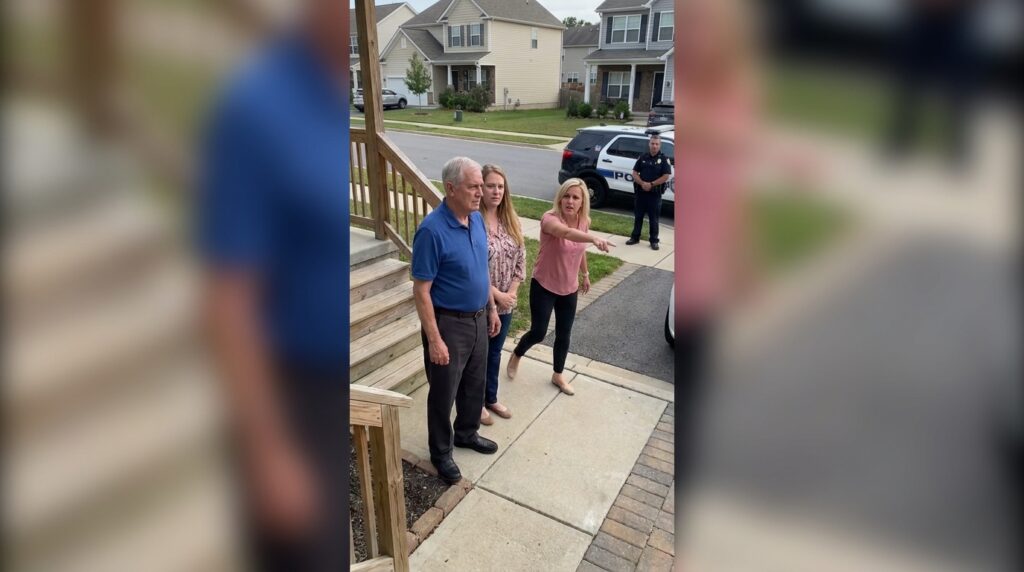
A black-and-white municipal police SUV swung smoothly around the corner of Maplewood Drive. Its tires gave a low, gravelly hum against the asphalt before stopping right beside the curb, perfectly parallel to Arthur’s truck. The driver’s door swung open before the engine even settled into an idle.

Officer Davis stepped out. He was a solid man in his late thirties, wearing a dark blue uniform that showed no creases despite the humidity. His duty belt clicked softly as he moved—handcuffs, radio, sidearm, flashlight—a heavy, methodical weight that carried the immediate, undeniable gravity of municipal law.

He didn’t draw a weapon. He didn’t shout. He moved with a swift, practiced momentum that cut straight across the open curb lane.

Before Brenda could thrust her hand out again, Officer Davis inserted his solid frame directly into the narrow gap on the walkway between Brenda and Arthur.

Without making contact, Officer Davis extended a broad, low open palm straight toward the center of Brenda’s pink top, creating an impenetrable wall of air two inches from her chest.

“Back up now,” Officer Davis commanded. His voice wasn’t loud, but it possessed a dense, clipped authority that shattered the suburban air. “Everyone stays calm while I handle this.”

Brenda’s momentum slammed into a dead stop. Her eyes dilated behind her glasses as she stared at the officer’s dark blue sleeve, her pointing finger freezing mid-air before dropping limp to her side.

“Officer!” Brenda gasped, her voice trembling with a mixture of shock and indignation as she took an involuntary step backward off Arthur’s walkway, her heel hitting the turf edge. “You need to cite him immediately! He’s trespassing on my private utility easement and refusing to clear the access route!”

Officer Davis didn’t turn his head. His eyes remained locked on Brenda, his posture immovably centered between the two property lines.

“Ma’am, I said step back,” Officer Davis repeated, his tone dropping an octave lower, cold and completely unbothered by her outrage. “You are standing on his walkway. Step onto the public curb right now.”

Arthur stood perfectly still behind the officer’s shoulder, feeling the deep, silent shift in the air. The long months of notes, orange cones, and public shouting had just run headfirst into a wall that no fake deed could tear down.

CHAPTER 6: THE RETREAT TO THE CURB

“I am not standing on his curb, Officer! I am standing on my easement!”

Brenda’s voice rang thin and brittle, her sneakers skidding back two inches over the dry concrete slab as Officer Davis held his position between them. Her hands shook, fingers clutching the yellowed 1978 deed copy so hard the paper crumpled along its aged seams.

Officer Davis didn’t raise his arm again. He didn’t need to. His frame occupied the full width of the walkway, blocking her vision of Arthur entirely.

“Ma’am, I’m only going to tell you one more time,” Davis said, his tone dropping into a flat, professional register that signaled the end of any conversation. “You are on private residential property without an invitation, blocking a homeowner’s path. Step back onto the public asphalt now.”

Brenda looked at the officer’s dark uniform, then past his shoulder at Arthur, who stood unmoving beside Clara. The silence along Maplewood Drive felt dense, suffocating. Across the street, Mr. Henderson had turned off his push mower entirely, leaning over the handlebars to watch.

“He is violating municipal parking code!” Brenda insisted, though her boots took two shuffling steps backward, off the walkway and onto the dry turf edge. “He has an unregistered utility trailer, and he is parking on a designated access strip!”

Officer Davis turned his head slightly, unhooking a heavy leather-bound notepad from his duty belt. “I ran his plate before I stepped out of the cruiser, ma’am. The Ford F-150 is current, registered, and lawfully parked on a public municipal street. There are no marked parking restrictions on Maplewood Drive.”

“I have the original developer grant!” Brenda thrust the yellowed paper forward, her voice rising in a desperate, cracking cadence. “Look at it! Lot 12 holds the private utility reserve!”

Officer Davis didn’t reach for the paper. He stepped past her, walking toward the hood of his patrol car. From his front seat, he retrieved a thick, spiral-bound blue binder—the municipal GIS infrastructure registry updated every five years by the county surveyor.

He laid the binder flat across the warm hood of the cruiser, flipping past two laminated divider tabs until he reached the parcel map for Phase II.

“You’re holding a 1978 preliminary subdivision draft,” Davis said, pointing a gloved pen at a solid red line running along the curb. “In July of 1994, the township council passed Ordinance 402 during the drainage modernization. The developer dedicated the outer ten feet of all residential lots along this curb line directly to the public domain. It’s public street right-of-way, ma’am. Has been for thirty-two years.”

Brenda stared at the blue map laid out on the hot hood. Her mouth opened, then closed. The yellow onion-skin paper in her hand fluttered in the light summer breeze, looking suddenly fragile, ancient, and entirely useless. The decoy authority she had wielded over the street for eighteen months didn’t just bend—it dissolved into thin air under the weight of thirty-two years of municipal record.

“This… this is an infringement on my property valuation,” Brenda stammered, her face turning pale as she backed another step into the street lane, her sneakers touching the asphalt near her orange traffic cones. “I am filing a formal grievance with the town board.”

“That is your right,” Officer Davis said, closing the blue binder with a heavy, muted thud that echoed off the hood. “However, if I am dispatched back to this block for you blocking this walkway, placing unauthorized markers in the public road, or harassing these residents, I will write you a citation for disorderly conduct and public obstruction on the spot.”

Brenda’s posture collapsed inward. Her rigid spine sagged, the bright pink top suddenly looking cheap and out of place against the quiet, gray suburban street. She looked around—at the officer, at Arthur, and at the three neighbors watching openly from their lawns.

Realizing there was no audience left to command, she lifted one hand in a weak, bitter gesture of protest.

“Fine,” Brenda snapped, her voice barely carrying past the bumper of the cruiser as she turned her back to them. “Fine, but document this right now!”

She marched across the asphalt, her head down, her sneakers kicking one of her own orange traffic cones out of her path as she retreated up her driveway and disappeared inside her front door.

Officer Davis stood by his car until the heavy oak door of 145 slammed shut. Then he turned around, taking off his cap to wipe his forehead with the back of his forearm. He looked over at Arthur, a quiet, knowing nod passing between the two men—a tacit acknowledgment of thirty years of quiet labor, solid concrete, and boundaries that finally held.

CHAPTER 7: THE EVENING GRAIN

The heavy slam of Brenda’s front door echoed down the length of Maplewood Drive before slowly dissolving into the hum of late-afternoon cicadas.

Officer Davis tucked his blue GIS binder back beneath his arm, his radio giving a soft, static squawk as he hooked it back onto his shoulder strap. He walked around the hood of his cruiser, his heavy boots making a dry, crunching sound on the small pebbles scattered near the curb line.

“Mr. Miller,” Officer Davis said, stopping two feet from the edge of Arthur’s lawn. He rested his hands lightly on his duty belt, his posture relaxed now that the immediate friction had cleared. “I logged the incident in the municipal call sheet. If she places those traffic cones back in the driving lane or steps back onto your walkway, call dispatch directly. Don’t engage her.”

Arthur nodded once, a slow, grounded movement. “Appreciate it, Officer. Safe afternoon.”

“Have a good evening, folks,” Davis said, nodding respectfully toward Clara before climbing into the black-and-white SUV. The engine purred to life, and the cruiser pulled smoothly away from the curb, its tires rolling over the precise strip of street asphalt Brenda had tried so desperately to claim.

For a long moment, nobody moved. The street lay still under the lengthening oak shadows. The heat of the day was finally breaking, replaced by the cool, damp scent of evening grass settling over the suburban lawns.

Then, from two houses down, the sputtering cough of a small engine broke the silence. Mr. Henderson pulled his push mower back onto his grass, but he didn’t start cutting again. Instead, he let the motor idle down, wiped his brow with a blue bandanna, and walked slowly toward the property line.

Further up the cul-de-sac, Mrs. Higgins stepped off her porch, her hand holding her newly shimmed railing for support as she watched the street.

Henderson reached the edge of Arthur’s driveway, his work boots stained dark green with grass clippings. He looked across the street at the dark, silent windows of 145, then down at the two orange traffic cones Brenda had left sitting uselessly in the curb gutter.

“Never did like those cones,” Henderson said softly, his voice gravelly from years of yard work. “Told her three weeks ago that my son parks his sedan on this street when he visits for Sunday dinner. She told him he was trespassing on her access corridor.”

Arthur stepped down off his walkway, his boots making a quiet sound against the gravel. “She was holding an old paper, Tom. People hold onto an old paper long enough, they start thinking the world stopped spinning the day it was printed.”

“Well, it didn’t stop in seventy-eight,” Henderson grunted, reaching down with one calloused hand to lift the middle traffic cone. He tossed it lightly into the grass near Brenda’s property marker, clear of the street entirely. “And it sure as hell didn’t stop today.”

Clara walked down to join them, her linen apron rustling softly in the cool breeze that blew down from the oak grove. She didn’t say anything, but her hand slid naturally around Arthur’s forearm, her fingers resting against the faded blue sleeve of his polo shirt. The tension that had held her shoulders tight for eighteen months was gone, replaced by a quiet, steady calm.

Arthur reached into his trouser pocket, his fingers closing over his copper measuring tape. He pulled it out and looked at the worn brass casing.

He walked two steps toward the edge of his grass, where the lawn met the concrete curb. With his boot, he nudged aside a clump of overgrown Bermuda turf, revealing a heavy cast-iron utility cap set flush into the soil. Stamped into the rusted iron surface were five simple words: PROPERTY OF TOWNSHIP WATER – 1994.

He had been thirty-two when he helped lay the pipe beneath that cap. He had stood right here in the red mud, holding the tape while the city surveyor set the pins.

Brenda Vance had looked at the street and seen an obstacle—a piece of land to hoard, measure, and weaponize against her neighbors. But Arthur knew the real truth of Maplewood Drive. A street wasn’t held together by deeds or orange cones. It was held together by the quiet, unwritten agreements between people who had to live side by side long after the concrete dried.

“Come inside, Artie,” Clara murmured softly, her thumb brushing his wrist. “The roast is ready.”

Arthur looked across the street one last time. The curtains at 145 were still, the house silent under the shadow of its oversized SUV. He didn’t feel anger, nor did he feel triumph. He felt only the deep, familiar weight of his home, his land, and the unshakeable boundary of a law that had stood firm for thirty-two years.

He slipped the brass tape measure back into his pocket, turned his back to the curb, and walked up his concrete path beside his wife, leaving the street wide, open, and clear for everyone.

Similar Posts

Leave a Reply

Your email address will not be published. Required fields are marked *