The Iron Beneath the Snow and the Long Shadow of Maple Drive

CHAPTER 1: THE BOUNDARY AT MAPLE DRIVE

“Move that car now, it does not stay on my property!”

The voice hit the windshield like thrown gravel, sharp and high against the low thrum of the idling V6 engine.

Mark Vance didn’t turn off the ignition. His heavy leather work gloves remained wrapped around the steering wheel of the silver sedan, the leather stiffened by the three-degree air settling over Maple Drive. Through the sweep of the wipers, the world was reduced to shades of gray, white, and a single violent slash of crimson.

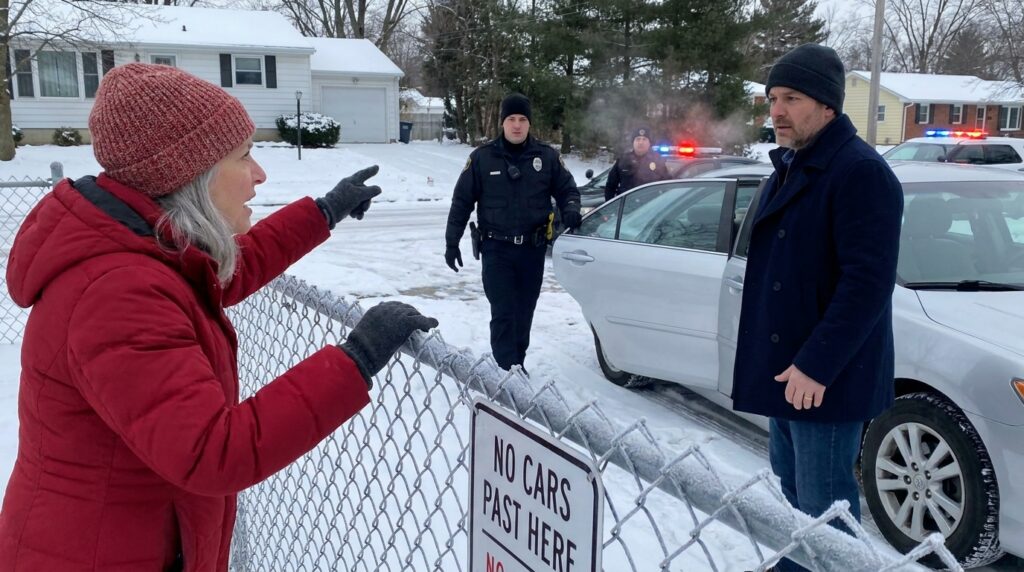
Brenda Higgins stood on the frozen dirt lane, framed by the cold zinc of the chain-link fence. Her red winter coat was a beacon in the storm, the dark fabric of her snow pants caked with slush near the boots. Her gloved fingers were threaded through the wire mesh, pulling the gate taut, her body positioned dead center in the only tire ruts that cleared the snowbank.

Wired to the top rail of the fence was a square of raw plywood, the black paint fresh enough that the fumes cut through the smell of pine and diesel exhaust.

NO CARS PAST HERE.

Mark let out a slow breath, the air rising in a thin plume inside the cold cabin. He shifted into park, pulled the handbrake until the ratchets clicked six times, and opened the driver’s door. The arctic air hit him instantly, biting at his clean-shaven jaw and pinning the navy fabric of his coat against his chest.

“Brenda,” Mark said. His voice was low, flat, carrying the dry rasp of a man who spent his days looking at framing squares and concrete footings rather than arguing across property lines. “It’s four in the afternoon. The plow is coming down the main road in an hour. Step aside so I can get the car to the rear garage.”

“You don’t have a garage past this line!” Brenda snapped. She didn’t let go of the chain-link. Her gray hair poked out from under a red-and-black knit beanie, her lined face pinched tight with a satisfaction that looked almost ceremonial. In her left hand, clutched against her chest like an armor plate, was a thick yellow plastic folder and a metal clipboard. “This lane is listed on my tax assessment as Private Parcel 4B. You’ve been driving over my drainage bed for six years, Mark. It ends today. Read the board.”

“I don’t need to read the board,” Mark said, stepping down onto the packed gray ice. He didn’t rush his movement. He took three deliberate steps toward the front bumper, his work boots crunching into the frozen slush. He stopped four feet short of the gate—far enough to keep his frame clear of the mesh, close enough that she had to tilt her head back to meet his eyes. “This driveway is a deeded easement, Brenda. You don’t have the legal authority to close it.”

“I have the deed right here!” She slapped the clipboard with her gloved palm, the sound like a gunshot in the quiet, snow-muffled street. “City code says non-conforming access points can be revoked by the primary titleholder if structural damage is present! Look at the curb, Mark! Look at the asphalt!”

Mark’s eyes didn’t drop to the curb. He knew every crack in the asphalt better than she did; he’d cold-patched three feet of it himself two summers ago when the municipal water crew left it rutted.

Instead, his gaze settled on the edge of the plywood sign. Beneath the rough hand-lettering, half-tucked behind the top wire of the gate, was a fresh piece of official white paper, secured with heavy blue painter’s tape. The red seal of the County Registrar caught the faint amber glow of the streetlamp turning on overhead.

Mark reached into his coat pocket for his gloves, his knuckles white against the dark leather. “What did you tape to my fence gate, Brenda?”

“It’s not your fence,” she said, her voice dropping into a razor-thin smile as she reached for her coat pocket and pulled out a ringing smartphone. “And you’re about to find out whose street this really is.”

CHAPTER 2: THE COLD IRON AT THE GATE

Brenda didn’t wait for a response. She pressed the smartphone to her ear, her gloved thumb smudging the glass screen. “Yes, dispatch? I need a unit at 412 Maple Drive. Immediately. I have a party actively trespassing on my private driveway parcel, refusing to clear the right-of-way, and obstructing municipal property lines.”

Mark stood motionless in the snow. He didn’t shout. He didn’t reach for his own phone. Decades of working construction had taught him that when a structure was shifting under pressure, you didn’t kick the framing; you inspected the load-bearing points.

His eyes stayed fixed on the paper taped beneath the plywood board.

The red seal of the County Registrar wasn’t a photocopy. It was embossed, the heavy paper crimped and stiffened by cold, bleeding slightly where snow hit the top edge. But it wasn’t a trespass warrant. Mark knew the typeface of the city building inspector’s office—12-point Courier, printed on dot-matrix or cheap laser stock from the municipal basement.

“He’s standing right at my gate,” Brenda continued into the receiver, her voice rising half an octave to ensure it carried over the engine idle of Mark’s sedan. “He’s making threats, dispatch. He’s claiming he owns the land.”

Mark stepped closer to the chain-link mesh. The zinc was freezing, coated in a micro-thin glaze of clear ice that cracked under his leather work gloves as he touched the top rail.

“You called code enforcement three weeks ago, didn’t you, Brenda?” Mark asked, his voice steady, low enough that the phone mic wouldn’t pick it up cleanly.

Brenda lowered the phone an inch, her eyes narrowing beneath the brim of her red beanie. “I filed a formal complaint regarding heavy vehicle degradation of residential sub-grades. This lane was never rated for three-ton commercial vehicles.”

“This is a 2014 silver sedan,” Mark said, tapping his knuckle against the door frame of his car. “It weighs thirty-four hundred pounds. My work truck stays at the yard on Industrial Parkway.”

“It’s the precedent!” she hissed, snapping the phone shut and slipping it back into her pocket with a final, decisive movement. “You drive your tools in here. You had a gravel delivery last May. You’ve compromised the drainage bed that feeds my retaining wall.”

“That gravel went into my drainage trench,” Mark said. “The one your husband helped me dig in 1998.”

A flicker of something dark and sharp passed across Brenda’s lined face—a brief fracture in the rigid armor of her red coat—before her jaw set hard again. Her late husband, Arthur, had been a surveyor for the county before his lungs failed him six years ago. He was the man who had walked the boundary line with Mark, holding the prism pole while Mark drove the three-foot steel rebar pins into the clay with a sledgehammer.

“Arthur isn’t here,” Brenda said, her voice dropping into a cold, flat register that matched the grey sky above them. “And the county records don’t care about memory. They care about title chains.”

Mark reached toward the taped paper on the gate. He didn’t tear it—he knew better than to touch evidence on an disputed boundary—but he tilted his head to read the bottom line exposed beneath the blue painter’s tape.

NOTICE OF INTENT TO VACATE UNAUTHORIZED EASEMENT – PRELIMINARY FILING 402-B.

It wasn’t an order. It was a preliminary filing receipt—a clerk’s stamp acknowledging that Brenda Higgins had paid seventy-five dollars at the county courthouse to start a civil review process. She had taken the receipt, taped it to a piece of plywood, and presented it as a police-backed eviction.

“You paid the clerk on Tuesday,” Mark said quietly. “You didn’t get an injunction. You got a filing number.”

“It’s an official record!” she snapped, gripping the fence mesh tighter until the dark fabric of her gloves bulged through the links. “And until a judge tells me otherwise, this gate stays locked!”

Down at the corner of Maple and 4th, the low, rhythmic thrum of an engine cut through the muffled quiet of the snowfall. It wasn’t the city snowplow.

A flash of blue and red light reflected off the icy power lines overhead, painting the gray snowdrifts in rhythmic, mechanical pulses. The police cruiser turned onto the street slowly, its tires crunching heavily over the unplowed slush, heading straight for the gap in the fence where Mark’s silver sedan sat idling.

Brenda straightened her back, adjusted her clipboard, and stepped right up to the edge of the gate line, her red coat standing out against the white landscape like a flare.

“Now,” she whispered across the wire, her breath rising in a sharp white plume. “Tell the officer about your easement.”

Mark didn’t move away from his car door. He reached inside, popped the latch on the glove compartment, and pulled out a thick, faded yellow folder bound with a rubber band. He didn’t open it yet. He just held it in his gloved hand, feeling the familiar weight of the laminated cardstock inside—the original plat map Arthur Higgins had signed twenty-eight years ago.

The cruiser’s brakes squealed softly as it pulled to a stop behind the silver sedan, its emergency lights flashing against the frozen chain-link.

CHAPTER 3: THE PAPER BARRIER

The cruiser’s engine rumble filled the gap between the two houses, the radiator fan blowing a warm, metallic haze across the snow-dusted hood of Mark’s sedan. The driver’s side door swung open, the heavy hinge groaning softly under the weight of winter ice, and Officer Miller stepped out into the biting wind.

He was a solid man in his late thirties, his black police winter jacket stiffened by the heavy duty belt at his waist. He didn’t unholster anything, nor did he reach for his baton, but his gloved hand rested lightly near his side as his boots crunched through the fresh slush. Behind the cruiser, Officer Jenkins emerged from the passenger side, staying back near the rear fender to observe the line of sight down Maple Drive.

Brenda didn’t wait for Miller to close his door. She took two steps forward along her side of the fence, thrusting her clipboard through a gap above the chain-link mesh like a shield.

“Officer! I am the property owner at 412 Maple,” she announced, her voice pitched to cut through the idle of both engines. “I filed a formal complaint regarding an illegal access trespass. That vehicle is currently blocking my access gate and violating a posted municipal weight restriction notice.”

Officer Miller didn’t look at the clipboard first. His eyes swept the scene—the silver sedan sitting square in the middle of the tire ruts, the hand-painted plywood sign wired to the gate, the red emergency lights painting the snow-laden pine branches in rhythm, and Mark standing still by his open door with a faded yellow folder in hand.

“Good afternoon, ma’am. Mr. Vance,” Miller said, his voice flat and calibrated to de-escalate. He paused three feet from the fence line, his breath rising in a quick, dense plume. “Dispatcher said we had a dispute over a blocked driveway.”

“It isn’t a dispute, Officer, it’s a code violation,” Brenda countered sharply, tapping the yellow plastic folder in her arm. “I have the municipal filing right here. Section 14-B of the city code dictates that private residential lanes cannot support commercial-grade axle weights without an engineer’s drainage certification. He’s been hauling heavy construction gear into his back yard for years, ruining the sub-grade. I’ve officially revoked permission to cross my land.”

Mark stepped forward, keeping his hands low and visible, the yellow folder held loosely at his hip. “Officer, this is a deeded easement created in 1996 when the parcel was split. It’s registered with the county land office. She doesn’t have the legal authority to revoke a recorded right-of-way with a seventy-five-dollar preliminary filing.”

“It’s a city ordinance!” Brenda shouted, her voice cracking against the cold air. “City law overrides private agreements when structural damage is involved! Look at the notice taped right there! That’s an official municipal seal!”

Miller stepped closer to the gate, his boots digging into the ice. He reached out with one gloved hand and tilted the paper taped below the wooden board. His eyes scanned the red seal, then moved to a handwritten line in blue ink beneath the printed heading: Code Enforcement Citation #882-W: Pending Weight Review.

“This isn’t a stop-work order, Mrs. Higgins,” Miller said softly, his eyes shifting back to Brenda. “This is a notice of a scheduled review by the city engineer’s office. It doesn’t grant authority to obstruct a road or erect an unpermitted barrier across an existing driveway.”

“It gives me the right to protect my property until the hearing!” Brenda insisted, her gloved fingers clenching into a tight fist against her clipboard. “He is destroying the sub-grade! Look at the paper—it explicitly cites structural compromise of the drainage bed!”

Mark watched her closely. Her knuckles were white where her gloves met the plastic edge. He knew that municipal citation number. It wasn’t a standard residential complaint; it was a specific, technical code reference that only someone who had spent decades reviewing county survey filings would know how to request.

“Show him the back page, Brenda,” Mark said calmly.

Brenda froze, her body stiffening inside the red coat. “What?”

“The yellow folder,” Mark continued, his voice dropping into a quiet, unwavering frequency. “The second page of the filing you made on Tuesday. You didn’t just ask for a weight review. You attached the 2004 municipal zoning map revision, didn’t you? The one that tried to reclassify rear access roads as secondary alleyways.”

Miller looked between the two of them, his brow furrowing slightly under his black knit cap. “Mr. Vance, what are you talking about?”

“She thinks the city zoning update from twenty years ago voided the private easement agreements in this subdivision,” Mark explained, taking another step toward the fence. “She filed the weight complaint based on an outdated zoning draft that was never adopted by the county board. That paper on the gate is relying on a rule that doesn’t exist.”

Brenda’s chest heaved once, a sharp, ragged intake of freezing air. “It was passed by the planning commission! Arthur kept the records! I have the signed minutes!”

“The planning commission recommended it, Brenda,” Mark said softly. “The county board voted it down six to one. Arthur knew that. He was in the room when they struck it down.”

Silence fell over the driveway, heavy and absolute, broken only by the steady, muffled thump-thump of the police cruiser’s exhaust. Officer Miller turned to Mark, his expression turning sharp and analytical.

“Mr. Vance,” Miller said, extending a hand. “Let me see what you have in that yellow folder.”

Mark pulled the rubber band off the faded paper and handed the laminated document across the cold galvanized wire of the fence.

CHAPTER 4: THE RED LIGHT ON THE PLX

Officer Miller took the laminated yellow folder across the top rail of the fence. His leather gloves made a dry, rasping sound against the stiff plastic coating.

Behind them, Officer Jenkins shifted his boots in the snow, his eyes scanning the windows of the neighboring houses along Maple Drive. A curtain twitched at number 408. Someone was watching from behind double-pane glass, but no one stepped out into the bitter air.

Miller unrolled the plastic document, holding it up so the strobing red-and-blue wash of the patrol car lights illuminated the black ink lines. The paper inside was yellowed at the margins, preserved beneath a clear, heavy-gauge heat laminate that had kept out twenty-eight winters of moisture.

“State Plat Map 96-C,” Miller read aloud, his voice clipped and neutral. His thumb rested over a bold black square marking the rear lot. “Deed Book 412, Page 88. ‘A perpetual non-exclusive right-of-way for ingress, egress, and utility maintenance over the northern twelve feet of Lot 4B.'”

“That was recorded before the 2004 municipal zoning update!” Brenda interjected, her boots crunching as she shuffled sideways along the fence line, trying to peer over Miller’s forearm. “You can’t rely on a 1996 filing when municipal code 14-B establishes weight limits for unpaved sub-grades! The city engineer’s office stamped my review request on Tuesday!”

“She’s right about the stamp, Officer,” Mark said, taking a step closer. The wind caught the open door of his silver sedan, making the metal latch groan against the ice build-up on the frame. “The city gave her a filing stamp. But look at the bottom right corner of that plat map. Below Arthur Higgins’s signature.”

Miller tilted the document down, angling it toward the headlights of his cruiser.

There, pressed into the thick paper before it had been encased in plastic, was an embossed circular seal. It wasn’t the city planning commission’s mark. It was the seal of the County Board of Commissioners, stamped in heavy, raised iron lettering, accompanied by a handwritten notation in faded black ink: Permanent Covenant Run with the Land—Grandfathered Partition Exemption.

“The weight restriction notice she taped to the gate is a decoy,” Mark continued, his voice firm, level, unhurried. “Section 14-B applies to newly dedicated public alleys. It doesn’t touch grandfathered private access covenants recorded under county partition acts. She used a city clerk’s intake receipt to make it look like an enforcement order.”

Brenda’s hands shook where they held the clipboard against her coat. “The drainage bed is cracking, Mark! The water runs down from your garage roof and freezes against my basement wall! Every time you drive over that dirt, you pack the clay down further, and the runoff has nowhere to go!”

Mark looked at her for a long second. The anger wasn’t there; what remained was the cold, unyielding reality of the earth beneath them.

“I offered to install an underground French drain along the property line three years ago, Brenda,” Mark said. “I bought the perforated pipe. I bought the washed stone. You told me if I set one foot on your side of the chain-link with a shovel, you’d call the sheriff.”

“Because you were trying to alter the boundary line!” she cried, her voice echoing down the silent, snow-choked street. “You wanted to lay pipe across Parcel 4B so you could claim adverse possession after ten years!”

Officer Miller raised his left hand, palm outward, taking two deliberate steps toward the center of the gate lane. His body position subtly blocked Brenda’s view of Mark.

“Ma’am,” Miller said, his tone dropping an octave into absolute authority. “Step back from the fence.”

Brenda blinked, her mouth opening slightly. “Officer—”

“Step back from the fence, ma’am,” Miller repeated, his hand remaining up. “Right now.”

She hesitated for a split second, her eyes darting to Officer Jenkins standing near the patrol car, then back to Miller’s face. Slowly, reluctantly, her boots dragged through the slush as she took two paces back into her snowy yard.

Miller turned his full attention to the wooden sign wired to the gate. He reached up, took hold of the plywood board, and gave it a firm tug. The rusted wire creaked under the tension, the blue painter’s tape holding the municipal notice tearing down the middle as the paper fluttered in the cold wind.

“Mr. Vance,” Miller said, looking over his shoulder at Mark. “Where are the physical survey pins for this easement located?”

Mark reached into his coat pocket and pulled out a small, heavy brass wire brush and an orange-handled trenching trowel.

“Six inches past the corner post,” Mark said, pointing his gloved finger at the base of the galvanized fence post buried in the snowbank. “Right under the frost line.”

CHAPTER 5: THE COLD ARCHIVE

Officer Miller took the trowel from Mark’s hand. He didn’t ask questions; he simply knelt down in the slush, his thick duty trousers tightening across his knees as his boots dug into the frozen gravel.

“Officer!” Brenda took a sharp step forward from the snowbank, her clipboard clutched against her chest like a weapon. “You have no legal right to alter or excavate my property line without a court order! That ground belongs to Lot 4B!”

“Ma’am, step back behind the fence line,” Officer Miller said without looking up, his tone dropping into a flat, unyielding register. “I’m not excavating. I’m verifying physical survey markers cited in a recorded county plat.”

He drove the tip of the orange-handled trowel into the hard-packed crust near the base of the galvanized fence post. The ice cracked with a sound like snapping glass. Miller scraped away three inches of gray, salt-crusted snow, revealing the frozen dark clay beneath. He worked Methodically, clearing a eight-inch circle around the galvanized steel post, the trowel scraping against buried river rock and gravel.

Mark stayed back near the door of his silver sedan, his hands resting on the top of the open window frame. His leather gloves were stiff from the wind, the cold seeping through the lining to chill his knuckles. Across the yard, behind the parted blinds of 408 Maple, a second silhouette appeared in the window—younger, phone held up against the glass, recording the strobing red lights against the snowbank.

“There’s nothing down there!” Brenda shouted, her voice thin and raspy in the arctic air. Her gray hair was coming loose from beneath her beanie, whipping across her forehead. “The fence was set thirty years ago! The fence is the boundary!”

“Fences move, Mrs. Higgins,” Miller said calmly. He switched to the brass wire brush, scrubbing the dense soil away from a dull metallic crown buried six inches beneath the surface grade. “Survey pins don’t.”

The wire bristles rasped against metal. A glint of dark gray iron broke through the red clay. Miller cleared the surrounding dirt until a solid three-quarter-inch steel rebar cylinder was fully exposed, its top flattened and stamped with a crosshair cut deep into the metal. Beside the pin, a weathered square of orange surveyor’s ribbon, faded to a pale straw color by decades in the earth, clung stubbornly to the iron shaft.

Miller reached down, his gloved thumb tracing the crosshair. He pulled a folding steel tape measure from his belt pocket, hooked the lip against the center of the iron pin, and extended the rigid yellow blade straight across the gate lane to the corner of Mark’s gravel bed.

“Twelve feet, zero inches,” Miller stated, his voice carrying clearly over the idle of his cruiser. “Exact measure to the deeded right-of-way line.”

Brenda’s jaw tightened until the muscles along her neck stood out like wires under her skin. “That pin was set by my husband! He wasn’t a licensed county surveyor when he drove that rod! It has no legal standing!”

Mark took a slow, deliberate breath, the cold burning his lungs. “Arthur was a licensed deputy surveyor for twenty-two years, Brenda. You know that. His seal is on the 1996 plat map Officer Miller is holding.”

“He didn’t have the authority to grant you an easement on our family land!” She took two strides toward Miller, her hand pointing violently at the exposed iron pin. “He did that as a favor to your father! It was a personal agreement between two men who are both dead! It died with them!”

Officer Miller stood up slowly, brushing the frozen dirt from his knees. He looked down at the exposed rebar, then back at the yellow plastic folder in his hand, his eyes cold and analytical.

“A deeded easement running with the land doesn’t die with the signatories, Mrs. Higgins,” Miller said, turning his body to face her directly. “And this notice you taped to the gate—it claims this lane is a private residential walkway with no recorded vehicular access.”

“It is a walkway!” she insisted, her voice rising to a near-screaming pitch as her eyes darted to the cruiser’s flashing lights.

“It isn’t,” Miller replied flatly. He held up the laminated plat map, pointing his gloved finger at the embossed seal of the County Board. “This seal certifies a perpetual vehicular easement. You taped a false notice to a gate on a public-adjacent right-of-way, blocked a legal access route, and called 911 to enforce a private restriction that does not exist in law.”

“I am protecting my home!” Brenda cried, her chest heaving as she pulled her red coat tighter around her shoulders. “He has no right to drive through here!”

“Ma’am,” Miller said, taking a step toward her, his posture rigid and commanding. “If you do not unhook that chain and remove that sign right now, I will cite you for filing a false police report and obstructing a lawful easement.”

Brenda stared at Miller, her face pale against the backdrop of the gray winter sky. Her gloved hands trembled on her clipboard, the yellow papers fluttering wildly in the sudden gust of wind that swept down Maple Drive.

CHAPTER 6: THE SHADOW OF THE PARCEL

The wind whipped down the alley between 408 and 412 Maple Drive, driving fine powder snow horizontally across the zinc wire. Brenda’s hand hovered three inches above her clipboard. Her red coat puffed out as she drew in a ragged breath, the arctic air rattling in her chest.

“I called you to enforce municipal order,” she said, her voice dropping into a desperate, razor-thin pitch. “Not to hand over my property line to a contractor who turns my lane into a staging ground.”

“Mrs. Higgins,” Officer Miller said, stepping closer until his shadow crossed hers over the cleared dirt pit. “You didn’t call for code enforcement. You called 911 and reported an active criminal trespasser on land you knew was subject to a recorded county easement. That is a misdemeanor under State Code 18-A.”

Behind Miller, Officer Jenkins took two slow steps toward the gate, unhooking a pair of heavy wire cutters from his utility belt loop. The cold steel of the tool clinked against his duty belt buckle, sharp and metallic in the quiet lane.

Brenda’s eyes darted from Jenkins’s hands to the exposed iron rebar pin at Miller’s boots. The crosshair stamped into the steel sixty years ago sat bare, unyielding, surrounded by scraped clay and ice. Her gloved fingers tightened until the yellow plastic folder under her arm bowed under the pressure.

“He’s going to ruin the grade,” she whispered, the defiant glare in her eyes giving way to something older, brittle, and gray. “If he drives over it every day, the water collects against my basement wall. Arthur promised me before he died that I wouldn’t have to rebuild that foundation alone.”

Mark didn’t move from his car door, but his posture softened slightly. He looked at the frost-cracked concrete foundation rising eighteen inches above the snowbank on her side of the fence.

“The drainage problem isn’t from my car, Brenda,” Mark said softly, his voice cutting under the whistle of the wind. “The municipal storm drain at 4th Street backed up four years ago when the city paved the upper cul-de-sac. The water runs down the public curb and pools against your gate because the street crown shifted. Arthur knew that too. That’s why he drew the easement twelve feet wide instead of ten—so there’d be room for a swale on the north edge.”

Brenda stared at him, her lips parted, the cold wind freezing the moisture on her eyelashes. “He… he drew it twelve feet?”

“It’s on Page Two of the plat map Officer Miller is holding,” Mark said, pointing a leather-gloved finger at the yellowed paper encased in plastic. “Arthur wrote the swale specification in red ink. He reserved two feet for a gravel drainage trench along the fence line. You don’t have to fix the foundation alone, Brenda. The trench was supposed to be built by whoever held the rear deed. That’s me.”

Officer Miller looked down at the map, his gloved thumb brushing over the fine red script along the margin of Lot 4B. He looked up at Brenda, his face grim but devoid of malice.

“The easement isn’t just a right-of-way, Mrs. Higgins,” Miller said quietly. “It’s a recorded maintenance agreement. Mr. Vance is legally obligated to maintain the drainage grade for both properties.”

Brenda stood motionless. The clipboard slipped an inch in her grip, the yellow paper fluttering against the red fabric of her coat. She looked at the wooden “NO CARS PAST HERE” sign wired to the gate, then down at the blue painter’s tape holding her seventy-five-dollar filing receipt.

“It… it was seventy-five dollars,” she muttered, her voice barely audible over the idle of the police cruiser. “The clerk told me it showed intent.”

“Intent doesn’t override a deeded covenant, ma’am,” Miller said. He turned to Officer Jenkins and gave a single, firm nod. “Take the sign down.”

Jenkins stepped up to the chain-link fence, set the jaws of the wire cutters against the twist of baling wire holding the plywood board, and squeezed. The cold wire snapped with a loud, metallic clink, dropping the wooden sign into the snowbank. He snipped the second wire, and the board fell flat into the slush, face down, burying the hand-lettered paint under white powder.

Brenda didn’t scream. She didn’t reach for her phone. She simply stepped back three paces, her boots sinking deep into the snow drift beside her porch steps, watching as Jenkins pushed the galvanized chain-link gate open until it clicked against the retaining post.

The twelve-foot driveway lay open, cleared, the gray gravel beneath the snow leading straight to the rear garage.

“Mr. Vance,” Officer Miller said, handing the laminated plat map back through the driver’s side window of the silver sedan. “You’re clear to park your vehicle.”

Mark took the folder, his fingers cold against the smooth plastic. He looked across the open gate line at Brenda, who stood alone near her porch rail, her red coat bright against the gathering winter dusk.

“I’ll bring the backhoe around on Saturday, Brenda,” Mark said, his voice carrying flat and steady across the snow. “We’ll lay the six-inch perforated pipe and the washed stone along the fence. Just like Arthur drew it.”

Brenda didn’t answer, but she didn’t turn away either. She stood on her porch, her clutched clipboard lowering to her side, as Mark shifted his silver sedan into drive and eased the tires over the open threshold.

CHAPTER 7: THE GROUND BENEATH THE ICE

The tread of the silver sedan’s front tires bit into the unplowed slush past the gate post, the heavy rubber crunching down through three inches of crust until it hit the solid bed of crushed limestone underneath.

Mark didn’t press the accelerator. He let the engine’s idle pull the car forward inch by inch, the vehicle moving through the exact twelve-foot corridor Arthur Higgins had staked out thirty years ago. The side mirror passed four inches from the open chain-link gate. On the passenger seat, the laminated yellow folder rested flat, the red county seal catching the final amber rays of the setting sun filtering through the pine boughs.

Behind him, the mechanical hum of the police cruiser’s engine shifted as Officer Miller placed the patrol car in park. In the rearview mirror, Mark watched Officer Jenkins drop the wire cutters back into his belt holster. Jenkins didn’t kick the fallen plywood board; he nudged it with the toe of his boot so it lay flat against the snowbank, out of the lane’s path.

Officer Miller walked slowly to the edge of the open gate. He didn’t step onto Brenda’s lawn, nor did he enter Mark’s gravel path. He stood precisely on the neutral strip where the public street met the private easement, his heavy winter coat squared against the wind.

Brenda hadn’t moved from the bottom step of her porch. Her gloved hands still held the yellow plastic folder against her red coat, but her shoulders had dropped, the rigid, sharp posture that had held her upright through the afternoon dissolving into the quiet gray dusk. She looked down at the freshly exposed dirt pit near the fence post, where the rusted iron rebar pin sat bare, its stamped crosshair holding the boundary line without a sound.

Mark brought the sedan to a stop beside his rear detached garage, killed the ignition, and pulled the handbrake.

The engine died with a soft shudder. The silence that followed was instant and absolute, the kind of deep, heavy winter quiet that only settles over northern suburban streets after a storm. Mark sat in the cold cabin for a long moment, his gloved hands resting on the steering wheel, his breathing slow and steady.

He opened the car door and stepped out into the freezing air. The gravel crunched under his boots—firm, stable, unyielding.

Officer Miller walked up the cleared edge of the driveway, his boots leaving clean, dark imprints in the slush. He stopped five feet from Mark, his hands resting naturally on his belt.

“We’re filing a formal report on the 911 dispatch, Mr. Vance,” Miller said, his voice quiet, carrying no heat, only the dry, administrative weight of his office. “It’ll record the property line verification and the presence of the grandfathered easement. If there are any further attempts to obstruct this right-of-way or post unauthorized municipal notices, call dispatch directly and cite Incident Report 402.”

Mark nodded, his face calm beneath the brim of his beanie. “Thank you, Officer. I appreciate you taking the time to look at the plat.”

“The plat made it simple,” Miller said, looking back toward the fence where the red light of his cruiser painted the white snow. “The iron in the ground doesn’t lie. Most people forget that before they call us out here.”

Miller turned and walked back down the lane toward his patrol car. As he reached the fence gate, he paused, looking across the lawn at Brenda.

“Mrs. Higgins,” Miller called out, his voice firm across the snow. “Make sure that fence gate stays secured back against the post so it doesn’t swing into the lane during the plow run tonight.”

Brenda didn’t answer with words. She gave a single, small nod, her gloved hand reaching out to touch the wooden handrail of her porch step.

Miller climbed into the cruiser, the door closing with a heavy, airtight thud. The emergency lights cut off, plunging Maple Drive back into the soft, blue-gray twilight of winter. The cruiser backed out slowly, its tires singing softly against the wet asphalt as it turned onto 4th Street and disappeared into the snow.

Mark walked to the front of his car, picked up his trowel and wire brush from the hood where Miller had left them, and walked over to the open gate.

Brenda was still on her porch step, watching him through the gathering shadows.

Mark knelt by the corner post, took the orange-handled trowel, and carefully pushed the cleared clay and gravel back over the iron pin. He didn’t pack it down with his boot; he laid the dirt back gently, covering the rusted crosshair and the faded surveyor’s ribbon, protecting the steel from the frost that would harden the earth before morning.

“The pipe I have in the shed is six-inch perforated PVC, Brenda,” Mark said without looking up from the ground. “It’s heavy-duty, rated for vehicle loads. We’ll trench it two feet deep along the fence line on Saturday. The water won’t touch your foundation again.”

Brenda stood on the wooden step for three long seconds. The wind caught her gray hair, lifting it away from her lined face.

“Arthur always said you had your father’s hands for earthwork,” she said quietly, her voice thin, carrying no fight left in it, only the flat truth of the cold air.

“My father built things to last, Brenda,” Mark said, standing up and brushing the frozen dirt from his gloves. “Arthur did too.”

He turned and walked back toward his rear garage, his boots making a steady, measured rhythm on the stone path. Behind him, the chain-link gate remained open, the twelve-foot easement clear and unobstructed, holding the line between two properties under the quiet, falling snow.

Similar Posts

Leave a Reply

Your email address will not be published. Required fields are marked *