The Iron Perimeter: A Story of Line-Item Law, Rusted Curb Rights, and the Weight of Private Ground

CHAPTER 1: THE FIRST ENCROACHMENT

The air carried the faint, dry scent of iron and cooked asphalt, the kind of heat that made the horizon warp just above the roofs of the subdivision. Behind Marcus, the garage door sat halfway open, revealing the empty concrete floor where the specialized mechanical lifting frame for his son’s physical therapy was supposed to be anchored by noon. Every minute the flatbed spent idling out on the road cost money he had already counted twice against his insurance deductible.

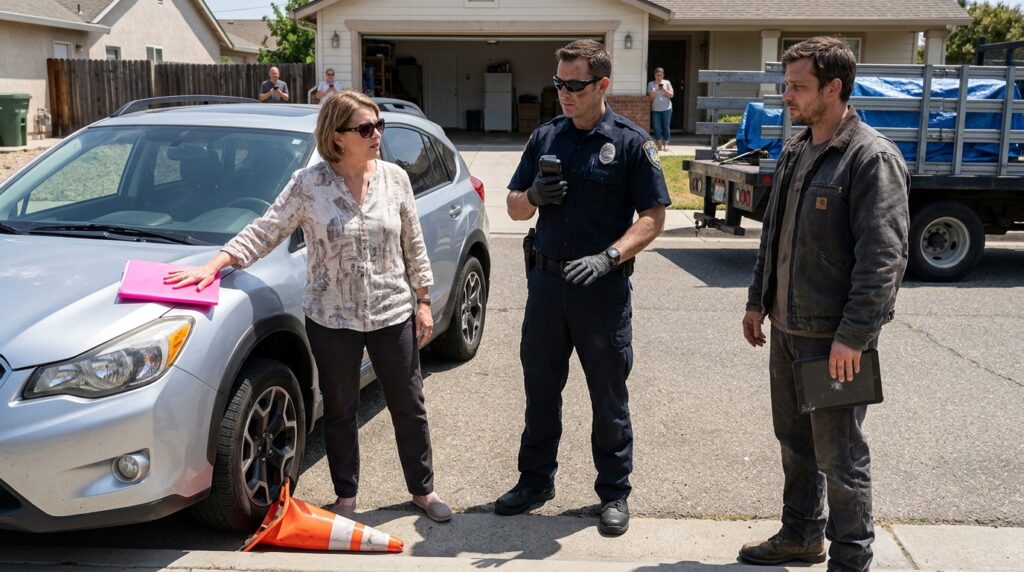
The truck’s air brakes hissed, a violent release of pressure that caused Mrs. Gable’s porch dog down the block to start its rhythmic, hollow barking. Marcus kept his thumb pressed against the glass of his tablet, verifying the digital seal on the city-issued right-of-way permit. Four orange traffic cones, faded from seasons of sun and scratched along their bases, stood like small markers in the gutter, reserving thirty feet of public curb.

Then came the crossover.

It didn’t slow down for the turn. The silver crossover swerved from across the lane, its tires catching the edge of the concrete gutter with a hard, metallic scraping sound that echoed between the houses. The vehicle jerked to a halt directly inside the cone boundary, its front bumper stopping less than three inches from the flatbed’s rear tires, effectively locking the commercial driver out of the approach angle.

The driver’s side door swung open before the engine had even settled into a silence. Brenda Gantry stepped onto the hot asphalt, her posture rigid, her chin tilted up as if she were addressing a courtroom rather than an empty driveway. She wore a patterned linen blouse that seemed too stiff for the humidity, and her oversized sunglasses hid everything but the sharp, pinched line of her mouth. In her left hand, she clutched a neon pink plastic folder like an executioner’s warrant.

“This street is a designated residential corridor, Marcus,” Brenda said, her voice dry, cutting through the low rumble of the truck’s engine without rising to a shout. She didn’t look at him; her eyes were fixed on the truck driver, who was already leaning his arm out of the cab window. “It is not a commercial loading zone for industrial freight. Move this vehicle immediately, or I am having the county dispatcher impound it for public obstruction.”

Marcus didn’t move from his spot on the gravel. He felt the cold weight of the tablet in his palm, the hairline fracture across the protective glass catching the glare of the noon sun. He didn’t look at the pink folder, nor did he look down the block where the click of front screen doors signaled that the first wave of witnesses was taking their places on the porch steps. He looked only at the space between Brenda’s front tire and the orange cone she had crushed beneath her right chassis panel.

“The space is permitted, Brenda,” Marcus said. His voice was sparse, leveled by the long weeks of hospital schedules and technical logistics. “The truck has two hours to offload the frame. Move the car.”

“The association bylaws are explicit about commercial weight limits on neighborhood asphalt,” Brenda replied, her pen tapping a fast, transactional rhythm against the plastic folder. She stepped directly into the path of the truck’s side mirror, her body posture blocking the driver’s clear view of the driveway mouth. “Your private family situation does not give you the right to degrade the infrastructure of this entire block. We have a standard here, and I intend to see it maintained.”

Marcus watched a crow drop onto the top of his mailbox, its black feathers sleek against the desaturated gray of the cedar post. The conflict wasn’t about the road, and they both knew it. Behind Brenda’s sunglasses lay the ledger of a woman who had spent five years treating the neighborhood boundaries as her personal property line.

He lifted the tablet, the screen glowing blue against his work jacket.
CHAPTER 2: THE PAPER BLOCKADE

The tablet felt heavy in Marcus’s hand, its cracked glass slick with the fine layer of road dust kicked up by the crossover’s tires. He didn’t offer the screen to Brenda a second time. Instead, he stepped laterally, angling his body to keep both Brenda’s front bumper and the commercial flatbed’s driver within his peripheral vision. The low, guttural vibration of the diesel engine hummed through the soles of his work boots, a constant reminder of the meter running against his savings.

Brenda did not flinch back. Her fingers shifted against the neon pink plastic folder, the plastic crackling under the sudden pressure of her grip. A small smudge of purple ink was visible along the top margin of the paper tucked inside—the distinct oval of a notary stamp, though the edges were blurred, the text within the ring unreadable from where Marcus stood.

“A digital screen doesn’t override county classification, Marcus,” Brenda said, her voice dropping into a rhythmic, practiced cadence. She took a half-step forward, her leather sandal pressing into the dry grass at the very edge of his ditch line. “I have the environmental division’s watershed buffer brief right here. This entire easement lane is under a dynamic runoff freeze. No heavy axle loads are permitted within thirty feet of the primary culvert until the state inspector signs off on the low-grade soil compaction test.”

Marcus looked down at the pink folder. The paper she was flashing had the official county typeface, but the layout was wrong; the spacing at the header was too wide, and the municipal seal lacked the crisp indentation of a modern city document. It was an old form, weaponized with a fresh coat of jargon.

“The culvert is reinforced concrete, rated for twenty tons,” Marcus said, his tone flat, stripped of any emotional color. “The county engineer logged the certificate three months ago when they cleared the deep-trench line. If you have a watershed freeze, Brenda, it needs a certified case number from the district clerk.”

Brenda’s mouth tightened until her lips almost disappeared into a pale line. “The case number is pending the secondary review, which my committee requested forty-eight hours ago. Until that board meets, the status quo remains locked. The driver handles his vehicle at his own legal peril.”

Behind her, on the opposite side of Elm Street, the neighborhood was beginning to solidify. Mr. Henderson had walked down his concrete path, his hands shoved deep into the pockets of his faded shorts, his eyes drifting between the massive flatbed and the silver crossover. Two more residents from the corner house stood near the curb, their faces desaturated by the harsh noon glare, their posture hesitant but lingering. They weren’t stepping across the asphalt to join her, but their presence formed a silent, shifting wall. Brenda saw them out of the corner of her sunglasses, her shoulder alignment widening as she drew on the collective weight of the audience.

“You’re disrupting the drainage baseline for every property on this low ridge,” Brenda announced, her voice carrying across the dry lawns to ensure the observers caught the specific threat. “We spent three thousand dollars out of the local improvement fund to clear that concrete pipe last fall. We aren’t going to let an unauthorized commercial delivery crack the sub-base because one resident refuses to use the designated regional freight terminal.”

The flatbed driver cut the engine. The sudden drop in sound left a heavy, ringing silence in the street, broken only by the pinging of the cooling metal beneath the truck’s massive hood. He slid his window down another three inches. “Look, buddy,” the driver called out, looking directly at Marcus. “I’ve got forty minutes left on my log before I’m in violation of my shift limit. If the lane isn’t clear to drop the frame, I have to turn this rig around and return the cargo to the yard. That’s a seven-hundred-dollar split-delivery fee on your invoice.”

Marcus felt the dry heat rising from the gravel under his soles, the smell of sun-baked oil thick in his throat. He looked past Brenda’s shoulder toward the silver crossover. The vehicle’s front left tire was jammed hard against one of his faded orange cones, the plastic buckled under the weight of the metal rim. His child’s therapy frame was sitting on the wood-planked bed of the truck, twenty feet of structural steel wrapped in protective blue tarp, completely stagnant because of an expired form and a manufactured committee rule.

He didn’t look at the neighbors whose phone screens were now angled toward his driveway. He took three measured steps toward the street, his work boots crossing the boundary line into the public right-of-way, stopping exactly two feet from the crossover’s driver-side door.

“The invoice stays with the carrier until the delivery window closes,” Marcus said, his eyes locking onto the dark lenses of Brenda’s sunglasses. “And the window doesn’t close until I sign the log. If you don’t clear the lane, Brenda, we aren’t waiting for your committee review. I’m dialing the county dispatcher right now to log a civil interference report against your private insurance policy.”

Brenda’s pen stopped tapping against the folder. The silence between them grew dense, weighted by the heat and the friction of two unyielding baselines. She reached into her pocket, her fingers closing around her phone, her thumb flicking the screen on with a sharp, transactional click. “Go ahead and dial, Marcus. Let’s see who the city coordinator supports when they see the tonnage report on this residential street.”

CHAPTER 3: THE CIVIC INTERVENTION

The high-pitched chirp of a short-band radio frequency cut through the dead air before the car itself rounded the corner. Brenda did not drop her phone, but her shoulder blades dropped an inch, a subtle shift in her rigid spine that Marcus caught instantly. She adjusted her sunglasses with her thumb, her knuckles white against the dark plastic frame as the white-and-blue municipal patrol cruiser crawled into the cul-de-sac.

The cruiser didn’t bounce on the cracked asphalt; it rolled with the slow, deliberate weight of a vehicle whose driver spent ten hours a day cataloging town boundaries. The tires stopped precisely six inches from the rear bumper of Brenda’s crossover. Through the heat distortion twisting off the hood, Marcus saw Officer Davis’s face behind the dust-streaked windshield. He wasn’t rushing. He sat in the air-conditioned cabin for exactly five seconds, entering a code into his mounted terminal, before clicking the heavy driver’s side door open.

The humidity hit the officer’s crisp uniform, leaving instant, dark half-moons under his shoulder straps. He adjusted his heavy leather utility belt with both hands, his thumbs hooking into the front loops near his holster as his boots took the weight of the pavement. He didn’t look at Marcus first. He didn’t look at Brenda. He looked at the flatbed truck’s rear gate, then at the orange cones, and finally at the left front tire of the silver crossover pinned against the buckled orange plastic.

“Afternoon,” Davis said. His voice was gravelly, dried out by the county line’s summer shift. He stopped at the neutral zone between the gravel driveway and the gutter. “We got a report through dispatch about an unrated commercial vehicle creating a public right-of-way hazard and a civil disturbance. Who owns the crossover?”

“I do, Officer,” Brenda said immediately. She stepped forward, her sandals clicking against the loose stones, her arm extending to offer the neon pink folder like a seasoned litigator. “Brenda Gantry, representing the Elm Street Neighborhood Improvement Coalition. This commercial operator is attempting to offload industrial equipment on a secondary residential street without an active engineering sign-off. As you can see by the layout, his flatbed is trapping local traffic and threatening the municipal sub-base.”

Officer Davis didn’t take the folder. He glanced at the blurred purple oval on the margin of her top document, his eyes lingering on the smudged date line for less than a second before moving to Marcus. “Warren?”

“The flatbed is here for a scheduled delivery,” Marcus said. He didn’t raise his arm. He held the cracked tablet flat against his thigh, his fingers wrapped around the rubber casing. “The right-of-way is cleared through the public works office. The cones were placed at dawn. Mrs. Gantry pulled her vehicle into the loading lane ten minutes ago to block the approach.”

“He doesn’t have an original hard copy, Officer,” Brenda cut in, her voice tightening, its pitch rising just enough to carry toward the two neighbors now leaning against Mr. Henderson’s chain-link fence. “He’s showing a digital screenshot from a cell phone app. This street is an active agricultural drainage corridor under a pending watershed freeze. The weight distribution of that flatbed is completely unauthorized.”

Davis turned his head slowly, his sunglasses tracking the line of the curb. He looked down at the crushed cone beneath her chassis, then took a single step toward the crossover’s driver-side window. “Ma’am, you’re straddling the concrete gutter line. This is a designated fire lane margin when a permitted vehicle is executing an offload. Did dispatch clear you to place a vehicle barrier here?”

“I am enforcing the standing easement restriction,” Brenda said, her fingers digging into the plastic folder until the cardboard inside bent. “The improvement fund paid for the culvert clearance. The city coordinator’s office promised a secondary review of this entire block’s zoning status. If that truck drops forty thousand pounds of steel on this grade, the drainage pipe will collapse.”

Marcus watched the officer’s hand drift down to his belt terminal. Davis wasn’t listening to the zoning argument; he was scanning the physical physics of the street. The truck driver had leaned his head entirely out of the cab now, his arm resting on the hot metal door panel. “Officer, I’ve got fifteen minutes on my log. If I have to haul this structural frame back to the county depot, it’s a civil line-item charge. I need a clear determination.”

Davis didn’t answer the driver. He turned back to Marcus, his face completely unreadable beneath the brim of his gray campaign hat. “Let me see the municipal authorization, Warren. The active screen, not a cached image.”

Marcus lifted the tablet, his thumb tapping the power button to wake the display. The screen flickered, the green city emblem glowing against the desaturated background of the dry lawn. He held the device steady at the officer’s eye level, ensuring the verified municipal timestamp and the encrypted QR code were fully visible in the direct glare of the sun. The hairline fracture across the glass split the digital seal down the middle, but the security border remained intact.

Davis reached down, his leather holster creaking as he pulled his department scanner from its bracket. The lens clicked as it caught the light, positioning itself two inches from the cracked tablet screen.

CHAPTER 4: THE LINEITEM REVERSAL

The scanner in Officer Davis’s grip emitted a brief, sharp beep that ended cleanly against the stone quiet of the driveway. A single vertical green line flashed across the device’s handheld face, reflecting off his dark lenses before his thumb released the trigger. He didn’t offer a direct commentary. He remained stationary for three full seconds, staring at the raw data layout populating his department terminal while the heat warped the silhouette of the massive commercial rig behind him.

Brenda did not drop her posture, but her hand twitched against the bright edge of her folder, her fingers inadvertently creasing the top page. A low murmur went through the group standing by Mr. Henderson’s fence line; one of the younger neighbors shifted his weight from the wood post, lowering his forearm from the rail as his phone screen swung toward the gutter.

“The registry code is active,” Davis said, his voice flat, dropping with the clinical weight of a field measurement. He didn’t tilt his hat back. He looked straight through the glare toward Brenda’s front bumper. “The city infrastructure log verified this right-of-way easement at eight-thirty this morning. The temporary weight exception code is signed by the district coordinator. It’s completely ironclad, ma’am.”

“That’s a regulatory oversight,” Brenda countered instantly, her voice cutting through the dry air with a sharp, transaction-driven velocity. She stepped closer to the hood of her crossover, her arm extending to track a line across the asphalt. “The local improvement fund owns the sub-base equity on this corner. Public works cannot override a standing district classification without a formal notice to the residential boundary committee. Look at the local agricultural code section on the margin here—”

“The code section on your page is an archived 2012 ordinance that was rewritten four sessions ago,” Davis interrupted, his hand dropping back to his leather utility belt with a heavy, final thud. He pointed a single gloved finger down at the cracked plastic cone pinned beneath her left chassis panel. “And this document isn’t a certified county order. The stamp on this margin belongs to an inactive district inspection office that hasn’t held jurisdiction over Elm Street since the deep-trench lines were integrated.”

Marcus watched the color drain from the exposed skin above Brenda’s patterned linen collar. The midday light caught the sweat sheen along her temples, her sunglasses sliding down her nose by a fraction of an inch as she pulled her pink folder back against her chest. The small purple ink oval on the paper—the micro-mystery she had used to freeze the loading lane—was completely exposed under the vertical glare of the noon sun. It wasn’t an authorization; it was a stale, unverified citation from an old parcel dispute.

“This is an administrative trap,” Brenda said, her voice dropping an octave as her fingers locked around the edges of the folder. She turned her head toward the porch watchers, her gaze searching for compliance along the sidewalk edge, but the crowd was no longer holding her alignment. Mrs. Gable had stepped down from her top riser, her smartphone held steady at chest level, her thumb actively scrolling as she recorded the space between Brenda’s bumper and the officer’s boot. “The neighborhood board explicitly flagged this parcel for structural review. If that delivery proceeds, the entire drainage baseline is compromised.”

“The baseline is clear, and the permit is valid,” Davis said, his tone tightening as he took a direct step into the narrow gap between the crossover’s side mirror and the flatbed’s steel rim. “Right now, your vehicle is straddling a permitted public loading zone during an authorized municipal window. That constitutes a Class C misdemeanor under the revised county transit code.”

Marcus stayed out of the officer’s path, his boots set firm behind his own property marker. He felt the cold texture of his tablet cooling in his palm, the screen blacking out as the timeout engaged. The truck driver let out a short, dry laugh from the cab window, his leather work glove tapping a steady rhythm against the exterior door panel. “Ten minutes left on my shift log, folks. Either the car clears the gutter or I call the yard for the obstruction surcharge.”

Brenda’s shoulder alignment buckled. She didn’t look at Marcus, and she didn’t look at the officer’s ticket book. She looked down at the crushed orange plastic beneath her front tire, her mouth moving in a silent, calculated count as the local social structure she had built over five years dissolved into the desaturated gravel of the right-of-way.

“I am going to file a formal grievance with the city coordinator’s office by two o’clock,” Brenda hissed, her fingers shaking slightly as she reached for her car door handle. “This entire block will be locked down under a civil property audit before the week is over.”

“You can file whatever paperwork you like at the courthouse, ma’am,” Davis replied, his arm extending toward her driver-side window as he reached for his belt terminal. “But if this vehicle isn’t out of the permitted loading lane within sixty seconds, I’m initiating a mandatory impound tow and logging a citation for willful public obstruction.”

CHAPTER 5: THE CLEAR RIGHTOFWAY

The car door slammed with a sharp, hollow concussion that rattled the loose gravel around Brenda’s front tires. She didn’t look out the side window as she threw the silver crossover into reverse, the chassis rocking backward as her front tire ripped away from the collapsed orange cone. The rubber scraped hard against the concrete gutter, leaving a dark, jagged skid mark across the white limestone dust before her vehicle cleared the driveway mouth entirely.

Marcus stood completely still as the crossover backed down Elm Street, its transmission whining under the sudden heat of her retreat. He watched the space open up—the thirty feet of public right-of-way returning to its proper alignment under the vertical midday sun. The heavy drone of the flatbed’s starter engine kicked back in, a mechanical roar that filled the gap Brenda had left behind.

Officer Davis didn’t follow her car down the block. He stepped back onto the dirt shoulder, his boots planted exactly behind the property stake, his gaze fixed on the flatbed driver who was already loosening the heavy yellow transport straps from the steel lifting frame. The crowd along Mr. Henderson’s fence line had gone dead quiet. The smartphones that had been angled toward Marcus’s driveway were lowering now, the neighbors looking down at their screens as the digital stream recorded a complete loss of local status. Mrs. Gable slowly uncrossed her arms, turning her back to the road as she retreated up her front steps, her porch screen door clicking shut behind her with a tinny, final snap.

The truck driver released the secondary air lock, and the massive hydraulic lift began its slow, grinding descent. The twenty-foot steel frame, wrapped tight in protective blue poly-tarp, tilted toward the gravel lane, its weight shifting with a heavy, metallic groan that resonated through the soil beneath Marcus’s feet. The steel frame settled onto the concrete floor of the garage with a dull, massive thud that raised a thin cloud of gray grit from the foundation.

Marcus walked down the slope of his driveway, his boots stepping over the flattened orange cone Brenda had left in the gutter. He picked up the plastic marker, its base warped and grayed by the heat of her tires, and set it on the timber retaining wall. He could see the silver crossover parked fifty yards down the road, tucked deep inside a dark, deep-set garage, the door rolling down by inches until the silver bumper vanished into the shadow of the subdivision layout.

“Sign here, Warren,” the truck driver said, stepping down from the cab with a metal clipboard held flat against his forearm. His pencil tapped the carbon page exactly over the line marked Receiver Validation. “Eleven minutes left on the logging device. You got it down to the wire.”

Marcus took the pen, the metal barrel hot from sitting on the dashboard. He signed his name without looking at the line, his fingers steady despite the slow, creeping exhaustion that always followed a long hospital run. He handed the clipboard back, his eyes moving to the underlying parcel ID numbers printed on the bottom of the city permit screen—the code Brenda had tried to obscure with her expired drainage brief. It was a clean record, logged in perpetuity, untied from the private utility layout she had spent months attempting to secure for the commercial expansion behind the ridge line.

Officer Davis walked over to the side of the flatbed cruiser, his thumb hooking back into his leather utility belt. He looked at the steel frame sitting secure on the garage floor, then down at the cracked tablet in Marcus’s left hand. “The department log will show a clear right-of-way resolution, Warren. If any further notices appear in your mailbox without a county seal, bring them straight to the district desk on Highway 90.”

“I will,” Marcus said. “Thank you, Davis.”

The officer gave a sparse, single nod before stepping back into the air-conditioned cabin of his patrol car. The door clicked shut, the short-band radio frequency chirping once more through the glass as the cruiser pulled away from the curb, its tires rolling over the loose limestone dust with a slow, heavy rhythm that signaled the end of the town’s intervention.

The street went entirely quiet again, the heat waves shimmering off the dark asphalt until the houses across the lane looked blurred, their neat lawns and painted siding desaturated by the blinding glare. Marcus walked back up the gravel lane toward the open garage. He reached out and touched the blue tarp wrapping the frame, the thick plastic hot under his palm, the solid iron beneath it cool and unyielding. The perimeter was restored. He turned his face away from the road, pulled the heavy garage door down until the bottom seal locked out the dust of Elm Street, and walked inside toward the house.

Similar Posts

Leave a Reply

Your email address will not be published. Required fields are marked *